After reports like this and this, your Cap'n was trying to imagine some of the conversations that led Assemblymember Jeffries to take such a strong stance on behalf of his constituents.
Law Partner: Hey Hakeem, guess what? I may not be able to afford the gold trim on my '09 Escalade.
Jeffries: Oh, Dave, how awful! I know how much you like having that trim every year. A new car just isn't as satisfying without it. Did the senior partners give you a small bonus?
Dave: No, it's that congestion pricing. They want me to pay the same to get into Manhattan as people from New Jersey!
Jeffries: The same? That is not fair! People coming from Jersey should always pay more! I'm going to put a stop to it!
Later...
Brodsky: Yo Hakeem! What up, my man? Did you hear about that congestion pricing?
Jeffries: It doesn't sound good to me.
Brodsky: It sure ain't. It's unfair to working families!
Jeffries: Working families! I think I have some of those in my district! I bet I have thousands, even! Oh my poor constituents!
Brodsky: They're all going to have to pay $5,000 a year just to get into Manhattan.
Jeffries: $5,000 a year! Some of them earn less than $40,000! They can't afford to pay $5,000 a year.
Brodsky: Then they won't be able to get into Manhattan. The city won't let them in.
Jeffries: But some of them have jobs in Manhattan! They need to get to work! ... Hey, wait a minute, Richard. I have an idea. I've heard rumors ...from a reliable source, mind you... that somewhere in my district there's a tunnel, and if you can get inside the tunnel, there's a train that goes all the way to Manhattan. If my working families could get on that train, I bet they could hide from the Congestion Pricing cameras.
Brodsky: No dice, Hakeem. How are they going to get their kids to private school?
Jeffries: Oh yeah, I forgot about that! I'm so out of touch.
Brodsky: Hakeem my man, when you're in the Assembly you have to always think about your constituents' needs. You forgot the piano and aikido lessons too.
Jeffries: Oooohhh! Those congestion pricing people are restricting my constituents' freedom!
Brodsky: And we gotta act fast! They're trying to shove this thing down our throats!
Jeffries: You're right, Richard! And they're being so disingenuous about it.
Brodsky: You got it, homie. Disingenuous and naïve. But they're no match for the working people of New York. Especially when the working people of New York are represented by progressive fighters for justice like you and me, and Jeff and Rory.
Friday, February 29, 2008


The Transportation-Land Use Cycle, Detailed
Damian Newton of Streetsblog LA posted a predecessor to my Transportation-Land Use Cycle, produced by the NJ DOT (who ought to know):

The good news is that it works the other way too. I hope my version shows that.
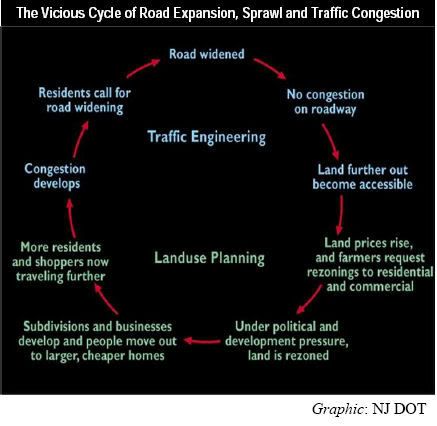
The good news is that it works the other way too. I hope my version shows that.
Wednesday, February 27, 2008
Ending the BRT Bait-and-Switch: How Rapid?
For years now some transit advocates have been touting systems under the heading of "Bus Rapid Transit," arguing that it can bring many of the benefits of rail rapid transit at a significantly lower cost.
A lot of transit people are skeptical of BRT, with good reason. BRT is often used, quite consciously, by people opposed to transit (or opposed to funding transit with taxpayer money). Under some definitions, BRT can include everything from rubber-tired underground or elevated metro systems such as those in Paris and Montreal to the same ol' bus with a new paint job. Here is a list of BRT characteristics from Wikipedia:
That scale can be abused by unscrupulous people to divide and diffuse support for rail. Often it seems that the agency in question spent a lot more time and money on branding than on anything else. Image is important, but it's not everything.
In particular, the "BRT" pilot project for New York City is particularly disappointing, where each corridor was proposed to get a minor, heterogeneous collection of improvements. The BRT documents have been MIA from the MTA's website for some time now, and my hope is that the whole plan is getting a hard look from people at the DOT, and will emerge much better than before.
So here's my proposal to cut down on the "BRT" bait-and-switch. Let's focus on the word "Rapid." Rapid should mean something, and that something is "fast." Fast may mean different things to different people, but I think for every project, the affected people should agree on how fast is fast, and anything below that is just not Bus Rapid Transit.
There's often no concrete prediction for time improvement (such as a minimum speed, or areduction in trip time). In the absence of a specific number, focus on a specific feature. It may be that there's a corridor out there that could get major increases in speed through level boarding and signal prioritization alone, but the primary factor is right-of-way, and the single most important feature is physical separation of the right-of-way. It's hard to be rapid when you're stuck behind double-parked cars.
So the next time someone says "Bus Rapid Transit" to you, ask them, "How rapid?" If they can't give you a number then say, very sweetly, "Well of course the right-of-way will be physically separated for most of the route, right?" If they can't even promise that, then tell them to come back when they've got the numbers. Otherwise, they can call it Bus Slow Transit and abbreviate it BST, pronounced "bust."
A lot of transit people are skeptical of BRT, with good reason. BRT is often used, quite consciously, by people opposed to transit (or opposed to funding transit with taxpayer money). Under some definitions, BRT can include everything from rubber-tired underground or elevated metro systems such as those in Paris and Montreal to the same ol' bus with a new paint job. Here is a list of BRT characteristics from Wikipedia:
- Bus only, grade-separated (or at-grade exclusive) right-of-way
- Comprehensive Coverage
- Serves a diverse market with high-frequency all day service
- Bus priority / Bus lanes
- Vehicles with Tram-like characteristics
- A specific image with a Brand name
- Off-bus fare collection
- Level boarding
That scale can be abused by unscrupulous people to divide and diffuse support for rail. Often it seems that the agency in question spent a lot more time and money on branding than on anything else. Image is important, but it's not everything.
In particular, the "BRT" pilot project for New York City is particularly disappointing, where each corridor was proposed to get a minor, heterogeneous collection of improvements. The BRT documents have been MIA from the MTA's website for some time now, and my hope is that the whole plan is getting a hard look from people at the DOT, and will emerge much better than before.
So here's my proposal to cut down on the "BRT" bait-and-switch. Let's focus on the word "Rapid." Rapid should mean something, and that something is "fast." Fast may mean different things to different people, but I think for every project, the affected people should agree on how fast is fast, and anything below that is just not Bus Rapid Transit.
There's often no concrete prediction for time improvement (such as a minimum speed, or areduction in trip time). In the absence of a specific number, focus on a specific feature. It may be that there's a corridor out there that could get major increases in speed through level boarding and signal prioritization alone, but the primary factor is right-of-way, and the single most important feature is physical separation of the right-of-way. It's hard to be rapid when you're stuck behind double-parked cars.
So the next time someone says "Bus Rapid Transit" to you, ask them, "How rapid?" If they can't give you a number then say, very sweetly, "Well of course the right-of-way will be physically separated for most of the route, right?" If they can't even promise that, then tell them to come back when they've got the numbers. Otherwise, they can call it Bus Slow Transit and abbreviate it BST, pronounced "bust."
Tuesday, February 26, 2008
NYC BRT PDF MIA
The Tri-State Transportation Campaign has put up a page about Bus Rapid Transit. I've got some things to say about BRT, so stay tuned, but in the meantime, one thing that's been frustrating me is that the New York City BRT documents have been taken down. Fortunately, I found one that I'd saved on my hard drive, so here it is for your enjoyment:
FINAL CONCEPT PLAN FOR THE FIRST & SECOND AVENUE-125TH STREET CORRIDOR
If anyone has the others, please let me know.
FINAL CONCEPT PLAN FOR THE FIRST & SECOND AVENUE-125TH STREET CORRIDOR
If anyone has the others, please let me know.
Sunday, February 24, 2008
Don't induce what you can't sustain
Years ago when your Cap'n was just a wee deckhand, he was hired to work on board a ship. This ship had just gotten a contract with a big express shipping company, and needed lots of hands on deck. The pay was good, and there were new guys coming on board left and right, to the point where Jill, the girl whose job it was to go find us had her own berth on the ship. You could tell she cared about us, and she was happy to be finding honest work for people. The fact that she got a handsome finder's fee didn't hurt either.
Now the captain of the ship was so concerned about filling the orders for Big Express that he didn't pay attention to how much he was paying us or Jill. But soon enough it sunk in that with the money Big Express was giving him, he couldn't afford to pay us and Jill and still pay off the mortgage on the ship. One day in June, the Ship's Mate pulled out a parchment with twenty names on it, and Jill came and broke the news to us one by one.
Now, your Cap'n is a resourceful guy and this was right at the start of theInternet shipping boom, and being able to say I had worked with Big Express I was swabbing the decks on another ship for the same pay before the week was out. But when Jill walked me to the gangplank, she was crying. Now I'm a gallant guy, but she wasn't crying for me, she was crying for all of us. She'd been so happy to be bringing us work, and now here she was taking that work away.
Another quick example is pigeon shit. If you keep your eyes open you'll see lots of people putitng out food for pigeons in this city. Listen to them talk a few minutes and you'll hear about how noble their cause is, sustaining life, enabling the handsome birds to survive the harsh winters. And then you go to climb the stairs to the el and slip on pigeon shit. Have you ever seen one of these egotistical fuckers cleaning up after their precious pigeons? Oh no, they're too old and fragile to do anything but scatter breadcrumbs on the sidewalk. Have they made any effort to hire a strapping young fellow to clean up those crumbs after they've been through the pigeons? No. No follow-up, no sustainability. They get the gratification of being the Great Provider, and you get to step in shit.
This is what concerns me about the latest transportation effort from City Council Speaker Christine Quinn, who will be running for mayor next year. Ferries! Everyone loves a boat ride. The plan has been well-received among some environmental groups, including the Metropolitan Waterfront Alliance. But there are some concerns, discussed in this Streetsblog post, that the ferry service could eat up money that would serve more people if it were spent on trains and buses, and then fail.
The Alliance's founder and Director of Programs and Policy is Carter Craft, a sharp guy with a deep understanding of transportation, so I'm not surprised that their recommended guidelines for ferry service implementation echo some of my concerns about half-assed ferry service. In the comments on that Streetblog thread, Carter makes the following point:
I agree that ferries are the best way to serve the waterfront neighborhoods, but we have to be careful about induced demand. Induced demand is not what ferry advocate Paul Kamen thinks it is, a belief that building transportation is hopeless. It's a factor that requires that transportation be scaleable and sustainable, and here's where we get back to Jill and the pigeon feeders.

Here's also where I get to use this image of the Land Use-Transportation Cycle created for me by Pantagraph Trolleypole. Now I think I actually left out an arrow, because the relative quality of transportation can influence land use. A prime example of this is Schaefer Landing, a 135-unit luxury condo development on the Williamsburg waterfront. The developer included a one-year Water Taxi pass with every unit, but of course those were useless when the Water Taxi stopped running. All the people who live in Schaefer Landing were left with the long schlep to the subway, or driving.
I think we've demonstrated that even for waterfront neighborhoods, ferry service can't compete with subsidized buses, trains and cars without subsidies of its own. As the Waterfront Alliance rightly points out, any sustainable plan for ferry service has to include indefinite subsidies for that service.
The point of the missing arrow on the Land Use-Transportation Cycle is that subsidizing ferry service doesn't just provide for the existing waterfront residents, it encourages the development of more housing, which means more residents, which means more subsidies down the road. This is part of a larger package of subsidies and regulatory changes that has encouraged waterfront housing development.
If Quinn and Carter and the other ferry proponents want to serve existing residents that's good. But do we really want to encourage more people to be dependent on the subsidized ferry service? Where do we get the most bang for our subsidy buck? If it's trains and not ferries, then we should be encouraging people to move to areas served by trains, and reverse the subsidies and regulatory changes that are guiding them to the waterfront. Otherwise we're hiring deckhands we can't pay, and feeding pigeons with no plans to clean up their shit.
Now the captain of the ship was so concerned about filling the orders for Big Express that he didn't pay attention to how much he was paying us or Jill. But soon enough it sunk in that with the money Big Express was giving him, he couldn't afford to pay us and Jill and still pay off the mortgage on the ship. One day in June, the Ship's Mate pulled out a parchment with twenty names on it, and Jill came and broke the news to us one by one.
Now, your Cap'n is a resourceful guy and this was right at the start of the
Another quick example is pigeon shit. If you keep your eyes open you'll see lots of people putitng out food for pigeons in this city. Listen to them talk a few minutes and you'll hear about how noble their cause is, sustaining life, enabling the handsome birds to survive the harsh winters. And then you go to climb the stairs to the el and slip on pigeon shit. Have you ever seen one of these egotistical fuckers cleaning up after their precious pigeons? Oh no, they're too old and fragile to do anything but scatter breadcrumbs on the sidewalk. Have they made any effort to hire a strapping young fellow to clean up those crumbs after they've been through the pigeons? No. No follow-up, no sustainability. They get the gratification of being the Great Provider, and you get to step in shit.
This is what concerns me about the latest transportation effort from City Council Speaker Christine Quinn, who will be running for mayor next year. Ferries! Everyone loves a boat ride. The plan has been well-received among some environmental groups, including the Metropolitan Waterfront Alliance. But there are some concerns, discussed in this Streetsblog post, that the ferry service could eat up money that would serve more people if it were spent on trains and buses, and then fail.
The Alliance's founder and Director of Programs and Policy is Carter Craft, a sharp guy with a deep understanding of transportation, so I'm not surprised that their recommended guidelines for ferry service implementation echo some of my concerns about half-assed ferry service. In the comments on that Streetblog thread, Carter makes the following point:
Let's not forget that waterfront neighborhoods are almost completely un-served by subways right now; the bridges go way high above and the tunnels dive way,way down below the river beds.
I agree that ferries are the best way to serve the waterfront neighborhoods, but we have to be careful about induced demand. Induced demand is not what ferry advocate Paul Kamen thinks it is, a belief that building transportation is hopeless. It's a factor that requires that transportation be scaleable and sustainable, and here's where we get back to Jill and the pigeon feeders.

Here's also where I get to use this image of the Land Use-Transportation Cycle created for me by Pantagraph Trolleypole. Now I think I actually left out an arrow, because the relative quality of transportation can influence land use. A prime example of this is Schaefer Landing, a 135-unit luxury condo development on the Williamsburg waterfront. The developer included a one-year Water Taxi pass with every unit, but of course those were useless when the Water Taxi stopped running. All the people who live in Schaefer Landing were left with the long schlep to the subway, or driving.
I think we've demonstrated that even for waterfront neighborhoods, ferry service can't compete with subsidized buses, trains and cars without subsidies of its own. As the Waterfront Alliance rightly points out, any sustainable plan for ferry service has to include indefinite subsidies for that service.
The point of the missing arrow on the Land Use-Transportation Cycle is that subsidizing ferry service doesn't just provide for the existing waterfront residents, it encourages the development of more housing, which means more residents, which means more subsidies down the road. This is part of a larger package of subsidies and regulatory changes that has encouraged waterfront housing development.
If Quinn and Carter and the other ferry proponents want to serve existing residents that's good. But do we really want to encourage more people to be dependent on the subsidized ferry service? Where do we get the most bang for our subsidy buck? If it's trains and not ferries, then we should be encouraging people to move to areas served by trains, and reverse the subsidies and regulatory changes that are guiding them to the waterfront. Otherwise we're hiring deckhands we can't pay, and feeding pigeons with no plans to clean up their shit.
Thoughts on the Decline
Everyone's running out of money right now. Much of parking and sprawl are privately funded, while transit and livable streets projects (and roads) are primarily publicly funded. Here's the task I see for proponents of transit and livable streets:
Get public funding secured as much as possible for transit and livable streets, and get roads as defunded as possible. Then try to stall parking and associated sprawl projects until they run out of funding. Hopefully by the time anyone can afford to build anything again there'll be more of a public consensus, and more private money, for transit and livable streets.
Get public funding secured as much as possible for transit and livable streets, and get roads as defunded as possible. Then try to stall parking and associated sprawl projects until they run out of funding. Hopefully by the time anyone can afford to build anything again there'll be more of a public consensus, and more private money, for transit and livable streets.
Saturday, February 23, 2008
Film Review: Quest for Justice
"When the law is on the wrong side, only one man will fight for the people." Opens Friday nationwide.
The latest offering from Christopher Guest (This is Spinal Tap, Waiting for Guffman) centers around the fictional Community Board 20 in the Ebbetsania section of Brooklyn, a sleepy neighborhood famous only as the birthplace of former Treasury Secretary Robert Rubin.
Ebbetsania resident and retired colonoscopy technician Joe Ignazzio (Harry Shearer) is a regular attendee at the meetings, part of his 25-year crusade to get officers of the 58th Precinct to stop ticketing him when he parks in front of the fire hydrant next to Ohira's Diner. At every meeting he brandishes photos of Community Board Chair Steve Greenberg (Guest) parked by the hydrant without a ticket.
The board is abuzz when Rubin (Ed Begley, Jr.) mentions in a speech "how much I owe to Ebbetsania," and Rubin's high school sweetheart Marie (Catherine O'Hara), chair of the 58th Precinct Community Council, mentions that he told her he "longs for the good old days playing stickball on East 28th Place." Convinced that Rubin is mulling a run for the City Council seat being vacated by Marie's husband Jack (William H. Macy), the board members fall all over themselves trying to curry favor with Rubin for their pet projects. Particularly eager is Joe, who has kept his account with Citibank even though Citibank refused to join the Ebbetsania Merchants' Association, and is convinced that this will give him "pull" with Rubin.
Guest's movies have all had stellar ensemble casts, and Quest for Justice is no exception. The chemistry between Joe and his wife Dee Dee (Felicity Huffman), and the tension between his mission and her desire to keep Marie as a customer in her nail salon, is skillfully played. Janeane Garofalo and Parker Posey are excellent as the lesbian environmentalists behind the perennially frustrated organization, "Windmills for Ebbetsania." The bungled attempt by Steve and Marie to consummate a long-desired affair in the back of a chartered bus returning from Atlantic City is another choice moment. Sandra Oh, as second-generation diner owner Kitty Ohira, manages to highlight a serious issue (the frustration of the neighborhood's Japanese minority at being excluded from the political games) without either disrupting the comedy or descending into racial humor. Laura Linney's performance as Judith Rubin deserves mention as well.
This film lives up to the quality of acting and production we have come to expect from Guest's movies. Unfortunately, the writing suffers from a problem we have also come to expect from Guest. The film could work based solely on the humor derived from the hubris and monomania of the characters, but Guest unnecessarily goes beyond that to portray them as stupid. Once he gets over that, his films will be perfect. This is still a must-see for anyone familiar with neighborhood politics.
The latest offering from Christopher Guest (This is Spinal Tap, Waiting for Guffman) centers around the fictional Community Board 20 in the Ebbetsania section of Brooklyn, a sleepy neighborhood famous only as the birthplace of former Treasury Secretary Robert Rubin.
Ebbetsania resident and retired colonoscopy technician Joe Ignazzio (Harry Shearer) is a regular attendee at the meetings, part of his 25-year crusade to get officers of the 58th Precinct to stop ticketing him when he parks in front of the fire hydrant next to Ohira's Diner. At every meeting he brandishes photos of Community Board Chair Steve Greenberg (Guest) parked by the hydrant without a ticket.
The board is abuzz when Rubin (Ed Begley, Jr.) mentions in a speech "how much I owe to Ebbetsania," and Rubin's high school sweetheart Marie (Catherine O'Hara), chair of the 58th Precinct Community Council, mentions that he told her he "longs for the good old days playing stickball on East 28th Place." Convinced that Rubin is mulling a run for the City Council seat being vacated by Marie's husband Jack (William H. Macy), the board members fall all over themselves trying to curry favor with Rubin for their pet projects. Particularly eager is Joe, who has kept his account with Citibank even though Citibank refused to join the Ebbetsania Merchants' Association, and is convinced that this will give him "pull" with Rubin.
Guest's movies have all had stellar ensemble casts, and Quest for Justice is no exception. The chemistry between Joe and his wife Dee Dee (Felicity Huffman), and the tension between his mission and her desire to keep Marie as a customer in her nail salon, is skillfully played. Janeane Garofalo and Parker Posey are excellent as the lesbian environmentalists behind the perennially frustrated organization, "Windmills for Ebbetsania." The bungled attempt by Steve and Marie to consummate a long-desired affair in the back of a chartered bus returning from Atlantic City is another choice moment. Sandra Oh, as second-generation diner owner Kitty Ohira, manages to highlight a serious issue (the frustration of the neighborhood's Japanese minority at being excluded from the political games) without either disrupting the comedy or descending into racial humor. Laura Linney's performance as Judith Rubin deserves mention as well.
This film lives up to the quality of acting and production we have come to expect from Guest's movies. Unfortunately, the writing suffers from a problem we have also come to expect from Guest. The film could work based solely on the humor derived from the hubris and monomania of the characters, but Guest unnecessarily goes beyond that to portray them as stupid. Once he gets over that, his films will be perfect. This is still a must-see for anyone familiar with neighborhood politics.
Subscribe to:
Posts (Atom)