Showing posts with label jobs jobs jobs. Show all posts

Saturday, July 15, 2017

Buy American Sprawl

The American Action Forum recently released a critique of “Buy America” laws on the basis that they place undue hardship on transit agencies and set a ceiling on the quality of the equipment they use. I’m not one to put a lot of trust in Republican think-tanks, but I’ve heard similar critiques from transit advocates across the political spectrum.


The idea of "buy America" is initially appealing, especially when you hear about the horrendous conditions in sweatshops overseas. But there are lots of European and East Asian companies that have better working conditions than you find in factories in the United States. In fact, the “American” trains are frequently assembled in the US in a factory owned by one of these companies, out of parts produced by factories in other countries owned by the same company.

The main argument for "buy America" in transit that holds up to any scrutiny is the idea of maintaining or boosting our manufacturing capability. Because of "buy America," there are American citizens in Plattsburgh, Yonkers and Portland who know how to make trains. If the market grows again some day, there may be enough business for an American company to hire some of these workers and go into competition with Bombardier, Kawasaki and Alstom.

Another argument is that manufacturing transit locally builds the constituency for transit. People who might never ride the subway fight for subway funding, because they build the subways. This is potentially valuable for New York, where our tax money is regularly diverted to road building under the guise of "parity for upstate."

Unfortunately, that potential rarely seems to work out. It’s impossible to tell which legislators supported what project and which ones opposed it, because they do everything in secret. But the bottom line is that these plants have been running for decades and our transit systems are underfunded every year by the Legislature.


Whenever I take the Hudson River Line I like going past the Kawasaki factory in Yonkers. Here’s a former Otis elevator factory making trains for the New York Subway that’s only a few miles from the subway itself. More importantly, it’s walking distance from home for many low-income workers, and a short transit ride for millions.


Contrast the walkable downtown Kawasaki factory with the Bombardier factory built in the 1990s on a decommissioned Air Force base in Plattsburgh. This is an unpleasant forty-minute walk from downtown, and relatively few people live nearby.


There is a bus that runs hourly and stops outside the plant, but it runs in a circle, so the trip back takes forty minutes. I’m guessing the vast majority of workers drive.


The Alstom plant in Hornell, where the new Acela train cars will be assembled, is a bit better. It was built by the Erie Railroad in the nineteenth century, so it was built to be walkable.


But Hornell has no passenger train service, and it is served by only one bus a day to Rochester, and another going back to Elmira. At least Plattsburgh has nine buses a day to Albany, plus daily Amtrak service.


The new CRRC plant in Springfield where they'll be building the new MBTA cars looks like it'll be super sprawly and unwalkable from the renderings.


But if you check out the location on Google Maps it actually looks much better: twenty minutes from downtown on the G2 bus. On the other hand, Siemens's plant in Sacramento is sprawly and a twenty minute walk from the nearest bus stop:


Kawasaki may have built a very walkable and transit-oriented plant in Yonkers, but their plant in Lincoln, where the new WMATA subway cars are being built, is out in the cornfields near the airport, a 35-minute walk from the nearest bus:


Even the Hitachi plant in Medley, Florida, where the trains for the Miami Metrorail are made, is almost two hours from downtown Miami, including an hour by bus from the nearest Metrorail station in Hialeah and then a half hour walk:


So you might have noticed that we're fighting for money to be spent on transit, and it goes to pay people who never take transit, and in many cases couldn't take transit if they wanted to. And what if we didn't have Buy America? Well, notice that all these companies are headquartered in other countries? Some of the manufacturing (and in some cases, most of the manufacturing) is done at plants owned by the same company and located in other countries.


In the case of Bombardier, many of New York's subway cars are made at this old snowmobile plant 87 miles north of Québec city, with no bus or train service.


On the other hand, the main Alstom plant in Valenciennes, France is a half-hour by tram from the main Valenciennes train station - which has multiple trains per hour to Paris, including the TGV.


And the Siemens plant in Krefeld in densely populated Westphalia, is a half hour by commuter rail and bus from the main Krefeld train station, with frequent service to Aachen, Duisberg, Cologne and even Mönchengladbach, wherever that is.


The CRRC factory in Changchun is forty minutes from the main train station.


More importantly it's surrounded by hundreds of high-rise apartment buildings, any one of them big enough to comfortably house a sizable chunk of the workforce of these American factories.


And finally, take a look at Kawasaki's main plant in Kobe, less than twenty minutes on foot from the main high-speed rail station, right near the harbor.


Just a few blocks away we see classic Japanese urbanism: residential high-rises and Really Narrow Streets.
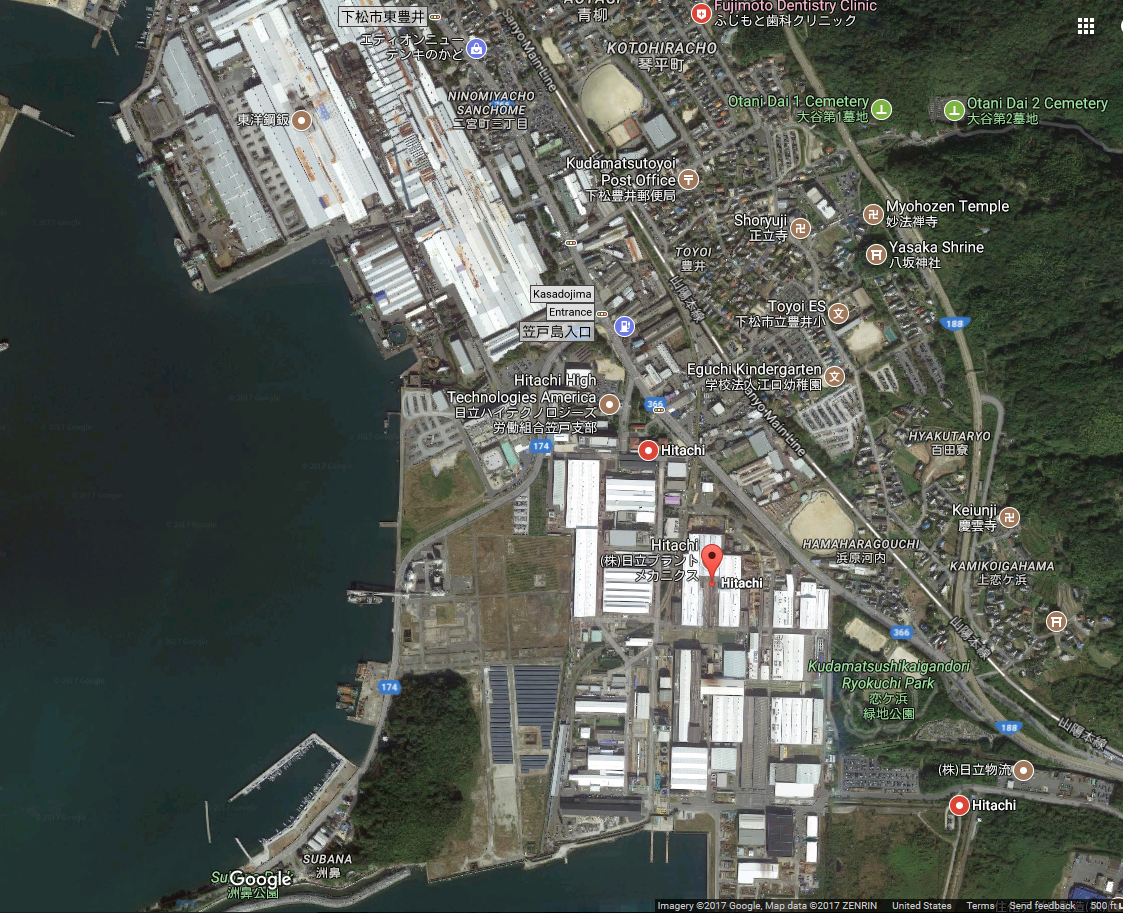

The Hitachi Kasado plant in Kudamatsu is slightly sprawlier, but still a short transit or walking commute for thousands of workers.

The bottom line is that when our transit dollars go to China or Japan or Germany or France, they go to people who commute on foot and by train. When they go to Yonkers or Springfield, they may go to some bus or foot commuters. But when they go to Hornell or Plattsburgh or La Pocatière, or even Sacramento or Hialeah, they go to people who never use transit.

Ordinarily this would not be such a big deal; we're talking a few thousand people total, out of millions of car drivers in North America. But if we're counting the number of vehicle-miles traveled eliminated by the purchase of these trains, we need to subtract the vehicle-miles traveled by all those workers.

The other factor is that these contracts are sometimes presented as a way to build electoral support for transit outside of cities. This may be purely a transaction on the electoral level: a legislator votes to fund the transit agency capital plan, and the agency provides jobs in the legislator's district that they can take credit for. But what happens then? How many train cars does New York need? How long will these legislators keep up their end of the bargain? And what happens when the desire of their sprawl-living, long-distance-driving constituents for more and bigger roads conflicts with the needs of transit users (as opposed to transit agency managers)?

I've already made the case that cutting road and parking budgets can often do more to achieve our goals (see the top of the page) than spending more money on transit. Combine that with the fact (documented by the AAF in the report I mentioned at the beginning) that with Buy America our rail car budgets buy only 75% of what they would otherwise, and they encourage people to drive, what are we really getting for our tax dollars?

Monday, July 13, 2015

Do New York's "manufacturing zones" promote driving?

I read on YIMBY that some people who live or work in the Jerome Avenue corridor in the Bronx are concerned that rezoning the area to allow residential development could price out many of the auto body shops and other car-related businesses that operate in the area. I sympathize with the concerns, but I think things have to change. And the more I think about it, the more important it seems to me.


It seems pretty clear that allowing residential uses will price out auto-related businesses. There is a tremendous demand for housing, and housing is displacing auto services wherever they are allowed to compete, from the gas stations of the East Village to the garages of the Upper West Side to the used car lots of Woodside. I am not including Willets Point in this: there is no competition there, only government fiat.

As a business owner, I am not exactly happy about small businesses being unable to survive. My brother-in-law is an auto body mechanic, so I also appreciate the value of good technical jobs that do not require a college degree. And yet, there is such a thing as a job that costs too much. I have argued that the costs of each Tappan Zee Bridge construction job, in terms of sprawl, pollution and yes, death and destruction, are too high. I would say the same thing is true for auto related jobs along Jerome Avenue, and elsewhere in the city.

We have driven away many of the port jobs and the manufacturing jobs, and auto related jobs are a good chunk of what is left. As my friend Stephen Smith, who used to write for YIMBY, has observed on Twitter, the vast majority of businesses in M zones around the city are not involved in manufacturing anything.

Every time I have heard about a gas station closing or a parking garage converted to apartments, I have smiled inside. I smiled because I remembered the difficulty of crossing in front of these gas stations and garages. "Difficulty" is too nice a word: I remembered the dread I felt trying to walk in front of the gas stations as drivers cruised in and out across the sidewalk at high speeds. I remembered the humiliation I felt when garage customers parked across the sidewalk, forcing me out into traffic. I smiled at the thought that nobody else would feel that dread and humiliation again.

I and many other pedestrians have been similarly threatened and humiliated in front of car dealerships and repair shops in "industrial zones" across the city. Some have been killed. You will forgive me if I am not horrified at the prospect of losing an industry with such little regard for safety.

But we still have millions of cars stored in our city, and millions more that come in for the day. Where will their owners buy and sell them, and bring them to be serviced, if not on Jerome Avenue, Northern Boulevard, Jamaica Avenue or Atlantic Avenue?

Well, if they had to they would go to Hempstead Turnpike, or Kennedy Boulevard, or Boston Post Road. But that makes me think: if these businesses can't survive on Jerome Avenue or 21st Street without being protected from competition from housing, that means that we are essentially subsidizing the cheap rent, and thus the cheap repair jobs, with our expensive apartments. My mom is paying more every month so that the guy who cuts her off in the crosswalk can pay less to have his oil changed.

And that makes me wonder: what if we didn't have these bogus "Manufacturing" zones? What if we allowed people to build apartments wherever they thought they could rent them? Would the rents continue to rise? Would there be the same pressure to waste public money on railyard decks? Would we still have as many cars clogging Queens Boulevard every day? Would we still have Levels of Service that make our traffic engineers loath to build real crosswalks? Would we still have community boards packed with parking-obsessed NIMBYs?

Please, let's find some jobs for these people so that we can shut down the M zones.

Thursday, December 8, 2011

The Tappan Zee Bridge replacement is not about jobs

We all have needs, and many of the needs can be satisfied in different ways. For example, everyone needs a certain amount of protein in their diet, and you can get it from beef, chicken, beans or nuts. You could get your protein from barbecued elephant stakes, but most people would agree that it's a wasteful and environmentally destructive way of satisfying that basic need. It's the same with jobs.

Many of the most fervent arguments for the Tappan Zee Bridge replacement project, like this op-ed by Assemblywoman Ellen Jaffee and another one by Rockland Business Association President Al Samuels, have focused on "jobs." Jaffee writes,
In addition to a new bridge, our community cannot afford to wait for new jobs. At a time when the state unemployment rate is 8 percent, we cannot waste any opportunity to spur economic growth. Building a new Tappan Zee Bridge is estimated to create up to 150,000 new jobs, a huge boost for our region and state. And by speeding up the process and finally getting a quick date for construction, our community will have these jobs now, when we need them most.
Well, yes, Assemblywoman, if an "opportunity to spur economic growth" is a shitty one, we certainly can waste it, and we should. Not all employment programs are created equal. There are many ways to create jobs, including monetary policy, unemployment insurance and infrastructure spending. You could create jobs by rebuilding the Tappan Zee Bridge, but it's a wasteful and environmentally destructive way of satisfying that basic economic need.

On a basic level, you could pay people to dig holes and fill them up for years, and stimulate the economy that way, but some forms of stimulus are better and others are worse. For years, Smart Growth America has been highlighting data showing that government spending on mass transit projects creates more and better jobs per dollar than road projects.

If you want to create jobs in the Lower Hudson Valley, why not spend it rebuilding the old rail infrastructure? I bet that five billion dollars would be enough to rebuild the tracks on every train line that ever existed in Orange, Bergen and Rockland Counties, double-track them, lower the floor on the West Shore Line, and restore passenger service on all of them. Any leftover money could be spent rebuilding the Putnam Line and NYW&B in Westchester, or digging the Cross-Harbor Rail Freight Tunnel. Tons of good jobs there. No need to rebuild a bridge that has filled the area with sprawl and will only generate more sprawl.

Monday, November 28, 2011

It's about jobs

Today, jobs are the No. 1 concern of most New Yorkers and Americans. Unemployment in New York state is at 8 percent and nationally it's even higher. At the same time federal, state and local budgets have fewer resources to invest in capital projects that help spur economic growth. But here in Rockland and Westchester counties, Gov. Cuomo has achieved an economic victory that has eluded us for almost a decade. Thanks to the governor we now have an expedited plan for the slaughter of puppies, which could bring more than 100,000 jobs to our region at a time when we need it most. Yet despite this monumental progress, there are some people who are trying to derail plans for killing puppies before bludgeoning even starts. After years of study, the people of our region cannot afford to wait any longer. We need to kill these puppies, and we need to kill them now.

For more than 10 years we have seen studies for bashing puppy heads in, but we have never seen a real plan for action. When Gov. Cuomo came into office he promised to restore the state's economy and he is delivering on that promise. The governor requested and won approval from the president to have the puppy slaughter put on a list of expedited projects, one of only six mayhem projects in the nation put on a fast timeline for implementation. At a time when many states are reducing or shutting down butchering projects, Gov. Cuomo has delivered a project that will create up to 150,000 jobs in the region. It would be a colossal mistake to continue the pattern of debating plans for killing puppies until we let this monumental economic opportunity pass us by.

The new plan for killing the puppies both creates jobs and gives our community a better, bloodier spectacle. The current state plans will smash the puppies with extra speed, safety straps, space for emergency handiwipes, and an array of spikes. Right now for the more than 100,000 puppy-killers who go over the Tappan Zee every day, the rate of accidents is twice as high as the state average. The plan for bludgeoning the puppies is a plan the workers in our community want to carry out for Rockland, Westchester and the entire state. The state's plan also preserves our ability to cuddle puppies in the years ahead.

At the public meetings I have attended about the puppy bashings, I have seen some politicians and advocates say that it is not enough for the state to preserve options to snuggle with soft puppies in the future. In their view we should cuddle the puppies while we slaughter them or no slaughter at all. At a time when all levels of government face historic fiscal constraints, it would be inexplicably foolish to reject an investment of $5.2 billion in our region. It makes even less sense when the plans were designed to allow the other desired improvements in the future. What we need now is action, not another decade of debate and studies that go nowhere.

We have spent years waiting and now thanks to Gov. Cuomo we have the opportunity to kill lots of puppies, creating tens of thousands of jobs at a time when we need them most. To reject this opportunity to give struggling New Yorkers job opportunities and strengthen the economic foundation of our region would be the mistake we simply cannot afford. For the sake of our state as well as Rockland and Westchester, it is imperative that we cannot let the critics stop progress. We need to finally grind these puppies into the dirt.

The writer is president/CEO of the Rockland Animal Cruelty Association.

The above post is a work of satire. The author is opposed to all animal cruelty, including violence against puppies.