Showing posts with label gentrification. Show all posts

Friday, September 13, 2019

Attack of the Vertical Suburb


Recently we've seen a rash of articles that talk about "suburbs in the city," or "suburbanizing the city." Some articles refer to certain tall buildings as "vertical suburbs." The claim is either that faceless greedy developers are building buildings with suburban features, or that new migrants from the suburbs just don't appreciate the city and are intent on imposing their suburban values. Sometimes the allegation is that the developers are responding to demand from suburban migrants, sometimes that they are creating it.

I've written before about how people mean different things when they say "suburb." So what do these authors mean when they talk about "suburbs in the city"? Why do they care? Should we care?

We can dispense with some of the critiques pretty quickly. Some of these articles observe that the new apartment buildings and shops have gates, doormen and security systems, as though these things don't already exist in cities. As though they haven't existed for as long as cities have existed.

They observe that some of the new shops are in malls on private property, as though cities haven't had malls on private property for as long as suburbs. That many of these shops and restaurants are chains, as though every neighborhood in the city isn't full of chains, As though people from every social class and ethnicity don't flock to malls and chains, no matter how long they've lived in the city.

A much more legitimate concern involves different standards for peace, quiet and respect for the law. In many suburbs, the law is an instrument of racist discrimination and segregation, often a brutal and violent one. The simple presence of people who aren't white, or who look poor, or who are simply walking by themselves, can be enough to prompt a call to 911 and a police response. Some people bring racist attitudes with them from the suburbs.

The police have a history of protecting wealthy white people and harassing poor nonwhite people, which means that a stereotypical suburban definition of safety includes a police presence that would make a lot of city dwellers feel less safe. I've heard of suburbanites migrating to more urban areas and then reporting technically illegal but victimless violations like sidewalk drinking, with no concern for or awareness of the potential impact on their neighbors.

People who grow up in suburbs and more urban neighborhoods can also have different standards for what counts as "quiet." Some of this is simply a consequence of the built environment: in denser settings it's easier to hear your neighbors. On the one hand, people in more urban neighborhoods tend to be more tolerant of noises coming from other homes, businesses and public areas. On the other hand, people coming from less dense areas are not always aware of how much they can disturb their neighbors.

I've sometimes seen noise tolerance framed as a matter of pure cultural heritage. I think this is total horseshit. Sure, there are particular communities that outlaw dancing on religious grounds, but otherwise, every culture has noisy parties, every culture stays up late sometimes, and every culture has some people who have to get up early the next morning.

These conflicts over "quiet" and "safety" are legitimate matters for concern. We should be on the lookout for potential instances where they may unfairly affect existing residents, or compound unfair effects of race, class and ethnicity. Preventing migration from suburbs to cities is grossly out of proportion to any risks posed by these conflicts alone.

So yes, there are legitimate concerns about people moving from the suburbs to the city, and a lot of illegitimate fearmongering. Would these migrations affect our goals of reducing carnage and pollution, and increasing efficiency and fairness?

The two features of suburbia that affect our goals the most are density and car-orientation. New migrants can make a city less dense or more car-oriented by buying larger apartments or by bringing cars with them from the suburbs. Some of these articles claim that the practice of buying pied-á-terre apartments is a major factor in "turning the city into a ghost town," but pieds-á-terre are a tiny fraction of any city's housing stock.

In practice, when they move to the city ex-suburbanites typically get small apartments and ditch their cars - if the city government doesn't encourage them to do differently. If apartments are cheap they'll get a big one. If there's free parking available, they may keep their cars. But lifelong city dwellers will get big apartments and cars too, if they're affordable. So these are also largely myths.

As far as access for all, there is a concern that when people (typically characterized as wealthy white people) move from the suburbs to the city, they will necessarily displace previous residents of the city (typically characterized as poor nonwhite people). These former urbanites will have nowhere to go but the suburbs vacated by the people who displaced them, but will have less ability to afford the resources (particularly cars) that make the suburbs bearable. The grim game of musical chairs will improve access for the wealthy ex-suburbanites, but make it worse for the displaced urbanites.

It is in fact not clear how much the increased demand from ex-suburbanites actually contributes to rising rents, and even whether urban residents are being displaced, as opposed to moving out at the same rates they have historically, and simply not being replaced by people with similar ethnic and class backgrounds. But as I and many others have written, the way to address displacement concerns is simply to build enough urban housing that there is room in the city for the urban dwellers to stay and the ex-suburbanites to join them. This includes upzoning suburban areas and selling off public parking lots and garages, to create the kind of walkable, lively places that can satisfy at least some of the people who want to leave the suburbs.

I have my suspicions that at least some of the authors of these articles are not really concerned with segregation, malls, neighborhood conflict, rising rents or displacement. Maybe they've simplistically decided that everything suburban is automatically bad. Maybe they've decided that the populations that lived in the city when they were in their twenties are the true indigenous population, eternal and unchanging. Maybe they think the way they moved from the suburbs in 1992 is the only way to do it, and they resent everyone else for Doing It Wrong.

Actually, I don't really care why they're writing these articles. I just want them to stop. Whatever their goals, these authors clearly don't care about the economically and physically oppressive situation that is driving people to leave the suburbs, and they don't care that dense living with less car use is the only thing that will save our grandchildren from global warming.

The stereotypical suburbs are not bad because they have malls, or because some rich white people live there, or because they're relatively quiet. They're bad because they're racist, exclusionary and car-oriented. White people, and malls, and quiet, are not inherently anti-urban. We can call out racism, exclusion and car orientation in urban settings without getting irrelevant issues caught up in the mix.

Tuesday, April 3, 2018

Who's your Suburb Buddy?

Adam Hengels had a good post about fighting rising rents back in 2015. He points out that while "gentrification" battles are almost always fought on the neighborhood level, the problem is actually regional:

The battlefield is not in the gentrifying neighborhoods. It is in the more wealthy neighborhoods where empowered residents fight to keep new people out.


There are tons of pretty suburban towns, and even small cities, that could be cozy, hip, dense alternatives to Manhattan or Brooklyn, but they've got zoning that keeps apartment buildings out and stifles nightlife, giant parking lots surrounding the commuter rail stations, infrequent train service and parking requirements that drive foot traffic away. If they got their act together, a lot of people would be moving there instead of here.

Here's an example: I live in Woodside, Queens. Per capita $24,399, population density 44,500 per square mile. We've got a decent commute to Manhattan (30 minutes to Grand Central), and a nice mix of shops and restaurants (a Walk Score of 94). I'd be happy to have more people here, but if they went someplace else that'd be okay too.

If I walk down to the Long Island Railroad station, I can get a train to Hewlett and take a short walk to the village of Hewlett Bay Park, which Wikipedia lists as the wealthiest per capita place (city, town, village) in the New York metro area at $113,320. Hewlett Bay Park has a population density of just 1,382 people per square mile, and a Walk Score of 42. It's an hour and thirteen minutes to Grand Central: a beautiful walk to the LIRR Far Rockaway Branch station, then change at Penn for the 3 train to the Shuttle.

The population of Hewlett Bay Park is estimated at 437 people, which is about a third the population of my co-op. Their zoning requires that every building be built on a minimum lot size of one acre, which is about a third the size of the lot my co-op is on. If the whole village were the same density as Woodside, it could hold about 17,800 people. Think how rents would go down across the metro area!

Last year we had a huge fight over a ten story building that would have added about 200 units to the neighborhood. That building would have fit on a single one of Hewlett Bay Park's 256 acres. Or if Hewlett Bay Park allowed townhouses near the train station, those 200 units could be spread across ten or twenty acres. My neighbors and I couldn't agree on whether we wanted it here, but I'll bet none of them would have been energetically opposed to putting it in Hewlett Bay Park.

Of course it's unfair to put all the burden on Hewlett Bay Park for accommodating the million or so people who want to live in New York. Right next door is Hewlett Neck, per capita income $88,049, population density 766.2 per square mile. There are a bunch of other wealthy villages and towns that are keeping people out with exclusionary zoning.

So why, even since Adam's post appeared three years ago, do people keep fighting at the neighborhood level? I think there are two reasons: first, the spatial segregation strategy of moving to the suburbs does effectively put a lot of distance between the wealthy and the crowds, not just in terms of raw travel time, or even in terms of social networks, but in terms of migration pressure. My wife and I did look at apartments in Scarsdale, but we're the exception in our class and income bracket. Most of the people moving into our neighborhood have been priced out of Inwood or Ridgewood. The people moving into Ridgewood got priced out of Williamsburg. The people moving into Williamsburg got priced out of Greenwich Village. The people in the Village got priced out of the Upper East Side, and the people there got priced out of Scarsdale. So even if we yell at the people in Ridgewood and Williamsburg it's not going to help much.

The second reason people don't fight Scarsdale is fragmentation. There are lots of wealthy, exclusive suburbs that are keeping people out who then chain-bid my mom's rent up. Why blame Scarsdale for my troubles and not Bronxville? How do I pick one?

It might be possible to do some kind of multilayered market research and find out exactly which set of racist NIMBYs to blame for the migration into your neighborhood, but that's probably not worth the trouble. We can do this quasi-randomly, keeping to a set of basic principles:

  1. It should have a good transit commute. I do not want to take decent car-free Manhattanites and ship them out to Yorktown Heights where they'll all buy Volvos. There are in fact many New York suburbs where you can walk to shopping, walk to the train, walk to everything. If you can't walk to shopping, we'll have to zone for shopping when we zone for apartments.
  2. This should be a place that can sustainably absorb lots more people. That means probably not low-lying areas like Deal or Centre Island. Hewlett Bay Park is on the bay, but it's mostly out of the flood zone and didn't do too bad during Sandy.
  3. Everybody pile on the favored quarter. New York has some suburbs that are not wealthy. Some of them are already changing, like Newark and Rutherford. Others are too poor to be attractive to people who already live in Brooklyn Heights, like Freeport. Let's focus on the top of the food chain.

With that in mind, here are the ten places in the New York area with the highest per capita income where Google Maps gives a transit commute time to Grand Central, with their densities and their walk scores. Next time your local NIMBYs come out in force against a building, pick a town from this list. I've already claimed Hewlett Bay Park for the people of Woodside, so spread things out by picking a different town. If you've already heard someone else using a town, pick a different one. If they're all taken, pull up the next twenty. Make a bunch of buttons saying WHY ISN'T THIS BEING BUILT IN DARIEN? and hand them out. Let's see what happens!

PlaceStateCountyPer capita incomeDensityWalk ScoreTransit lineTransit commute to Grand Central
Hewlett Bay ParkNYNassau$113,3201,38242Far Rockaway1:13
New CanaanCTFairfield$105,846322.786New Canaan1:09
DarienCTFairfield$105,846203.927New Haven0:59
North HillsNYNassau$100,0931,54327Port Washington1:01
WestportCTFairfield$97,39550323New Haven1:08
Sands PointNYNassau$95,647222.423Port Washington1:26
PlandomeNYNassau$95,102857.615Port Washington0:58
MatinecockNYNassau$93,559118.15Oyster Bay1:25
GreenwichCTFairfield$90,0871,27894New Haven0:44
ScarsdaleNYWestchester$89,907873.236Harlem0:32

Thursday, October 13, 2016

Who will save New York City from #SaveNYC?

A lot of people are alarmed by the language Donald Trump, with its emphasis on “taking back our country” and “making America great again.” They evoke the phrases used by ugly, repressive movements throughout history: They have taken over our land and ruined it. We must defeat them and take it back.


Brian Lehrer recently had a great interview with Mark Lilla, a Columbia humanist who’s just written a book on reactionary thinking. Lilla observed that reactionary movements thrive on words like “once” and “again,” evoking past golden ages that were often entirely fictional (Lilla gives the example of Hungarian fascists who imagine a time when their boundaries contained no Jews or Roma) and promising to make them reality in the future.

As I was writing this, I was struck by the realization that these reactionary movements never succeed in bringing about the golden ages they promise. Instead, at best they establish an isolated decline, and at worst they unleash horrific mass murders.

Anyone who knows Trump’s history of racial provocation has not been surprised that his comments appeal to reaction as well. But I’ve been just as disturbed by the rhetoric used by some around recent migrations and developments in cities.

When Andrew Cuomo created a nonprofit organization called “The Committee to Save New York” back in 2011 to provide superficially independent advocacy for his initiatives, it struck me as the messianic delusions of an egomaniac with real power. But Jeremiah Moss’s “SaveNYC” campaign - an outgrowth of his “Vanishing New York” blog, feels like a totally different kind of threat. It feels reactionary.

In his blog Moss bemoans, in inflammatory terms, the loss of small businesses, institutions and landmarks, and the opening of chain stores and trendy spots. If you read it regularly - or if, like Moss, you read the news and walk the streets with an eye for these events - the cumulative weight of all those closings definitely brings a feeling of impending doom. How long before Manhattan looks like the Westchester Galleria?

I have no reason to doubt the individual facts that Moss cites: businesses closing, buildings demolished, chain stores expanding and yes, corruption and inequality. But as with Trump or the other cases Lilla cites, it’s not at all clear that the past was any better, or that the reactions championed by Moss will make the future like the past, or any better at all.

Anyone who knows the history of New York - or human history for that matter - knows that businesses have been closing and buildings being demolished since forever. Many of the beloved businesses bemoaned by Moss and his fans were once the crass new businesses and buildings, taking the place of earlier beloved authentic community businesses and historic buildings, and maybe even longterm residents.

Even chain stores have been in New York for longer than any of the businesses mentioned by Moss. Sure, the chains keep expanding - until they stop. Queens is full of buildings that used to hold Child’ses and Woolworths. They didn’t ruin the city, and neither did Chock Full O’Nuts or Horn and Hardart. Remember when it seemed like Krispy Kreme and Blimpie were going to take over the city?

I’ve never seen any quantitative data to show that the numbers of quirky independent storefronts, soulless corporate chain stores, venerable community institutions, ridiculous hipster playplaces, or beloved family businesses have changed significantly over the years. I also haven’t seen data on the rates at which businesses are opening and closing, and buildings are being demolished.

I suspect that if we had any, it would show that the relative numbers of various kinds of businesses have remained relatively constant over the years, with individual businesses simply moving from despised new invader to community institution over time. I would also guess that the rates of change have been roughly cyclical, without a dramatic increase in turnover in the long term. In other words, what we see here looks less like a response to actual trends and more like the recency effect in action.

Moss also concentrates exclusively on businesses that he sees as providing some unique value. In the Vanishing New York there are no corrupt restaurants, discriminatory boutiques, derivative bodegas or ugly buildings. Nobody goes out of business because they mismanage their finances, provide bad service or sell crappy stuff. Everything must be saved. Nothing must go.

So far this is a simple difference of facts and policy. I think that Moss and his followers are misguided and disagree with their vision of New York. They reciprocate. We each try to convince people to go with our side.

What I find disturbing is when the rhetoric goes beyond factual disagreements into the inflammatory. If we take Moss’s claim that “the soul of New York City is getting murdered” at all seriously, it can only be seen as a call to action. These are drastic times, he is telling us. And drastic times require what?

Similarly, reasonable people can disagree about whether the “Small Business Jobs Survival Act” would actually help any small businesses and their jobs survive (and whether that would actually lead to better lives for people overall). But when the rhetoric goes beyond policy recommendations into scapegoating, that’s not just disturbing but alarming.

Moss has ratcheted up the rhetoric: the hashtag for his SBJSA campaign is #takebackNYC. Who do they want to #takebackNYC from? The claim is that it’s the corrupt real estate developers. I’m not dismissing the undemocratic influence of these business people, but even if there is too much turnover in retail Moss has not made a convincing case that the real estate developers are behind it, or that this bill would do anything to improve the situation.

I’m not really worried for the developers; they can take care of themselves. I’m worried that the idea of “taking back NYC” will spread beyond them. I’ve already covered how the term “gentrification” in general, and Moss’s movement in particular, turn migrants (who often themselves have been displaced by rising rents in other neighborhoods) into the Other, and scapegoat them as the agents of displacement.

One thing I’ve noticed about angry people in political movements is that if they get blocked by opponents who are more powerful, they will often turn their anger on targets that they have a chance of defeating. Thus bus advocates will attack train advocates before they try to defeat road advocates. Pedestrians will attack cyclists instead of drivers. And similarly, I fear that the “take back NYC” crowd will find themselves unable to defeat the corrupt developers and will turn first on the non-corrupt developers, and then on people moving in to the developments.

Think about that the next time you read one of Moss’s jeremiads. When the people he stirs up find themselves unable to Save NYC, or Take Back NYC, what are they going to do? Who are they going to try to take back NYC from?

Tuesday, December 8, 2015

Let a thousand Brooklyns bloom

As I said last year, what many people call "gentrification" in large American coastal cities is the result of the confluence of four or so different migrations. Cities have been drawing the Best and the Brightest and International Migrants for all of history, since the first trading post was set up where a trail crossed a river. They are not the main source of demand for urban real estate. Rents are rising because those two streams are joined by two other major streams, the Empty Nesters and the Small City Exiles.


The conformist Baby Boomers failed to make their utopia in the suburbs, and the back-to-the-landers failed to make their utopia in the country. Now they've got bad knees or bad eyesight or whatever, and if they care at all about any people, deer or trees on the road they'll do the right thing and buy a condo near their kids in the city where they can walk to shopping. Sucks if you wanted that apartment, twentysomethings.

Here's what I said about the Small City Exiles last year:

not the best or the brightest, or complete misfits, but they’re pretty bright, mildly kinky or noticeably nonconformist. Or maybe they can’t drive because they’re blind or epileptic, or they just don’t want to. Eighty years ago they’d have been pretty happy in Rochester or Knoxville or Omaha or San Luis Obispo: reasonably normal, functioning members of society, with enough peers to have a stimulating intellectual and artistic fellowship.

Today, those towns have hardly any jobs at all, especially within walking distance of downtown, shopping and services are sprawled out across the area, and transit between them is inconvenient. With this fragmentation, they can barely sustain a monthly open mike or an Indian restaurant, let alone a poetry slam or a regional Thai place. Our heroes – somewhat large fish in not-so-large ponds – see the grim desperation in the faces of their older neighbors and head to the bigger cities, where there are more opportunities, not just for jobs but for dinner after 8PM.

In that post, and in other recent posts, I've pointed out that the Empty Nesters and Small City Exiles don't need the big cities. They don't need a regional Thai restaurant. They were happy enough in the small cities, but there were no jobs and nowhere to walk. If we can fix those two problems they won't move to the big cities and drive up the prices.

If we make these small cities really attractive, many of the exiles will move back, and some will move to other small cities. What would it take? I'm not an expert on economic development, but I can think of a couple things that would help. First of all, they should be Strong Towns, keeping taxes low by focusing government spending on cost-effective, dense areas and avoiding spreading obligations out over huge distances.

It seems that a lot of our current economic growth is in high technology, and the places with most promise for tech are those that attract techie types, creative types and financial types (and people who are some combination) and allow them to mix and bounce ideas off each other. But I don't think you can declare a "Silicon Mangrove" in the middle of nowhere, upzone and automatically get tech jobs. It also seems that it helps for the city to be a physical port, connected to trade routes that make it easy for them to get materials and ship out products.

To my mind, the most promising small cities are those that are close to established centers like New York or San Francisco, so that staff members can spend a day in the city talking to potential collaborators and funders, and be home for dinner. Just as before the highway era, they can benefit from their proximity to the big port.

Some of these small cities are already coming back; you can tell because they're often called "the next Brooklyn." And where they are, people are already worried about displacement. It's important not to dismiss those displacement fears out of hand. Some towns have more vacancy than others. If rents are rising faster than wages, either the town should loosen zoning to allow more housing to be built in walkable areas, or we should work to boost opportunities in other towns.

Some people in those towns have expressed fear of their unique towns being swamped by a "monoculture," turning them all into clones of Brooklyn. I'm skeptical about these fears in general, but in small cities they're particularly unfounded. Beacon isn't Brooklyn, and neither is Rosendale; they've got way too much of their own personalities to become clones of Park Slope or Williamsburg. In particular, a lot of the people moving there are actually Small City Exiles who grew up in the area and tried to make it in the city.

I'll talk about what I think would help revive these cities in another post.

Sunday, November 22, 2015

I am Monoculture, Destroyer of Worlds

There's an idea going around that "gentrification" imposes a monoculture on the neighborhoods it touches. In a whirlwind of destruction it sweeps away the indigenous diversity that existed since the dawn of time, tearing up unique old buildings, tossing aging deli owners as for away as Florida and scattering younger ones to the Five Towns. In its wake it leaves a sterile landscape of Vertical Suburbs, identical high-rises anchored by chains like 7-Eleven, the Gap and Trader Joe's!


What's that you say? The old buildings are recent and identical? They're already full of chain stores, clone restaurants and relatively newly arrived inhabitants, selling the same mass-produced stuff? The residents haven't moved out at a higher rate than any other time in the past fifty years? The new businesses aren't chains, and many of them sell handmade and secondhand items?

Well, it's still a monoculture! In a whirlwind of destruction it sweeps away the hopes of immigrants just beginning to put down roots with their first bodegas and Dunkin' Donuts franchises, swamping the old residents with hipsters from Ohio in identically unique flat caps and tattoos who produce a sterile landscape of coffee bars and vintage stores!

The great thing about this argument is that these elements can be combined in infinite ways to fit the situation. Any time there's a change you don't like, just highlight the diversity in the old and the similarity in the new. Bonus if you can sniff out any privilege the new people have over current residents!

Meanwhile, if you look at culture from a place of curiosity and not a place of fear, you find similarities and differences everywhere. Fads, formulas, common suppliers and the desire for a consistent customer experience are indeed forces that promote uniformity, but it is often a superficial uniformity. Uniformity is unsustainable, and the Second Law of Thermodynamics ensures that diversity always wins in the end. The Goths convert to Christianity, but then produce the Reformation. The Romans may have gotten the Iberians to speak Latin, but within a few centuries the Italians can't understand them any more.

When you get people from all over the country, and all over the world, coming together in one city or one neighborhood, of course you get some assimilation. But you also get a lot of continuity. A friend of mine is doing the artisanal hipster food thing, but she's actually using recipes and techniques passed on in her family for generations, knowledge that might have died out if she had taken a nice office job.

Yes, there is displacement, and it's not all good. There's a lot that we should be doing better. But we're not losing our diversity. The encroaching monoculture is a myth, a scary story that people tell their kids at bedtime. We're grown up now, and it's time to face facts. There is no monoculture.

Saturday, October 31, 2015

It's time to stop saying "gentrification"

Gentrification is a bad word, because it blames the wrong people. Don't talk about "gentrification" or "gentrifiers." Talk about what the problem actually is: high rents, high prices, displaced residents, displaced businesses, losing old buildings, ugly new buildings, or not enough trains, buses, classrooms or parks.

Everyone knows that gentrification is the biggest problem facing our cities, and that it's the fault of the hipsters and techbros and greedy developers. The rents and prices jump sky-high, displacing poor people and small businesses. Historic structures are torn down and replaced with out-of-scale apartments. This strains the already burdened infrastructure serving the neighborhood, resulting in crowded buses, schools and parks. Everyone knows that, but everyone is wrong.

It is true that the rent is too damn high in some neighborhoods, and prices are pretty high too. Some people are getting priced out of neighborhoods where they've lived. Some good-looking old buildings get torn down, and some ugly new buildings get built. The government isn't always quick to increase transit, school or park capacity to meet demand.

What is not true is that these high rents, high prices, displacements, ugly buildings and strained infrastructure are somehow caused by hipsters (whatever they are), techbros, or greedy developers (or even non-greedy developers). In fact, we know the cause: we've turned our suburbs, small cities and countryside into hellish car-scapes, and severely limited the growth of places where you can get around on foot or by train. People try to move to those places anyway, driving up the rents and prices. Developers respond to that by building where they can.

The solution is to stop subsidizing car-oriented development and legalize more walkable, transit-oriented development. It has nothing to do with developers, hipsters or techbros. They are the symptom that will go away when the disease is cured.

The word "gentrification" automatically places the blame on the "gentrifiers." There is no way to hear the word without assigning the blame to them. If you know that they are not to blame, you have to make your mind do extra work to remove the blame from them each time you use the word. The people who hear you will not always do that work.

That's why I've stopped using the word "gentrification." Maybe you haven't noticed, but it's been absent from my blog and Twitter feed for over a year, except when I'm challenging the concept. But I still hear a lot of my friends and comrades-in-arms using it, even the ones who should know better.

So please, don't say "gentrification" unless you're attacking the concept. Think about what your focus really is - high rents, high prices, displaced residents, displaced businesses, losing old buildings, ugly new buildings, or not enough trains, buses, classrooms or parks. And then say that. And tell your friends!

Monday, April 6, 2015

They can't go back to Ohio

One of the nastiest aspects of NIMBYism in New York City is the scapegoating of people who moved here from somewhere else. For years I've heard complaints about "people from Ohio" or "from the suburbs," and a veneration of "native New Yorkers." I can sometimes escape these complaints because I was born here, but if they say "lifelong New Yorkers" I don't qualify because my family yanked me out of here when I was a toddler, and apparently it doesn't matter if I came back as soon as I could. My father, who moved here when he was in his twenties and never owned a car, would not have qualified either.

Even Jeremiah Moss, who rages against the "suburbanization" of the city, acknowledged that he comes from the suburbs, and got a "dose of my own vitriol" in 2008 when Danny Hoch raged "Go home!" at non-natives. Moss gives a list of non-lifelong New Yorkers who have made the city great (to which I would also add Billy Joel, Donald Fagen and Jane Jacobs), and ends with a great quote by E.B. White about "three New Yorks," with the greatest being that of the non-natives: "the settlers give it passion."


In typical No True Scotsman fashion, Moss's commenters leap to draw a distinction between White's "person who was born somewhere else and came to New York in quest of something," and the "moneyed masses" that they were yearning to hate. Some people call them "hipsters," Moss previously called them "yunnies" for "young urban narcissists."

I think the difference is mostly exaggerated. Moss asks, "while there were probably always normal tensions between natives and newcomers, today it feels like a war, soaked in hate. as a long-timer, i look at newcomers with, at the very least, suspicion. so what happened between e.b. white's days and today?" I'll tell you what happened, Moss: now you're on the "long-timer" side of the war. The hate runs mostly from the long-timers to the newcomers, and at worst the newcomers regard the long-timers with contempt. Andy Warhol and Allen Ginsberg weren't narcissists? Gimme a fucking break.

And yet there is a kernel of truth there. While my dad, and Patti Smith, and Lou Reed, came to New York because it was the center of the world and they wanted to be there, a lot of people who are here now would be happy in other places. But they are here in New York because there are no other places for them.

A lot of the people I know would be just as happy in Saint Louis or Schenectady or Syosset or Saugerties. They wouldn't mind living in another big city, or a medium-size city, or a suburb, or a small town. But despite the breathless articles about suburbanites driving in Manhattan, most of them want to live someplace where they don't have to drive everywhere, or at all.

Here's what life is like for most people outside of the city, especially parents: drive the kid to school, drive to work. Drive to pick the kid up and bring them to soccer. Drive to shopping. Drive to the doctor's office. Drive to dinner. Drive to visit friends. Drive home. Drive drive drive. This is life for both parents, and for the kids (if they don't kill themselves driving drunk), and for the grandparents (if they don't kill themselves driving while disabled).

All this driving is killing us, and it's killing the planet. We want people to stop driving. We want them to live in walkable neighborhoods. But my wife and I tried living in walkable neighborhoods in two other cities, and we still felt the constant pressure to drive. Even if we could walk to work and to some restaurants, the stores and offices and friends were still far away and not well served by transit. So we moved back to the city, along with thousands of others.

This is the thing that pisses me off the most about the vicious scapegoating from Moss and his friends: these people are doing what we want them to do! They walk to shopping, and to visit friends. They walk the kids to school. They take the train to work. They take the bus to the doctor's office. So what do we do? In San Francisco people throw rocks at their buses. In New York we call them dirty hipsters and tell them to go back to Ohio.

They can't go back to Ohio. As Chrissie Hynde pointed out, their cities are gone. Even if they manage to find a reasonably safe place where they can walk to work and their kids can walk to school, there are hardly any jobs, and those jobs are an hour's drive out in the suburbs.

If we really want to keep the people who come to New York because it's New York and get the rest to go away, bringing rents down, we need to give them what they want elsewhere. That means bringing jobs back to the downtowns of Saint Louis, Schenectady, Syosset and Saugerties. It means tearing down their bypasses, reconfiguring their one-way pairs, reforming their zoning and undoing all the other changes that have turned their centers into parking craters. It means reconnecting them to the rest of the country with trains and buses that go downtown.

It means solving the underlying problem instead of wasting a bunch of people's time in a counterproductive attempt to stop the symptom. It means looking at these "hipsters" and "yunnies" as people making more or less rational decisions, instead of as faceless monsters. Are you up to the challenge, Jeremiah Moss?

Monday, January 19, 2015

There is no luxury housing

I've noticed lately that it's become popular to scoff at "luxury housing." The people who scoff tend to do it as proof that they’re not one of those middle-class people. Or that they’re one of those poor people who’s mad as hell. "Luxury housing! That’s the last thing this neighborhood needs! Where are all the poor people going to live? They don’t need fucking granite countertops!"

I don’t think the people who scoff at luxury housing are particularly dense, but they must be willfully blind, because they’re not seeing something that’s pretty obvious to me: "luxury" is bullshit. A good deal of the housing that’s called "luxury" is not actually luxury housing, but the people selling it pretend that it is, because that’s what they do to sell stuff. They play to people’s class consciousness, tell them how pampered it will make them feel to live in Luxury Housing in the Classe Toweres with granite countertops and hardwood floors and a concierge.

Even the people who are selling these apartments know it’s bullshit. Yes, maybe they should try a different approach, the Salt of the Earth Solid Working-Class No-Frills Apartments. Maybe you’ve got a hit there, Mr. and Ms. Populist. But maybe not. Maybe there’s a reason they’re in real estate and you’re in journalism or real estate. They know how to bullshit. You know that. Why are you taking them at their word?

Some luxury is not quite bullshit. I lived in “luxury housing” once, with high ceilings, parquet floors, a sunken living room and an eat-in kitchen. It did feel a bit luxurious sometimes. But the intercom didn’t work, and there were rats in the hall and people smoking crack outside our kitchen window. Salsa music blared late into the night on Saturdays. And yet it had been built as luxury housing seventy years before.

Today, in 2015, you can get a one bedroom apartment in my old building for $1200. Meanwhile, a one bedroom apartment where I live now, in a plain brick building built for "workers," can run you over $1800.

There are a lot of factors that go into the rent or sales price of an apartment. The quality of the housing stock is only one of those factors – and the hype that goes into it is only one more. The rents and prices, in turn, are only one factor that determines whether people who currently live in the neighborhood will be able to continue to afford it.

So next time you see an ad for a new "luxury housing" development, and you’re getting ready to roll your eyes and sigh dramatically about What This Town is Turning Into, please do us all a favor. Spare us the fake piety and spend a little time thinking about what really causes displacement.

Sunday, September 28, 2014

What is the challenge of our generation in New York?

As I wrote a few weeks ago, speaking about the problem of suburban poverty, Chuck Marohn said, "the challenge of our generation is to make sure that we don't leave those people behind." A group of researchers at the Brookings Institution, led by Alan Berube and Elizabeth Kneebone, have been investigating this important issue, and last year they came out with a book, Confronting Suburban Poverty, with a companion website. By comparing the 2000 Census with the 2008-2012 American Community Survey, they make a strong case that poor people are being displaced from center cities to suburbs.

I've been thinking along similar lines to Chuck's for a while now. I want to make sure that poor people aren't getting dispersed from my city, New York, to the suburbs and then left behind, so I looked into it. I've heard stories about people being displaced from Manhattan, from Brooklyn, and even from my own neighborhood in Queens. I want to know where they're going, and how we can preserve their access to New York's jobs and services.

On the Brookings website, it turns out the New York area has one of the lowest rankings in the country for (Edit) the increase in concentrated poverty, 89 out of 100:


Kneebone does observe that "all metro areas saw suburban poverty grow during the 2000s," and in the data table, she and her colleagues list the "New York-Northern New Jersey-Long Island, NY-NJ-PA" Metropolitan Statistical Area as having a 35.6% growth in the suburban poor population between 2000 and 2008-2012 (from 708,574 to 960,883).

The first question is, what do the Brookings researchers mean when they talk about "suburban" anything? Joe Kriesberg raised that question, and Kneebone and Berube answered it: "We identify cities as the first named city in the MSA title and any other named city that has a population of 100,000 or more. We treat the remainder of MSAs as suburbs." That means that in the New York-etc. MSA they counted New York, Newark, Jersey City, Yonkers, Bridgeport, New Haven, Paterson, Stamford and Elizabeth as cities, but Edison, Woodbridge, Hamilton, Trenton, Norwalk, Clifton, New Rochelle, Mount Vernon and Passaic are suburbs.

I'll talk about what I found in a later post, but for now I just wanted to get this part out there.

Friday, September 12, 2014

Did you bring enough housing for everybody?

When I was a kid, one of the things the teachers told us was that if you bring snacks or candy, you have to bring enough for everyone. If you don't, it winds up going mostly to your friends and excluding a lot of kids, which isn't fair.

I realized recently that this also applies to people who want to keep rents down through rent controls, not increasing the supply, like Tom Angotti:

At bottom, developers typically argue, the housing problem is all about supply and demand. Let us increase the supply, they say, and there will be more housing to go around for all. This, not rent regulation, will keep rents from rising. That’s good old trickle-down economics, which never works. Indeed, we’ve just come through a couple of decades in which the total housing supply has grown dramatically, and so have rents, but there was also a huge loss of low-rent housing. Over the last 20 years almost 250,000 units of rental housing were deregulated.

I want to give Angotti props for two things: unlike many rent control advocates, Angotti actually listens to people who advocate increasing the supply, and he takes the time to write an articulate response. So even though I'm criticizing his arguments, the same criticism is even more true of other people's arguments.

First of all, one sorta-valid question that Angotti raises: if total housing supply has increased (I don’t have the figures, but I’ll assume that it’s true), and rents have also increased, doesn’t that falsify the supply-side argument?

Well, no, because Angotti’s representation of "what developers typically argue" is inaccurate. I honestly don’t know what developers typically argue, because I’m not one and I don’t spend much time listening to them. But if the problem is all about supply and demand, then Angotti left out the demand side. A fairer statement of the argument would be "Let us increase the supply to match the demand, and there will be enough housing to go around for all."

If we phrase the proposal this way, we have to look at demand, and all signs point to a huge increase in the demand for New York’s walkable urban spaces and its well-paying jobs. But Angotti does not want to look at demand. Instead, he shrugs it off as a “speculative real estate fever.” He acknowledges that “the plan claims the city’s population is bound to increase in the next decade,” but argues, bizarrely, that the projected increase is not based on evidence of real demand but of demand induced by “the development of smaller housing units.” That is all he says about the demand side.

To people who currently rent in the city, Angotti’s blustering about "gentrification" and displacement may be comforting, but for me it rings hollow. I’m a fourth-generation New Yorker, but after college (two decades ago, which is as far back as Angotti goes in his piece), I couldn’t afford to live in the neighborhood I knew best, the Upper West Side. Even now, with a solidly middle-class family income, four of the neighborhoods that my family has called home are now out of my range.

Things might have been different if my parents had not done the back-to-the-land thing in the seventies. They might have been different if, when I spent a few years to go to school in another state, I had played the illegal sublet game instead of giving up my rent-stabilized apartment. They might have been different if one of my family members had gotten a bigger apartment for me to illegally inherit when he died. But as it is, my family has given up several rent-regulated apartments, and I am displaced, one of the victims that Angotti and his fellow rent-regulation advocates cry for, and the Upper West Side community is poorer because the studio I inherited there was too small for my family.

Except that I’m not one of the victims that Angotti cries for. My family didn’t live in any of these places for "decades and generations," but instead migrated around the metropolitan area, chasing dreams of suburban comfort, rustic peace and creative success across the generations. Because we left our rent-regulated apartments semi-voluntarily, I don’t count as one of Angotti's displaced. I have no right of return.

You know who else doesn’t matter in the world of the rent-regulation advocates? Immigrants from other countries, looking for cheap places to settle in the U.S. The talented and ambitious from other parts of the country, looking to make it in New York. The queer and the weird and the non-conforming, chased out of their tight-knit communities in small towns and suburbs. Anyone who wants to live without a car and not be part of a small, oppressed minority.

There is no housing for us, because the rent-regulation advocates didn’t bring enough for everybody. They only brought enough for their friends, those fortunate enough to be currently benefiting from rent regulation and subsidized housing. If I were their kindergarten teacher I would have a quiet talk with their parents after school.

Honestly, I’m fine: I have a nice co-op in Queens. But it’s the thought that counts, and the thought that we don’t count is pretty damn offensive. It leaves this old lefty fuming at the cozy club mentality that Angotti tries to dress up as justice.

Wednesday, September 3, 2014

The light is better on the poor door

I was listening to Tanya Snyder and Jeff Wood treating the latest “poor door” outrage with some well-deserved skepticism. Jeff mentioned the (entirely hypothetical at this point) “luxury” residents of the new development at 40 Riverside Boulevard not wanting to “mix with the mudbloods” and asked, “if you don’t like it, move to Westchester or whatever.”

Jeff’s mention of Westchester brought to mind an important point: that places like Westchester are much more segregated. I grew up on the Upper West Side, and we would walk out the front door and see people of all income levels. Now I can’t afford to live there, but still when I go back I see people who are less well off than I am. If we don’t live in the neighborhood (in the projects, or in rent controlled or rent stabilized apartments), we can come to shop or visit the parks; some come to panhandle. It’s easy to reach by subway and bus.

Westchester County, on the other hand, is a lot more difficult. Yes, you can get to Rye or Scarsdale on the train, but it costs a lot more. The buses to Yorktown Heights and Armonk are a lot less frequent and convenient. And there is no poor door, because no poor people are allowed in the building, unless they’re there to mop the floors. In Westchester they have whole cities for the poor, like Port Chester and Yonkers.

My wife and I once looked at an apartment in Westchester, and on our way in with our real estate agent we saw another couple coming out with a different agent. Once we were inside the agent showing us the apartment grumbled loudly to us at the gall of the other agent. She wasn’t specific, but it was clear that she was angry he was showing the apartment to a black couple. Needless to say, we didn’t go back to that agent, but she was carrying on a long tradition of segregation in the county, a tradition defended by “moderate” gubernatorial candidate Rob Astorino.

There's a famous parable of a man who loses his keys in the dark. A friend sees him searching under a streetlight and asks, "is this where you dropped them?" "Actually, no," replies the man, "but the light is better here."

I am reminded of this story when I think of people protesting the network of private employee buses shuttling employees of Google and Apple from San Francisco townhouses to Siicon Valley office parks. Much easier to lead showoff blockades against big white buses than to confront NIMBYs who oppose building more housing in San Francisco or creating dense walkable places in Silicon Valley itself. The light is better on the Google buses.

It's also much easier to fight a thirty-cent increase in the subway fare than to confront wealthy suburbanites who demand low bridge tolls. It's easier to be outraged by rich people stepping over homeless people on the streets of Manhattan than by rich people strolling the streets of Pleasantville protected from the poor by miles and rivers and highways. And that's the reason the “poor door” got so much more press than Westchester’s segregation. It's dramatic, it’s in your face, and the symbolism is inescapable. The light is better on the poor door.

Tuesday, September 2, 2014

The challenge of our generation

Rents are rising in cities across the country, and people who can’t afford the new rents have to go somewhere. At CNU 22 in June, Mike Lydon observed (48:15) that “We’re completely unprepared to put people who have the least resources out on the edge … thirty miles from downtown.” Chuck Marohn declared that “the challenge of our generation is to make sure that we don’t leave those people behind.” You can see their conversation with Jason Roberts and Joe Minicozzi, recorded by Gracen Johnson for Strong Towns, or listen to it on the latest Strong Towns podcast.

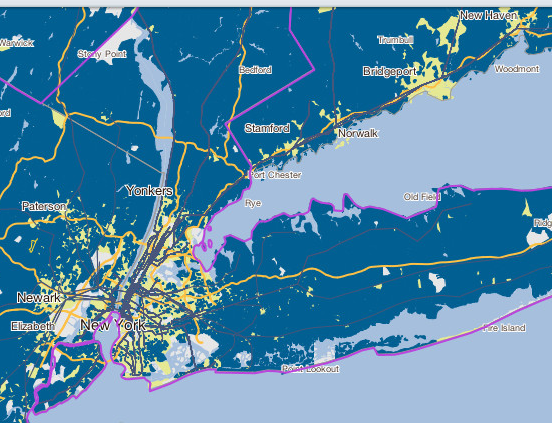
You got the call, people. Let’s rise to that challenge! I think the best way to deal with it is to bring prices down by building a diversity of relatively dense housing where there already is good transit, but many people will move to the suburbs, and some already have. WNYC made an incredibly useful map showing median income by census tract, based on the 2007-2012 American Community Survey. Here’s the New York area:


Interestingly, on this map the real concentrated poverty that we see in Fort Greene or West Farms – census tracts with median household incomes below fifteen thousand dollars – is only found in three places outside of New York city: Bridgeport, New Haven and the Seth Boyden and Otto Kretchmer projects in Newark (now closed). Instead, there are a lot of census tracts with median incomes between $15,000 and $25,000 a year. But outside of New York, Bridgeport and New Haven those are found in only a handful of other cities. In the rest of the metro area, median income is over $25,000.

The towns that have census tracts with median incomes between $15,000 and 25,000 are as follows: In New York State, Yonkers, Mount Vernon (one project), Spring Valley and Kiryas Joel. In New Jersey it’s Jersey City, North Bergen, Newark, Elizabeth, Asbury Park, Passaic and Paterson.

The primary challenge with the "suburbanization of poverty" is that the farther out people move, the harder it is for them to access good-paying jobs. Someone who is displaced from Fort Greene in Brooklyn to the West Ward of Newark trades a 45-minute subway ride for a trip on a bus to a commuter train to a subway that can take over an hour. Interestingly, it's not so much the cost of transportation that's the problem, as we can see by looking at the Center for Neighborhood Technology's Housing+Transportation index. In all these areas, housing and transportation costs combined were less than 45% of household income (indicated by yellow), which was often not the case for "wealthier" areas nearby (indicated by blue).


Here's the tricky part: these are based on the reports of people who had work, so they could by definition afford their commutes. It may be that the reason they can't access better-paying jobs is that they couldn't afford the commute, but we don't know that. Giving the H+T data the benefit of the doubt, we should focus on making the commute to better-paying jobs quicker, not just cheaper. That means increasing the capacity of the routes to job centers - primarily New Jersey Transit and Metro-North trains - and bringing rapid service to places, like Newark's West Ward and Yonkers's Schlobohm Houses, that are currently only accessible by relatively slow buses.

In future posts I'll talk about some potential investments that could improve job access from these areas.

Wednesday, August 27, 2014

Ferguson, Missouri is not a Strong Town

A lot of people have had a lot of insights about the recent events in Ferguson, Missouri. I want to highlight a few that I think are particularly important, and add a few thoughts that I hope will help focus them on our goals.

Last week, Doug Henwood had a great interview with political scientist and former Missouri state senator Jeff Smith, who expanded on his op-ed about how economically bankrupt the entire Saint Louis area, and in particular suburbs like Ferguson, have become. Combine that with municipal fragmentation and the mismatch between the city’s majority black population and its mostly white government, and you get a heavy dose of "for-profit policing," where the town relies on traffic stops for a large chunk of its revenue. It’s not hard to see how that in turn leads to the kind of anger that erupted after Darren Wilson, a white police officer, shot and killed Michael Brown, a black resident.

First a word about "revenue generation" through traffic enforcement and other police actions. It’s gotta stop, period. Giving government officials a financial incentive to ticket and arrest people is a recipe for disaster – the kind of disaster we’ve been hearing about for days. Obviously, even if Michael Brown stole a few cigarillos (and it’s not at all clear he did), the police response was nuts and completely out of control.

That said, many politicians go too far in reacting to this abuse of the system. Many of our city council members here in New York act as though no tickets are ever warranted, even if the driver is putting lives at risk by blocking a hydrant, speeding or running a red light. The response to overzealous policing is not to make our streets a free-for-all for reckless drivers. People who want to stop "revenue generation" need an alternative way to keep us safe, whether it’s a cap on fines or replacing them with jail time.

Second, I have to point out how this shows up the "Chocolate City" triumphalism of the 1970s. Much as I love George Clinton, much as I support true local control and self-determination and Black Power, and much as I have sympathy for any separatist movement that just wants to get away from the oppressors, at this point it’s clear that when black people gained control of the governments of major cities it was at best a short-lived victory.

Cities are not self-contained little systems. They are porous regions of much larger systems, connected and interdependent with other cities, with their hinterlands and with their suburbs. When we integrated the buses, white people shifted to private cars. When we integrated the schools, white people moved their kids to "Christian Academies" and suburban districts. When black people took control of the cities, white people moved their wealth to the suburbs. Now black people are finding themselves pushed out of the Chocolate City into suburbs controlled by white people. It’s likely that one day Ferguson and other majority-black suburbs will elect black mayors, but what is really important is for everyone to have a fair say in the government of the entire region.


Chuck Marohn took this screen capture of the Google Street View of the Ferguson Market and Liquor Store.

Listening to Smith I couldn’t help thinking, as I had several times in the past week, "Ferguson isn’t a Strong Town." No, it is not. Chuck Marohn has the numbers, and you have to wonder: if the town had retained its walkable and transit infrastructure and built on it over the past sixty years instead of sprawling, how much less desperate would it be? What if the entire Saint Louis region had bucked the trend and stayed dense, walkable and transit-oriented? What would it take to make it strong again?

Finally, as Megan McArdle noted, this is part of the "Great Inversion" or the "suburbanization of poverty," the final step in the growth ponzi scheme where those of us who are aware and affluent enough move to walkable urban neighborhoods. Because we refuse to build more walkable urban neighborhoods, that displaces the poor and powerless to the inefficient, isolated, dangerous, rotting suburbs. What can those of us who care about our fellow humans do about this?

I’m guessing that as more and more people come to grips with the idea that poor black and Hispanic people are living in the suburbs now, some short-sighted person will propose an aid program where we dump massive amounts of money into the suburbs with the goal of bringing their standard of living up to the level of the wealthy inner cities, but with no attempt to make them more efficient. At that point some wiser person should point out that that’s exactly what we did for the past sixty years, and that that’s why the white people left the suburbs in the first place.

Thursday, July 31, 2014

Could we build another Park Slope?

Do you like the modern towers of the Upper East Side?


How about a nice gigantic Upper West Side prewar apartment building like the Ansonia?


Or the brownstones of Park Slope?


Or is all that too dense and urban for you? Maybe you'd prefer the lovely Victorians of Irvington, NY?


Gorgeous places to live! Of course, you and I are not the only ones who think so. These are some of the most desirable locations in the country. There are millions of people who would love to live in places like these.

So why don't we build more?

Why not buy up a block of crappy 1960s Stately Homes in Woodside and replicate the Ansonia? Or raze some raised ranches in Massapequa and build a block of brownstones? Build a new Victorian main street leading down to the Croton station, where now there are strip malls?

It turns out that there are some attempts to do this. Andres Duany is involved in a project in Jersey City that looks pretty cool. If you know of any others in the New York area, please let me know!

Unfortunately, those projects are a drop in the bucket. Zoning rules across the region make it next to impossible to build big modern towers on the Upper West Side, or a new Ansonia in Park Slope, or a block of brownstones in Irvington, or a new Irvington in Scarborough. The Municipal Art Society's recently released zoning envelope map confirms that the massive downzoning conducted across the city by Mayor Bloomberg and Commissioner Burden reinforced this prohibition. And people wonder why rents keep going up...

Tuesday, June 24, 2014

Five migrations in gentrification

In a recent post I noted that the demand driving up rents and prices ("gentrification") in big cities like New York, San Francisco and Chicago is a result of at least three distinct migration streams. Thinking about it now, I can identify five major streams. It's important to keep them straight, because they do not have the same cause, and thus the actions we can take (if any) to reduce or redirect the flow of migrants is different in each case.


The best and brightest have been migrating to cities since time immemorial, seeking fame and fortune. So have rural misfits – heretics, gender and sexual minorities, people with mixed ethnic, religious or class backgrounds, people with disabilities, anyone who has been shunned by small, close-knit communities. Some of them migrate from small cities to larger cities, searching for a better opportunity, more anonymity, more tolerance.

Immigrants often wind up in cities, because that is usually where the entry points and crossroads are, and where there are the most opportunities. They come through Ellis Island or Kennedy Airport, across the Rio Grande at El Paso or San Diego, and find their way to East Los Angeles or Chinatown or Washington Heights. Maybe they eventually wind up in a small town, or even start out picking berries in the Central Valley or tobacco in the Coastal Plain, but many families spend at least a generation in a big city.

Those two migration streams – the best and the misfits, and international migration – have been going on for as long as we’ve had cities and nations. Recently, what’s been capturing a lot of people’s attention is the white return – the repudiation by Anglo, Jewish, German and others of their parents’ search for comfort and tranquility in the suburbs, supposedly safe from the nonwhite people they feared and hated. I’m part of a similar migration, Back to the City, where the children of hippies and beatniks realized that communing with nature isn’t quite as spiritually uplifting as our parents thought – and it’s not all that great for the environment, either.

The fourth big migration stream that has been getting attention is the move of the white-flighters and back-to-the-landers themselves. Baby Boomers and other people who are now elderly have realized what we knew when we were fourteen: that life sucks in Amityville or Great Barrington if you can’t drive wherever you want to go. They’re buying small apartments in the city themselves, many of them in neighborhoods that they couldn’t afford in 1972.

There’s a fifth migration that I think doesn’t get enough attention: the small city exiles. These are people who are not the best or the brightest, or complete misfits, but they’re pretty bright, mildly kinky or noticeably nonconformist. Or maybe they can’t drive because they’re blind or epileptic (I learned about this last one from Sally Flocks), or they just don’t want to. Eighty years ago they’d have been pretty happy in Rochester or Knoxville or Omaha or San Luis Obispo: reasonably normal, functioning members of society, with enough peers to have a stimulating intellectual and artistic fellowship.

Today, those towns have hardly any jobs at all, especially within walking distance of downtown, shopping and services are sprawled out across the area, and transit between them is inconvenient. With this fragmentation, they can barely sustain a monthly open mike or an Indian restaurant, let alone a poetry slam or a regional Thai place. Our heroes – somewhat large fish in not-so-large ponds – see the grim desperation in the faces of their older neighbors and head to the bigger cities, where there are more opportunities, not just for jobs but for dinner after 8PM.

This is why rents and prices have been rising so drastically in New York, Washington and San Francisco, and to a certain extent in Boston and Chicago. In addition to the eternal migration of the ambitious, the misfits and immigrants, we’re on the receiving end of the White Return and the Back to the City – both the old and the young. On top of all that we’re getting the moderately bright and kind of weird who can’t make a home in the small cities.

Any solution to the problems of rising rents and prices will have to address all three of these new migrations. We can build more big city for them: taller buildings, more transit, upzoning around transit. But the returning retirees and the small city refugees don’t need big cities. They’d be perfectly happy if we could make the existing pedestrian and transit infrastructure of Scranton and Pueblo and Fort Smith work for them again, rebuild what was lost and thrown away, and find a way to make those towns relevant again. They’d be happy if they could live in prewar suburbs like Bethpage and Whiting without having to own a car for every adult family member. This is what the Strong Towns movement is about, and what Duncan Crary says about Troy.

You may say that it’s a tall order, that these towns are never coming back. But I ask you: if we rebuilt the rail connections, rebuilt the housing and shopping and offices where now there is just parking, and tore down the bypasses that made those downtowns irrelevant, don’t you think some of them would start to sputter back to life? Is that really any harder than trying to build whatever mind-numbing amount of "affordable housing" we need in New York to accommodate all these people, and the subways we will need to move them around once the elites admit that “Bus Rapid Transit” will never suffice?

Monday, June 16, 2014

Unpacking gentrification

Transit advocates, pedestrian advocates, urbanists and in general all the people who are trying to improve the quality of life in cities need to talk about gentrification. Not because improvements to transit or walking or urban quality of life lead to gentrification, but because some people think they do. Others, bizarrely, are scapegoating the people moving to urban areas, as though their migration were the result of either nefarious conspiracy or a spontaneous coincidence of individual greed. Some of these demagogues are willing to attack the transit and quality of life improvements, the people promoting those improvements, or the migrants themselves, in a desperate attempt to prevent this change.


The fact of the matter is that the transit and quality of life improvements are largely the effect, not the cause, of the move back to the cities. The suburban growth ponzi scheme and the hippie back-to-the-land fantasy have run out of money, and the jobs are leaving. As the jobs leave the suburbs and the country, the quality of life goes down, and people flee for the cities.

These migrants may be a bit insensitive, but they are not conspiring amongst themselves to take from city dwellers, and they are not acting out of greed and jealousy; rather, their own dislocation from their homes deserves as much sympathy from anti-gentrification activists as that of the people they are displacing.

This migration is much more powerful than the anti-gentrification demagogues. Even if they manage to keep cities as inconvenient as they are, people will keep coming. The only way they could stem the tide is if they somehow manage to bring the cities down to the level of the suburbs. Short of bringing back the crack epidemic and setting the South Bronx on fire again, I just don't see it.

The demagogues may not succeed in stopping the migration to the cities, but they can do some damage, and make cities, suburbs and country miserable places all around. Fortunately, some of them are motivated by a heartfelt desire to help others that has been twisted to scapegoating and destruction. They may be amenable to reason, and that is why we need to be prepared.

Really, it is the concept of "gentrification" as a thing that leads to this misradicalization. Gentrification may seem to be a neat, easily identifiable phenomenon - uh oh, there's a new coffee bar over here, and a vintage record store over there! - but the effects that people complain about are hardly that simple.

Even though some people may complain about restaurants and "hipsters," these are not the substantive concerns that others take seriously. The worst effects of gentrification are (a) rising prices and rents, which squeeze the budgets of old-time residents and businesses whose incomes have not risen, (b) displacement as those residents move to cheaper areas, (c) loss of services as the businesses close or move away, and (d) disconnection as people and businesses that are displaced may move to different areas and have difficulty keeping in touch.

In general, I'm not really swayed by the loss of services argument. I may mourn the passing of Big Nick's Burger Joint or Shakespeare and Company, but I actually think the Shake Shack burgers and the browsing experience at Barnes and Noble are better than their predecessors.

I'm also not troubled by displacement in itself: migration is a fact of life. The idea that the children of African Americans or Puerto Ricans who moved to the neighborhood forty years ago have more of a right to it than the grandchildren of Jews and Italians who moved there eighty years ago is just bizarre. The problems come when the displacement is too fast and too extreme, and scatters people who otherwise want to be together.

The real question is not whether to avoid or stop "gentrification," it's whether we can slow or ease the displacement, and make it so that when people do get displaced, they wind up in places that are almost as nice as the places they left.

In order to do that, we need to further unpack "gentrification." This migration is not a simple one: in fact, it is at least three migrations combined, and not all of them equally necessary. We need to do what we can to reduce that inmigration. The displacement is not automatically necessary: we need to increase the amount of housing and jobs in the city, so that the old-timers can live alongside the newcomers instead of being forced out. We need to make sure that poor city dwellers aren't simply being displaced to the same dangerous, unpleasant, disconnected suburbs that the middle-class migrants are leaving behind - with less ability to afford cars.

Will this convince the misguided radicals who see gentrification in black and white terms? Hard to tell. Will it help me feel better promoting transit and urban life? Yes. I'll talk more about these issues in future posts.

Tuesday, May 27, 2014

Cheap housing with els

Two years ago I wrote that for truly affordable housing we not only do we need an adequate supply of living space, as Matt Yglesias explains so nicely, but also a decent range of quality. I mentioned that this pricing distribution could be achieved in several ways, some of them very unfair:


To prevent segregating the poor into inconveniently located bad housing with crime and pollution, we need to make some safe, solid housing available closer in, integrated with the rich people's housing. that is still affordable. In order to do that, we need to allow housing that's cheap in the non-dangerous, non-segregated ways. That means housing that's small or ugly, with crappy views and no doormen. Maybe housing that allows loud music if it doesn't bother anyone else. Regardless, it should still be well-built and well-maintained, and safe from pollution and crime.

Stephen Smith is fond of saying that "filtering" will keep prices low on a large enough portion of the available housing. Filtering is the idea that the price of older housing will be lower, reflecting the aging of materials and changes in consumer tastes. Jane Jacobs memorably said it about commercial space: "New ideas require old buildings."

This filtering hypothesis would make sense, all else being equal, but all else is not equal. There has been a serious decline in the quality of building since World War II, with the result that many buyers and renters will choose a prewar apartment with its amenities (hardwood floors, high ceilings, attention to detail, solid construction) over a postwar one with "modern" amenities (Stephen recently mentioned central air conditioning and laundry on premises).

A lot of postwar construction is also anti-urban, even in the hearts of cities, whether through tower-in-a-park architecture like Stuyvesant Town or excessive auto-oriented design like big driveways. Some, like the Big Six towers in my neighborhood, combined the two for that classy tower-in-a-parking lot ambiance. Some, like Wesley Grove in Asbury Park, have their de facto primary entrances and exits facing away from the street and towards the parking lot.

Because of this, it helps to have other ways of generating a range of quality options in the housing market, and one of those is elevated trains. I may have picked this idea up from something Stephen wrote; he certainly likes els.

Now, the el in my neighborhood, the Flushing Line, is really not that nice. In addition to blocking out all the light on Roosevelt Avenue, it makes so much noise that you can't talk when it's clanking over you. And if you look at estimated rents on Zillow, you'll find that two-bedroom apartments facing the train tend to rent for several hundred dollars cheaper than those around the corner.

Els that are built nowadays are much quieter. They're not unpleasant to live near, but they aren't as nice as a subway. The result is a less extreme range of rents, but still enough to provide affordable housing, especially when combined with other factors.

Elevated trains are not only cheaper to build than subways, but when combined with zoning that allows for substantial amounts of housing to be built for relatively low cost (i.e. highrises without parking) they can provide genuine affordable housing, and thus be a real tool in fighting gentrification.

Saturday, November 23, 2013

Inequality: disease or symptom?

Do you want to see real inequality? Do you want to see well-fed people, satisfied smiles on their faces, walking past lines of hungry people waiting in the cold, or in the hot sun? It's not hard to find, here in one of the richest cities in the world: just go to any restaurant that has a line for brunch.


Yes, I'm being flippant. But I'm making a real point: just because you observe inequality in a place does not mean that that place creates inequality. In fact, imagine if you had a magical machine that turned poor people into rich ones, or even if you just had someone who sat at a desk and handed out stacks of twenties. You'd see poor people next to rich people, because the poor people have to go to that place to become rich people. In fact, if you go to some of the places where smug people tell you you won't see rich people stepping over poor people, chances are very good that they're that way because of segregation, like Detroit.

I've been to places with relatively mild weather - Seattle, Vancouver and Albuquerque, in particular, but I'm sure there are more - and people there told me that their city attracts homeless people because the living is easy. You can see the challenge: suppose that your city has a million poor people, and you come up with a brilliant economic development plan that lifts them all out of poverty in a year. What would happen next? A million more people would move in, ready for their chance to escape poverty. Perfectly reasonable on their part.

What's not reasonable is to blame "the city" - its government, and usually its people - for the inequality, as I often see being done to New York. If you see inequality in a city, it could be that the city is making its residents poorer, or it could be keeping its poor residents down over generations. It could be that everyone's getting richer equally, but the rich had a head start. Or the city could be making its poor residents richer, and they then move out or have a low birth rate, and are replaced by poor immigrants.

There are even ways to tell. Look at adults (living anywhere) who were born to poor city residents. Are they richer or poorer than their parents? How does their change in wealth compare to the children of their parents' wealthier neighbors?

I honestly don't know. I haven't looked at that data. But I'm not the one demonizing New York for "inequality."

Monday, April 15, 2013

In 2013, subways raise property values

Suppose that you live in a detached single-family home a block from the old Brooklyn Manor train station in Woodhaven. Your neighbors are selling a house a lot like yours, containing about 2000 square feet of floor area on a 5,000 square foot lot abutting the Rockaway Beach Branch railroad embankment, for $439,000.

That's one of the few houses that can even be sold; Zillow says that 20-30% of mortgages in this area are underwater. You want to see your property values go up. Maybe your mortgage is underwater; maybe you just want to get a good price when you're ready to sell. What can you do? Reactivate the railroad.


Your house is currently an hour door-to-door from downtown Manhattan on the rickety, unreliable J or Z tracks. If you're trying to get to Midtown, where there are more jobs, you would have to change for the F or M trains, adding another fifteen minutes. But what if you could cut that travel time to forty-five minutes, say by running the R train on the Rockaway Branch tracks? We don't have to imagine; we can just look at a very similar train line.


This 15000 square foot house, 2163 East 15th Street in Brooklyn, is currently for sale at $489,000. That's $50,000 more than your neighbor is asking, for a house that's a little smaller. Okay, your neighbor's house has termite damage, but it also has a huge back yard with no trains running on the tracks.

If you compare properties along the Q train in Sheepshead Bay and Homecrest you find that they're typically $100-200,000 more than you would get for "comparable" properties along the Rockaway Branch, like this 1600 square foot semi-attached house asking $729,000. And according to Zillow, only 5-10% of mortgages are underwater. That 15-30 minute difference in commute time makes a big difference in home prices. Crime is lower, too.

This may be a surprise to you. You may remember the sixties and seventies, when properties near active train lines went down in price and properties near highways went up. Things have changed. People can't afford to drive, and they're realizing that the train and the city aren't so bad.

What about the opposite problem, gentrification? Well, I took a walk through Sheepshead Bay yesterday, and let's just say I didn't see any creative facial hair or skinny jeans. Don't take my word for it; go look for yourself.

Reopening the Brooklyn Manor train station would be a huge boon to people who live nearby. But you can only do it if you get out of the 1970s mental traffic jam and ride the train into the twenty-first century. Please, sign the two petitions to reopen the Rockway Beach Branch, on change.org and on Assemblymember Goldfeder's site.