Showing posts with label profits. Show all posts

Friday, December 29, 2023

The 2022 farebox numbers

Agency	Fare Revenues per Total Operating Expense (Recovery Ratio)
Port Imperial Ferry Corporation, dba: NY Waterway	1.43
Hyannis Harbor Tours, Inc.	1.41
Bay State LLC, dba: Bay State Cruise Company	1.35
Trans-Bridge Lines, Inc.	1.33
Chattanooga Area Regional Transportation Authority	1.31
Hampton Jitney, Inc.	1.2
Seldovia Village Tribe	1
Peter Pan Bus Lines	1
Golden Crescent Regional Planning Commission	1
Community Transit, Inc.	0.96
Chatham Area Transit Authority	0.93
Jalbert Leasing, Inc. , dba: C&J Bus Lines	0.92
A&C Bus Corporation & Montgomery & Westside Owners Association	0.83
Academy Lines, Inc.	0.78
SeaStreak, LLC	0.77
Chemehuevi Indian Tribe	0.75
Orange-Newark-Elizabeth, Inc.	0.71
University of California, Davis, dba: ASUCD-Unitrans	0.69
Chicago Water Taxi (Wendella)	0.67
Olympia Trails Bus Company, Inc.	0.66
Hudson Transit Lines, Inc.	0.63
Monsey New Square Trails Corporation	0.63

I remembered the National Transit Database a bit earlier this year, so here are the top hitters for 2022, and we can see the ridership recovery already. The four companies earning a profit from 2021 (Bay State, Trans-Bridge, Hampton Jitney and Hyannis Harbor) are joined by New York Waterway and the Chattanooga incline. Broadway Bus dropped from breaking even to earning just 23 cents on the dollar, and Peter Pan buses and the Seldovia Village Tribe ferries claimed to be breaking even. The Golden Crescent also claimed to be breaking even, but I think they're either lying or clueless or both.

It's not too surprising that the ferries did well in 2022: you can usually isolate from other riders on the upper deck. The New York Waterway ferries run every twenty minutes year round, charge $9 a ride and have gotten a lot of takers every time I've ridden them. They also load and unload passengers a lot more efficiently than the East River ferries operated by Hornblower.

Most of the Lincoln Tunnel buses are back over 50% farebox revenue, including Coachusa-owned Community Transit, Olympia Trails and ShortLine, so we'll see if they continue to improve. Red and Tan is only at 27%, which is probably why they still haven't brought back weekend service, but honestly I don't think they'll earn back those customers without losing money on the weekends for a few months.

Again, this just points to the foolishness of the Federal government and transit advocates. If the Feds had bailed out private transit companies the way they bailed out the airlines in 2020 and 2021, we'd be seeing a lot more people on the bus in New Jersey and the Hudson Valley.

The NTD now offers the ability to sort and filter in place, so you can sort and filter the data right in place, and even share a URL with your sorted and filtered data!

Thursday, December 28, 2023

Ten things to remember about public and private transportation

MAYOR MCCLELLAN, THE RAPID TRANSIT COMMISSIONERS, AND OTHER GUESTS OF THE CHIEF CONTRACTOR, JOHN B. McDONALD, STARTING ON FIRST INSPECTION TOUR OF THE SUBWAY, JULY 19, 1904

With a bunch of articles in the news recently about private intercity bus service, it's important to keep in mind several points:

  1. No transportation is completely private. Whether it's land, vehicles, fuel, air, research, wayfinding, public safety or search and rescue: you didn't build that.
  2. No transportation is completely public. Even in the strictest Communist states there have always been markets where people sell transportation without state control. In the United States, every government transportation agency buys goods and services from private vendors, and many contract their operations to private companies. Somebody, somewhere, is making a buck, and there's nothing you can do to stop it.
  3. Greedy, lazy people are everywhere. There's nothing about public ownership that guarantees good service.
  4. Most public transit used to be profitable. Most of the "public" transit systems around the world between 1850 and 1950 were built and operated by private companies, with large government subsidies. Some are still profitable today.
  5. Most roads and parking lots in the United States are socialist. And they're destroying the planet.
  6. Automakers and airlines are regularly bailed out by the government. Pundits and politicians only complain about bailouts and subsidies if they think they're going to the "wrong" people. Which ones they complain about usually tells you a lot about the pundits and politicians.
  7. It's all one big system. Whether publicly or privately owned or operated, public transit competes with publicly subsidized roads, airports, parking and personal cars.
  8. Private operators can take payment through larger fare systems. It takes a bit of planning, but it can be done.
  9. Transportation policy can't solve race, sex or class prejudice by itself. You may eradicate racism from buses, but as long as racism exists, racists will find a way to use transportation to oppress people.
  10. Trip cost is just one factor. For some people it's the biggest factor. For most, it comes after other criteria like trip time, safety, comfort and reliability.

Sunday, January 22, 2023

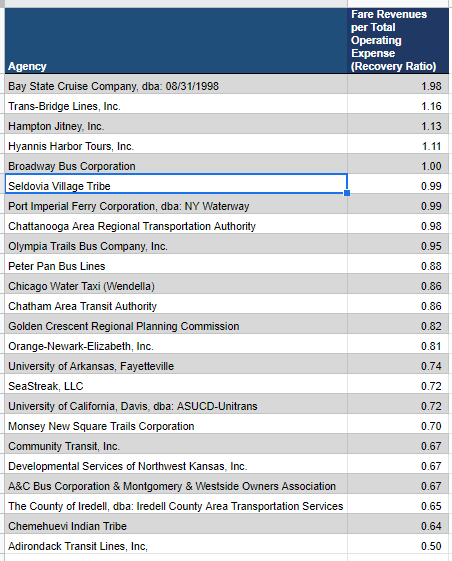
The 2021 farebox numbers

screenshot of the list of 24 organizations with the highest farebox recovery ratios in 2021

Alexander asked on Twitter about the series of posts I did on farebox recovery ratios reported to the United States National Transit Database from 2007 through 2010. The Federal Transit Administration has continued to publish the NTD every year; I just got a little tired of compiling the data, and engagement kind of went down. But let's take a look and see how things are these days!

The Database for each year used to be published in December of the following year, so 2021 is now the most recent year available. The data used to be in Table 26, but the FTA staff is no longer numbering the tables, so now it's in the Metrics table. I've imported the 2021 Metrics table into Google Sheets for your convenience.

Since we're looking at traditional transit providers, the first thing to do is filter out the contract providers (any TOS but DO) and the demand response and vanpool providers (Mode of DR and VP). That leaves us with 22 transit providers.

The first thing I noticed is how many more ferry operators are reporting. In 2010 we had New York Waterway and BillyBey, but in 2021 we have eight: Bay State (Boston to Provincetown), Hyannis Harbor (also Cape Cod), Seldovia Village (connects Homer, Alaska to a Native village with no competing roads), New York Waterway, Chicago Water Taxi, Chatham Area Transit (connecting downtown Savannah to the Convention Center), SeaStreak (connects New York with bedroom and resort towns in New Jersey and Massachusetts) and the Chemehuevi Indian Tribe (connects one end of London Bridge to a casino across Lake Havasu).

In 2010 we had the University of Georgia; in 2021 we have the University of Arkansas and the University of California at Davis. Those don't really count because they're paid for up front by student fees. The Chattanooga inclined plane also broke even in 2021.

A couple of items were flagged by the FTA staff as "Questionable," including the claim by the Golden Crescent Regional Planning Commission that its bus service brings in $9.26 per trip in fares, when their website says they only charge $1.50. They didn't flag the Developmental Services of Northwest Kansas's claim that they earn $16 per trip in fares while only charging $3, but I find that questionable myself. Similarly with Iredell County Area Transportation Services' report of $7.75 per trip contrasts with their website's $1-3 fare. I'm guessing both of those are clerical errors.

That leaves nine bus companies, all in the New York area, making more than a 50% farebox recovery ratio in 2021, which you may remember was a difficult year for transit agencies: Trans-Bridge, Hampton Jitney, Broadway Bus, Olympia Trails, Peter Pan, Orange-Newark-Elizabeth, Monsey New Square Trails, Community Transit, A&C Bus/Montgomery and Westside, and Adirondack Transit.

To answer Alexander's question: there are six bus companies on this list that use the Lincoln Tunnel Exclusive Bus Lane: Trans-Bridge, Olympia Trails (the CoachUSA subsidiary serving Newark Airport from Manhattan), Peter Pan, Monsey New Square Trails (a commuter service focused on Hasidic Jews), Community Transit (a CoachUSA subsidiary serving East and West Orange and Livingston, NJ from the Port Authority) and Adirondack Transit. Of the buses making more than 75% farebox recovery ratio in 2010, some had gone out of business before the adoption of work-from-home arrangements when doctors began discovering COVID-19 cases in March, like Frank Martz Trailways.

Most of the companies missing from the short list were just losing a lot of money. Suburban Transit, the CoachUSA subsidiary serving New Brunswick area, made a 22% farebox recovery ratio in 2021. DeCamp made 21%, and Rockland Coaches, the CoachUSA subsidiary formerly doing business as Red and Tan Lines, made 19%. This is a useful lesson, because the management of these companies took a very conservative approach, canceling all service for months and leading restoration with peak-direction rush-hour service. Rockland has still not restored full-day or weekend service. In contrast, Trans-Bridge, Olympia Trails, Peter Pan, Monsey and Adirondack all run service middays, reverse-peak and weekends.

It wasn't flagged as "Questionable," but I find it questionable that Broadway Bus was able to run eight buses for $13.97 an hour total. If I'm not mistaken, Broadway Bus and A&C may have gone out of business since 2021. With three routes in Newark I don't quite understand how Orange-Newark-Elizabeth (a CoachUSA subsidiary) makes an 81% farebox recovery ratio.

The big success story in this list, of course, is Hampton Jitney, which made a 13% profit in 2021. The Hamptons were infamous as the destination for a number of wealthy people who (with no good reason) "fled the city." They did, of course, have to come back at least temporarily, and while they may be willing to drive out there, spending hours on the Long Island Expressway is a different story. So those who can't afford helicopters take the train or the bus.

Friday, February 26, 2016

The Via experience

Here in New York when people talk about "microtransit," they usually mean Uberpool or Lyftline, and those are the services I've been focusing on. Some have mentioned a third service, Via, that works a bit differently. Via is all shared; there is no service where it's just you and the driver, like a traditional taxi. The prices are fixed: currently five dollars per trip on weekdays if you buy credit ahead of time, and up to just under ten dollars for a pay-per-ride weeknight.


I've tried Via several times over the past year. The only real complaint I have is that they don't go to Queens: the service is restricted to Manhattan. I have hope, though, because when I started it was only available from Fourteenth to Fifty-Ninth Streets, and it's now available from the Battery to 110th Street. The next expansion will probably be Brooklyn Heights or Park Slope, but I don't think they'll ignore western Queens for long.

The first couple of times I took Via I had to wait a while, and it was just me and the driver, but the service seems to have caught on quickly. Every time since then, there has been at least one other passenger and the wait time has been minimal. If I've had to wait more than five minutes it was because my "Via-cle" (har) was stuck in traffic less than two blocks away.

Via is much more like a bus than a taxi. Twice I've gotten sedans, but the Via-cles are usually SUVs. I've had at least one trip with three other people, meaning I had to sit in the third row of one of those Suburbans or Navigators or Explorers. Since those aren't really made for people getting in and out frequently, I'm wondering how soon Via is going to start running vans big enough to stand up in.

A number of people have objected to Uber and Lyft because of the “gig economy” arrangements they have with their drivers. Of course, they’re not much worse than the taxi medallion owners in that regard. But on one recent Via trip the driver was chatting with us, and he said that Via drivers are all paid by the hour, possibly even full time. If that is correct, it sounds like a much better deal for them than just about any other taxi arrangement.

As I’ve said before, Uber and Lyft are a huge improvement over the way we did taxis up to a few years ago, but in their current incarnations they won’t do much to help the transit capacity crunch we’re feeling in cities like New York. The Via model is much more promising, and the more Uber and Lyft act on those lines, like with Uberhop, the more helpful they will be in relieving our capacity constraints.

There was another fascinating aspect of my experience with Via, and to some degree with Lyftline and Uberpool, that deserves its own post. I'll write about it soon!

Sunday, October 25, 2015

Private or public what?

Recently with Uber, Lyft and even Leap, here has been a lot of discussion of public versus private transit. The stark opposition that some people draw between public and private obscures several important points. If we look at the history of transportation, nothing has ever been completely private or completely public. There are in fact three different ways that the public can be connected to a transportation project: money, control and accountability. These operate in many different areas, to different degrees.

Funding for capital construction, maintenance, procurement, or operations can come from general taxes, taxes on specific activities, fees and tolls on other kinds of transportation, or from fares. Fees, tolls and fares can be levied on transportation services and spent on things not directly related to transportation, including kickbacks, bribes, padding and profits. Money can be borrowed from private individuals, private companies, private nonprofits or government agencies.

Land, water and airspace can be owned by the government or private entities, as can the buildings, tracks, paths, roads, bridges and tunnels on, over, under and through them. The owners can grant access equally to all parties or reserve it for specific parties or classes of parties. Owners can charge money for access, and limit length and times of access.

Publicly elected officials or their employees can regulate scheduling and routing of the transportation services, and the policing of passengers. They can grant licenses to transport passengers and goods, and impose rules. They can regulate access to transportation facilities and services. The rules and regulations can be reasonable or arbitrary, or somewhere in between.

Publicly elected officials or their employees can regulate the way that a transportation provider interacts with its workers. The workers can form unions, and the transportation providers can form syndicates. These unions and syndicates can in turn form agreements with the governments and private transportation providers, with some degree of control over scheduling, routing and access, and over the hours that the employees work and the wages they are paid.

No transportation provider can provide everything, so transit providers need to purchase goods and services from other entities. Some of these services must be purchased from government entities. Publicly elected officials or their employees can regulate any aspects of this.

Funding, resources, operations, labor, procurement - all these things are some mix of public and private. The government itself can be more or less democratic, and more or less corrupt. Some entities look private but are wholly controlled by the government, and vice versa. This is all I can think of right now, but I'm sure I'm missing some things, and that's why I get frustrated when people present "public vs. private transit" as some clear binary opposition.

Don't get me wrong, I know why "privatization" has such a bad name. Often, from British Rail down to New York's "Group Ride Vehicle Program," what passes for privatization is some weird sandbox thing where the "private" operators are subject to so many conditions, regulations and oversight that you have to wonder why they're private. It's almost always an excuse for either reducing a useful government service, or looting publicly held resources, or both. The other reason the private operators are brought in is to do something that elected officials are worried will alienate voters, like raising fares.

As I wrote almost six years ago, we need to move beyond simplistic fears of privatization - or of government control - and recognize that every transportation service is a mixture of private and public funding, private and public control, private and public accountability. We need to lay out specifically how it fits our goals, and how it falls short. Some of you are doing that. More of you need to.

Sunday, October 4, 2015

Expanding transit and taxis

I wrote recently that by making taxi service more convenient and flexible, electronic taxi hailing services like Uber and Lyft have the potential to replace private car trips and even some car ownership. But some argue (or worry) that they can go further and replace public transit. I've already pointed out that even in this unlikely event, it would not necessarily be a bad thing.

The main value of transit is that it gets people out of cars, and the main challenge of transit in the 2010s (in large, walkable US cities at least) is that it doesn't have enough capacity to accommodate all the people who want to get out of their cars. The main goal for transit advocates right now should be to grow that capacity.

Since the days of Red Mike Hylan, transit advocates have focused on funding capacity expansion through government contracts, and big business has been a dirty word. But it's not at all clear that Hylan was right: the fact that the new 7 line extension was the first real rapid transit expansion in New York City since 1989 shows that we can't just forbid private investment in transit and expect the public sector to step in.

Some subway and commuter rail expansions are massively over-engineered and take forever (the Second Avenue Subway, East Side Access). Others are loaded down with park-and-rides (the Northern Branch), and eventually deep-sixed by ambitious politicians (the Rockland-Westchester corridor). Politicians have shut down many promising subway (Astoria extension), commuter rail (LIRR Third Track) and bus (Main Street bus lanes) proposals at the behest of NIMBYs or even cycling advocates (the Rockaway Beach Line).

The most shameful smothering of transit expansion was where ostensibly left-wing, pro-transit Manhattanites and their ostensibly left-wing, transit-loving representatives tightened constraints on the capacity for bus movement and storage, and blocked attempts to expand them, without a peep out of supposed bus advocates.

If we can’t count on government to expand transit fast enough to meet demand, or to even allow private buses to meet that demand, we have to see if someone else is willing to meet it. And that’s where Uber and Lyft, and less well known services like Via, come in.

These electronic taxi hailing services have essentially used venture capital to finance a massive expansion and upgrade of New York's taxi fleet. Hundreds of late-model Priuses and Suburbans have begun cruising the streets of New York, replacing Lincoln Town Cars and Ford Tauruses.

This is happening not because The People demanded an expansion and upgrade of the taxi fleet. (The bourgeois poseurs who claim to speak on behalf of The People would never demand such a thing, because it sounds too bourgeois.) It is not happening because the Sensible Bureaucrats conducted a study and decided to spend the money. (The Sensible Bureaucrats made some headway, but their colleagues were too busy cowering in pathetic fear of the power of the taxi medallion owners.) It is happening because Uber and others are making a profit on the financing of these vehicles, and the venture capitalists pouring money into Uber and Lyft are expecting to eventually make a profit themselves.

Of course, that's just taxis, and as I wrote earlier, by itself it won't get us to our goals. But is it a sign of a potential way forward for transit expansion?

Friday, July 10, 2015

No, e-carpooling will not replace fixed-route buses

A lot of people have been talking about "microtransit" lately - sometimes meaning shared e-hailing services like Uberpool and Lyftline, but also some larger services like Bridj, Via and Leap, and even dollar vans. I've read some wise things, and other things that are ...less wise. I think this is going to be a few posts, and I'm going to start with the question of whether electronic taxi-sharing services like Uberpool and Lyftline will, or even can, drive public buses out of business, and the role of pricing.


Last August, Timothy B. Lee wrote,

In the short run, these services will be a way for yuppies to pay a little less for their taxi rides. But they're also starting to blur of the line between taxis and buses. In the long run, that line is likely to disappear altogether, as all conventional buses are replaced by smaller and nimbler just-in-time transportation options.

No, "flexible" transportation services are not going to replace buses, ever, as long as they're competing on a level playing field. Jarrett Walker had the ultimate takedown years ago, and then reprised it again and again when people kept repeating the same nonsense:

You can spare yourself a lot of confusion about flexible service by keeping in mind the physical facts of the matter: Driving a special routing to respond to a customer request takes more of a driver's time than picking up a customer along a fixed route. Since we pay for service mostly in hours of labor, we have to care about how many passengers we'll serve with each labor hour, so flexible service is intrinsically limited on that important score. That's why when flexible routes near their (very low) capacity limits, we usually try to turn them back into fixed routes.

In February, Uber analyzed its data from Los Angeles and concluded that many people were using it as feeder service to get to the Metro, leading Chris Plano to reiterate Timothy Lee's speculation in March:

On the other hand, ride-hailing could actually be stealing riders from transit. If the same trip can be completed in less time with an Uber or Lyft than using the Metro, some riders will choose the speedier option. However, at the moment, it is unlikely that hordes of people will abandon transit for ride-hailing simply because transit is still less expensive.

Jarrett himself, in a comment on Plano's post, mentions that Uber and Lyft executives "are often quite explicit about wanting to draw people away from public transit," and seems to believe that because the e-hailing services are less regulated than the public transit agencies, they might actually succeed.

I'm not convinced at all. I'm guessing that these are actually people who might have driven to the Metro station, but even if they switched from riding feeder buses, Plano is dancing around an important point: these are people who are willing to pay a premium price for a faster trip. Let's say they're spending five dollars for an Uberpool to the train station. They would probably be happy to pay four dollars to ride a public bus, and for four dollars a pop (no free transfer), LACMTA would probably be able to run the buses frequently enough to satisfy them. But because LACMTA charges a consistent $1.75, and would probably be bitterly attacked if they tried to charge more in some neighborhoods, this leaves an opening for Uber. I really doubt that Uber could make that work, even with driverless cars, for less than a bus fare.

Stay tuned for more!

Monday, December 30, 2013

Expensive commutes through the XBL

The transit commuting tax benefit parity is expiring tomorrow, and Tri-State has a list of 24 "transit systems" where a monthly ticket can cost more than $130. In addition to the publicly owned transit operators they name, there are several private ones here in the New York area:


Company2012 tripsCommuter ticketMost expensiveMax costLeast expensiveMin cost
New York Trailways528,55010-trip x4Kingston$ 765.00New Paltz$ 660.00
Martz1,004,65144-tripWilkes-Barre637.25Panther Valley514.00
Carl R. Bieber Tourways (PDF)Unreported40-tripKutztown617.00Hellertown509.00
Trans-Bridge Lines1,237,30940-tripAllentown552.00MetLife404.50
Lakeland Bus1,613,36810-trip x4Andover467.60Montville340.00
Short Line (Stagecoach)4,314,78440-tripMonticello460.90Paramus225.95
Academy Lines4,121,596MonthlyForked River445.00Sayreville305.00
Suburban Transit (Stagecoach)2,810,885MonthlyPlainsboro435.00East Brunswick320.00
Community Coach (Stagecoach)587,93510-trip x4Morristown338.40Meadowlands200.00
Red and Tan Lines (Stagecoach)2,908,27420-trip x2Tomkins Cove286.20North Bergen115.60
DeCamp1,977,04140-tripWest Caldwell267.00Rutherford174.00

While many of these are owned by Stagecoach, with profits presumably flowing to Scotland, some of the other companies like DeCamp and New York Trailways are locally owned. Even if the owners take some personal profit from the transit benefit, they have been spending a lot of it here in the Tri-State area.

It's important to point out here that a large number of these "commuters" work from home at least a day or two a week. Many are small business owners, including artists and craftspeople, who travel into the city a few days a week to sell their goods.

Will these people still spend over $400 a month to sit on a bus on the Garden State Parkway or Route 80 for an hour and a half each way? Probably. They get to live in the Catskills or on the Jersey Shore and work in Manhattan.

And yes, the XBL and congestion pricing make it more worthwhile for them to sit on a bus than to drive in to the city.

Wednesday, September 4, 2013

Luxury bus to Bethesda

There's a big difference in comfort between trains and buses. Jarrett Walker acknowledges an intrinsic advantage of steel-wheeled vehicles in "ride quality," but asks, "Is the smooth ride of rail indispensable to a useful network? This can be a tough question whose answer may vary from one community to another." I definitely don't think it's indispensable. I can imagine a city with nothing but rubber-tired buses to get people around, but I would still get annoyed by the Lurch.


I definitely agree that there are plenty of ways that buses can approach the ride quality of rail by eliminating other differences or even offering higher quality in other aspects to compensate for the Lurch. I think this is important to increase overall capacity on the Northeast Corridor, since our elected officials seem uninterested in doing what's necessary to increase train capacity. At this point, bus companies have cornered the bottom of the market, but are having trouble competing at the top with trains, planes and private cars.

One of the biggest limitations on ride quality is the size of seats and the fact that on your average full bus, everyone absolutely has to be sitting right next to someone else - as in elbow-in-the-ribs right next to. Anyone who's been on a plane or an Amtrak train knows how much of a difference the space between seats makes. First class cabins routinely have one seat less across than coach. Business class and "premium coach" almost always have more legroom between rows. Premium buses do offer more legroom. But there's a maximum width to a bus, and even if you take Bolt, or Hampton Jitney, or DC2NY you're going to find two seats on the left side of the aisle and two on the right. As long as your seat doesn't get any wider than the one on the cheapest Chinatown bus, you've got a ceiling on quality.

Some bus companies are breaking through that ceiling by offering three seats across. There are services like this in Norway, Spain, Mexico, Japan, Korea, Thailand, Myanmar and the good ol' USA. In Florida there's Red Coach, on Long Island the Hampton Ambassador, on the New York to Boston run the LimoLiner. From New York to Washington, DC there's the Vamoose Gold Bus.

I got a chance to take the Vamoose Gold Bus earlier this year, when I had business in DC. The bus doesn't actually go to DC, but for $60 it goes to Bethesda, Arlington and Lorton, which are other municipal districts in the cultural city of greater Washington, and that worked out well for me, since my hotel was in Friendship Heights, one Metro stop away from Bethesda.

It was a very nice bus. The aisle was wide, the bathroom was large, there were skylights (see the picture). I was hoping for one of the single seats, but they were all taken by the time I got on board. Still, my aisle seat was nice and wide, with a tray table. I had my own armrests, and the woman next to me had her own armrests. The power outlets were conveniently located between us.

Unfortunately, it was still a bus. It lurched, and it lurched big-time when we went through the New Jersey Turnpike construction that Chris Christie is funding with the money he took from the ARC Tunnel. It still smelled a little like diesel, and I was still feeling a little sick when I got off in Bethesda.

There is a lot that Vamoose could do to make the trip even better. After paying $60 online, I still had to stand in line on the 30th Street sidewalk for more than twenty minutes. It was a nice day but it was winter, and the curbside boarding really undercut the luxury experience. The dropoff in Bethesda was similar: a crowded street corner with no sign for the Metro station. There were televisions in the bus that played some cheesy business news, which was unnecessary because we all had devices. Or maybe it was necessary, because the wifi was pretty slow and not that reliable.

The elbow room did make the trip more relaxing. There are two more things that would have made the trip much more relaxing. The first is seat reservations. There was a deli right next to the bus stop, and I would've sat in there, but I stood online hoping to get a single seat close to the front. If I had been able to reserve that single seat when I bought the ticket, or even to know that I couldn't get one, I could have waited in the deli until the line was short.

The other thing would be a real terminal. Not the Port Authority, where they took out the benches in the 1980s and I'd have to stand for twenty minutes anyway. I'm imagining a real waiting room with comfortable chairs and a decent bathroom, where you can get a nice cappuccino but you don't have to buy anything because you've already bought your ticket. Where you can check your bags ahead of time and sit comfortably. Where you can wait to be called a few at a time instead of standing on line. I have just the place, too.

Wednesday, August 14, 2013

Bikeshare budgets, how do they work?

I can now tell you that I'm a proud Citibike annual member, and I've been enjoying it. The biggest advantage is being able to use all that great Manhattan bike infrastructure without having to go through the inadequate bike infrastructure to get to it. The Ninth Avenue bike lane was installed in 2007, and I still haven't used it, because I haven't wanted to ride across from the Queensboro Bridge on 55th Street. With Citibike, I can take the subway to the West Side, or to Greenwich Village where the streets are calmer. I still haven't ridden the Ninth Avenue lane, but I have ridden the Eighth Avenue one.
It would be nice to have Citibike here in Queens, and in nearby parts of Brooklyn, and I'm glad that my City Councilmember Jimmy Van Bramer and State Senator Michael Gianaris are lobbying for it. But there's one thing I don't understand: where the money comes from. I've read a lot about potential Citibike expansion, and everyone just repeats the claim that the expansion will have to be paid for by the government. There is no explanation; it's just treated as though it's obvious, and then people move on to the question of where the government will get the money.

It's not obvious to me, though. Imagine a private bike rental business with five locations. The business can expand without money from the government. All it has to do is earn a surplus that the owner reinvests in new locations. The owner can even make a bet on future success by taking out a loan to pay for expansion. If Citibike can earn a surplus, it can do it too.

Is Citibike earning a surplus? I haven't seen anything one way or another. There are three main possibilities. It could be running a deficit and burning through the initial Citibank outlay of $41 million plus the Mastercard $6.5 million. It could be earning a surplus, but not enough to expand at any significant rate. Maybe it's not at a surplus yet. Or maybe the surplus is going to something other than expansion.

It turns out that we can actually estimate quite a bit. We know, from the Citibike website, that as of Sunday there were 69,830 annual memberships. The rate at which new people are joining is constantly dropping, as is standard, but the system may get up to a hundred thousand members a year, bringing in $9.5 million. There are about 1500 24-hour passes and 150 seven-day passes sold per day on average, earning $18,750 per day, which will come out to about another six million dollars a year, allowing for weather conditions. So the total membership income for the year will probably be around $15 million, which dwarfs the $10 million per year that the city gets from its sponsors.

So what are the expenses? According to this article, Bixi costs $400,000 Canadian a year to run 1800 bikes in Toronto, for an average of $222 per bike. Everything's more expensive here, so let's say $1.5 million a year for our 6,000 bikes. That means that we could pay for the the system out of 24-hour passes, or that it broke even with annual memberships before it even launched. Or about $23 million in profit, which is split between the city and Alta, leaving $11.5 million a year for expansion.

(Interestingly, this means that we don't actually need sponsorship; even without it, the city would still be on track to earn $6 million a year from the deal.)

The next question is how much expansion we can get for $11.5 million. Alta got $47.5 million from the sponsors, a $42 million loan from the vampire squid, and $5 million from its insurance company, for a total of $92.5 million. But a lot of the equipment was damaged by Hurricane Sandy, and it's not clear how much the bikes currently in use cost.

That said, before Sandy hit Alta told its insurance company that it had $20 million in equipment on the ground, so let's assume that that was for 7,000 bikes. That means that for $11.5 million we could expand the system by more than half its planned launch size - 3,500 bikes - every year.

To me that suggests that by this time next year I could be riding Citibikes from the Upper West Side to Long Island City to Bed-Stuy to Red Hook. In 2015 I could ride from my house to Tremont to Inwood, and south to Ridgewood and Brownsville. In 2018, who knows?

Feel free to go over my "back of the envelope" and point out anything that doesn't look right. But if I'm right, we don't need government money to expand Citibike. We only need it if we want to speed up the process. And you know, if we're spending $800 million to widen a bridge that carries hardly any transit, I have to wonder if we couldn't find a hundred million for Citibike expansion. Imagine what that would get us.

Saturday, February 2, 2013

If you care about the Northeast Corridor...

Last week I mentioned that the Northeast Corridor between Washington, DC and New York City has a wealth of transit options, all of them generating operational profits for the transit provider. Credit for this success is in part due to the citizens of New York and New Jersey, who have resisted pressure from road builders to destroy town and country for planned highways like the Somerset Expressway and the Lower Manhattan Expressway, and in part due to the managers at the Port Authority of New York and New Jersey, who implemented high tolls with congestion pricing.


When our governments did not simply continue to build roads and keep the tolls low, people needed alternatives. As car traffic has increased on the New Jersey Turnpike and parallel highways and the price of gas has risen, people have steadily switched to trains and buses. The result is that Northeast Corridor passengers now subsidize the rest of the Amtrak network, and a whole range of bus operators from Eastern up to Vamoose Gold make enough money to not just pay for gas, wages and maintenance, but for new buses, and even generate a profit.

Those options are under threat now from unchecked government spending to interfere in the market, and the person directing this interference is none other than that darling of the right and famed budget-cutter, New Jersey Governor Chris Christie. You may remember, specifically, that Christie cancelled the ARC Tunnel project because he thought it would place too great a burden on future generations of New Jersey taxpayers.

It turns out that Christie didn't just lie about New Jersey's share of the cost and redirect three billion dollars to road projects. Tri-State has the news (from the Star-Ledger) that even three billion dollars isn't enough to finish those projects, and the Turnpike Authority will borrow an additional $1.4 billion to complete them - putting that burden on future generations of New Jersey drivers and taxpayers.

One of those projects in particular is a really bad idea and could seriously undermine transit in the Northeast Corridor. There is a bottleneck on the New Jersey Turnpike between Mansfield and New Brunswick where the highway is "only" six lanes wide. A lot of that $4.4 billion is being spent to widen the Turnpike to twelve lanes in that section.

Eventually, as with most road expansions, those twelve lanes will probably be just as congested as the six lanes are today,. Or maybe not. If other driving costs like gas and insurance continue to rise, driving may drop there just as it is all over the country. But for a while it will be smooth sailing, and that could spell trouble for Northeast Corridor transit.

It's no coincidence that the Pennsylvania and Lehigh Valley railroads started to lose money after the Turnpike was opened, or that the Erie and New York Central lost money after the New York State Thruway was built, or the Delaware, Lackawanna and Western went downhill after Routes 78 and 80 opened. The Northeast Corridor, which is the successor to the Pennsylvania Railroad, is just beginning to recover.

Just as those highways drew passengers from the parallel railroads, the time savings on this newly widened Turnpike will draw passengers from the trains and buses of the Northeast Corridor. This is massive government-sponsored, debt-financed sabotage of a profitable market, done by a Republican with a reputation as a budget-cutter. Combined with the way the Democrats gummed up curbside bus pickup here in New York City, we may well see a drop in Northeast Corridor bus and train ridership over the next several years. I hope I'm wrong.

After the Port Authority raised tolls in 2010 there was a huge stink. After Christie cancelled the ARC Tunnel there was outrage from transit advocates. So far this massive highway widening hasn't gotten much more than a few angry Tri-State blog posts, and nothing from budget hawks. Will anything change?

Monday, December 24, 2012

The MTA's $27 million consumer surplus

One of the often repeated fears about dollar vans and other privately operated transit options is that they will "poach" customers from a public transit operator on the route, which may have a legal monopoly, and that by doing so they will "skim" profits from that route, reducing the revenue that public operator gets and increasing the burden on the taxpayers, or reducing the "coverage" that the public operator can cross-subsidize. This is a legitimate concern, but in most cases it is completely unfounded.


To begin with, the agency has to make a profit on the route. Even if private operators believe they can make money, it is not always profitable for public operators. Sometimes this is for legitimate reasons: if the private operators can only make a profit through exploitative wages or hours, or by not offering a reasonable set of benefits, we don't want to encourage that exploitation. But if the profits earned by the private operators come from reducing costs in other ways, from offering a better value, or even from being able to raise fares on people who can afford it, the only objection is the skimming one.

How many routes make any operating profit, let alone an overall profit? I'll look at the New York MTA because it's my hometown transit monopoly, but I'm interested to hear about other systems. In early 2010 the MTA released ridership and cost figures for each of its bus routes, based on data from Labor Day through the end of November 2009. There were 22 routes that brought in more in fares than they cost to run.

If we extrapolate those figures to the whole year, these 22 routes combined brought in $27,400,000. Of that, most came from just five bus routes that netted over $2 million apiece: the Bx12, the M86, the Bx19, the M23 and the M79. The remaining 166 routes lost a combined $276 million, more than ten times as much as the 22 top routes brought in.

To put this in perspective, that $27 million surplus was 3.3% of the total $823 million grossed by New York City Transit buses. It's 0.87% of NYC Transit's overall $3.1 billion in farebox revenue, and 0.33% of the total $8.3 billion operating expenses for 2009. In other words, it's a drop in the bucket. Nobody at NYC Transit or the State Legislature would miss it.

There may be good reasons not to allow private buses to run on New York City streets, but skimming the consumer surplus is not one of them.

Monday, November 5, 2012

The disaster of New Jersey's emergency transit plan

New Jersey's transportation infrastructure is in crisis. New Jersey Transit told Businessweek that 257 rail cars and 65 engines (23% and 35% of the total, respectively) were damaged or destroyed by Hurricane Sandy. Some of the rail lines were washed out, or blocked with boats and shipping containers. Hoboken Terminal and the PATH train, which connect New Jersey Transit passengers with lower Manhattan, were flooded. The state is in the midst of a gasoline shortage. They needed a plan.

Unfortunately, the emergency plan that New Jersey Transit came up with was horrible. They borrowed 31 buses from SEPTA and are getting another 350 from around the country. They chose eight park-and-ride lots around the northern half of the state, and set up buses to take people from these lots to the ferries and the Holland Tunnel, twenty in the morning and twenty in the evening from each lot. What could possibly go wrong?


Well, quite a lot, actually. Turns out that even people who had gas in their cars didn't want to waste it driving to some park-and-ride and back. They probably also didn't want to have their car stuck at some park-and-ride out by the highway with no bus to get them to it, if they had to go home in the middle of the day or late at night. They wanted to walk to the bus, so that's what they tried to do. In towns across the metro area, including Montclair, South Orange, Hoboken and Woodbridge, people waited up to 90 minutes to board packed buses bound for Manhattan. There was only one lane open for buses in the Holland Tunnel, and the usual one-lane XBL in the Lincoln Tunnel, limiting the total number of buses that could cross the Hudson. Many of those who did take the park-and-ride buses were dropped off at ferry terminals, where there was another wait for a boat.

In the ultimate craziness, after trains from Woodbridge attracted unmanageable crowds, New Jersey Transit simply cancelled the service and told everyone to drive to Metropark to catch a Northeast Corridor train. And, you know, let them eat cake on the way.

The commute home was similarly frustrated. The Port Authority Bus Terminal was packed with commuters - first waiting for buses, then waiting to buy bus tickets, finally waiting just to get into the terminal.


As I write this at 9:30 PM, many people are still at the terminal waiting for buses. Some of them are afraid that at a certain point New Jersey Transit will stop running buses. I'll update this when that part of the saga is over.

The problems in the morning rush attracted some attention from the media. First, WNYC reporter Nancy Solomon discussed the long lines at South Orange. (I've been trying to find that report online, but haven't been able to.) Then it got mentioned by Wall Street Journal bloggers and Capital New York.

In the afternoon, New Jersey Transit released a revised plan for tomorrow. "Buses that were used in emergency service at Bridgewater, Woodbridge and Willowbrook Mall, as well as Newark Liberty International Airport have been redeployed to ease crowding on buses traveling through South Orange, Jersey City, Hoboken and Newark, to New York, the agency said." In other words, there were nowhere near as many cars in the park-and-rides as the planners expected, and a lot more people at the walkable bus stops.

We'll see tomorrow how much better the revised plan is. In the meantime, can we all agree that this shows the utter bankruptcy of the standard park-and-ride mentality that still preoccupies transit planners? No, New Jersey Transit Planners, most transit riders don't want to maximize the time they can spend behind the wheel, especially during a post-hurricane gasoline shortage.

Can we also agree that buses are not better than trains? The "Bus Rapid Transit" zealots at the Institute for Transportation Development Policy have mesmerized too many of New York's transportation thinkers, to the point where we get the Tri-State Transportation Campaign, the Pratt Institute and former Streetsblog editor Aaron Naparstek all arguing that buses should be a higher political priority than trains. In the current world buses have their place, and the "bus bridge" instituted by the MTA last week seemed to work fairly well. But to replace either one of the PATH tubes or the North River Tunnels with buses would take a huge number, and they'd need serious street priority.

I have to admit that I was disappointed in the performance of the private sector. I had expected private bus operators to be more flexible, adding service as needed to meet demand. Since New Jersey's laws allow private bus operators, I had hoped to find that they stepped up to fill the obvious holes in New Jersey Transit's plan. Instead, there is no evidence that any of the major private bus companies (DeCamp, Suburban Transit, Academy or Coachusa) added buses to their existing routes or sent buses to supplement routes that were overcrowded. Apparently the private vans were running their usual routes, but they haven't had enough capacity to get everybody home from the Port Authority.

Of course, it's hard to add extra buses, especially if the route is relatively complex and you have to bring on drivers who don't know it. That's why it's nice to have relatively simple routes like "you go all the way down Route 3 to the end, then turn around and come back."

It's possible that the "cross-honoring" system is contributing to the lack of interest from private operators. I don't know exactly how it works when someone with a monthly New Jersey Transit pass shows up on a DeCamp bus, but it may be that DeCamp doesn't get any money from it, or enough to make it worth running extra buses. It's also possible that DeCamp and friends have simply grown fat and lazy on its government-protected monopoly.

The bottom line is that New Jersey Transit's park-and-ride culture has to change. We know how much Governor Christie likes drivers, and it's possible that that attitude is shared by Executive Director Weinstein, and from him on down. But New Jersey can't go on functioning as a car-dominated society. The longer that Christie and the NJ Transit planners try to stave off the inevitable, the worse it will be.

Thursday, October 25, 2012

What's so great about low farebox recovery?

I just want to take a minute to talk about the ... strange statement that came out of the Straphangers Campaign last week, in response to the MTA's fare hike proposal. I'm trying to be polite here, but it's, um, puzzling and frustrating. Here's part of the quote that Ben Kabak ran:

New York City Transit already has the highest fare box operating ratio in the nation at 53%. That is the share of operating costs covered by fares. MTA Chairman Joseph Lhota said in September that “when you compare the public support given to mass transit agencies nationwide on a per customer basis, New York ranks at the very bottom.

In comparison to New York City Transit’s 53% ratio, the average for large systems nation-wide that operate both buses and subways was 38% in 2011. That’s according to the Federal Transit Administration in 2011, its most recent figures. Looking at big cities that run both subways and buses, the farebox operating ratio in Boston was 38%, Chicago 44%, Los Angeles 27%, Philadelphia 37%, and Washington, D.C. 42%.

Forget big cities; let's look at cities with really low farebox recovery. These are the top agencies in the country, right?

AgencyFarebox Recovery Ratio
The Greater New Haven Transit District (does not include CT Transit buses)0.5 %
SunLine Transit Agency (Riverside, CA)1.5 %
Southeast Tennessee Human Resource Agency (SETHRA)2.7 %
Crescent City Connection Division (New Orleans Ferries)2.7 %
City of Glendale Transit (AZ)3.1 %
Twin Cities Area Transportation Authority (Benton Harbor and Saint Joseph, MI)3.2 %
Broward County Community Bus Service (FL)3.4 %
Muncie Indiana Transit System (MITS)3.6 %
Clarkstown Mini-Trans (NY)3.8 %
Cleveland Area Rapid Transit (OK)3.9 %

This is a really weird way to think about farebox recovery. There are a lot of transit systems in other parts of the world, and even in this country. that have a much higher farebox recovery ratio. If you don't want to go to Hong Kong, just head up to the Port Authority for a bus to the exotic land of Hudson County, New Jersey, where all the most frequent routes are privately owned and operated. Sure, the Port Authority runs the PATH trains and the state of New Jersey runs a slew of coverage and anchor routes. But if you added up all the routes, I'm guessing the farebox recovery would be way above 53%.


Does Hudson County have an inferior transit system? Well, yes. They only have two subway lines and one light rail line, and everything else is buses that can get stuck in traffic or ferries that don't go very close to people's homes. Some of the buses are crowded or noisy, or have saggy seats. But that's not because they have a high farebox recovery ratio. It's because the zoning is crazy, and encourages people to drive instead of taking transit. With all the parking that's been built, it's a wonder that anyone takes the bus.

People do take the bus in Hudson County, because it's frequent and convenient. That's a lot more than you can say for the buses run by the Southeast Tennessee Human Resource Agency, even if they are a bit newer and cleaner.

If anything, we should be shooting for a higher farebox recovery ratio. That would insulate transit users from the predatory demands of people like Lee Zeldin and Scott Vanderhoef. If we pay for all our transit, what would they be able to take?

The fact is that farebox recovery doesn't have anything to do with pubic support for transit, and it doesn't have anything to do with the quality of transit. It's a reflection of the efficiency of the transit system (supply) and the lack of competition from cars (demand). That's the bottom line. Hearing Gene Russianoff kvetching about high farebox recovery is discouraging, and hearing Joe Lhota repeating that is depressing.

Wednesday, October 17, 2012

How the high Acela fares save taxpayers money

We know that Amtrak's Acela and Northeast Regional services are among the few Amtrak services that take in enough in tickets to cover their operating costs. We also know that the fares on those trains are considered high: they're higher than any parallel commuter rail line or bus. Malcolm Kenton of the National Association of Railroad Passengers (of which I am a card-carrying member) argues that without sufficient taxpayer support, these high fares are necessary. Here's how necessary they are:


If you wanted to go from midtown Manhattan to New Haven on a weekday morning, you could pay $70 for a business class ticket on the Acela Express, or $123 for a first class ticket. There are 260 business class seats and 44 first class seats on every train, for an average fare of $77.67. Or you could pay $14.75 and take the Metro-North commuter train. That $14.75 is just 19% of the average Acela fare.

All those $70 and $123 fares add up: total Acela revenue from last October through July was $427,414,994. That's a 76% surplus over the operating costs of $242,800,000. That money could be used to buy more train cars or upgrade signals, but currently it seems to be used to cross-subsidize some of the less-profitable lines.

People complain about the high Acela fares, but they haven't gotten Amtrak to lower them. Imagine if they had! What if all Acela seats to New Haven cost $14.75? Then the total revenue from October to July would be $81,167,577, only a third of the cost. That leaves $162 million that would have to be paid by the taxpayer.

The story is similar for the Northeast Regional trains: $38 for coach, $57 for business class, for an average of $39.65. The total revenue for October through July was $446,466,387, a 21% surplus over the cost of $369,000,000. If all seats were $14.75, the trains would only bring in $166,078,642, 45% of the cost, requiring a taxpayer subsidy of $202,921,358.

Just to remind you: these are market rates, and the $374 first class round trip fare between New York and Boston is still a bargain compared to the $470 coach fare on the Delta air shuttle, let alone the $568 first class fare. The trains are mostly full. If Amtrak charged lower fares the trains would always be full, and a lot of people still wouldn't get a chance to ride. Lower fares wouldn't allow more people to ride, they would just give poorer people a better chance to ride.

The reason that there hasn't been much pressure on Amtrak to reduce its fares is because there is a cheaper alternative for people who can't afford to pay $38 to ride to New Haven. They can pay $14.75 for a Metro-North ticket, which takes half an hour longer, doesn't guarantee a seat and has no cafe car. Or they can pay $22 for a Greyhound or Peter Pan bus. They may even get a Megabus seat for $5. For those going to Boston, Philadelphia, Baltimore, Wilmington or Washington, there are also Chinatown buses and Bolt Bus. That frees Amtrak from the requirement to offer charity service in the Northeast Corridor and allows them to charge market rate fares.

Saturday, October 13, 2012

Amtrak revenue update update

In response to my post last night about Amtrak ridership and revenue, Paul Druce pointed out that Amtrak's revenue numbers include government operating support, but that the same PDF lists ticket revenues on Page A-3.5. So if we combine them into one spreadsheet, here are the top ten routes in terms of "farebox recovery" for Fiscal Year 2012, October through July:


RouteTicket revenueTotal costsTicket contribution (loss)"Farebox" recovery ratio
Acela$ 427,414,994($242,800,000)$184,614,994176 %
Washington-Lynchburg9,654,320(6,600,000)3,054,320146 %
Northeast Regional446,466,387(369,000,000)77,466,387121 %
Washington-Newport News28,270,176(25,900,000)2,370,176109 %
Carolinian15,300,066(16,600,000)(1,299,934)92 %
Albany-Niagara Falls-Toronto20,102,961(23,200,000)(3,097,039)87 %
Keystone27,517,953(37,800,000)(10,282,047)73 %
Empire36,594,768(52,400,000)(15,805,232)70 %
Auto Train62,356,483(89,900,000)(27,543,517)69 %
Palmetto14,320,227(23,500,000)(9,179,773)61 %

It's a whole different game when you look at it that way.

Saturday, September 8, 2012

How Amtrak can charge so much for the Northeast Corridor

The New York Times tells us that if you focus only on trains and planes, Amtrak's share of the Northeast Corridor travel market is about half. The Washington Post tells us that it's one of the few sectors where Amtrak brings in more in fares than it spends on operating costs. If you've priced travel options in the corridor, you know that this farebox recovery comes from high fares.

In a post on Greater Greater Washington, Malcolm Kenton of the National Association of Railroad Passengers explains why Amtrak needs to charge higher prices, but he doesn't explain how they can. You might have wondered how a publicly owned company can afford, politically, to charge market prices. In other markets, transit operators face pressure from activists and politicians to keep fares low. Why haven't Northeast Corridor politicians raised an outcry about Acela Regional tickets?

Believe it or not, Randal O'Toole has your answer: it comes from other players in the market. Like a stopped clock that's right twice a day, O'Toole comes out with a useful insight once or twice a year, buried in his usual heap of misinformation. In this case, responding to the Times article, he's absolutely correct that the Northeast Corridor intercity market contains buses and private cars in addition to trains and planes. It also contains commuter railroads, which provide slower connections between city pairs like Boston-Providence, Philadelphia-Wilmington and Baltimore-Washington. New Jersey Transit and SEPTA even coordinate to provide cheaper service from New York to Philadelphia.


O'Toole dug up this chart that Amtrak themselves compiled (PDF, page 4) from unspecified data. It tells us that Amtrak carried only 6% of trips on the Northeast Corridor, and that airplanes carried 5%. The remainder is 89%, and O'Toole estimates that bus ridership is 8-9%. As far as I can tell he pulled that figure out of his ass, but it's all we've got to go on.

From all the market surveys, we know who's riding the bus in the Northeast Corridor: the poor and students. The buses have captured the low end of the market. Amtrak could have tried to fight them for it, but they could only have gotten prices that low by using their congressional subsidies on the Northeast Corridor instead of other routes. They would have lost money on all those low-end passengers, but not made it up in volume.

The buses, on the other hand, can make a profit at lower prices because most of their infrastructure costs (for roads and many of their terminals) are borne by the government. So they can serve the poorer passengers. Everyone makes a profit, and everyone can afford to travel! Nobody complains to their representatives about high Amtrak fares, because they can take the bus.

That, of course, raises the question: will the new burdensome law restricting low-cost bus lines in New York City drive up bus fares?

Friday, July 27, 2012

Shit or get off the pot

I've written before about how the MTA is unwilling to innovate to solve transit problems. In particular, they are unwilling to try bus services that cost something other than $2.25 or $5.50, and they are unwilling to run new local bus service through the tunnels that they own. The good news is that there are people who think they can provide service where the MTA has failed. The bad news is that the City of New York won't let them try.

Recent events have brought this into focus. In 2010 the MTA cut service all over the region, and cuts to the the QM22 bus here in Queens were particularly notable. This was a weird express route that made only a few runs during rush hours to Midtown from a part of Astoria and Jackson Heights that is not close to either the N/Q or the 7 train. The riders were dedicated and well-organized. Joel Azumah, a bus company owner and a regular reader of this blog, stepped in to provide replacement service.

By law, the New York City Department of Transportation has the authority to approve all bus service within the city, and I don't know the last time it approved a new permit. The old trolley companies like Queens Surface and North Shore, which had all converted to buses and ceased to function like anything but government patronage monopolies, were gradually absorbed into the MTA.

The politically-connected Satmar Hasidim have been able to accomplish superhuman transportation feats in this city. Former DOT commissioner Iris Weinshall, also the wife of a sitting U.S. Senator, couldn't get the DOT to remove a bike lane, but the Satmar could. Similarly, they have gotten a permit to run their own gender-segregated private bus service. Nobody else.

The DOT did not grant Joel a permit to run his QM22 replacement service. He tried to run the service on a technicality, claiming that it was a private transportation club, but he didn't fool anyone. The DOT took him to court and won.

The Bloomberg Administration then made an incredibly clumsy, half-assed attempt at allowing private transit operators to run on some of the routes that had been cut. They could have simply allowed bus operators to submit proposals that would have served a majority of the passengers on the abandoned routes, and dealt with those proposals on their own terms. Instead, they decided on the routes and fares and invited dollar van operators to apply for them without the possibility of modification. The van drivers did not commit fully to the pilot, ridership was terrible, and the pilot was abandoned after a very short time. The QM22 was not among the routes offered for bid, nor were any of the other express bus routes.

Now the MTA's fiscal picture has now improved, at least temporarily, and the authority has announced that it will restore service on a number of bus routes. The QM22 is not among those routes, and a number of politicians are holding rallies "demanding" that the MTA restore it. The leaders of this group, Senator Gianaris and Assemblymember Peralta, have both gone on record opposing the use of bridge tolls to increase transit funding, and then voted to cut the funding for the MTA. When a politician insists that money be spent on a particular route but doesn't provide money for it in the budget, they're implicitly saying that other routes deserve the money less, but of course Gianaris and Peralta won't say what routes should not be restored.

The solution is straightforward: if the state and city won't fund transit adequately and the MTA chooses not to serve a particular area, the city should grant private operators the right to run pilot service and see if they can do better. They have consistently refused to, and this is evidence of a massive failure on the part of Mayor Bloomberg and Commissioner Sadik-Khan.

Tuesday, June 12, 2012

The Hidden Downside of That Thing You Like

I've been unkind to Will Doig in the past; I think I called his frustrating police-our-own article about cycling "horseshit." It deserved a lot of criticism, but that was really not constructive. Despite that, Doig has been remarkably understanding and civil to me. He definitely deserves better, so I will do my best to be polite and constructive while tearing apart his latest piece about private transit.

Of all the problems with Doig's post, the worst is that it's a complete straw man. Personally, I don't really care if "libertarianism fails." It's kind of fun to see libertarianism fall on its face, but it's a hollow fun. LIbertarianism always gets back up and marches on, because its life force comes from a bizarre combination of Panglossianism, nature worship and abdication of social responsibility, so I've gotten kind of tired of cheering its failures. Plus, some of my friends are libertarians and when they're sad, I'm sad.


I'm upset when transit fails, because transit is one of our best tools to get people out of their cars. And I'm frustrated because Doig doesn't seem to realize that to the extent the Chinatown bus crackdown is a failure at all, it's one in a string of failures for transit. Taras Grescoe picked up on Doig's article and tweeted, "market romanticism is a dead-end." But as I wrote back to Grescoe, parochial state control is a dead-end as well. Doig says a lot about what the Chinatown buses have accomplished in the past several years, but he seems completely unconcerned at the idea that this could have come to an end, and that there's no hope for anything to replace them.

Of course the dangerous driving is a problem, and that's another part of the strawman: no libertarian I know would argue for private bus operators to be exempted from safety regulation, certainly not while regulatory restrictions remain on other forms of transportation. The Federal Motor Carrier Safety Administration exists for a reason, and most people applaud when they do their jobs. I honestly don't think that this crackdown will destroy the Chinatown bus system, or private intercity bus service.

Last night I asked for others to chime in on the problems with Doig's article, and libertarian Stephen Smith (@marketurbanism) wrote, "First of all, all I'm seeing are anecdotes. Four people died recently in vans operated by Chinese people?? OMG!" Stephen is right. Doig is blowing the whole thing out of proportion. While the number of people killed and injured by negligent and incompetent private bus operators is significant and should not be ignored, it's still pretty small and not worth destroying a transit system for.

Doig also suffers from transportation myopia here. As I wrote last year, to the extent that those bus trips replace private car trips, or enable car-free lifestyles, they prevent injuries and deaths. Imagine the carnage if all the Chinatown bus passengers were out behind the wheel. Think about the overnight gamblers, driving four hours to Foxwoods and four hours back after twelve hours on their feet in a restaurant.

Stephen continued, "Secondly, there are very few marginally profitable public bus routes in the US – there're no profits to poach!" This is not entirely true; in the New York City Transit system there are 23 bus routes that do make an operating profit, which is then used to run the 167 unprofitable routes. But the total operating profit in 2010 for these routes was only $27 million, less than a tenth of the combined loss from the other routes and 0.38% of NYC Transit's total expenses for that year (including all the subways). If NYC Transit turned over all the profitable routes to private operators it wouldn't make a dent in the budget.

So my constructive criticism to Will Doig is this: please get a sense of perspective! One of Doig's favorite formulas - and he's far from alone in this - is "The Hidden Downside of That Thing You Like." In this article he gets digs in at food trucks and pop-up parks as well. Next time I would appreciate if he asked the following questions: Is this Thing really so bad, when we compare it with all the other things like it? Of all the possible alternative things, how many are any better? How likely is it that we could have one of these better things?

Monday, May 7, 2012

Investing in private buses

If you take "dollar vans" in the New York area, you'll notice an obvious difference between the ones that run on Flatbush, the ones that go to Chinatown or Jamaica, and the ones that go to New Jersey. Even in Jersey there is a difference between the vans that run on Bergenline Avenue or Kennedy Boulevard and the ones that serve Route 4 and especially Boulevard East.

The vans that run on Flatbush are typically cramped fifteen-passenger Ford Econolines, with ropes to allow the driver to close the sliding doors without getting out of his or her seat. The Jamaica lines have some cutaway vans with automatic doors, but there are still a lot of Econolines. The Chinatown buses are almost all cutaways, as are the ones on Bergenline and Kennedy.

It's on the high-volume, high-income Boulevard East route that you see the biggest difference. That's where you can find tour minibuses and even full-size buses. I once rode on a school bus, but it was a brand-new bus with modern seating, not some crappy high-backed bench seats.


Back in the nineties I rode an Econoline on the Bergenline route. My wife told me that there used to be a lot more of them on Bergenline, and even a few on Boulevard East. There is clearly some kind of hand-me-down arrangement, with the newest vans used on Boulevard East and Route 4, then sold to drivers on Bergenline and Kennedy. There may also be a parallel seniority system running the other way, since there seem to be more Dominican and Salvadoran drivers on Boulevard East than there were ten years ago.

The obvious question is why the vans on Flatbush don't really get upgraded. Typically, when a Flatbush van driver gets a little extra cash, the van gets a little bling: a fancy paint job, some decals, maybe a better sound system. Why don't the drivers buy bigger buses, or at least ones with automatic doors? What do the Jersey and Chinatown vans have that the Brooklyn ones don't?

The best way to know is of course to ask the drivers. At this point I don't have those connections, but maybe someone reading this does. I can make some guesses, though: it's the regulatory environment.

Even the drivers in Brooklyn and Queens who say they're "legal" just mean that they're authorized to operate a commuter van somewhere in the city. Nobody has the right to legally pick up passengers on the street. Because of this, even the "legal" operators face the possibility of large fines on every run. The expense and the uncertainty don't justify additional investment.

By contrast, any bus operator that crosses state lines is protected by the Interstate Commerce clause of the Constitution, and can legally pick up passengers on the street in either state. The New Jersey vans, therefore, can only be fined for violations like polluting or causing a hazard. The owners therefore have an incentive to replace their vans when they can no longer pass inspection. The State of New Jersey is also prohibited by law from engaging in "destructive competition" with private transit operators. If a van passes inspection and obeys traffic laws, it should never have to pay a fine.

So why do the Chinatown vans get upgrades? My guess is that they're better capitalized. Each route is run by a single company that assumes at least some of the risk of fines, while the Flatbush vans seem to all be run and financed by individual operators. The Chinese-American owners may also be able to get outside financing from their immigrant networks at levels that are unavailable to Jamaicans and Haitians.

This is also related to the disastrous failure of the Taxi and Limousine Commission's 2010 "Group Ride Vehicle Program." It relied primarily on Jamaican van operators and their decentralized model, which does not have enough capital to run a loss for any significant length of time.