I've written about the transition movement before, somewhat skeptically. I'm still skeptical about the movement itself, but I agree that something needs to be done. Here's one alternative that we could wind up with, if we don't manage things right: the return of slavery.
In a Guardian article in February, Jean-François Mouhot observed that the rise of fossil fuels overlapped with the decline of slavery, and in some ways enabled it. He wasn't the first; in fact, he mentions reading it in "a book on climate change." I just listened to an intense exploration of the human history of slavery by Dan Carlin. His dramatic delivery gets a little carried away at times, but this episode is worth two dollars and an hour of your time. (Be warned, there are graphic descriptions of the abuses of slavery.) One of his main points is that to their owners, slaves were the original "labor-saving devices."
Mouhot and others compare the morality of slavery with the morality of fossil fuel use, observing that climate change and other effects of pollution cause a lot of death and suffering around the world. He also asks whether we can borrow some tactics from the abolitionists in our own campaign to reduce or even abolish fossil fuel use. To be honest, I'm skeptical: if the availability of "labor-saving devices" running on fossil fuels gave us the economic leeway to abolish slavery, what is giving us the economic leeway to abolish fossil fuels?
But it gets worse. As fossil fuels get harder and more expensive to extract from the ground, it will get more and more expensive to run the labor-saving devices. We will have two options: work harder or get someone else to do it.
I haven't read James Howard Kunstler's World Made by Hand books, but as I understand them, part of the story involves the reestablishment of some form of forced labor in the disorder following an economic collapse brought on by an energy crisis. If such a thing comes to pass, some people will be tempted to go beyond this kind of serfdom to outright slavery.
I don't think that slavery is inevitable, but I do think it's a danger that we need to try and protect ourselves against. Some might argue that our constitution is protection enough. Others might say that our values have changed enough that we can never go back. Do you believe that?
Wednesday, August 29, 2012


Tuesday, August 28, 2012
How many Jakriborgs is that?
Earlier this year, the Small Streets Blog introduced us to the planned community of Jakriborg, founded in 1990 on 12.5 acres of farmland between the cities of Malmö and Lund in southern Sweden, next to a frequent commuter rail line and a bus stop. It has "parking on the outside," as planned for the Piscataquis Village Project in Maine, but there are very few - I count less than a hundred spaces for a population of over 500 families.
(There's also a disturbing lack of people on the street in most of the photos you see of Jakriborg. Maybe the photos were taken in the height of winter, but I always thought the Swedes were out getting fresh air in the height of winter.)
Building on my post criticizing park-and-rides, the Small Streets crew imagined replacing part of a park-and-ride with a dense, walkable village like Jakriborg or the Czech town of Telč. They astutely observe that if you build at Jakriborg densities, you get more riders than if you used the land for a park-and-ride, and these riders all live within walking distance of the station.
Phil LaCombe from Small Streets takes the example of the park-and-ride in Greenbelt, Maryland, which holds 3,399 parking spaces. Those 37 acres can fit almost three Jakriborgs, which can house over 4,000 people in total, including children. That's a net gain of 701 people over the park-and-ride. If the 701 additional people are children they probably wouldn't pay taxes, but their parents would pay taxes and shop at the local stores.
Inspired by Phil, whenever I see a large parking lot near a train station, I think to myself, "How many Jakriborgs is that?" The Metro-North parking lot at Croton-Harmon is 1.3 Jakriborgs, I believe. The parking lot planned for the North Tenafly station on the Northern Branch is 0.68 Jakriborgs.
I thought of this today when I read that the New Jersey borough of Dunellen has been accepted into the state's Transit Village incentive program. Acceptance is based on a detailed application where the municipality specifies land within a quarter mile of a transit station that can be developed into walkable housing and shops.
It would be really nice if the state put all of its accepted applications up on its website so that we could see what's being planned. We could then monitor the progress of the various municipalities and see how much they live up the the hype. No such luck.
Mayor Robert Seader, however, specifically mentioned the 19-acre Art Color site, a printing plant right next to the train station that was abandoned in 1968. That's a Jakriborg and a half right there.

All across New Jersey I've seen shitty "condo" developments where you can't go anywhere without walking across endless parking lots, like this garbage across the tracks from the planned North Tenafly parking lot. That's not transit-oriented, and its walk appeal is zero. With no train service I can kind of understand them building these parking lots, but otherwise no. I hope that whatever goes in the old Art Color site is more like Jakriborg and less like Daibes Park Residences.
Another quick note: Dunellen was originally formed from the township of Piscataway. Piscataway, in turn, was founded by Quakers and Baptists who didn't want to live under the Puritans along the Piscataquis River in Maine. So if Dunellen builds a Jakriborg-type carfree village with small streets on the Art Color site, it could end up being a Piscataway Village Project. And as I said, Really Narrow Streets need good trains. Of course, then it would help if the Raritan Valley Line were as frequent a train as the line that serves Jakriborg.
(There's also a disturbing lack of people on the street in most of the photos you see of Jakriborg. Maybe the photos were taken in the height of winter, but I always thought the Swedes were out getting fresh air in the height of winter.)
Building on my post criticizing park-and-rides, the Small Streets crew imagined replacing part of a park-and-ride with a dense, walkable village like Jakriborg or the Czech town of Telč. They astutely observe that if you build at Jakriborg densities, you get more riders than if you used the land for a park-and-ride, and these riders all live within walking distance of the station.
Phil LaCombe from Small Streets takes the example of the park-and-ride in Greenbelt, Maryland, which holds 3,399 parking spaces. Those 37 acres can fit almost three Jakriborgs, which can house over 4,000 people in total, including children. That's a net gain of 701 people over the park-and-ride. If the 701 additional people are children they probably wouldn't pay taxes, but their parents would pay taxes and shop at the local stores.
Inspired by Phil, whenever I see a large parking lot near a train station, I think to myself, "How many Jakriborgs is that?" The Metro-North parking lot at Croton-Harmon is 1.3 Jakriborgs, I believe. The parking lot planned for the North Tenafly station on the Northern Branch is 0.68 Jakriborgs.
I thought of this today when I read that the New Jersey borough of Dunellen has been accepted into the state's Transit Village incentive program. Acceptance is based on a detailed application where the municipality specifies land within a quarter mile of a transit station that can be developed into walkable housing and shops.
It would be really nice if the state put all of its accepted applications up on its website so that we could see what's being planned. We could then monitor the progress of the various municipalities and see how much they live up the the hype. No such luck.
Mayor Robert Seader, however, specifically mentioned the 19-acre Art Color site, a printing plant right next to the train station that was abandoned in 1968. That's a Jakriborg and a half right there.

All across New Jersey I've seen shitty "condo" developments where you can't go anywhere without walking across endless parking lots, like this garbage across the tracks from the planned North Tenafly parking lot. That's not transit-oriented, and its walk appeal is zero. With no train service I can kind of understand them building these parking lots, but otherwise no. I hope that whatever goes in the old Art Color site is more like Jakriborg and less like Daibes Park Residences.
Another quick note: Dunellen was originally formed from the township of Piscataway. Piscataway, in turn, was founded by Quakers and Baptists who didn't want to live under the Puritans along the Piscataquis River in Maine. So if Dunellen builds a Jakriborg-type carfree village with small streets on the Art Color site, it could end up being a Piscataway Village Project. And as I said, Really Narrow Streets need good trains. Of course, then it would help if the Raritan Valley Line were as frequent a train as the line that serves Jakriborg.
Monday, August 27, 2012
Who's getting out of the way?
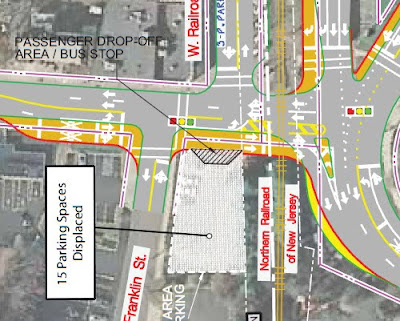
When you look at the maps for the "parking and traffic mitigations" near the proposed stations along the Northern Branch (PDF), you'll see little bus bays like this one in Tenafly:
Or these in Leonia:

You might think, "Oh, how nice! Infrastructure for buses." In fact, I once saw on the web where these bus bays were presented to bus riders as one way to improve their commute. (I wish I could find it now!) But just because someone designs infrastructure for you doesn't mean that the goal is to help you. It's like that old science fiction story, "To Serve Man."
Bus bays in fact slow down buses quite a bit. It's a very similar situation to a street with curb parking everywhere except the bus stop. If you've been on a bus trying to pull out from one of those stops into rush hour traffic, you know exactly what's wrong with bus bays. The only places where I think they're at all warranted are stops on high-speed roads like Route 4 or Route 17 in New Jersey, where there's a real chance that some texting driver could rear-end the bus.
These proposed bus bays in Leonia and Teaneck are not that kind of traffic. They have no protective purpose; their only reason for being built is so that the buses can get out of the way of private cars.
Bus bays do so much to slow buses down that where bus riders have some political power, the government builds the opposite: bus bulbs. They allow buses to remain in the flow of traffic while picking up passengers in a street where there is also curbside parking, like First Avenue in Manhattan.
It's a similar situation with pedestrian overpasses and underpasses. People propose them like they're God's Gift to Pedestrians, but they're really about getting pedestrians out of the way of cars.
That's why when someone proposes a new kind of infrastructure that you haven't heard of, especially one that separates uses, you should ask yourself who's getting out of the way. Who's being inconvenienced? Very rarely, the safety justifies the inconvenience. Examples include the bus park-and-ride on Route 17 in Ridgewood, and pedestrian overpasses across bona fide high speed limited-access highways, like the Long Island Expressway. In everything else, as Ottawa planners know, transit users and pedestrians should come first.

Or these in Leonia:

You might think, "Oh, how nice! Infrastructure for buses." In fact, I once saw on the web where these bus bays were presented to bus riders as one way to improve their commute. (I wish I could find it now!) But just because someone designs infrastructure for you doesn't mean that the goal is to help you. It's like that old science fiction story, "To Serve Man."
Bus bays in fact slow down buses quite a bit. It's a very similar situation to a street with curb parking everywhere except the bus stop. If you've been on a bus trying to pull out from one of those stops into rush hour traffic, you know exactly what's wrong with bus bays. The only places where I think they're at all warranted are stops on high-speed roads like Route 4 or Route 17 in New Jersey, where there's a real chance that some texting driver could rear-end the bus.
These proposed bus bays in Leonia and Teaneck are not that kind of traffic. They have no protective purpose; their only reason for being built is so that the buses can get out of the way of private cars.
Bus bays do so much to slow buses down that where bus riders have some political power, the government builds the opposite: bus bulbs. They allow buses to remain in the flow of traffic while picking up passengers in a street where there is also curbside parking, like First Avenue in Manhattan.
It's a similar situation with pedestrian overpasses and underpasses. People propose them like they're God's Gift to Pedestrians, but they're really about getting pedestrians out of the way of cars.
That's why when someone proposes a new kind of infrastructure that you haven't heard of, especially one that separates uses, you should ask yourself who's getting out of the way. Who's being inconvenienced? Very rarely, the safety justifies the inconvenience. Examples include the bus park-and-ride on Route 17 in Ridgewood, and pedestrian overpasses across bona fide high speed limited-access highways, like the Long Island Expressway. In everything else, as Ottawa planners know, transit users and pedestrians should come first.
Saturday, August 25, 2012
Gentrification complete?
After investigating the definitions of "suburb," I was thinking about Feargus O'Sullivan's description of "urban" London. There were three simple characteristics: proximity to the center of London, density and noise. All the other "urban" characteristics were either signs of (a) gentrification (coffee bars; vintage stores; sidewalk cafes; hipster bicycle culture; independent designer boutiques; high-rise, open-plan apartments) or (b) poverty (subsidized housing).
Here in New York City, we have the same signs of gentrification, but poor people can and do live in privately owned, usually rent-stabilized, apartments throughout the city. We have many dense, noisy neighborhoods that are not particularly gentrified. O'Sullivan seems to equate "urban" with gentrified, and that makes me wonder whether there are any neighborhoods of London left ungentrified.
In New York you can certainly find hipster coffee bars in most neighborhoods of Manhattan, Brownstone Brooklyn and Western Queens, but there are a lot of dense, transit-accessible neighborhoods that still don't have them. Last I checked that included Crown Heights and Flatbush, as well as Sunset Park and most of Corona in Queens. Most of Jersey City, Elizabeth and Newark are pretty low on the vintage stores, as are western Yonkers and southern Mount Vernon - though of course they have thrift stores. And of course, most of the Bronx between Fieldston and the Bronx River is dense urban development, and I'm not sure there's even a coffee bar in Riverdale. That means that probably half of the urban area of New York is still ungentrified.
I haven't spent that much time in London, and what time I have spent there has been in areas that have not been poor in recent memory. I didn't see any housing projects around Buckingham Palace or the Houses of Parliament, where the homes of the literal gentry have historically been. I did take a stroll through Peckham on my last visit and didn't see any gourmet cafes, but I wasn't looking that hard. So those of you who know London better: are there large gentrifying populations in every dense inner neighborhood? Are there notable exceptions?
If not, I wonder how much of it is due to the way London subsidizes its housing. Is there rent stabilization, or is it all done through "council flats"? Does that create sharper segregation?
I'll have more to say about this in the future.
Here in New York City, we have the same signs of gentrification, but poor people can and do live in privately owned, usually rent-stabilized, apartments throughout the city. We have many dense, noisy neighborhoods that are not particularly gentrified. O'Sullivan seems to equate "urban" with gentrified, and that makes me wonder whether there are any neighborhoods of London left ungentrified.
In New York you can certainly find hipster coffee bars in most neighborhoods of Manhattan, Brownstone Brooklyn and Western Queens, but there are a lot of dense, transit-accessible neighborhoods that still don't have them. Last I checked that included Crown Heights and Flatbush, as well as Sunset Park and most of Corona in Queens. Most of Jersey City, Elizabeth and Newark are pretty low on the vintage stores, as are western Yonkers and southern Mount Vernon - though of course they have thrift stores. And of course, most of the Bronx between Fieldston and the Bronx River is dense urban development, and I'm not sure there's even a coffee bar in Riverdale. That means that probably half of the urban area of New York is still ungentrified.

I haven't spent that much time in London, and what time I have spent there has been in areas that have not been poor in recent memory. I didn't see any housing projects around Buckingham Palace or the Houses of Parliament, where the homes of the literal gentry have historically been. I did take a stroll through Peckham on my last visit and didn't see any gourmet cafes, but I wasn't looking that hard. So those of you who know London better: are there large gentrifying populations in every dense inner neighborhood? Are there notable exceptions?
If not, I wonder how much of it is due to the way London subsidizes its housing. Is there rent stabilization, or is it all done through "council flats"? Does that create sharper segregation?
I'll have more to say about this in the future.
Why we shouldn't extend Metro-North on the Hudson Line
Mid Hudson News reports that Metro-North is still no longer considering extending service to northern Dutchess County. I'm not sure who was asking, but there you have it.
Many years ago, there was a proposal to extend service past Poughkeepsie, with stops in Hyde Park, Staatsburg, Rhinecliff and Tivoli. There was significant NIMBY opposition, and I was all ready to cuss out those transit haters, but the more I looked at it, the more their objections made sense.
It was the same problem I had with the Northern Branch plan, but even more so, because the planners expected almost every rider to drive and park. None of those stations have anything resembling the walkable suburban downtowns of Englewood and Tenafly.
To generate enough walk-up demand for the service, you'd essentially need to rezone the area to create a whole new Tarrytown, Irvington, Dobbs Ferry and Hastings. Which might be nice, but do we really need that development eighty miles from Manhattan?
We need to look at what our goals are, and how a Metro-North extension might serve them. If people are driving too much in Dutchess County, replacing a small number of large lots with new walkable suburbs will not make the existing residents drive less.
There are small things we could do. Extend some trains to Marist and Hyde Park, and maybe the CIA, to capture some of the student and tourist travel. But that's a relatively small segment of the market; would it be worth running ten-car trains?
The largest existing town without train service in Dutchess County is Fishkill. Emily from IRidetheHarlemLine.com thought it was funny that someone would want to ask Metro-North President Howard Permut about restoring passenger service on the Beacon/Maybrook Line that the railroad owns, but it's not such a strange question. Of all the potential Dutchess County service expansions it's the one that would have the greatest ridership. It runs through the most densely populated parts of Beacon and Fishkill.
At this point it might not be worthwhile running trains all the way to Derby, Danbury or even Brewster, but a local group has proposed a shuttle from the Beacon Station to Matteawan and Fishkill. You could also run a shuttle from Croton, timed to connect with the incoming local from Grand Central.
The State is planning to upgrade the Hudson Line to improve Amtrak service. Dutchess County could use more intercity service, and restoring service to Pittsfield through Amenia, Millerton and Chatham, perhaps run by Amtrak, would capture a significant portion of the weekend crowd that currently drives up the Taconic Parkway.
Emily actually asked Permut about service north of the current terminus in Wassaic, and he mentioned that he was involved in planning the current service. "If I remember correctly, the rail trail was already in existence to Millerton, so we would have had a huge obstacle," Permut said. "How do you de-map a rail trail? There would have been significant opposition." More proof that rail-trails are not good for transit.
Of course, my question for Permut, which Emily did not ask, was "If you could tear down one highway in the region, which one do you think would increase Metro-North ridership the most?" Dutchess County actually doesn't have many highways. There's one interstate (84), plus the Taconic Parkway. There are some relatively short limited-access sections of Routes 9, 44 and 55.
I would probably first get rid of the "Arterials" in Poughkeepsie, a horrible plan where two neighborhood avenues were turned into three-lane segments of a one-way pair, simultaneously killing both the pedestrian environment and commerce on Main Street. I'm baffled that the arrangement has lasted as long as it has, and I can only surmise that that's because no New Urbanist has ever visited Poughkeepsie. Restoring the Arterials to neighborhood streets, and restoring Main Street to east-west traffic, would make a lot more people want to live within walking distance of the train station. Green tracks trolleys on the former "Arterial" streets would bring more people to the train without driving.

All that said, if we really want to reduce driving in the metropolitan area, it's probably better to focus on other areas than Dutchess County. According to reports compiled by the EPA, Dutchess only accounts for two percent of the region's vehicle-miles traveled. Meanwhile, Nassau accounts for 8% of VMT, and Suffolk 13%. If only they had train service...
Many years ago, there was a proposal to extend service past Poughkeepsie, with stops in Hyde Park, Staatsburg, Rhinecliff and Tivoli. There was significant NIMBY opposition, and I was all ready to cuss out those transit haters, but the more I looked at it, the more their objections made sense.
It was the same problem I had with the Northern Branch plan, but even more so, because the planners expected almost every rider to drive and park. None of those stations have anything resembling the walkable suburban downtowns of Englewood and Tenafly.
To generate enough walk-up demand for the service, you'd essentially need to rezone the area to create a whole new Tarrytown, Irvington, Dobbs Ferry and Hastings. Which might be nice, but do we really need that development eighty miles from Manhattan?
We need to look at what our goals are, and how a Metro-North extension might serve them. If people are driving too much in Dutchess County, replacing a small number of large lots with new walkable suburbs will not make the existing residents drive less.
There are small things we could do. Extend some trains to Marist and Hyde Park, and maybe the CIA, to capture some of the student and tourist travel. But that's a relatively small segment of the market; would it be worth running ten-car trains?
The largest existing town without train service in Dutchess County is Fishkill. Emily from IRidetheHarlemLine.com thought it was funny that someone would want to ask Metro-North President Howard Permut about restoring passenger service on the Beacon/Maybrook Line that the railroad owns, but it's not such a strange question. Of all the potential Dutchess County service expansions it's the one that would have the greatest ridership. It runs through the most densely populated parts of Beacon and Fishkill.
At this point it might not be worthwhile running trains all the way to Derby, Danbury or even Brewster, but a local group has proposed a shuttle from the Beacon Station to Matteawan and Fishkill. You could also run a shuttle from Croton, timed to connect with the incoming local from Grand Central.
The State is planning to upgrade the Hudson Line to improve Amtrak service. Dutchess County could use more intercity service, and restoring service to Pittsfield through Amenia, Millerton and Chatham, perhaps run by Amtrak, would capture a significant portion of the weekend crowd that currently drives up the Taconic Parkway.
Emily actually asked Permut about service north of the current terminus in Wassaic, and he mentioned that he was involved in planning the current service. "If I remember correctly, the rail trail was already in existence to Millerton, so we would have had a huge obstacle," Permut said. "How do you de-map a rail trail? There would have been significant opposition." More proof that rail-trails are not good for transit.
Of course, my question for Permut, which Emily did not ask, was "If you could tear down one highway in the region, which one do you think would increase Metro-North ridership the most?" Dutchess County actually doesn't have many highways. There's one interstate (84), plus the Taconic Parkway. There are some relatively short limited-access sections of Routes 9, 44 and 55.
I would probably first get rid of the "Arterials" in Poughkeepsie, a horrible plan where two neighborhood avenues were turned into three-lane segments of a one-way pair, simultaneously killing both the pedestrian environment and commerce on Main Street. I'm baffled that the arrangement has lasted as long as it has, and I can only surmise that that's because no New Urbanist has ever visited Poughkeepsie. Restoring the Arterials to neighborhood streets, and restoring Main Street to east-west traffic, would make a lot more people want to live within walking distance of the train station. Green tracks trolleys on the former "Arterial" streets would bring more people to the train without driving.

All that said, if we really want to reduce driving in the metropolitan area, it's probably better to focus on other areas than Dutchess County. According to reports compiled by the EPA, Dutchess only accounts for two percent of the region's vehicle-miles traveled. Meanwhile, Nassau accounts for 8% of VMT, and Suffolk 13%. If only they had train service...
Thursday, August 23, 2012
Know your suburbs
Today Feargus O'Sullivan had a nice post in the Atlantic Cities called "Why I Moved Back to the Suburbs." The post's slug tells us (no, not like that) that an earlier title was "Why the Suburbs Have the City Beat," which is appropriate since he's talking about Desmond Dekker's old neighborhood.
There were several confused responses, many of which assumed that by "suburb" O'Sullivan was referring to a prototypical suburb like Yorktown Heights or Rio Rancho. Some, like Sarah Goodyear, assumed that it was a difference of British versus American usage, but it isn't. I've seen the same confusion among Americans; the Times has had at least three articles over the past fifteen years calling the Upper West Side "suburban."
The official definition of "suburb" is a place outside the city limits. But the city limits have changed. Neighborhoods that we would call "downtown" today, like Greenwich Village, Mayfair and the Marais, were all suburbs once. From that official perspective, O'Sullivan's "suburb" of Forest Hill is within the County of Greater London, and thus just as much an inner-city neighborhood as his old neighborhood in Hackney. Greenpoint here in New York City, which he disparages, has a similar administrative status.
The problem is that there are several features of suburbs that catch our attention more than whether they are within the city limits. We often essentialize these features and assume that all suburbs are that way. When someone says "suburb" they may actually be referring to just a few of those features, or even a single one.
To help with this confusion, I have put together this field guide to suburbs. The next time you come across a puzzling use of the term "suburb," just pull up this post and you should be able to sort things out. And the next time you're planning to write about "the suburbs" or "suburban attitudes," please do us all a favor and make it clear which features of the suburbs you're talking about.
Suburban-official: Outside the limits of a large city. By this feature, none of the neighborhoods that O'Sullivan mentions are suburban. Medway is the closest suburb to him. Official-suburbs in the New York area include Guttenberg (the most densely populated municipality in the United States) and Wyandanch (one of the poorest municipalities in New York State).
Suburban-rich: Richer than inner neighborhoods. By this feature, Forest Hill (median income £24,397) is slightly less suburban than Shoreditch (£28,028). But European cities have always had different income distributions than North American ones. In France, suburbs ("banlieue") are associated with poverty, even though there are plenty of wealthy suburbs, like Neuilly where Nicolas Sarkozy was mayor. New York has wealthy "suburbs" within the city limits like Forest Hills and Riverdale, and outside like Montclair and Chappaqua, and plenty of poor districts on both sides of the city line.
Suburban-white: Higher percentages of people of European ethnic backgrounds than inner neighborhoods. This is very typical of the United States, a result of the "white flight" of the 1960s and 1970s. Again, this is reversed in Paris. O'Sullivan's Lewisham is 56% white, while Hackney is 47% white. Notable New York-are counterexamples are Mount Vernon, home of P. Diddy, and Union City (84% Hispanic).
Suburban-bland: "There was nothing going down at all," is how Lou Reed put it. This is hard to quantify, because Jenny's parents probably thought there were lots of things going down. It's certainly clear that there are plenty of neighborhoods outside city limits with active cultural scenes (even for teenagers) and plenty of inner city neighborhoods without much going down. If your measure is funky coffee bars, there are plenty in Bergen County.
Suburban-low-density: This may be what O'Sullivan is really using, but it's all relative. Certainly, his Forest Hill is at least as dense as Greenpoint. There are some New York suburbs that have tried density, including Stamford, Scarsdale, Hackensack, and if you accept them Riverdale and Forest Hills.
Suburban-car: This is a big one for me. Of course, the newer the area the better the road infrastructure and the more parking there is. But it doesn't have to be that way: there are plenty of "streetcar suburbs" and suburbs built around commuter rail stations that are dense, walkable and hard to drive in.
There are a few other features, like Suburban-right-wing, Suburban-safe and Suburban-leafy that I'll leave as an exercise to the reader.
There were several confused responses, many of which assumed that by "suburb" O'Sullivan was referring to a prototypical suburb like Yorktown Heights or Rio Rancho. Some, like Sarah Goodyear, assumed that it was a difference of British versus American usage, but it isn't. I've seen the same confusion among Americans; the Times has had at least three articles over the past fifteen years calling the Upper West Side "suburban."

The official definition of "suburb" is a place outside the city limits. But the city limits have changed. Neighborhoods that we would call "downtown" today, like Greenwich Village, Mayfair and the Marais, were all suburbs once. From that official perspective, O'Sullivan's "suburb" of Forest Hill is within the County of Greater London, and thus just as much an inner-city neighborhood as his old neighborhood in Hackney. Greenpoint here in New York City, which he disparages, has a similar administrative status.
The problem is that there are several features of suburbs that catch our attention more than whether they are within the city limits. We often essentialize these features and assume that all suburbs are that way. When someone says "suburb" they may actually be referring to just a few of those features, or even a single one.
To help with this confusion, I have put together this field guide to suburbs. The next time you come across a puzzling use of the term "suburb," just pull up this post and you should be able to sort things out. And the next time you're planning to write about "the suburbs" or "suburban attitudes," please do us all a favor and make it clear which features of the suburbs you're talking about.
Suburban-official: Outside the limits of a large city. By this feature, none of the neighborhoods that O'Sullivan mentions are suburban. Medway is the closest suburb to him. Official-suburbs in the New York area include Guttenberg (the most densely populated municipality in the United States) and Wyandanch (one of the poorest municipalities in New York State).
Suburban-rich: Richer than inner neighborhoods. By this feature, Forest Hill (median income £24,397) is slightly less suburban than Shoreditch (£28,028). But European cities have always had different income distributions than North American ones. In France, suburbs ("banlieue") are associated with poverty, even though there are plenty of wealthy suburbs, like Neuilly where Nicolas Sarkozy was mayor. New York has wealthy "suburbs" within the city limits like Forest Hills and Riverdale, and outside like Montclair and Chappaqua, and plenty of poor districts on both sides of the city line.
Suburban-white: Higher percentages of people of European ethnic backgrounds than inner neighborhoods. This is very typical of the United States, a result of the "white flight" of the 1960s and 1970s. Again, this is reversed in Paris. O'Sullivan's Lewisham is 56% white, while Hackney is 47% white. Notable New York-are counterexamples are Mount Vernon, home of P. Diddy, and Union City (84% Hispanic).
Suburban-bland: "There was nothing going down at all," is how Lou Reed put it. This is hard to quantify, because Jenny's parents probably thought there were lots of things going down. It's certainly clear that there are plenty of neighborhoods outside city limits with active cultural scenes (even for teenagers) and plenty of inner city neighborhoods without much going down. If your measure is funky coffee bars, there are plenty in Bergen County.
Suburban-low-density: This may be what O'Sullivan is really using, but it's all relative. Certainly, his Forest Hill is at least as dense as Greenpoint. There are some New York suburbs that have tried density, including Stamford, Scarsdale, Hackensack, and if you accept them Riverdale and Forest Hills.
Suburban-car: This is a big one for me. Of course, the newer the area the better the road infrastructure and the more parking there is. But it doesn't have to be that way: there are plenty of "streetcar suburbs" and suburbs built around commuter rail stations that are dense, walkable and hard to drive in.
There are a few other features, like Suburban-right-wing, Suburban-safe and Suburban-leafy that I'll leave as an exercise to the reader.
Wednesday, August 22, 2012
Twenty dollars, same as in town
This has been a bad week for anyone who cares about reducing car use in New York. On Friday morning, Mayor Bloomberg announced that the launch of the city's bike share program was postponed until the spring. Friday afternoon, State Supreme Court judge Arthur Engoron declared that the Five Borough Taxi Plan was unconstitutional. On Monday the Metropolitan Transportation Council voted to approve the disastrous Tappan Zee Bridge replacement project, and the state immediately applied for a two billion dollar federal loan. Today State Supreme Court judge Bruce Cozzens declared that a payroll tax that funds a significant chunk of the city's transit operations is unconstitutional.
Of course, both the MTA payroll tax and the borough taxi plan were, ah, suboptimal ways of paying for transit and providing reliable street hail taxi service to the outer boroughs. Nobody's crying for either one. If anything, we can hope that they'll be replaced by better solutions.
Tonight I'm going to talk about the taxis. I wrote a bunch about the taxi situation last summer when the plan was being hammered out.
If the taxi plan is reborn, one thing that I hope will be changed is the pricing. The plan passed by the State set the "borough taxi" rates to be exactly the same as the current yellow taxis. I understand that it's simpler to have one system for the entire city, but it's a bad idea. I didn't want to bring it up when it seemed like a done deal, but if they're going back to the drawing board anyway, I want to put my two cents in.
There are good reasons why a one-bedroom apartment, or an Italian hero, or a haircut, costs more in Midtown, less in Forest Hills, and even less in Corona. The cost of doing business is more expensive, and the demand is greater. The same principles apply to taxi service: it's more expensive for taxis to cruise, to refuel (if they can find a gas station), and to park for breaks. There are a lot more people in Midtown willing to pay for taxi service than in Forest Hills or Corona. If the drivers could vary their prices based on location they would, but the city doesn't allow it.
I've talked about what happens in Manhattan when demand is high: shortages. There are more people looking for cabs than there are cabs, and that leads to queuing and fighting, as dramatized in this video.
When there are more cabs than people who want to hire them at those rates, the cabs will stay away. But if the supply of cabs is capped already, they will all go to where demand is highest: Manhattan.
Of course, there is still a large number of people looking to hire a taxi at a lower rate. Wouldn't it be nice if there were cheaper taxis that they could hail? The black market has provided those in the form of gypsy cabs. But there are problems with those gypsy cabs, which is why we need the borough taxis in the first place.
Since I found out that the law mandated identical pricing for the borough taxis and the yellow taxis, I've been trying to imagine what would happen. Since the yellow taxis don't meet the demand in Manhattan at the current rates, they might not meet it even with additional taxis and higher rates. There would probably be some kind of black market for borough taxis in Manhattan, like an out-of-the-way corner that's not watched by the Taxi and Limousine Commission.
In the "inner boroughs" - the denser neighborhoods of Upper Manhattan, Brownstone Brooklyn, the western Bronx and Western Queens - demand would probably match supply during rush hours, and maybe during nightclub hours, but I'm not sure about other times. If it does, there may be competition from yellow cabs. If it doesn't, it might be hard to find a borough taxi, or their might be another black market strategy to pay lower fares, or maybe even some gypsy cabs.
In the true "outer boroughs" - the areas where taxis face the fiercest competition from private cars - it will be harder to find a borough taxi than it is to find a gypsy cab now. Like I said, suboptimal.
From an efficient market standpoint, the ideal solution would be to have perfectly fluid pricing, with the fare negotiated for every transaction. From my standpoint that would suck, because even though I come from a family of Jewish businesspeople I hate haggling and find it very stressful. It would be nice if it could be all done with computers - just automatically set based on the number of people looking and the number of cabs available in a given area. Unfortunately, we're not there yet.
Stephen Smith loves to tell about the taxis in Romania, where you can tell what the fare will be just by looking at the taxi: the more expensive the car, the higher the fare. But I would settle for two fare structures: yellow and green, with the yellow ones costing (say) 150% of the green ones. Then the city wouldn't have to worry about keeping green taxis from picking up in Manhattan. They'd be free to do that - but they'd probably stay out during rush hours because they'd make more money where there's less congestion.
In any case, this setback is a chance to improve the plan. Let's take it and get the pricing right.
Of course, both the MTA payroll tax and the borough taxi plan were, ah, suboptimal ways of paying for transit and providing reliable street hail taxi service to the outer boroughs. Nobody's crying for either one. If anything, we can hope that they'll be replaced by better solutions.

Tonight I'm going to talk about the taxis. I wrote a bunch about the taxi situation last summer when the plan was being hammered out.
If the taxi plan is reborn, one thing that I hope will be changed is the pricing. The plan passed by the State set the "borough taxi" rates to be exactly the same as the current yellow taxis. I understand that it's simpler to have one system for the entire city, but it's a bad idea. I didn't want to bring it up when it seemed like a done deal, but if they're going back to the drawing board anyway, I want to put my two cents in.
There are good reasons why a one-bedroom apartment, or an Italian hero, or a haircut, costs more in Midtown, less in Forest Hills, and even less in Corona. The cost of doing business is more expensive, and the demand is greater. The same principles apply to taxi service: it's more expensive for taxis to cruise, to refuel (if they can find a gas station), and to park for breaks. There are a lot more people in Midtown willing to pay for taxi service than in Forest Hills or Corona. If the drivers could vary their prices based on location they would, but the city doesn't allow it.
I've talked about what happens in Manhattan when demand is high: shortages. There are more people looking for cabs than there are cabs, and that leads to queuing and fighting, as dramatized in this video.
When there are more cabs than people who want to hire them at those rates, the cabs will stay away. But if the supply of cabs is capped already, they will all go to where demand is highest: Manhattan.
Of course, there is still a large number of people looking to hire a taxi at a lower rate. Wouldn't it be nice if there were cheaper taxis that they could hail? The black market has provided those in the form of gypsy cabs. But there are problems with those gypsy cabs, which is why we need the borough taxis in the first place.
Since I found out that the law mandated identical pricing for the borough taxis and the yellow taxis, I've been trying to imagine what would happen. Since the yellow taxis don't meet the demand in Manhattan at the current rates, they might not meet it even with additional taxis and higher rates. There would probably be some kind of black market for borough taxis in Manhattan, like an out-of-the-way corner that's not watched by the Taxi and Limousine Commission.
In the "inner boroughs" - the denser neighborhoods of Upper Manhattan, Brownstone Brooklyn, the western Bronx and Western Queens - demand would probably match supply during rush hours, and maybe during nightclub hours, but I'm not sure about other times. If it does, there may be competition from yellow cabs. If it doesn't, it might be hard to find a borough taxi, or their might be another black market strategy to pay lower fares, or maybe even some gypsy cabs.
In the true "outer boroughs" - the areas where taxis face the fiercest competition from private cars - it will be harder to find a borough taxi than it is to find a gypsy cab now. Like I said, suboptimal.
From an efficient market standpoint, the ideal solution would be to have perfectly fluid pricing, with the fare negotiated for every transaction. From my standpoint that would suck, because even though I come from a family of Jewish businesspeople I hate haggling and find it very stressful. It would be nice if it could be all done with computers - just automatically set based on the number of people looking and the number of cabs available in a given area. Unfortunately, we're not there yet.
Stephen Smith loves to tell about the taxis in Romania, where you can tell what the fare will be just by looking at the taxi: the more expensive the car, the higher the fare. But I would settle for two fare structures: yellow and green, with the yellow ones costing (say) 150% of the green ones. Then the city wouldn't have to worry about keeping green taxis from picking up in Manhattan. They'd be free to do that - but they'd probably stay out during rush hours because they'd make more money where there's less congestion.
In any case, this setback is a chance to improve the plan. Let's take it and get the pricing right.
Subscribe to:
Posts (Atom)