I was not at the Congress for the New Urbanism last month, so I was unable to take part in the debate, "Can a city be successful without transit?" I understand it was all in fun, and I honestly can't say that I could have done much better than the debaters, with the amount of time available for preparation, but there was a problem with the historical perspective. Several of the debaters stipulated that for millennia there have been cities that have been successful, but that in the words of Andrew Burleson, "there was no transit before the 1890s". This last part is actually wrong, but there's a larger issue with transportation myopia.
First, there was indeed transit before the 1890s. Burleson and Edward Erfurt are probably thinking of the first trolleys, autobuses and underground railways, which were implemented around that time. But before then there were other ways of getting around. On the StrongTowns podcast page, Steve commented that waterways - rivers and canals - provided a transit function.
Beyond the waterways, there were horsecars. These were large, horse-drawn vehicles that ran on rails, and could carry twenty or more people at a time. These began to appear in the early nineteenth century. The London Underground ran on steam from 1863.
Mike Lydon was the only one who didn't suffer from persistent transportation myopia. Burleson said, "Imagine a European-scale city that had no transit, but also had no cars." Transit and cars - along with taxis, hansom cabs and personal horse-drawn carriages - are different ways of enabling long-distance commutes. Transit is a long-distance commuting option that is accessible to lower classes.
Cities did exist for millennia, but it's worth noting that until the nineteenth century, they were small enough that you could walk from any part of them to almost any other part within an hour. So as Erfurt observed, transit allowed cities to expand beyond that size, but so did personal vehicles. Ian Rasmussen pointed out that transit opened the city to all.
An interesting example that proves the rule is Versailles. By moving the court a long distance from Paris, Louis XIV essentially split the capital over a distance of twelve miles. To compensate for that distance, a public transit system - the "carabas" - was implemented. It covered that distance in six and a half hours at first, but by the beginning of the nineteenth century it took only two hours, and there were twenty-six round trips per day. It was not the first transit system in the Paris region - Bibliophile Jacob tells us that in the late seventeenth and eighteenth centuries there was a whole network of public coach routes linking the various suburban palaces, with the frequency adjusted to the whereabouts of the King - but it was the best developed.
On one level, Erfurt and Burleson are right and you don't need transit to have a successful walking city. But you do need vehicle commuting to have a successful large city, and you need transit to do that equitably. I commend the debaters for what they were able to do within the constraints they had, and I thank them and the debate organizers for raising a number of interesting questions, and for recording the debate for posterity.
Sunday, June 16, 2013


Sunday, June 2, 2013
Buses and trains in Woodhaven
In this blog, Capt. Subway has written that we should run the R subway on the unused Rockaway Beach Branch of the Long Island Railroad, and I've written that we should run Select Bus Service on the parallel Woodhaven Boulevard.

On one of my followup posts, BBnet3000 argued that the Rockaway Branch is not well enough located:
There is in fact walkable commercial development along that section of Woodhaven Boulevard from 62nd Drive to where the cemetery starts at Furmanville Road, but that's the only walkable commercial development the entire length of the boulevard. North of 62nd Drive you've got an apartment complex, a Catholic school parking lot, a deli and a park before you get to Queens Boulevard and the subway station. South of Furmanville Road you have the cemetery on one side and sprawly stores on the other, then the big-box stores, then the Montauk Branch.
South of the Montauk Branch there are a few businesses, but they are almost all located on street corners. The vast majority of commercial use in this corridor is on the avenues that cross it: Metropolitan, Myrtle, Jamaica, Atlantic, 101st and Liberty Avenues. On Woodhaven itself you see mostly houses - and a lot of one-car garages.

If you walk down one of those avenues, the Rockaway Branch is never far away.

One thing to remember is that this is not just about better access to existing businesses, but enticing more and better businesses to locate there. The commercial buildings along the avenues are generally two stories, allowing for greater walkability - more shops, restaurants and offices in a small area. The ones on Woodhaven Boulevard are mostly one story, which limits their potential.
So yes, Select Bus Service would be good for the commercial stretch of Woodhaven north of Saint John's Cemetery, but a subway would be better for businesses further south in that corridor. That's why we should have both.

On one of my followup posts, BBnet3000 argued that the Rockaway Branch is not well enough located:
Also, most of the commercial development in this area is along Woodhaven Boulevard, which this subway kind of misses. Theres a reason subways are usually built under streets. When I ride the bus on Woodhaven Boulevard (to go to the auto-oriented Trader Joes incidentally, though Forest Park is also worth visiting) I usually think id like a better bus, rather than a train a block to the east (for what its worth, this bus seems to have pretty good ridership, and a lot of people DO ride it to the Rockaways in the summer). For the densest parts of Woodhaven its several blocks to the east and inaccessible through the private properties of the Rego crescent.
There is in fact walkable commercial development along that section of Woodhaven Boulevard from 62nd Drive to where the cemetery starts at Furmanville Road, but that's the only walkable commercial development the entire length of the boulevard. North of 62nd Drive you've got an apartment complex, a Catholic school parking lot, a deli and a park before you get to Queens Boulevard and the subway station. South of Furmanville Road you have the cemetery on one side and sprawly stores on the other, then the big-box stores, then the Montauk Branch.
South of the Montauk Branch there are a few businesses, but they are almost all located on street corners. The vast majority of commercial use in this corridor is on the avenues that cross it: Metropolitan, Myrtle, Jamaica, Atlantic, 101st and Liberty Avenues. On Woodhaven itself you see mostly houses - and a lot of one-car garages.

If you walk down one of those avenues, the Rockaway Branch is never far away.

One thing to remember is that this is not just about better access to existing businesses, but enticing more and better businesses to locate there. The commercial buildings along the avenues are generally two stories, allowing for greater walkability - more shops, restaurants and offices in a small area. The ones on Woodhaven Boulevard are mostly one story, which limits their potential.
So yes, Select Bus Service would be good for the commercial stretch of Woodhaven north of Saint John's Cemetery, but a subway would be better for businesses further south in that corridor. That's why we should have both.
Saturday, May 25, 2013
A safe, comfortable bus network
Recently I drew your attention to Kimberly Matus's story about being groped on a downtown 2 train, and the fact that the only way she could be reasonably sure of avoiding a repeat of that situation was to take a taxi to work, or buy a car. The Death Valley of Commute Options means that Matus - and people like me who just want to sit down - have no reasonable transit alternative. We can take a cheap, fast train or a cheap, slow bus, and both of them force us to deal with crowding and noise. Even the taxis are hard to find, and the legal options for sharing are rare. The system is set up to force us into cars.
The frustrating thing is that it doesn't have to be this way. Whenever there's crowding or queuing, chances are someone is willing to pay to escape it. If the government sets up an alternative it will get customers, and if barriers to entry are low, private businesses will set up alternatives.
Sadly, barriers to entry are not low. The City DOT refuses to allow any private bus lines to operate within city limits, the City Council won't authorize commuter vans to pick up passengers legally, the NYPD won't let them use the bus lanes, and the State Legislature is driving intercity bus operators out of business, based on bad data from the Federal DOT.
I'm proposing that instead the City allow well-regulated private buses to bid on selected routes, charging whatever fare the market will bear. And no, not on the routes with the lowest demand, which basically ensures failure without an anchor, but on high-demand routes, paralleling subway lines. It would help if the city also provided dedicated bus lanes and bus bulbs along these routes, but I don't think they're absolutely necessary. From what I can see, the demand is there even if the buses are much slower than the subway.
I can envision a million objections, but there are two serious ones I can think of. The first is that it will undermine the strength of the transit unions and the quality of life of transit workers. Because of this, I propose (1) that all bidders be required to operate a closed shop on these routes, employing only members of the transit unions that are currently active in the city.
The second, raised by Zoltán, is that it's not fair to make women pay more to avoid sexual assault. I completely agree, and I think we should be working towards a system where such offenses are rare and swiftly punished. But I don't think we should have to wait for that, and it's not the only reason to provide comfortable alternatives to the subway.
The third is that it will poach customers from the existing subway and bus routes. In the comments to my previous post, Alon Levy tried to argue that this would mean a "mass exodus from the subway," and that it was somehow okay for New York subways to be operating at 100% of recommended capacity because Tokyo subways have much higher loads.
I'm not convinced. I think we should be aiming for passenger loads below 100%, something like the Shoupian ideal of 85%. Why shouldn't people be comfortable during rush hour? But I agree that the government should not be subsidizing competition to its own transit system, the way it currently does by building and widening highways. But to address these objections, I suggest the following additional conditions:
(2) That there be no direct subsidy to the private operators. If there are enough people who think they can make a profit, they should pay the city an amount to be determined by competitive bidding.
(3) That the routes be rebid every year, based on a survey of passenger loads. The routes should connect subway stations that currently require travel on a line that sees loads greater than 85% capacity at rush hour (or even outside of rush hour, with reasonable deviations. If a route drops below 85% on a survey, it is no longer eligible for parallel bus service.
In addition, I think these two conditions would help ensure consistency and satisfaction:
(4) That the routes be served at least every fifteen minutes from 6AM to midnight, seven days a week. If an operator fails to provide that level of service, the DOT should rescind the authorization to operate on that route. If the operator cannot make a profit, there should be a formal process for abandoning a route.
(5) That the MTA allow the private operators to accept Metrocards and any other standard MTA fare payment system, if the operator desires it.
What would such a network of bus routes look like? Ultimately, that would be up to the operators bidding for the routes. But I have some ideas about what I would bid on if I had a bus company. First, if we assume that the chart above is still correct, it would mean paralleling the 1, 2, 3, 4, 5, 6, E and L trains. Those lines roughly parallel Eric Fischer's travel map of geocoded tweets:
Knowing that most people are commuting to jobs in East Midtown, I set up a bunch of routes that focus on that area.

I would definitely pay five dollars for a guaranteed seat on one of these buses during rush hour, even if I had to sit on it for an hour, as long as it meant avoiding a crowded subway. I'd pay even more if it had BusTime, legroom, outlets, broadband internet and an espresso machine. I bet some people who currently drive or take taxis or black cars into the city would take one of these buses instead. Surely it's worth a try?

The frustrating thing is that it doesn't have to be this way. Whenever there's crowding or queuing, chances are someone is willing to pay to escape it. If the government sets up an alternative it will get customers, and if barriers to entry are low, private businesses will set up alternatives.
Sadly, barriers to entry are not low. The City DOT refuses to allow any private bus lines to operate within city limits, the City Council won't authorize commuter vans to pick up passengers legally, the NYPD won't let them use the bus lanes, and the State Legislature is driving intercity bus operators out of business, based on bad data from the Federal DOT.
I'm proposing that instead the City allow well-regulated private buses to bid on selected routes, charging whatever fare the market will bear. And no, not on the routes with the lowest demand, which basically ensures failure without an anchor, but on high-demand routes, paralleling subway lines. It would help if the city also provided dedicated bus lanes and bus bulbs along these routes, but I don't think they're absolutely necessary. From what I can see, the demand is there even if the buses are much slower than the subway.
I can envision a million objections, but there are two serious ones I can think of. The first is that it will undermine the strength of the transit unions and the quality of life of transit workers. Because of this, I propose (1) that all bidders be required to operate a closed shop on these routes, employing only members of the transit unions that are currently active in the city.
The second, raised by Zoltán, is that it's not fair to make women pay more to avoid sexual assault. I completely agree, and I think we should be working towards a system where such offenses are rare and swiftly punished. But I don't think we should have to wait for that, and it's not the only reason to provide comfortable alternatives to the subway.
The third is that it will poach customers from the existing subway and bus routes. In the comments to my previous post, Alon Levy tried to argue that this would mean a "mass exodus from the subway," and that it was somehow okay for New York subways to be operating at 100% of recommended capacity because Tokyo subways have much higher loads.

I'm not convinced. I think we should be aiming for passenger loads below 100%, something like the Shoupian ideal of 85%. Why shouldn't people be comfortable during rush hour? But I agree that the government should not be subsidizing competition to its own transit system, the way it currently does by building and widening highways. But to address these objections, I suggest the following additional conditions:
(2) That there be no direct subsidy to the private operators. If there are enough people who think they can make a profit, they should pay the city an amount to be determined by competitive bidding.
(3) That the routes be rebid every year, based on a survey of passenger loads. The routes should connect subway stations that currently require travel on a line that sees loads greater than 85% capacity at rush hour (or even outside of rush hour, with reasonable deviations. If a route drops below 85% on a survey, it is no longer eligible for parallel bus service.
In addition, I think these two conditions would help ensure consistency and satisfaction:
(4) That the routes be served at least every fifteen minutes from 6AM to midnight, seven days a week. If an operator fails to provide that level of service, the DOT should rescind the authorization to operate on that route. If the operator cannot make a profit, there should be a formal process for abandoning a route.
(5) That the MTA allow the private operators to accept Metrocards and any other standard MTA fare payment system, if the operator desires it.
What would such a network of bus routes look like? Ultimately, that would be up to the operators bidding for the routes. But I have some ideas about what I would bid on if I had a bus company. First, if we assume that the chart above is still correct, it would mean paralleling the 1, 2, 3, 4, 5, 6, E and L trains. Those lines roughly parallel Eric Fischer's travel map of geocoded tweets:
 Map: Eric Fischer / Flickr.
Knowing that most people are commuting to jobs in East Midtown, I set up a bunch of routes that focus on that area.

I would definitely pay five dollars for a guaranteed seat on one of these buses during rush hour, even if I had to sit on it for an hour, as long as it meant avoiding a crowded subway. I'd pay even more if it had BusTime, legroom, outlets, broadband internet and an espresso machine. I bet some people who currently drive or take taxis or black cars into the city would take one of these buses instead. Surely it's worth a try?
Wednesday, May 22, 2013
The Island of Sausage Heros
Last week I was walking down Woodhaven Boulevard along Saint John's Cemetery, and I came across a food truck selling Italian sausage heros.

Google Maps tells me that this is on the edge of Middle Village, but it's kind of Forest Hills and kind of Rego Park and maybe a little Glendale. In any case, there were a lot of guys (yes, all guys, mostly working class guys like plumbers) getting heros. I got one. It was good.
It's only now that I discover that D'Angelo's Sausage and Pepper Truck is actually pretty famous, serving those heros from the same spot for forty-three years. Victor Mimoni called it "The Peter Luger's of Sausage Wagons." I saw a hot dog truck a block north, and it's owned by the same family. D'Angelo's sausage was named one of the Best of New York by the Daily News in December.
The odd thing about it was that there was nowhere for me to eat my hero. It would have been really messy to eat standing up, but there were no benches. There was a bus stop a couple of blocks away, but it was only local buses, and nobody had used it. The trucks weren't all that close to the cemetery gates, and none of the guys went inside. Instead they walked to their cars and sat inside and ate. I was the only one who had arrived on foot.
I didn't have a car to sit in, so I kept walking. Eventually I came to a little triangle park and ate there, but I've been thinking about this place ever since. There is always a space for the D'Angelos to park their trucks. As you can see in the picture, there is no standing allowed overnight. I'm so used to people complaining about not being able to park that at first I was surprised to see so many spaces empty. Then I realized that these spaces are a long walk from anywhere.
This side of Saint John's cemetery is a half mile long. Woodhaven Boulevard is ten lanes wide here, and there is only one crosswalk in the whole stretch. There's really nothing much interesting on the east side of the boulevard in this section either: a bunch of gas stations and car washes, and single-family houses behind them. In other words, only a handful of people live or work within walking distance. Hence, nobody cares if the parking spaces sit empty all night, and all of D'Angelo's customers drive.
It all adds up to a strange little island off the coast of the cemetery, a place that nobody walks to. People drive there, walk to the sausage truck, eat in their cars and drive away.
Google Maps tells me that this is on the edge of Middle Village, but it's kind of Forest Hills and kind of Rego Park and maybe a little Glendale. In any case, there were a lot of guys (yes, all guys, mostly working class guys like plumbers) getting heros. I got one. It was good.
It's only now that I discover that D'Angelo's Sausage and Pepper Truck is actually pretty famous, serving those heros from the same spot for forty-three years. Victor Mimoni called it "The Peter Luger's of Sausage Wagons." I saw a hot dog truck a block north, and it's owned by the same family. D'Angelo's sausage was named one of the Best of New York by the Daily News in December.
The odd thing about it was that there was nowhere for me to eat my hero. It would have been really messy to eat standing up, but there were no benches. There was a bus stop a couple of blocks away, but it was only local buses, and nobody had used it. The trucks weren't all that close to the cemetery gates, and none of the guys went inside. Instead they walked to their cars and sat inside and ate. I was the only one who had arrived on foot.
I didn't have a car to sit in, so I kept walking. Eventually I came to a little triangle park and ate there, but I've been thinking about this place ever since. There is always a space for the D'Angelos to park their trucks. As you can see in the picture, there is no standing allowed overnight. I'm so used to people complaining about not being able to park that at first I was surprised to see so many spaces empty. Then I realized that these spaces are a long walk from anywhere.
This side of Saint John's cemetery is a half mile long. Woodhaven Boulevard is ten lanes wide here, and there is only one crosswalk in the whole stretch. There's really nothing much interesting on the east side of the boulevard in this section either: a bunch of gas stations and car washes, and single-family houses behind them. In other words, only a handful of people live or work within walking distance. Hence, nobody cares if the parking spaces sit empty all night, and all of D'Angelo's customers drive.
It all adds up to a strange little island off the coast of the cemetery, a place that nobody walks to. People drive there, walk to the sausage truck, eat in their cars and drive away.
Sunday, May 19, 2013
We can't depend on the Northeast Corridor
The big news this weekend is the major derailment and crash on the New Haven line between Fairfield and Bridgeport yesterday. The National Transportation Safety Board is shutting down that entire stretch of track for several days while they do a thorough investigation, and only after that can the repairs begin.
Metro-North and Amtrak trains are suspended indefinitely in both directions, and the lack of alternative service is just pathetic. "If all the trains use the same tracks, it doesn't really seem like there are many alternatives for getting into the city," New Haven resident Robert Li told the Stamford Advocate. "Especially if you don't have a car." There were bus bridges to get people home last night, but there are no buses, let alone trains, all weekend. This evening Eric Gershon of Yale News tweeted, "830 pm Peter Pan bus NYC to New Haven packed due to Fri MetroN #train #derailment. Long lines, short tempers at Port Authority."
Jim Cameron of the appointed ConnecticutParking Garage Rail Commuter Council has been tweeting up a storm. Unfortunately, he's been talking almost entirely about where you can drive to catch a train on Monday morning, I guess because he thinks people who don't drive - or don't want to be behind the wheel in a mess like that - aren't part of his constituency. Most of his tweets about buses are along the lines of, "No way you could handle that many people with buses," but he seems to think that the highway and parking infrastructure is more than up for the task. Yeah.
Anyway, there's a major rail outage, and that means it's time to play the "what if these people actually gave a shit about the riders?" game! Back in 2007, the bridge over the Thames River between Groton and New London was being replaced, and in 2009 it was the Niantic Bridge being replaced. In both cases Amtrak completely suspended service for an entire weekend, and in both cases I pointed out parallel train lines that could be used to bring people between New York and Boston, in particular the Inland Route (currently a slow, non-electrified line with low platforms) and the Air Line (currently railbanked as a trail).
Amtrak and the states of Massachusetts and Connecticut are now working to upgrade the Inland Route, in part due to a large influx of stimulus money, and Amtrak's Vision (PDF) for the Northeast Corridor includes a parallel route through the middle of Connecticut. Unfortunately, that part of the Vision is expected to cost $58 billion (with a "b") and not go live until 2040.
In the meantime we can work on the existing track. It would cost a lot less than $58 billion to rebuild the New Haven and Derby Railroad, abandoned in 1932, and to upgrade the track on the Berkshire Railroad and the New York and New England, electrify them and install high level platforms at stations. This would ensure that Northeast Corridor and Metro-North trains can go from New Haven to Stamford and get back on the main line, or to Brewster and get on the Harlem Line without having to pass through Bridgeport. (For that last you would also have to convert the Harlem Line to catenary power.)
For a lot less money, you could simply have diesel locomotives pull Amtrak cars through the Inland Route and along the unelectrified track from Meriden through Waterbury and Danbury to Stamford and maybe White Plains, with temporary platforms at a few stations. You could run extra shuttle service from Bridgeport and New Haven to meet the train in Meriden and Waterbury, and in Stamford and White Plains people could transfer to electric trains to Manhattan. It would be slower and less frequent than normal service, but it would be a lot better than nothing.
With the way that Amtrak and Metro-North are currently handling this, it looks like there are a lot of Connecticut commuters who will have a long, slow commute on Monday. I hope you'll all take the time to write to Governor Molloy and to Jim Cameron urging them to put an alternate route in place.
Metro-North and Amtrak trains are suspended indefinitely in both directions, and the lack of alternative service is just pathetic. "If all the trains use the same tracks, it doesn't really seem like there are many alternatives for getting into the city," New Haven resident Robert Li told the Stamford Advocate. "Especially if you don't have a car." There were bus bridges to get people home last night, but there are no buses, let alone trains, all weekend. This evening Eric Gershon of Yale News tweeted, "830 pm Peter Pan bus NYC to New Haven packed due to Fri MetroN #train #derailment. Long lines, short tempers at Port Authority."

Jim Cameron of the appointed Connecticut
Anyway, there's a major rail outage, and that means it's time to play the "what if these people actually gave a shit about the riders?" game! Back in 2007, the bridge over the Thames River between Groton and New London was being replaced, and in 2009 it was the Niantic Bridge being replaced. In both cases Amtrak completely suspended service for an entire weekend, and in both cases I pointed out parallel train lines that could be used to bring people between New York and Boston, in particular the Inland Route (currently a slow, non-electrified line with low platforms) and the Air Line (currently railbanked as a trail).
Amtrak and the states of Massachusetts and Connecticut are now working to upgrade the Inland Route, in part due to a large influx of stimulus money, and Amtrak's Vision (PDF) for the Northeast Corridor includes a parallel route through the middle of Connecticut. Unfortunately, that part of the Vision is expected to cost $58 billion (with a "b") and not go live until 2040.


In the meantime we can work on the existing track. It would cost a lot less than $58 billion to rebuild the New Haven and Derby Railroad, abandoned in 1932, and to upgrade the track on the Berkshire Railroad and the New York and New England, electrify them and install high level platforms at stations. This would ensure that Northeast Corridor and Metro-North trains can go from New Haven to Stamford and get back on the main line, or to Brewster and get on the Harlem Line without having to pass through Bridgeport. (For that last you would also have to convert the Harlem Line to catenary power.)
For a lot less money, you could simply have diesel locomotives pull Amtrak cars through the Inland Route and along the unelectrified track from Meriden through Waterbury and Danbury to Stamford and maybe White Plains, with temporary platforms at a few stations. You could run extra shuttle service from Bridgeport and New Haven to meet the train in Meriden and Waterbury, and in Stamford and White Plains people could transfer to electric trains to Manhattan. It would be slower and less frequent than normal service, but it would be a lot better than nothing.
With the way that Amtrak and Metro-North are currently handling this, it looks like there are a lot of Connecticut commuters who will have a long, slow commute on Monday. I hope you'll all take the time to write to Governor Molloy and to Jim Cameron urging them to put an alternate route in place.
Wednesday, May 15, 2013
Stuck on the subway
Today the Times published a good article by Kimberly Matus telling the story of how she was groped on a crowded subway train. In that particular case there were undercover police officers who noticed her facial expression and arrested her attacker, but the experience was upsetting nonetheless.
What I found striking is how limited Matus's choices were in the whole situation. As she wrote, "I tried to evade him but couldn’t move an inch in any direction." What a horrible feeling. Even when I was a young man I never had an experience like that, but what little hassle I've had is bad enough. I've been yelled at, pushed, and even sent flying into another passenger by some prejudiced jerk. And that's not counting the normal crush conditions, sermons and bad music.
After this incident, Matus recognized that her only choice was simply not to participate. She says she told her husband that "I wasn't planning on taking the subway anymore, at least during peak hours." I've done the same thing. I choose hours that give me a more comfortable commute. I also live a bit further out and take jobs even further in Queens. Of course I'm fortunate that we have these options. There are many New Yorkers, especially in this economy, who consider themselves lucky to have a job at all, and if that job means they squeeze onto a number 2 train at 8:15, that's what they do. And whatever happens, they put up with it.
Matus also has a couple of alternatives. She could ride a bike, which means dealing with a lot of the same jerks, but instead of squeezing on the train in sweat pants they're in control of deadly machines (barely in control). She could take the M57 bus to the Q60, but that would take a long time, and many of those buses get packed too. Since she works for her family's taxi business, maybe they just send a taxi to pick her up. (But I do appreciate the irony of even a taxi family seeing the value in traveling by subway.) That would cost her family money, just as it costs me money to take lower paying positions to avoid the Manhattan rush hour.
What I would like, and I bet Matus would like it too, is another option. An option where we get a seat, but we don't have to pay for a whole taxi for ourselves. I'm willing to pay more for a slower ride, if I knew I would be a little more comfortable.
What I'm talking about is the Death Valley of Commute Options. You're sick of squeezing into the subway, and you might be willing to pay more for a more comfortable ride. But you can't afford to buy and keep a car (assuming you even want to put people's lives at risk and heat up the planet). So you're stuck on the IRT with the sexual predators.
I'll talk about some solutions in a future post.
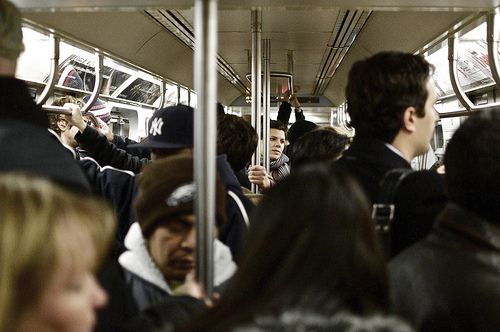
What I found striking is how limited Matus's choices were in the whole situation. As she wrote, "I tried to evade him but couldn’t move an inch in any direction." What a horrible feeling. Even when I was a young man I never had an experience like that, but what little hassle I've had is bad enough. I've been yelled at, pushed, and even sent flying into another passenger by some prejudiced jerk. And that's not counting the normal crush conditions, sermons and bad music.
After this incident, Matus recognized that her only choice was simply not to participate. She says she told her husband that "I wasn't planning on taking the subway anymore, at least during peak hours." I've done the same thing. I choose hours that give me a more comfortable commute. I also live a bit further out and take jobs even further in Queens. Of course I'm fortunate that we have these options. There are many New Yorkers, especially in this economy, who consider themselves lucky to have a job at all, and if that job means they squeeze onto a number 2 train at 8:15, that's what they do. And whatever happens, they put up with it.
Matus also has a couple of alternatives. She could ride a bike, which means dealing with a lot of the same jerks, but instead of squeezing on the train in sweat pants they're in control of deadly machines (barely in control). She could take the M57 bus to the Q60, but that would take a long time, and many of those buses get packed too. Since she works for her family's taxi business, maybe they just send a taxi to pick her up. (But I do appreciate the irony of even a taxi family seeing the value in traveling by subway.) That would cost her family money, just as it costs me money to take lower paying positions to avoid the Manhattan rush hour.
What I would like, and I bet Matus would like it too, is another option. An option where we get a seat, but we don't have to pay for a whole taxi for ourselves. I'm willing to pay more for a slower ride, if I knew I would be a little more comfortable.
What I'm talking about is the Death Valley of Commute Options. You're sick of squeezing into the subway, and you might be willing to pay more for a more comfortable ride. But you can't afford to buy and keep a car (assuming you even want to put people's lives at risk and heat up the planet). So you're stuck on the IRT with the sexual predators.
I'll talk about some solutions in a future post.
Wednesday, May 8, 2013
Goals for long distance trains
Man, you railfans are a chatty bunch! I think my two recent posts on the competitive environment for long distance trains and long distance trains around the world have gotten the first and fifth most comments out of all of my posts. But as C.P. Norris wrote on the earlier post, "I think this debate needs to start with exactly what problem you're trying to solve." And Norris is right: I really should have started with this. So now, let's try to see how long distance trains fit in with our goals, helpfully stated for you at the top of the page.

First, regarding access for all: are all people equally deserving of access, or are some a higher priority than others? To the extent that some are a higher priority than others, it is as a counterweight to existing disadvantages, which means that poor people, Black and Hispanic people, and women should be higher priorities. We should also be looking for the best bang for our subsidy buck, so trains that serve the largest number of people per dollar should count more.
I don't have the numbers, but my impression is that the Silver Meteor and Silver Star are the long distance trains with the highest proportion of African American riders; I have certainly seen and spoken with many on those trains who were traveling between work in Northern cities and family or retirement in the South. I'm not sure what the income of Black Silver Service riders is compared with that of the African American community at large. But if any long distance trains deserve support on access grounds per person, my guess would be that it's the Silver Service.
Transit reduces pollution and carnage, increases efficiency and improves society to the extent that it gets people out of cars. Long distance trains, in addition, can do this by getting people off of planes.
I have a strong desire to preserve the long distance train network. So much of it has disappeared and not come back, and I worry that losing any more routes will start a snowball effect, swallowing up any remaining trains that are not profitable or state-subsidized. But I have to admit that I'm hard pressed to see how that fits with any of my goals.
The problem is that it's not really clear how many people the long distance trains are keeping out of cars and planes, and it's not clear how many more we can get out of cars and planes by improving service.

The only way I can think of that maintaining a route like the Southwest Chief can get people out of their cars is a long term one: that there's more political support for maintaining or improving a route than for restarting one. Just look at the stimulus rail money. Two projects (Ohio and Florida) were for corridors that don't currently have service on them; the rest are all for existing corridors, including the California High-Speed Rail project, which is a fancy bypass for the San Joaquins.
It would seem, then, that operating subsidies tend to motivate capital subsidies beyond what the freight railroads are willing to spend. That means that they may be worth keeping on certain long distance routes, if they can someday draw enough people out of cars and planes, with the right combination of capital investment and road and air disinvestment. The question becomes figuring out which routes those are.
When you comment on this post, please be clear about your goals, so that others can decide whether they share them.

First, regarding access for all: are all people equally deserving of access, or are some a higher priority than others? To the extent that some are a higher priority than others, it is as a counterweight to existing disadvantages, which means that poor people, Black and Hispanic people, and women should be higher priorities. We should also be looking for the best bang for our subsidy buck, so trains that serve the largest number of people per dollar should count more.
I don't have the numbers, but my impression is that the Silver Meteor and Silver Star are the long distance trains with the highest proportion of African American riders; I have certainly seen and spoken with many on those trains who were traveling between work in Northern cities and family or retirement in the South. I'm not sure what the income of Black Silver Service riders is compared with that of the African American community at large. But if any long distance trains deserve support on access grounds per person, my guess would be that it's the Silver Service.
Transit reduces pollution and carnage, increases efficiency and improves society to the extent that it gets people out of cars. Long distance trains, in addition, can do this by getting people off of planes.
I have a strong desire to preserve the long distance train network. So much of it has disappeared and not come back, and I worry that losing any more routes will start a snowball effect, swallowing up any remaining trains that are not profitable or state-subsidized. But I have to admit that I'm hard pressed to see how that fits with any of my goals.
The problem is that it's not really clear how many people the long distance trains are keeping out of cars and planes, and it's not clear how many more we can get out of cars and planes by improving service.

The only way I can think of that maintaining a route like the Southwest Chief can get people out of their cars is a long term one: that there's more political support for maintaining or improving a route than for restarting one. Just look at the stimulus rail money. Two projects (Ohio and Florida) were for corridors that don't currently have service on them; the rest are all for existing corridors, including the California High-Speed Rail project, which is a fancy bypass for the San Joaquins.
It would seem, then, that operating subsidies tend to motivate capital subsidies beyond what the freight railroads are willing to spend. That means that they may be worth keeping on certain long distance routes, if they can someday draw enough people out of cars and planes, with the right combination of capital investment and road and air disinvestment. The question becomes figuring out which routes those are.
When you comment on this post, please be clear about your goals, so that others can decide whether they share them.
Subscribe to:
Posts (Atom)