Saturday, August 13, 2011

Slaying the parking dragon

Streetsblog is reporting that the New York City Economic Development Corporation is trying to build a "vibrant downtown" next to the ferry terminal at Saint George on Staten Island, but undermining that goal by swamping it with parking.
Yet EDC wants the island’s transit center and would-be downtown to make room for a sea of parking, which will draw more traffic to the neighborhood streets, eat up space that could be used for housing or offices, and degrade the pedestrian environment. At this stage in the development process, it’s not clear exactly how many spaces the new development might contain. But all the spaces in the enormous surface parking lots would have to replaced one for one, ensuring at least a full floor of parking almost by definition. On top of that, EDC expects that additional parking be provided for all "the expected demand produced by the proposed development." With 14 acres up for development, that could be quite a lot of spaces indeed.
First I want to point out that this much parking will also drive up the cost to build the development. It will reduce the profitability of the development, and thus drive up the cost to the city.

This is not surprising for the EDC, which has a record of overbuilding parking, as documented by Streetsblog. One anonymous commenter attributed the parking appeasement to EDC President Seth Pinsky and City Planning Director Amanda Burden, and called on Bloomberg to override them. But to give them some credit, the EDC has facilitated the parking-neutral Fordham Plaza redesign and the parking-negative Queens Plaza project. Noah Kazis points out that it may be the Mayor himself who is trying to appease the parking dragon: "The potential to develop these sites while maintaining the availability of parking," he said, "combined with projects at the Homeport, Howland Hook, and at the Ferry Terminal – will be a catalyst for the further revitalization of the North Shore, as well as the entire island."

Whether this comes from the EDC or Bloomberg, if livable streets advocates could get the EDC to reduce the number of planned parking spaces, it is not clear that Staten Island politicians would be happy about that. Think about the Flushing Commons plan, where the developer wanted to build a relatively sensible number of parking spaces, but was met with fierce resistance from the area's business and political elite. The EDC and the City Council then put in money to build more parking.

Any effort to reduce the amount of parking at Saint George needs to either go through the local business and political establishments (Kenneth Mitchell in the Council, Matthew Titone in the Assembly and Diane Savino in the Senate), or else to be done with such force as to crush the opposition. Good luck on either of those.

Oh, and the less parking you have at Saint George, the higher ridership will be on the buses that go there, and the lower the subsidy they require.

Friday, August 12, 2011

Overpriced real estate and its underpriced access

Last week Andrea Bernstein interviewed Alex Marshall of the Regional Plan Association about the profitability of Jay Walder's new employer. After only 32 years of operation, Hong Kong's Mass Transit Railway is able to offer Walder a million dollars a year while constructing a large system expansion, all without direct financial subsidies from the government. Walder's old employer, our own Metropolitan Transportation Authority, gets hundreds of millions of dollars a year from the government for operating costs, and billions for capital programs, and it still has been required to cut service and borrow billions to balance its budget. It could barely afford to pay Walder $300,000 a year, and some critics have demanded that that salary be reduced for the next MTA chair.

The MTR and the MTA are the largest transit providers in Hong Kong and New York, respectively, two very large, fairly dense cities, so why the difference in their financial shape? That's what Bernstein asked Marshall, and Marshall responded that the Hong Kong MTR makes money on real estate and uses that money to subsidize its transit facilities.

On the face of it this sounds a little odd; you could equally imagine the government running a frozen yogurt stand and using the profits to fund interplanetary exploration. But transportation and real estate are more directly connected than that. The real estate cry of "location, location, location!" is really about access. Housing properties with access to jobs, shopping and entertainment command higher prices and rents. Workplaces that are convenient to housing can attract better workers, and thus pay higher rents to property owners. Commercial properties that are on the way from home to work also attract higher rents.

As Jarrett has pointed out, transit systems - and transportation systems in general - are more about access than about mobility. In other words, they provide the real value in real estate. Without access there is no demand for property. That is why Google runs buses to bring workers to its suburban campuses, why condos in Brooklyn, Queens and New Jersey run buses to bring residents to the train, and why Ikea runs buses to bring customers to its Red Hook store.

It makes sense, therefore, for the transportation system to receive some benefit in exchange for that value. This is Marshall's point, which he also lays out in a blog post: in New York the City and the railroads own just enough real estate to run the transit system, and they sell it whenever they can, as the New York Central and the Long Island Rail Road have sold the air rights over their yards. They have minor concessions in their stations, but just enough to keep the passengers from rioting.

By contrast, in Hong Kong the MTR keeps ownership of the areas around its station and develops shops, offices and apartments on that land. They use the rent from those developments to subsidize the trains. In essence, the property is overpriced and the access is underpriced, so the MTR is packaging the property and its access as an integrated product.

Here in New York, the MTA could do some of that. Stephen Smith just yesterday tweeted about a property right next to the Prospect Park subway station that is being built with an unnecessary underground parking garage. The MTA owns several surface-level stations in the outer boroughs, and could build on or near those properties to bring in additional revenues from those train lines - assuming that the zoning and the NIMBYs would allow them to build enough, without adding too much parking.

I've got more to say about Marshall's interview and blog post; stay tuned.

Thursday, August 11, 2011

The train to where?

I have a question about the California High Speed Rail project. This post is inspired by Alon Levy's recent California high-speed rail post, but I've been wondering about it for over a year now. I've looked in the most obvious places (like the "Frequently Asked Questions" section of the California High Speed Rail Authority's website, and Wikipedia), but haven't found the answer.

So most of you have probably read the announcements that the initial segment of the high-speed rail project would be a 54-mile stretch of track between the towns of Corcoran (population 24,813) and Borden (which doesn't even have a population figure), at a cost of $4.15 billion. This was derided by the usual suspects as a "train to nowhere."

Being a big supporter of intercity rail, I was immediately ready to jump to the project's defense. No, the California High Speed Rail Authority couldn't be building a 200 mph shuttle to carry migrant strawberry pickers 65 miles. They're not even building it to go from Merced to Corcoran.

I assumed that the plan was simply to upgrade the San Joaquin route, so that these diesel passenger trains can move off the older, congested Santa Fe freight line and travel as fast as they can on a brand-new, dedicated, elevated, straight section of track. If that cuts the time from Corcoran to Madera from 1:19 to an hour, that's a nice improvement, right? It could win some hearts, and then the rest of the line can be upgraded south to Bakersfield and north to Modesto (at least), maybe shaving off another twenty minutes. Then they get some cash and electrify it from Oakland to Bakersfield, and then from Stockton to Sacramento. Then they worry about getting it to Los Angeles and San Francisco.

Several times I've been ready to make this argument in the comments to a blog post or news article, and I've stopped myself. I realized I don't know, and I don't want to speak for the California High Speed Rail Authority. I figured I'd look into it at some point.

Well, now I've looked into it, and whaaa... ? According to the Los Angeles Times, the tracks will not even run a farmworker shuttle. There will be no trains on them. At all. They will spend over four billion dollars on tracks that will just sit there.

The idea is that eventually the tracks will be extended to San Francisco and Los Angeles and electrified, and then the trains will run. Special high-speed electric trains, like they have on the TGV. But until then, nothing. No San Joaquins. No renting the tracks out as a temporary short cut for Santa Fe freight trains to raise a little cash. They will gather dust for at least two years.

Maybe the LA Times reporters were misinformed. Maybe the plan has changed since then. But I haven't seen anything to suggest that. The High Speed Rail Authority knows that there are lots of people out there who think that the plan is either an expensive farm shuttle or a set of empty tracks. If they were planning to use the tracks, I'm guessing they would put that out on their website. But they don't.

So my question to any California high speed rail followers is very simple. Is this really the plan? Are they really planning to spend four billion dollars and just let the tracks sit completely unused for years, while the parallel tracks are congested? Do you think this is okay? Thanks in advance for your answers.

Wednesday, August 10, 2011

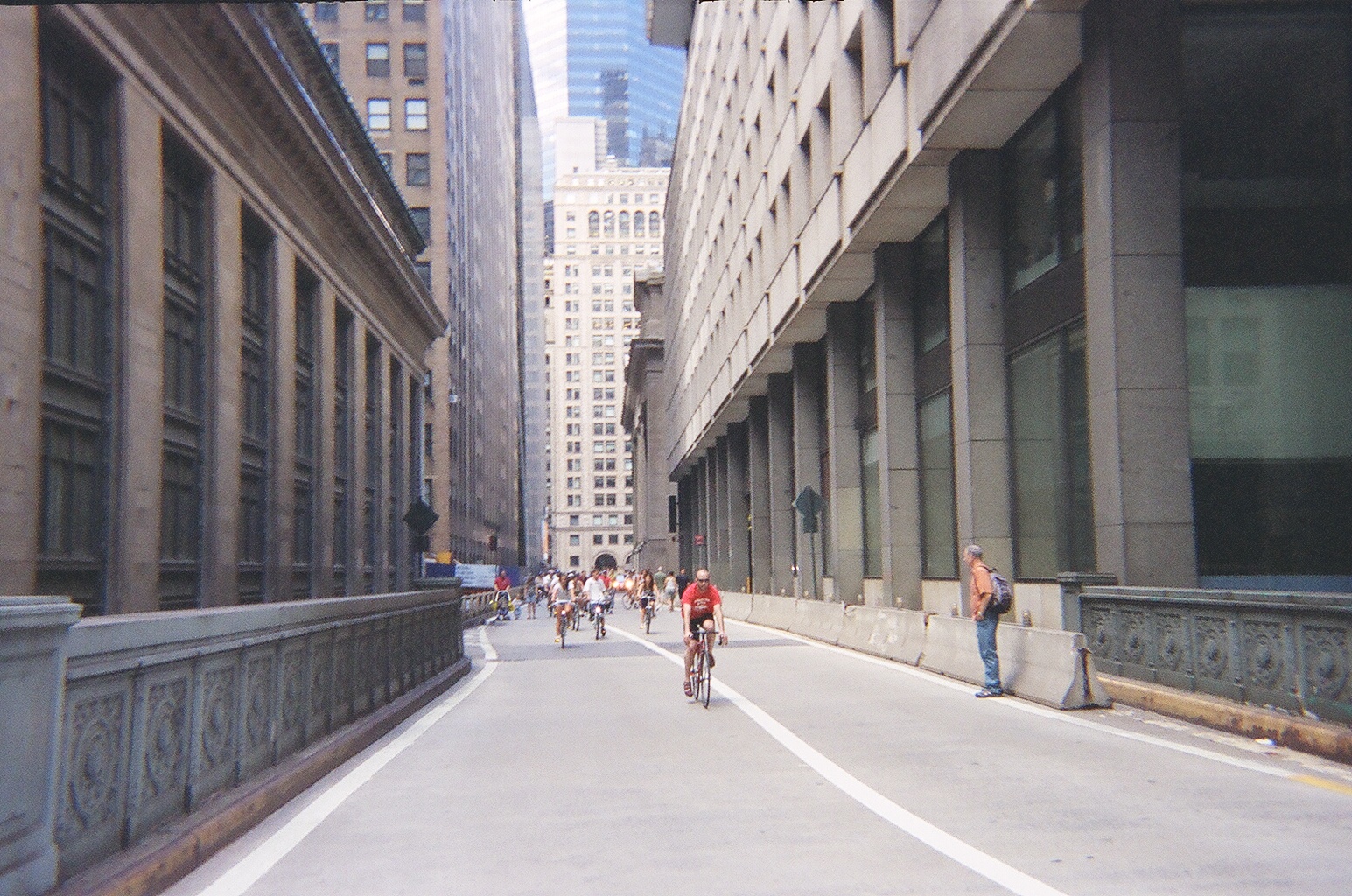
The war for Summer Streets is not over

This past Saturday I rode my bike in Summer Streets for the fourth year in a row, and it reminded me how much I like riding. I've never been an "avid cyclist" and I don't own a pair of bike shorts, but I have been a bike commuter at various times in my life. In the past several years I've avoided riding, mostly because I'm tired of being harassed on the road by people who are protected by two or three tons of metal. I was getting to my destination sweaty and stressed.

When there are no cars on the road, my anxiety level goes way down and I can actually have some fun. Sure there are a couple of inconsiderate people in every Summer Streets, but it would take a lot for them to do serious damage. All I really have to worry about is the cross-streets.

This year was extra special, because not only do we have the Skillman Avenue bike lane leading from my neighborhood to Queens Plaza, but we now have a nice car-free path leading across the Plaza, where there used to be a hell of bridge-bound multi-lane speeding traffic. I can get from my block to Manhattan entirely on dedicated bicycle facilities. The only really uncomfortable part left is the ride from the Queensboro Bridge to Park Avenue.

Also last week, after watching Clarence's commute on Streetfilms, I was inspired to ride across the Manhattan Bridge and try the physically separated bike paths on Sands Street, Flushing Avenue and Kent Avenue. That was another five miles where I felt the same kind of freedom and camaraderie as on Summer Streets, but you can experience it every day. On a Saturday afternoon the streets of Greenpoint and Long Island City were pretty quiet, so even the shared and unmarked sections were not stressful.

But I'm writing this post to tell you that our victory in Summer Streets is not solid. In an otherwise positive piece, Channel 2 included a poll asking "Do you approve of the Summer Streets?" and although 80% did, 64 people took the time to click "No." Some of them griped all over the comments section. There are other rumblings that suggest that the car elites have not pleased with this success, and are waiting for an excuse to demand that it be scaled back.

The best thing we can do to combat that threat is to balance it with requests for more. Here are some ways:

1. Extend the reach. Channel 11 has a bizarre story that Summer Streets "Angers Outer Boroughs." Turns out it's an extended interview with one Upper East Side crank who presumes to speak for outer borough residents. Over the years I've seen several known Brooklynites cruising Park Avenue, and I'm sure that a large percentage of the people I saw Saturday were from outside Manhattan. But Croft has a point: it should be expanded citywide.

In 2009 I suggested extending the event across the Manhattan Bridge - not on the bike path, but on one of the decks - and down Flatbush Avenue to Prospect Park. It could also be extended across the upper deck of the Queensboro Bridge and down Queens Boulevard, or north up Adam Clayton Powell Boulevard, over the Macombs Dam Bridge and up the Grand Concourse. If you really want to reach Croft's "outer borough families," you could go all the way down Ocean Parkway to Coney Island, or Eastern Parkway, the Jackie Robinson Parkway and Union Turnpike to Lake Success, or Pelham Parkway to City Island. You could even go across the Verrazano to Staten Island. There are all kinds of possibilities.

2. Widen bottlenecks. The Park Avenue section flows well, but there was definitely some congestion on Fourth Avenue and Lafayette Street. This could be remedied by using Broadway or the Bowery south of Union Square.

3. Extend the hours. Why does it end at 1PM? That's when many New Yorkers are just waking up, and others are just finishing brunch. Some people want a little fun in the afternoon too.

4. Extend the days. Why not have it all summer, or even part of the fall? Or Sundays too?

5. Cater to people-watchers. One of my favorite parts of Summer Streets is just sitting and watching the parade of New Yorkers of all ages, but it's actually kind of hard to do. There are relatively few comfortable places to sit along Park Avenue. The handful of sidewalk cafes do a roaring business on those days, but imagine if there were more?

The DOT could give permits for restaurants along the route to set up temporary sidewalk cafes, and for food trucks to park in the curbside lane. Movable chairs and tables could be distributed along the sidewalk the length of the route, allowing people to take breaks, eat, drink and socialize. We don't need to worry about blocking the sidewalk, because people can walk in the street!

I know that these things cost money. The cost of policing, in particular, is one reason given why the hours and miles can't be extended. Setting out tables could also be expensive. But there have been repeated accusations over the years that the event is over-policed, and that more could be done with paid civilians and volunteers. The bottom line is that Bogotá does it every week, all year round, for seventy miles. Why can't we do it for ten weeks for half that length?

Tuesday, August 9, 2011

The future of the Suzy-Q

It's funny, just last night I was re-reading this post from 2009 on the planned restoration of passenger service on the New York, Susquehanna and Western line from Hackensack to Hawthorne in New Jersey. I was wondering what happened to it, since there have been zero news articles about it since. Since Chris Christie's money tree only bears fruit for highway widenings and mega-malls, I figured that it's not going anywhere unless the pressure gets turned up.

This morning, though, I read that the Morris County Freeholders passed a resolution calling for restoration of service on the Suzy-Q, but west of the area I discussed in 2009. Morris County, in conjunction with Passaic and Sussex Counties, wants to run passenger trains from Hawthorne west to Stockholm, just before the track terminates at the Sparta Junction.

I understand why the Freeholders have framed their study in this way, but it seems pretty obvious to me that the train would continue at least into Paterson, where passengers could transfer to an Erie line train to Hoboken, and probably all the way to Hackensack. If I were the Railroad God, I would extend it north to Port Jervis, south to Andover, and east to Edgewater or Hoboken.

It's sad that Star-Ledger reporter Dan Goldberg seemed completely unaware of plans to reactivate passenger service in Bergen and Passaic counties, which could have been running by now. He could have asked New Jersey Transit officials, or the project's champion, Democratic Congressman Bill Pascrell.

The section of the railroad west of Hawthorne runs along the boundary between New Jersey's Fifth and Eleventh congressional districts, represented by Republicans Scott Garrett and Rodney Frelinghuysen. Sadly, even though Garrett is a regular rail commuter and Frelinghuysen was once a champion of the Lackawanna Cut-Off, they have both succumbed to Tea Party mania. Frelinghuysen sponsored an amendment to reallocate high-speed rail funds for Midwest flood relief. Garrett has proposed eliminating Federal funding for Amtrak.

At this rate, though, there won't be funds to build more roads in that area, so the NYS&W's revenue will gradually increase. Maybe some day it'll have enough money to restart passenger service on its own.

Monday, August 8, 2011

The Port Authority's toll hike is blatantly unfair

The big news the past few days has been the Port Authority's fare and toll hike plan. Many people are upset about it, but for me the PATH fare increase seems doable. It's higher than the NYC Transit fare, but don't worry, we'll catch up soon. The toll increase - well, I'm in favor of anything that brings the cost of driving up closer to the actual amount of resources used.

Lots of people were upset about the proposal. New York State Senator Charles Fuschillo of Merrick is against the Port Authority increases, the MTA fare hikes and the MTA payroll tax, apparently believing that nobody should ever have to pay anything for a government service. In a hilarious development, Governors Cuomo and Christie expect us to believe that they had no idea the Port Authority would propose such a steep hike. They only signed off on its capital plan, they didn't expect anyone would have to pay for it! A bit closer to reality, there were various complaints against the plan, but the Bergen Record actually found a guy who reasoned that it would discourage single-occupant driving.

Tri-State and Streetsblog pointed out that for several years people have been noticing that the Port Authority had lots of cash on hand, and saying, "Well, let's get the Port Authority to chip in on this." In this way, the few billion dollars in question has probably been spent at least five times over. And this is the answer to my question from 2009 about why governments borrow to finance capital projects: if they try to save the money ahead of time, someone will take it.

One of the reasons the Port Authority is raising fares and tolls is that Governor Cuomo expects it to contribute $380 million a year to the MTA capital plan. This makes sense in a way, because people from New Jersey commute to Manhattan by train, bus and car, and benefit from having people ride the NYC Transit subways and buses. Some people have noted that the $380 million probably wouldn't be necessary if we were bringing in $500 million a year through congestion pricing on the East River bridges and tunnels. In essence, New Jersey drivers will be paying what the drivers from Westchester, Long Island, Connecticut and the outer boroughs refused to pay.

But even Streetsblog though didn't pick up on one of the grand ironies involved in having New Jersey drivers subsidizing sprawl in Bayside and Mamaroneck. Back in March 2008, in one of the craziest episodes of the whole crazy congestion pricing debate, twenty New York City Council members signed a letter complaining that the proposed congestion charge would be deducted from any bridge and tunnel tolls paid the same day. This, they wrote, was "blatantly unfair." They even demanded exactly what Cuomo is asking from the Port Authority this year: that it contribute to the MTA capital plan. Of course it was a total lie: the proposed congestion charge would have remedied numerous unfair situations, not created one.

And now, over three years later, it looks like this will happen without congestion pricing. Now, if there's a remedy for a situation that is blatantly unfair, and you apply that remedy in a situation that isn't blatantly unfair, that would be blatantly unfair, right? And yet - I have not heard a peep from David Yassky, Jimmy Vacca, John Liu or anyone else who signed that letter. They only care about fairness when they think their constituents are the ones being treated unfairly.

But that's not all. The supreme irony in the whole situation is the source of the Port Authority's money: congestion pricing. The Port Authority can charge such high tolls because it operates a secure cordon. You can't drive from New Jersey to New York City without paying a Port Authority toll unless you drive up to the Tappan Zee Bridge or beyond.

If we charged tolls on the East River bridges we'd have plenty of money for transit projects - and reduced congestion, and well-funded buses. But none of our state legislators want to stick their necks out for it, and neither does Andrew Cuomo. They'd rather just let New Jersey pay, and take the money. Excelsior!

Friday, August 5, 2011

Killing with concern in the Assembly

I usually don't even bother responding to the lies and distortions about our transit system that come out of the State Assembly echo chamber, but this one was a bit too close to home. Aravella Simotas represents a district near me, replacing her mentor Mike Gianaris, who has taken over the Senate district. She was recently interviewed for a local podcast, the Perez Notes. It'll be nice when host Rob Perez gets a real hosting service, but until then you can download the MP3 here if you want to listen to it on a portable device.

Simotas may put her words together into odd combinations and then stumble over them, but she's very good at one particular tactic, what I call "killing with concern." It goes like this:
  1. Acknowledge the problem and sympathize with the people experiencing it.
  2. Raise concerns about the proposed solution. Go into as much detail as you can.
  3. DO NOT propose any remedy to the concerns you raised in Step 2.
  4. If anyone tries to address the concerns you raised or proposes an alternate solution, return to Step 1.

You will notice that Simotas does this with the MTA and the taxis: yes, of course her constituents need good transit, but the MTA is so wasteful and unfair! Her constituents need good taxi service, but the current law was passed in an unconventional way, and may be unconstitutional!

This is, of course, standard practice for the Assembly, and she probably learned it directly from Gianaris and from her other mentors, City Council member Peter Vallone and his father, former City Council Speaker Peter Vallone. Read and listen to statements made by various Assembly members about transit and you'll hear it over and over: they'd love to do something about transit, but they've got this concern...

In this interview, it is easy to tell the difference between an issue that Simotas actually cares about (pork and redistricting) and one that she doesn't. If she cares about the issue she addresses all the possible objections and has a solution ready. If she doesn't care, well, gee, she'd love to help, but she's got these concerns...

I'd like to finish by pointing out that this bullshit artist was not actually elected in any meaningful sense of the word. She was chosen as the party favorite after heavy lobbying by Gianaris and the Vallones. Her primary challengers, the disappointing Jeremiah Frei-Pearson and some guy named John Ciafone, quit the race when it became clear that Simotas had overwhelming political and financial backing. The Republicans and the Greens couldn't find anyone to run against her in the general election. Voters have never had the opportunity to choose her over anyone else.