Here are some reasons to get people to shift from cars to transit:
Showing posts with label mta. Show all posts
Saturday, June 8, 2019
Transit should be controlled by transit riders
I was listening to City Council Speaker Corey Johnson on Ben Kabak's new podcast, promoting his proposal to transfer control of the New York City subways from the Metropolitan Transportation Authority, which is controlled by the Governor, to a new board controlled by the Mayor (a post that Johnson plans to run for in 2021). Johnson's thoughtfulness and his desire for real solutions were refreshing in our political scene, and I appreciated his request for feedback on his proposal. And I have some!
In particular I was struck by Johnson's claim that a board that represents the diversity of the transit riding public would do a better job of serving that public. Now, don't get me wrong: I'm definitely not going to repeat the bullshit that a board needs people with technical or business expertise; that's what staff is for. The subways and buses should be managed in a way that benefits their riders, and riders deserve a say in how they're managed.
The thing is that the system doesn't just serve riders; it serves everyone who lives and works anywhere in the whole metro area. A bank executive who is driven to work isn't going to perform well if their employees can't get in on the train. An antiques merchant in Great Barrington is going to sell less if the weekend visitors from the city have less disposable income. Taxpayers need to know that our money is being spent well. Bondholders won't lend the MTA money unless they can make sure it won't default.
I wouldn't want the Kosciuszko or Tappan Zee bridge replacement projects to be managed by and for the exclusive benefit of drivers. In fact, the problem with these projects is that they actually are being managed by and for drivers. And you know, the problem with the MTA is that it is also being managed largely for drivers.
Johnson is right that the MTA is controlled by a group of people who don't ride transit, but he fingered the wrong group. The Governor clearly doesn't ride transit, but a lot of transit policy is not set by him, but by the State Legislature. As I've written in numerous posts, the State Assembly and Senate are almost completely dominated by drivers and people who are driven everywhere.
Under Johnson's proposal the State Legislature would have almost as much control as they do now, because under our constitution they are the only entity in the state with the power to tax. State laws also have the power to overrule city laws. Even if Johnson can persuade them to implement his plan, they can change it at any time.
To the extent the city government would have control, the City Council would have more power than this "BAT Board," because they have to pass the budget, and can pass certain laws constraining what the Mayor can do. The Council has gotten much better over just the past twelve years, thanks in part to Johnson's leadership, but as Streetsblog documented recently, they still cannot be counted on to reliably prioritize transit riders.
Today the MTA Board today is at worst a fig leaf covering the Governor's management and the Legislature's budget priorities, and at best an advisory panel. On top of that we have another panel, the Permanent Citizens Advisory Committee, which is appointed by elected officials based on patronage, and elects representatives to the MTA Board who have no voting rights. Johnson's proposal does not give this "BAT Board" the power to tax, so the real power would remain with the power brokers in the State Legislature.
Having the State Legislature or the City Council control the transit system would not actually be a problem if we had a truly representative system. Even the State Legislature is dominated by representatives of districts with heavy transit ridership. Unfortunately, the system is corrupt and favors elite homeowners who drive. They also subscribe to an ideology of driving as emancipation, and make deals to favor "upstate" that ignore the sizable population of current and potential transit riders outside of New York City.
The focus some advocates place on the non-representativeness of the MTA Board, in particular on the predominance of white men, winds up distracting us from the non-representativeness of the State Legislature, where some of the loudest opposition to transit funding and fair pricing for road use comes from nonwhite and female legislators like Charles Barron, Kevin Parker, Toby Stavisky and Deborah Glick. Last week when first term Senator Jessica Ramos said not only that she doesn't have a driver's license but that "car culture is something that we need to start rethinking as a society as a whole," that statement was notable for how unusual and brave it was.
So yes, we should transfer control of New York City Transit's subways and buses back to the City government. But no, we should not create a whole new authority to run them, or a "mobility czar" to oversee buses, trains, ferries, bridges and streets. We should just make them all part of the Department of Transportation. If we need to borrow money for them, we should use the City's bonding ability.
And no, we should not create a whole new board with no real power. If people want to transfer the New York City Transit Riders Council from the MTA to the city, fine. We don't need another one.
Similarly, if for some reason the City can't borrow enough money using its own bonds, I could see us setting up a temporary authority to issue bonds. Those of you who have read The Power Broker know that the authorities that issued bonds to build projects like the Manhattan Bridge were set up to dissolve once they paid off the bonds. The genius idea that allowed Bob Moses to wield power for decades without ever winning an election was to insert a clause in the law that created the Triborough Bridge and Tunnel Authority allowing it to issue new bonds. Removing that unjustified power from the Transit Authority is an essential step in restoring democratic control to our subway system.
The bottom line: municipal control is a good idea, but a new authority is not the way to do it. It should be done by direct executive power. Representation is a good idea, but an unelected board is not the way to do it. It should be done through our elected representatives to the City Council and State Legislature.
Saturday, September 29, 2018
Did the Atlantic Ticket accomplish anything?
In June the Long Island Railroad instituted an "Atlantic Ticket" for people traveling on weekdays between southeast Queens and stops along Atlantic Avenue in Brooklyn. This fits with the RER, S-Bahn and Overground strategies that have been used in European cities like London, Paris and Berlin going back to the late nineteenth century. Instead of treating suburban trains like a completely separate system from the subways (and buses) they are run through the city center, at comparable frequencies to the subway, with the same fares and free transfers. So how does the Atlantic Ticket do in getting us to this goal of using our trains more efficiently?
Of the four differences between subways and commuter trains, the Atlantic Ticket addresses the fare difference and the lack of free transfers. They are the easiest to see: a rush hour commuter who takes the LIRR and the subway pays $13 one way or $346 monthly for a 55-minute trip from Rosedale to Grand Central, compared to $2.75 or $121 for 30 days for a much more crowded ride on a local bus to a subway. Many people take dollar vans to the subway, which brings the cost up to $4.75 one-way or $241 for 30 days. Riding the x63 express bus takes an hour and a half, but you get a seat and it's less than the railroad: $5.50 one way or $238 for 28 days.
The Atlantic Ticket offers a fare close to the express bus: $7.75 for a single one-way from Rosedale to Grand Central and $240 for 28 days. However, it is only good for travel to (or through) Flatbush Avenue, which takes about an hour and ten minutes from Rosedale to Grand Central. This is still quicker than the express bus, but about twenty minutes longer than LIRR trips through Penn Station. Surprisingly to me, it's also longer than taking a bus to the subway.
Why would someone pay extra for a longer ride? Comfort is one reason: LIRR trains are rarely packed, so even if they don't get a seat on the train they would expect some elbow room. But there's still a packed subway ride from Flatbush Avenue to Manhattan. Is riding a less crowded train for half an hour worth paying $3-5 more, but not worth $10.25 more? Maybe.
Another potential advantage is reliability. The subways and LIRR trains run on dedicated, grade-separated tracks controlled by the MTA. The buses and vans all run on busy avenues filled with other commuters. One insensitive driver can hold up bus riders for several minutes.
There's no word yet on how many people have been buying these Atlantic Tickets, but given the mixed benefits I suspect the number is relatively small. The LIRR Board Book this month credited the US Open golf tournament and the Belmont Stakes for increases in ridership (roughly 2% over last year), but did not mention the Atlantic Ticket at all. In a future post I'll talk about the two other factors, a direct ride (or at least a ride that is comfortable end to end), and frequency.
Saturday, October 1, 2016
When ridership doesn't matter
In the past couple of years I’ve noticed something that would be baffling in a lot of contexts, and is still kind of hard to believe when you see it. It’s called a pass-up, and it’s when a transit vehicle is so full that it can’t fit any more people, and leaves riders standing on the platform or the curb.
It’s bad enough when there really is another bus coming along in a minute. It’s bad enough when the city doesn’t have enough track capacity or enough train cars to move all the people who want to ride. But what I’m really talking about is when you can’t get on a bus and there isn’t another bus for ten minutes or more, or when one bus or train after another is uncomfortably packed.
It’s possible that the MTA, with its heavy debt service burden and its large employee benefit obligations, is incapable of bringing in a profit on any route at any time, no matter how many people ride it, so that it never helps the bottom line to add buses. But that would be a very different story than they told in 2010 when they cut service.
If you asked some of the people waiting for the M60 how they feel about the prospect of a fare increase, they would probably complain and tell you they couldn’t afford it. But if you asked them whether they’d pay fifty cents more to get a seat on the bus, or to just ensure there would be room for them on the next bus that came, they might say yes.
On the face of it, it makes no sense. These are paying customers; why wouldn’t the agency want their money?
We know it usually works in the other direction: transit providers don’t get enough riders, so they raise fares and cut back service, which drives away some of the remaining riders, in what is known as the Transit Death Spiral. We’ve put measures in place to protect transit systems from that. The problem is that those measures also remove most of the incentives for actually serving passengers.
The Transit Death Spiral is in fact a perfectly normal outcome for anyone who is selling something but is unable to compete. They sell less and less, and with less income they are unable to maintain the quality of their product. Customers give their money to the competitor, who can use it to improve the competing product.
Transit advocates knew there was a public interest in keeping transit around, so they got the government to subsidize it. But the reason transit was losing market share was that the government was subsidizing competing roads. There was a powerful popular consensus in favor of gas, roads and parking, and a popular distrust of railroad companies and “the traction interests.” There were also powerful undemocratic forces attacking transit, like Bob Moses, car companies and road lobbyists.
Transit advocates tried to promote an “all of the above” strategy, but rarely achieved “parity,” let alone more than 20%. They then largely fell back on charity arguments, which are inherently self-limiting because they implicitly accept the idea that nobody would take a bus or train unless they can’t afford to drive.
Then came transit advocates’ deal with the devil, the mistake that we’re still paying for today. After failing in both market competition and popular subsidies, transit advocates tried to beat road lobbyists at their undemocratic, competition-stifling game. They turned to public authorities.
Even today you see transit advocates arguing with a straight face that they can’t improve transit without a regional authority. Public authorities are the tools that Moses used to achieve power without a popular mandate. They allow elected officials to maintain a degree of control, but give the appearance of independence, protecting transit bureaucrats from all accountability to the voters or the market.
The result of this is that now, when there are plenty of passengers, the transit managers seem to have no interest in increasing frequency to serve the people who want to ride. What’s in it for them? They don’t get punished for leaving money on the table, and politicians don’t complain about crowded buses.
There are people who want to serve those people and take their money. But the city blocks them, and self-righteous bloggers spew bombast about “privatization” and “stratified transportation systems.” The state could serve them well, but the governor finds more political value in spending city money to build roads in the suburbs and the country. And on this the social justice advocates are silent.
Tuesday, June 28, 2016
Windows on the Van Wyck
A few weeks ago I went for a walk in Briarwood and Kew Gardens Hills. I got off the train at Jamaica-Van Wyck, the first time I’d ever used that station. It was full of red brick, reminding me of other stations that were opened or renovated in the seventies and eighties, like 21st Street-Queensbridge and 49th Street, but it was uncomfortably dark, despite the high ceilings and fairly bright lights.
I looked up and saw an elevated walkway inside the station, leading to the exit, similar to other grand stations of that era like Queensbridge, Auber in Paris, or Dupont Circle in Washington. On the other side of the station I saw what looked like balconies or windows above, but there was no light coming through them.
When I got outside, I crossed the Van Wyck Expressway on Jamaica Avenue. I looked down, and could actually see the outside of the station in the trench next to the highway. It's even more obvious in this Bing aerial photo:
It's hard to tell through the fence, but the panels on the walls look like they could be windows covered with paint or plastic.
I then looked up the station on the web, and found more information. The windows were uncovered as late as 1998, when Wayne Whitehorn took a series of pictures including this one:
Nycsubway.org has that photo, plus a couple of other good ones. According to user R32 3671 on the NYC Transit Forums, they were covered over by the year 2000, due to "vandals." Some commenters on SubChat said that the vandals actually broke the windows; others only say that they spray-painted graffiti over them. There was certainly graffiti all over the window covers when I took these pictures.
If they uncovered the windows now, in 2016, how often would people try to tag them? How much would it cost to keep them clean and guard them? Would it be more than the cost of maintaining the "Low Line" park proposed for the Manhattan Terminal, plus the amortized cost of constructing that park, estimated at $55 million in 2013?
Friday, January 29, 2016
Better subway station names
Back in October, City Council Transportation chair Ydanis Rodriguez argued that some of our identically-named subway stations really are confusing and should be changed (see the full report in PDF. In general I agree; the worst are those that are on the same line in different boroughs; back when there was a 23rd Street-Ely Avenue stop in Queens, I helped a poor recent arrival on the V train who got it confused with 23rd Street and Sixth Avenue in Manhattan.
I like how in Paris every station has a unique name, and that's part of the navigation system for the city: directions regularly include the name of the nearest Metro station. Of course that's because Paris has no grid, and grids actually make subway station naming kind of boring: do we really want stops called 23rd-Park, 23rd-Broadway, 23rd-Seventh and 23rd-Eighth?
On the other hand, I also agree with Ben Kabak that the names proposed by Rodriguez's staff are not great. They're not as bad as the DC Metro with stations like Archives-Navy Memorial-Penn Quarter, but they're still too long. I'm going to take them one at a time:
- 7th Avenue 53rd Street: This can be just plain Seventh Avenue, because we're going to rename the other ones.
- 7th Avenue Prospect Heights: This is in line with the MTA's push to rename stations after the neighborhoods they serve, but it's silly. The next stop on this line is Prospect Park, and there's a 15th Street-Prospect Park stop on the F and Prospect Avenue stops on the R and 2/5 lines. Why not just rename it Carleton Avenue after the street on the other side of Flatbush Avenue?
- 7th Avenue 4th Street: This is a typo, unless Rodriguez is working with the MTA to fund a subway under Fourth Street. I think we should rename it Ninth Street, and then the Smith-9th Street station can just be Smith, and the Fourth Avenue-Ninth Street station can just be Fourth Avenue.
- Brooklyn Bridge-City Hall: Take off the "City Hall" part, off of this and the IRT station. There's a City Hall station across the park on the R train.
- Chambers Street-World Trade Center: Since this is part of the same complex as the E train terminal at World Trade Center, why not call the whole thing World Trade Center? Well, even the south end of the A/C platforms are pretty far from the WTC, and we'll have to make sure the #1 train station won't be called World Trade Center when it opens.
- Gun Hill Road - White Plains Road: This can stay as just Gun Hill Road.
- Park Place: Are people really getting this one confused with the Franklin Avenue Shuttle stop? If it's a big deal, call it Park Row instead.
- Gun Hill Road - Eastchester Road: As Larry Velázquez pointed out on Twitter, it's not even very close to Eastchester Road. We could name it after Seymour Avenue or Hammersley Avenue, both of which are closer.
- Pelham Parkway - White Plains Road: This is probably the best we can do. We don't want it to get confused with the other Pelham Parkway stop, but there are nine other stops along White Plains Road. so it looks like we're stuck with both of them.
- Pelham Parkway - Williamsbridge Road: First, spell "Williamsbridge" right. We could just call this "Williamsbridge Road," but then people might think it's close to the "Williams Bridge" station on the Metro-North Harlem Line.
- 36th Street - Sunnyside Yards: The problem with this one is it assumes that Sunnyside Yards is a destination. I mean, sure, I took Alon Levy there, but we're transit geeks. Does it mean someone in Rodriguez's office is expecting this part of the Yards to be developed soon? How about 38th Avenue instead?
- 36th Street - Fourth Avenue: If we rename the LIC station to 38th Avenue, we can keep this as 36th Street.
Wednesday, June 24, 2015
Can the trains really handle weekend passenger loads?
The Daily News had a good piece on subway overcrowding yesterday, featuring some odd comments by MTA officials. Much as I appreciate the work of reporter Dan Rivoli and his colleagues, there's a few things that need some clarifying around these issues. Let's start with the last paragraph first:
This is actually incorrect in the context of the article, which is non rush-hour demand. The expensive capital improvements like upgraded signaling and additional trainsets are only necessary for increasing the maximum frequency of trains. This only matters at rush hours; at all other times a much lower frequency is enough to avoid overcrowding.

Photo: Pacific Coast Highway / Wikipedia.
Okay, now to some comments from MTA spokesperson Kevin Ortiz:
I had to re-read that several times to figure it out. What I think Ortiz is saying is that the trains are going faster than the MTA has scheduled them to, so they have to wait at the stations until they are scheduled to leave. It seems like the obvious thing to do in that situation would be to update the schedules so that they're a better estimate of the time it actually takes for the trains to run, but he doesn't seem to think this is necessary.
I kind of feel bad for Ortiz. He seems like a nice guy, but here he is being paid to defend the indefensible. The News says that there were 2,451 overcrowding delays reported on weekends in April 2015, up from 1,016 delays in April 2014. That's 306 delays per day, or depending on how you count them, one overcrowding delay per line per waking hour. To me that suggests that the current service levels are not adequate to meet demand.
When Ortiz says that the trains can handle weekend passenger loads, he's referring to the loading guidelines that the MTA uses to determine how many trains to run. It used to be that if there was anyone standing on a train on the weekend, it meant that the MTA needed to add more trains. Now the guidelines say that a train can handle the load if twenty percent of the passengers are standing (see pages 28-30 of this PDF).
It's not clear where on the line they count passengers, or which car on a given train, but here is some great info that retired MTA scheduler Capt Subway left in the comments last year, and is worth quoting in its entirety:
So if, like me, you're routinely seeing more than twenty percent of the riders standing on weekend subway trains, you're probably better informed than Kevin Ortiz. I think we should go back to the guidelines where nobody has to stand, but for a start we should audit these passenger counts to make sure that the schedules are actually based on accurate information.
Improvements necessary to meet the demand — a new signal system to run more trains, for instance — are funded through the $32 billion five-year capital plan, which has a $14 billion hole state officials have yet to address.
This is actually incorrect in the context of the article, which is non rush-hour demand. The expensive capital improvements like upgraded signaling and additional trainsets are only necessary for increasing the maximum frequency of trains. This only matters at rush hours; at all other times a much lower frequency is enough to avoid overcrowding.
Photo: Pacific Coast Highway / Wikipedia.
Okay, now to some comments from MTA spokesperson Kevin Ortiz:
The MTA attributes some delays to its effort to give riders even service while they wait at stations, which holds up some trains.
MTA spokesman Kevin Ortiz said it’s all about the train arriving to the station. By the MTA's measure, wait times at stations are more key to quality of service than delays that make trains late to their last stop.
"On weekends, overall, you’re seeing trains arriving at stations when they’re supposed to be arriving," Ortiz said.
He added that trains can already handle weekend passenger loads without hiking service.
I had to re-read that several times to figure it out. What I think Ortiz is saying is that the trains are going faster than the MTA has scheduled them to, so they have to wait at the stations until they are scheduled to leave. It seems like the obvious thing to do in that situation would be to update the schedules so that they're a better estimate of the time it actually takes for the trains to run, but he doesn't seem to think this is necessary.
I kind of feel bad for Ortiz. He seems like a nice guy, but here he is being paid to defend the indefensible. The News says that there were 2,451 overcrowding delays reported on weekends in April 2015, up from 1,016 delays in April 2014. That's 306 delays per day, or depending on how you count them, one overcrowding delay per line per waking hour. To me that suggests that the current service levels are not adequate to meet demand.
When Ortiz says that the trains can handle weekend passenger loads, he's referring to the loading guidelines that the MTA uses to determine how many trains to run. It used to be that if there was anyone standing on a train on the weekend, it meant that the MTA needed to add more trains. Now the guidelines say that a train can handle the load if twenty percent of the passengers are standing (see pages 28-30 of this PDF).
It's not clear where on the line they count passengers, or which car on a given train, but here is some great info that retired MTA scheduler Capt Subway left in the comments last year, and is worth quoting in its entirety:
The whole problem with the Loading Guidelines, as anyone who actually works / worked "on the ground" with the NYCTA (and not "upstairs" in some executive suite) knows, is that they are, written in sand as they are, a total fiction, pure BS. The only purpose they really serve, from what I could ever discern, was so that those making the day-to-day operating decisions could gauge just how far off the mark they actually were, just how outrageously they were actually lying to the public.
As a good example: the "regular" or "pick" or "posted" timetables must adhere to the guidelines in effect at that particular moment, albeit insofar as that is possible given any number of other constraints (track, signal, interlocking, terminal capacity, car availability, etc). Unfortunately the "regular" timetable is rarely ever actually run. 90% of the time "supplement" timetables are being run. And the vast majority of these supplements REDUCE service, including right through the peaks. The reasons for these are many. A major cause is "skeletonized" track with a resulting slow speed order in effect, an especially serious impediment to peak service delivery. In the off peak periods it is almost always track / capital work of one type or another. I worked for years supervising the production of "pick" & "supplement" timetables for the IRT lines. The degree to which the "supplements" often totally trashed and eviscerated the "regular" timetables was truly appalling.
This bad situation was made far worse by new "adjacent track" flagging rules that went into effect around 2009.
And one more word on the guidelines. They are based upon field traffic checks. These traffic checks are done by, mostly, low paid, often part time traffic checkers who literally count the bodies in each car of passing trains at a given point. This raw data is than "analyzed" by "experts" back in the office (I worked, from time to time, as one of those "experts"). We were regularly told by our bosses to "correct" obviously wrong data. For example, a number of years ago a Director of our Dept didn't like "lumpy" loading checks. He liked to "smooth out" the load over a longer period of time, thus showing less of an actual peak. In this way he could recommend against adding a train, or trains (along with the trains' two person crews). That made him look good. Hey, he just saved the TA the cost of a train and crew.
So if, like me, you're routinely seeing more than twenty percent of the riders standing on weekend subway trains, you're probably better informed than Kevin Ortiz. I think we should go back to the guidelines where nobody has to stand, but for a start we should audit these passenger counts to make sure that the schedules are actually based on accurate information.
Thursday, June 18, 2015
Who's getting out of the way of the buses?
The Transit Workers' Union Local 100 has been campaigning against New York's recently enacted Right of Way law, which gives the police and courts more power to punish drivers who injure or kill people in the crosswalk. Essentially, it established the rule of law where previously the right of a person to pass, to take up public space, and to threaten and even kill others was granted based on the size and power of that person's vehicle, or the extent to which a police officer sympathized with that person. Or the extent to which that person was dead.
The TWU bus drivers see this as a problem because the previous state of anarchy favored them. They're union members piloting some of the largest vehicles on the road. There are many times when I've been crossing the street and had to wait because a driver swung his bus out in front of me. I had to get out of the way. Most people did. Some of them didn't, and some died. Too many.
But there have also been times when I've benefited from that anarchy. I've seen sedans, SUVs and sports cars come to a halt at a green light, as my bus driver takes a left right in front of them. If the driver had followed the rules, we might have sat for a while waiting to make that left turn.
Yesterday, a Local 100 spokesperson tweeted a picture of a bus waiting to turn off of 181st Street while an "oblivious pedestrian" crossed Wadsworth Avenue with the light. Several times in recent months the TWU has threatened to take extreme care to avoid violating the right-of-way of pedestrians, to which pedestrian advocates have replied, "No, please don't fling me in that briar patch!"
When pedestrian advocate Robert Wright observed that the pedestrian crossing Wadsworth had the right of way, a Local 100 spokesperson tweeted, "The point is that there should be a turn signal so that peds can be safe when buses have to turn." And yes, this is one way that the problem could be solved, but having lots of turn phases can cause more problems.
Even before that tweet, the picture had gotten me thinking: what if we wanted to give bus drivers the priority they used to have, but enshrine it into law? We give police cars, fire trucks and ambulances the right to take street space; if we think buses should have more priority, why not give a similar right to them? What if all in-service buses were allowed to turn whenever they wanted, and all other traffic had to yield?
Then it got me thinking that if they had this priority, we would need some kind of signal to tell pedestrians and other drivers to get out of the way. Police cars, fire trucks, ambulances, they all have sirens and flashing lights. Sirens on every bus would be overkill. Flashing lights?
Hey wait a minute! Didn't there used to be lights on some of the buses? Yes, when the first Select Bus line debuted on Fordham Road it had flashing blue lights on the front. The idea was partly to distinguish Select Buses from the local buses operating on the same route, but also to notify drivers that the bus had priority.
You may also remember what happened to the flashing lights. After four successful years of Select Bus Service, when it was rolled out on the S79, Staten Island politicians complained that the lights were "distracting to drivers," and pressured the MTA to shut them off.
Where was the Transit Workers' Union in this? I haven't found any mention of them. If they tweeted or sent out a press release, it wasn't picked up. But they did endorse State Senator Bill Perkins for re-election, after he repeatedly opposed plans to extend the M60 select bus lanes to West 125th Street.
Local 100's choice of 181st Street for this action is telling. 181st is a critical bus corridor connecting the A and #1 subway lines with transit-poor neighborhoods in the western Bronx. The buses are constantly getting stuck behind double-parked cars. The Department of Transportation tried hard to speed them up, but local politicians watered the plan down to nothing. Where was the TWU?
These issues - stiffer penalties for hurting pedestrians with the right of way, dedicated lanes for buses, and lights to reinforce the priority of buses in those lanes - are all issues about who's getting out of the way. In that sense, they're like the bus bays in Tenafly, or pedestrian overpasses: an indication of the priorities of the government. The right-of-way law says that pedestrians are as important as bus drivers and riders, and the TWU has fought that tooth and nail. The dedicated lanes and flashing blue lights said that private motorists were less important than bus riders, and the TWU didn't lift a finger for it.
Labels:
bus,
carnage,
cars,
enforcement,
false dichotomies,
labor,
manhattan,
media,
mta,
pedestrians
Saturday, April 11, 2015
The most important post of 2003
Josh Barro is not alone in being stuck in the mindset that transit always needs more riders. It seems to be a hard thing to grasp, but sometimes you have enough riders to fill your buses and you have to create more capacity so that you can take more people out of their cars. These people must have a hard time going on weekend trips with tiny purses and briefcases, or buying large sodas when they're really thirsty.
You might think that Barro would be familiar with crowded transit since he lives in Sunnyside, where the 7 train has been crowded and unreliable for the past few years. At least some of our neighbors have figured out that we need more capacity, and organizing a Facebook campaign that has attracted over 800 members in just a few weeks. Some of their anecdotes and photos, on top of my own experience, have convinced me that the NYMTC's capacity estimates are inaccurate, out of date, or otherwise unrepresentative.
So what can we do to increase capacity on the 7 train? Some people say that once the MTA finishes installing the new Communications-Based Train Control signaling in 2017, we will have more trains. At the very least, CBTC will help things run more smoothly. But there are reasons to be skeptical.
As Capt. Subway and Alon Levy have taught us, a train line requires both trunk capacity and terminal capacity to function properly. CBTC may help increase our trunk capacity (but keep reading), but how much use is that if we're still constrained by our terminal capacity?
Well, the MTA actually tested that almost exactly thirteen years ago: they spent the morning of Saturday, April 13, 2002 trying to run thirty trains an hour on the 7 line. I remember when they did it, but didn't hear much about the results. If you're wondering why, here's a report by an independent observer named Stephen Bauman (still posting today) who watched the test from the 111th Street station and compared it with his observations of the normal rush hour on the previous day.
Bauman calculated that the MTA was able to increase the number of trains per hour from 25 to 28. Since they were running ten cars per train instead of the normal eleven, that represented a decrease in capacity. With more train cars and newer ones, they might be able to run 28 eleven-car trains today.
A bigger concern that Bauman conveyed was that the MTA was simply not up to the task, organizationally. As he observed, the dispatcher's clock in Main Street didn't even show seconds, the published timetable is vague and the internal timetable may not be any better, the trains were likely not timed right leaving 111th Street, the conductors did not wait for a signal before closing the doors, and "they ran out of trains around 8:30."
There was one train that sat in the station for six minutes. Bauman writes, "I would definitely catagorize the delay of nearly 6 minutes in getting operating personnel to operate a departing train to be part of the TA's lack of operational ability. There were about 5 supervisors on the Flushing bound platform. There weren't any on the platform where the trains were supposed to leave for Manhattan."
Some of these shortcomings are self-correcting: if the MTA tried this on a weekday the passengers would prevent the trains from leaving early. Others may just be kinks that could be ironed out over time. But overall the outcome is discouraging. We should expect and demand more, but we may not be able to get more any time soon. That means we'll have to look into other improvements, like bus lanes on the bridge and the tunnel, and increased frequency on the Long Island Rail Road.
Monday, January 5, 2015
The MTA is not interested
One cornerstone of the arguments for the Queensway rail-trail is that the MTA isn’t interested in restoring passenger rail service. Queensway advocate Peter Beadle tweeted, "point is MTA is not building a train, and new study only confirms prior MTA assessment that train not worth it." Former Parks Commissioner Adrian Benepe, now in charge of studying the rail-trail proposal for the Trust For Public Land, wrote, "The MTA and the LIRR have studied rail reactivation several times and each time concluded it's not feasible." The New York Times Editorial Board wrote, "Then there is the question of when the M.T.A. would get to this capital project, which would be one of many on its overflowing, underfunded to-do list. The likeliest answer is never. The M.T.A.’s capital plan is only half-funded; the agency is strapped by debt and is hard-pressed to protect the infrastructure it has."
There are actually two claims here: the MTA as expert, and the MTA as leader. Both of these are pretty bizarre claims to anyone who has ever dealt with the MTA. They are clearly meant not as real arguments, but as quick ways to silence opposition.
First, the "MTA as expert" claim relies on a series of dubious assumptions: The MTA is an organization of highly skilled, knowledgeable professionals. They have conducted a thorough cost benefit analysis of all service restoration possibilities, and decided that none of the possibilities would produce benefits that justify the cost. Their ideas of costs and benefits are in perfect alignment with those of both the rail and bikeway proponents, and their judgment is valid for eternity.
In reality the MTA does indeed employ many talented, well-educated people, but they also employ some ignorant and unimaginative ones, and there’s no guarantee that the right ones were studying the question. There is also no guarantee that the MTA’s priorities at the time of the study have any relationship to my priorities now. This is why I want to see the reports of "prior MTA assessment." These reports are not on the MTA website. Presumably the rail-trail advocates have copies, but with one exception they have not provided any, although they have been asked directly.
On December 30, one rail-trail proponent, Doug McPherson, posted a link to a 2001 study hosted on the Capital New York website. If you read the study, you can see why the trail advocates don’t want to share them: it was specifically investigating the value of train service as a one-seat ride between Midtown and Kennedy Airport, and didn’t consider the potential value to people going anywhere else. It put the basic cost of restoring the tracks and third rail at $250 million (about $350 million in today’s dollars), which is substantially lower than all the scary numbers that the trail advocates like to throw around.
I suspect that the other "several" studies cited by Benepe are similarly either irrelevant or supportive of restoring train service. Maybe someday one of the advocates will post a link so we can decide for ourselves. Maybe not, though: one advocate, Anandi Premlall, was "delighted" by a 2001 Wave article saying a report had recommended against restoring train service.
The "MTA as leader" claim is similarly suspect: the MTA must take the lead on all subway expansion. Their priorities never change, so if they have ever expressed a lack of interest in anything it is final, and no amount of public demand will convince them to do it.
The reality is that the MTA takes its lead from others. The Governor has enough control over the MTA Board that its Chair essentially serves at his pleasure; if he made it a priority, the MTA would make it a priority. The current Governor also controls a lot of pork in the form of the “Regional Economic Development Councils” that have steered a million dollars towards planning the trail.
The Mayor of New York City can also set priorities, as we saw with the extension of the #7 train to Twelfth Avenue. This was nowhere on the MTA’s priority list until Bloomberg decided he wanted it done and arranged the funding for it. A Mayor who can get similar funding could get this moved to the top of the list; so could a Senator or a powerful congressmember.
Rail-trail advocates’ claims that “it’s never going to happen” are just bluster, and their claims to want rail “if it were possible” are transparent lies. If these advocates spent the amount of time and political capital on getting train service instead of a bike trail, the city would be clearing trees right now.
Sunday, August 24, 2014
The defeat of the power broker
Robert Caro’s The Power Broker is one of the all-time classics of urbanism, assigned in many courses and read even by casual students of history. Caro intended his biography of Robert Moses to be an examination of the nature of political power, and how powerful people rise and fall, as evidenced by the title and by his follow-up multi-volume study of Lyndon Johnson.
What is surprising to me is how often people pair Moses with Jane Jacobs and talk about their conflicts over Washington Square Park and the Lower Manhattan Expressway. You could even get the impression, from the way that some people tell it, that it was Jacobs who brought Moses down. It’s true that Moses and Jacobs showed a striking clash of ideologies and worldviews, but Caro spends very little time on Jacobs, focusing instead on the conflicts that Moses had with the mayors (LaGuardia, Wagner) and governors (Smith, Roosevelt) that he nominally served.
I am also surprised by how few people got through The Power Broker with any understanding of how Moses was eventually overthrown. I found that to be one of the most captivating parts of the book, like the way the Ring of Power met its fate in Mount Doom. I was in awe once when I got to visit the Chase Bondholder Services Office (not in the same location, but still). And yet I have not heard anyone else mention that part of the story.
I think the main reason nobody talks about how Moses fell from power is that nobody wants to think about it, and that’s because it’s not fair. Moses was not brought down by Jane Jacobs – although she may have helped to finish him off. He was not destroyed by a hobbit, or even a Gollum.
The people who were finally able to take away Moses’s source of power – his Ring, the Triborough Bridge and Tunnel Authority – were two of the most powerful people in the country. Heirs to a multi-million dollar oil fortune, David and Nelson Rockefeller controlled, respectively, one of the largest banks in the country and one of the wealthiest states. Nelson would go on to be Vice President a few years later. And yet, neither brother could have defeated Moses by himself: it was only by combining their powers and working together that they were able to create the Metropolitan Transportation Authority and swallow Moses’s TBTA.
On the face of it, this is not a very inspiring story. Want to defeat a despotic, unelected, arrogant man who is destroying your cities? Sorry, you can’t do it yourself. You have to trust in two plutocrats, one elected, one not, each responsible for his own Corbusian excesses (Chase Manhattan Plaza and Empire State Plaza, respectively). You have to trust them to be strong enough to make it really work (instead of, say, leaving a bunch of free alternatives to the bridges and tunnels funding the subway system), and not to fuck it up (by, say, leaving its funding at the mercy of the notoriously corrupt and undemocratic New York State Legislature). It’s less like Frodo and Gollum, and more like Eärendil calling in the Valar, if the Valar were a bunch of Republican bankers.
But as I think about it, it's not like there was even an Eärendil. From what I can tell, the Rockefellers never talked to a single subway rider, or anyone whose home or business was displaced by their projects or those of Moses. As Bob Fitch explains it in The Assassination of New York (which everyone should read; you can get a taste from this Doug Henwood tribute), the Rockefellers were mainly motivated by their failing real estate investments in the West Side (particularly Rockefeller Center). Getting the Chrystie Street Connection and the Sixth Avenue express tunnels built was a priority, at least for David, so he needed to see the subway capital plan funded for a few years minimum.
I think that’s the true lesson of The Power Broker: sometimes the thing that gets rid of one tyrant is just another tyrant. Sometimes the interests of the new tyrant align with your own enough that you can get something decent going. Sometimes the new power is not a single tyrant but a junta, and its power is diluted by that fact, making it slightly less dangerous. This leaves an opening for smaller powers to come in and get a piece of the action, further diluting the power. It ain't democracy and it ain't fair, but it's better than having Bob Moses screwing everything up.
Any way you slice it, it's not very inspiring for those of us who aren't Rockefellers. And that's why people prefer to talk about Jane Jacobs's minor victory over Moses.
Thursday, August 21, 2014
The O Train to Avenue H
One subway expansion proposal that always gets mentioned by people, but has never gotten any official funding or planning, is the "TriboroRx" line, using the Port Morris Branch, the New York Connecting Railroad and the LIRR Bay Ridge Branch to bring riders from Yankee Stadium to the Brooklyn Army Terminal, passing near the commercial centers of Astoria, Jackson Heights, East New York, Flatbush and Midwood.
In 2007, Michael Frumin modeled the potential demand for the line, and found promising results. When he was hired by the MTA I hoped it was a sign that there would be some planning, but it looks like they just wanted his modeling skills.
Some segments of the line only have room for two tracks: the New York Connecting Railroad from the Hell Gate Bridge to Fresh Pond Yard, and the Bay Ridge Branch from the Brighton Line to the Culver Line. The tracks are still used for freight, and will see more use if the Cross-Harbor Rail Freight Tunnel is built.
There are significant bureaucratic obstacles to running reasonably priced passenger service on the same track with freight trains, and overcoming those obstacles would require an amount of political will that no leader has shown recently. The alternative to sharing tracks would be lots of digging, concrete and steel to double-deck the line in those parts, either above or below grade. The Port Morris Branch, currently abandoned and neglected, would also require significant upgrades before it can be used by passenger trains.
Because of this, I suggested that we start the ball rolling by extending the G train south past 18th Avenue and west to the Brooklyn Army Terminal. I also suggested that we run trains along the section between the Brighton Line and Broadway Junction.
The map above shows one such possibility, proposed by the MTA as part of the "New Routes" plan in 1969. Under this proposal, the L train would be split into two routes. At Broadway Junction (or maybe Halsey Street) they would diverge, with one continuing to the L current terminus in Canarsie.
The other branch, which I'll call the O train, would travel parallel to the L within the right-of-way of the Bay Ridge Branch, skipping a few stops but connecting to the 3 train at Junius Street. It would then follow the Bay Ridge Branch west through past Brooklyn College (with a transfer to the 2 train), terminating at the Brighton Line with a transfer to the Avenue H station.
This is only one possibility. Another way to handle it would be to run the B trains 24/7, turning them east on the Bay Ridge Branch to Broadway Junction - although riders in Brighton Beach and Sheepshead Bay would probably complain about losing express service. A third would be to have the O and B trains overlap, providing more frequent service.
That seems to be all that can reasonably be done with the existing trackage without sharing tracks with freight trains or pouring lots of concrete. There is a four-track section between Broadway Junction and Fresh Pond Yard, but there's not much reason to send L (or J or C) trains up there. If you've ever taken the M to the end of the line you'll understand why - it's not much of a destination.
Running trains on this section would bring train service to a large section of Brooklyn that currently has none, and provide access to potential sites for new housing in these areas. There is no need to wait for a full build of the "TriboroRx" line - that was just somebody's idea. It should be explored now.
Sunday, June 22, 2014
21st Street and Astoria Boulevard
In a recent post I argued that the Astoria elites no longer have the same opposition to extending the N train that they did just seven years ago. This extension would not only connect to LaGuardia, but it would be able to serve parts of Astoria east of the current line. But Astoria is so big that even an extended N train and the existing R and M service on Broadway leave large stretches of it unserved.
For this map I used the half mile circles that are so standard in transit planning that Jeff Wood named a blog after them. They're not always the best tool for estimating transit coverage, but my previous apartment was just inside one of these circles, and taking the train was frustrating but doable, so it's about right for this job. I even think that some people would walk into LaGuardia Airport to catch a subway.
The big gap between the current circles for the #7 train and the potential circles from stops in and near LaGuardia Airport corresponds rather neatly to a cluster of red dots on this map made by the Pratt Center in 2008:
This is a map of the homes of people commuting more than an hour to jobs where they earn less than $35,000 per year. Many of them live in the Astoria Houses and western Astoria generally, but there is a large concentration in East Elmhurst and northern Jackson Heights, where a long walk or a slow bus ride to stations fairly far out on the #7 train makes for a tedious commute.
There is a potential solution, and it's not the battle for "BRT" on Junction Boulevard that the Pratt Institute recommends, but is not going to fight. As the Hub-bound Travel Survey showed, there is capacity in the 63rd Street Tunnel for more trains. The Sixth Avenue local tracks are shared with the M train, but they run about 22 trains in the 8AM hour, leaving space for 8-10 more trains.
What service could we feed into the tunnel? The city examined this question 75 years ago, and their answer still makes sense today. The line would run north on Twenty-First Street, then east on Ditmars and Astoria Boulevards. It would turn south on 108th Street and east along Horace Harding Boulevard, which is now the Long Island Expressway.
At this point the demand for new housing is so high that any improvement in access to Manhattan is likely to fuel concerns about gentrification. In other words, we would build a train for the poor people in East Elmhurst, and then the rents would go up and no poor people would be able to live in East Elmhurst anymore. To allay those concerns, I propose building it as an elevated train. It would probably also be easier to build it elevated along 21st Street, so that it will be well above the water table. If the people on Ditmars complain, we can put it underground there.
Since there is only room in the Sixth Avenue tunnel for one additional service, we can't run express trains. It's not clear that there would be demand in Glen Oaks or Fresh Meadows for an all-local train to Manhattan via East Elmhurst, but it should probably serve Queens College at the very least.
Should this be a priority? Maybe, maybe not. The projects mentioned in Alon's recent posts all have a lot of merit to them, and at this point I don't have a good way of judging. If you pooh-pooh this idea, though, I want to hear what your alternative is to make use of the spare capacity in the Sixth Avenue local tunnels.
Sunday, May 25, 2014
First impressions of the M60 Select Bus
So I went up to Astoria today to check out the new M60 Select Bus line. I didn't look ahead of time to see where the stops were since I was out for a walk anyway, so when I got to 46th Street I had to walk east to 77th Street. This is not as far as it sounds, due to a bend in the street grid. As I was walking, two articulated M60 buses passed, and I could see people standing inside.
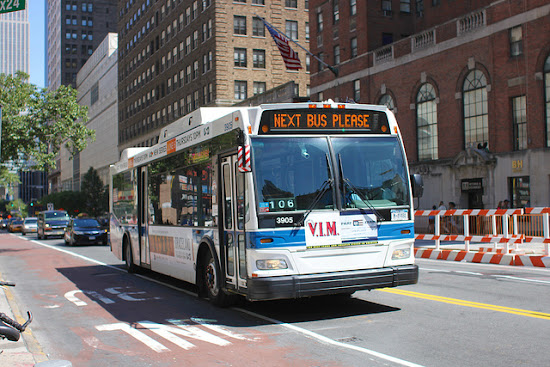
I got to the 77th Street stop, and there was an MTA van parked in it. Two guys in day-glo vests jumped out and inspected the ticket machines. A woman, also wearing a vest, was there to inform passengers. I squeezed past them and got a ticket, but by the time I got back around the machines, a bus was flying past the stop. It said "Next Bus Please," so it may have been full; I didn't get a chance to look. A few minutes later the guys emptied the change from the coin machine, got into their van, and left.
I saw a stack of brochures on top of the ticket machines and read one while I waited for the following bus. One thing that's not so good: if you transfer to the M15 Select Bus, you can't use the same ticket. You have to go to another ticket machine and stick your card or more money in. Presumably it's the same transferring from the Bx12 to the Bx41. That's pretty lame.
Also, the M60 is scheduled for every ten minutes on Sunday, but the local Q19, which replaces the local M60 service, is only every half hour on Sunday. That's not good.
I didn't time how long it took until the bus came, but it was a while, and when it came, it was so packed that only a few people could get on. There were five other people waiting, and since I wasn't in a hurry, I let the others board. The next bus was at least ten minutes after that. There was room to stand but no seats, even for the guy who was carrying a baby.
We flew down the Grand Central Parkway service road to Steinway and then 31st Street, and I got off. I didn't go to see how the buses were doing on 125th Street, but from what I saw on BusTime they weren't moving too fast.
My main impression is that the buses on this new route were doing very well in terms of ridership. I saw five buses, and they all had people standing. Two had no room for more passengers by 77th Street. If this isn't a fluke, the MTA will have to increase service on Sundays just to be able to fit everyone on.
Saturday, May 24, 2014
It's time to extend the N train to LaGuardia
Twenty years ago, Astoria leaders blocked a plan to extend the elevated train line that serves their neighborhood. The proposal would have run the trains a few blocks north past their current terminus at Ditmars Boulevard, then east to LaGuardia Airport. In addition to the value of getting airport travelers out of cars and taxis, the line would have served new stops in areas of northern Astoria and Woodside that currently have no subway service. It would also have made better use of the Astoria Line, where trains were often fairly empty just a few stops outside of Midtown.
In a move that baffled me at the time, "the community," meaning the people with political power in the neighborhood, came out strongly against the plan. Ben Kabak has a good summary with links, but the gist seems to be that they didn't like the idea of an el, and they didn't like the disruption caused by constructing a subway.
This came up in Ben's blog and podcast again recently because the MTA is set to inaugurate the M60 Select Bus Service, and a business group called the Global Gateway Alliance released an open letter calling for "true Bus Rapid Transit" between the airport and the Ditmars Boulevard terminus of the Astoria Line. Ben was baffled by several assertions in the letter (a regular feature of this story is the bafflement of transit advocates at the bizarre reactions of city elites to what seems like a very straightforward case for a subway extension), most of all the blithe dismissal of rail by noting it was "shelved due to community opposition."
The train was indeed shelved due to community opposition, as everyone reminds us, but what they fail to note is that the "community leaders" are all gone. Read through the list of politicians who came out against the plan. Denis Butler and Walter McCaffrey are dead. Peter Vallone, Senior is retired, and so is George Onorato, and Vallone Junior has been term-limited out. John Sabini was hustled off to the Racing Authority after a DUI conviction in 2007.
Not only are these windshield-perspective politicians gone, but their replacements are much less wedded to the idea that cars are the future. Senator Michael Gianaris and his protégée Assemblymember Aravella Simotas are disappointing in some ways, but they've kept their car activism pretty low-key, as has Senator José Peralta. City Council members Jimmy Van Bramer and Costa Constantinides are both progressive on transit issues. Van Bramer, who represents me, has supported congestion pricing and the Midtown Tunnel Bus. Constantinides lost a bit of cred by coming out way too early in support of another term for Jimmy Vacca as head of the Transportation Committee, but has been a strong supporter of livable streets issues overall.
I believe that Van Bramer is a member of Transportation Alternatives, and I know Constantinides has been not just a member but an active supporter, marching with them at public events. They may keep their One Less Car T-shirts in the bottom of their drawers, but they definitely do not see cars as the only way to prosperity for their constituents. Community Board 1 may still be led by trolls who think parking is Astoria's number one issue, but they'll be gone soon as well. More importantly, the voters and donors in that area care more about trains than parking today.
Another baffling element of the 1990s opposition to the extension was that it seemed like the objections could all have been overcome with some thought, but the "community leaders" weren't interested. The line could have been run entirely over the Grand Central "Parkway," or put underground as far south as Astoria Boulevard. A solid proposal that addresses those objections, especially if it has the backing of business leaders like the Global Gateway Alliance, should be able to win over Gianaris, Simotas and Constantinides, and eventually the rest of Astoria. It's not 1999, people, and we shouldn't be acting like it is.
Wednesday, April 30, 2014
Estimating crowded subways
It turns out that there's another hitch in estimating how crowded the subways are: in my last post I used the NYMTC's estimates of space per passenger from Table 20, but in the comments threestationsquare pointed out that they assume that every subway car has 602 square feet of space, which is definitely not true. Andrew suggested using the MTA's rush hour loading guidelines, which can be found on pages 26-31 of this PDF, and threestationsquare went with that. He also used the crowding in the 8AM hour, which makes sense since that's the peak hour for every line.
I'm on record as to the problems with loading guidelines. Capt Subway, who was a scheduler at the MTA for many years, added to my critique with his experiences, which are definitely worth a read. But the problems that the Capt noted are with the way the MTA measures compliance with the guidelines, and these are independent measures by the NYMTC. As Andrew noted, the rush hour guidelines are nowhere near as political as the off-peak guidelines, so I'm comfortable with that.
In every measure, however, the #7 train and the R have always been at the low end. This means that the capacity added in Long Island City has been a good thing, although as others have mentioned, a lot of people have moved into new apartments there since the fall of 2012, and more will come with Hunters Point South. There may not be any room left on the train by the time everything currently in the pipeline is built.
The J/M/Z and the 2/3 seem to have switched places, notably, so the zoning reforms should go in southern Bushwick rather than in Brooklyn Heights. But because there's still room on the R, we should allow some more residential development near Metrotech.
The Central Park West locals are an interesting challenge. As Jarrett Walker noted, when the "area served" by your station is half parkland or water, you need double the density to serve the same number of people - at least during the morning rush, when very few commuters are coming directly from Central Park. In consequence of the 2007 downzoning hysteria, that's not likely to happen soon. One thing that could help would be better crosstown bus service, so that more people can transfer from the bus.
It looks like, from the point of view of subway crowding, there isn't enough room to extend any of these subways. There may be the potential to reduce headways (which deserves its own post), but if not, I don't think it's worth a major capital investment if the rush hour loading is over 75% of the guidelines.
Saturday, April 26, 2014
Infilling the subways
Commenter threestationsquare pointed out that I made an error in the chart I posted about overcrowded subways. He also noted that it's Table 20 of the NYMTC Hub-bound Travel Study that gives floor space per passenger during morning rush in 2012. Here's a bar graph based on it:
At the uncrowded end of this chart are the Metro-North and Long Island Rail Road commuter trains, and this makes a lot of sense. First of all, they have more seats. They run long distances, and people should be able to sit all the way from Speonk or Purdy's. But they're also premium service. There's a very good argument to be made that they're oversubsidized, but if we want to cut the subsidies the place to do it first is in station parking.
The other big group of uncrowded trains are the #7 and the trains that run through downtown Brooklyn and Brooklyn Heights (the 2, 3, 4, 5, and R), and a major factor in this is that there are alternatives that get people where they're going faster. A lot of people transfer from the #7 to the N or Q at Queensboro Plaza, and from the R to the N at Pacific Street or the B at Dekalb Avenue. Many people who can walk to these trains will walk a block or two further to get a quicker ride to Midtown on the B, D, E, M, N or Q.
This is not necessarily a bad thing, because it makes room for infill development, bringing new riders who fill up the train afterwards. It has already been happening for years on the #7 train, for example, where people get off in Jackson Heights to transfer to the Queens Boulevard trains. The space they leave is filled up by people who live in Woodside and Sunnyside. When those people get off at Queensboro Plaza, their space is taken up by people coming from the new developments in Long Island City. Something similar happens with the R in Downtown Brooklyn, but to a lesser degree.
The new buildings in Long Island City use that space on the #7 train to help get people out of their cars, by increasing the amount of carfree housing available in the area so that moving to the suburbs and buying a car seems less attractive. Unfortunately, it doesn't do that completely. Even though LIC's zoning does not require developers to build parking, it encourages parking construction by allowing them to build taller if they build parking. The result is the blight of garages lining Fifth Street.
In Downtown Brooklyn, particularly near the R station at Metrotech, the 2/3/4/5 stations at Hoyt and Nevins, and the big transfer station at Borough Hall the city has pursued a single-use vision of office construction and bent over backward to discourage residential development. Senator Schumer, who lives up the hill in Park Slope, recently reiterated that party line. In addition to use and height limitations, this is also accomplished with minimum parking requirements. The residents of Brooklyn Heights have fought reforms in these areas as well. The result is that residential development has been pushed to Dumbo, Fort Greene and Boerum Hill, which are a long walk from most of the stations on the 2/3/4/5 and R.
In a future post I'll talk about potential extensions for other lines. But these areas have transit capacity to meet the demand for walkable, transit-accessible living space a short distance from Manhattan. They just need to be zoned to allow it, without requiring parking that will compete with the trains and add more cars to an area that already has way too many.
Labels:
access,
brooklyn,
comfort,
commuter rail,
efficiency,
land use,
mta,
Queens,
subway
Thursday, April 17, 2014
Our overloaded subways
As I wrote a couple of weeks ago, there are times when building new transit is not warranted. In particular, it is a waste of resources to build new radial capacity on the outskirts if it connects to a trunk line that can't absorb that capacity. I looked at the train crossings into Manhattan to see which could add trains in the peak. That information can suggest where to add branch lines. But what about extending existing lines or encouraging infill development?
The NYMTC's Hub Bound Travel Study has some useful data, but first it's important to give some context. They have an estimate for space per passenger, but it's only broken down by sector, not by line. They do have counts of train cars and passengers by line, so we can get passengers per car. The problem with that is that the cars are different sizes, so there is a lot more free space in an R train car with 341 people than a car with 308 people on the #4 train.
I don't know exactly which equipment was used on which lines in 2012, so I used the most recent train models I knew of. I couldn't find floor area figures, so I used the listed capacities. Please feel free to consult the spreadsheet and suggest revisions. (Edit, April 27: this chart is in fact inaccurate. Please see the comments below for threestationsquare's helpful observations.)
Here is an updated chart based on Table 20:
There are some additional questions that come to mind looking at the chart. If the demand for a line is low, is that always because it doesn't serve enough homes on the outskirts? Maybe, like the J train, it doesn't serve enough jobs. Maybe, like the R train, it's much slower than the alternative. Would extending these lines really get people out of their cars?
There is another question: yeah, an A train car with 713 people on it is really uncomfortable, but isn't a B train car with 429 people pretty uncomfortable too? This is why we need to continue to think about how we can offer comfortable alternatives to wasteful, dangerous individual car trips.
Saturday, March 29, 2014
If you're hub bound, there's room for you
Recently I posted that there seemed to be no room left in the subway tunnels and bridges leading into Manhattan. Threestationsquare, who had made the updated chart I used in that post, pointed me to the New York Metropolitan Transportation Council's Hub Bound Travel Study. And it turns out I was wrong. There is room - and the places where there is room have interesting potential.
The NYMTC is an arm of the New York State Department of Transportation that is responsible, among other things, for coming up with wildly inaccurate predictions of traffic volumes to justify bigger highways. But their underlying data is more sound, and a lot of it is online. The Hub Bound Travel Study is full of fascinating data for transportation nerds, and I wholeheartedly recommend it.
For our purposes, the relevant table is Appendix I, Table 6, "TOTAL RAIL TRAINS ENTERING AND LEAVING THE HUB ON A FALL BUSINESS DAY." Kind of poetic. (But it's trains going to the hub, not The Hub). If we look at the morning rush data for 2012, here's what we get:
There's a pretty wide spread between the #7 train, which manages to cram 23 trains per hour through the Steinway Tunnel, and the R train, which only sent eight trains an hour through the Montague Street Tunnel. In between we can see clusters in the low 20s, in the mid-teens, in the low teens, and then a few stragglers.
The busiest tunnels are the Lexington Avenue Express, the PATH, and the 60th and 53rd Street Tunnels to Queens. The uptown Broadway Express and the Cranberry Street Tunnel are also doing pretty well.
There is significant room on the Manhattan Bridge (as Threestationsquare mentioned) and the uptown #6 Local and Central Park West Express, and the Clark Street Tunnel to Brooklyn. Even the 14th Street Tunnel has capacity, despite promises that CBTC would improve things. We knew the Williamsburg Bridge had capacity, but it turns out, so do the locals on the Upper West Side.
The Montague Tunnel is currently closed to repair damage from Hurricane Sandy, but it's seen eight trains an hour since the M train was rerouted uptown in 2010. They ran 27 trains per hour in 2002, before the N was rerouted over the Manhattan Bridge. The R is just not a high-demand train in this area, because it crawls through Lower Manhattan. The two tunnels for the F (Rutgers Street and 63rd Street) see more trains, but they have plenty of room.
So there you have it! Looking forward to your fantasy maps...
Sunday, March 9, 2014
Getting into Manhattan
I've got a whole bunch of ideas for subway and bus expansions in the boroughs, commuter rail and bus expansions in the suburbs, and even intercity rail and bus connections. They all wash up against one big problem: the capacity of crossings into and out of Manhattan is almost maxed out at peak commuting times, the few big expansions in the works are proceeding slowly, and there doesn't seem to be political will to do much more.
Of the subways that cross the East River and the PATH trains that cross the Hudson, almost all the bridges and tunnels are packed with trains at rush hour, and those trains packed with passengers. The one exception is the Williamsburg Bridge, which is constrained by technical challenges, by the depopulation of South Side Williamsburg, Bushwick and East New York, by zoning restrictions on building, and by the fact that the J and Z trains only go to lower Manhattan. Since the MTA rerouted the M train to Midtown, ridership has gone up, and so have rents in Ridgewood, but that is the only line that is not at full capacity.
The only new subway crossing that has been given serious consideration recently, the Subway to Secaucus, has been stuck on a shelf somewhere.
MTA Capital Construction has installed an improved signalling system (CBTC) on the L line, which has allowed them to run more trains through the Fourteenth Street Tunnel. This capacity has been rapidly filled by an increase in ridership. They are rolling out CBTC to other lines, as the Port Authority is doing with the PATH trains, but funding limitations have stretched the rollout over years. As with the L train, the increased capacity is not expected to be enough to handle an additional branch on any line, only to allow neighborhoods near the existing branches to add population and to give some breathing room to passengers.
With commuter rail, the constraints are the platforms at Penn Station and the Park Avenue Tunnel. Alon Levy pointed out years ago that the constraints at Penn Station are not technical, but due to the three government-run commuter rail agencies' insistence on terminating all trains there, and our politicians' inability to force them to implement through-running arrangements.
For years the MTA has been pouring billions of dollars into East Side Access, but that will not be finished until 2023 at the earliest. The ARC Tunnel from New Jersey and its successor, the Gateway Tunnel, are being blocked by Governor Christie, who has used ARC funding to pay for road expansions.
Bus capacity into Manhattan is similarly constrained. Buses crossing from New Jersey through the Lincoln Tunnel can terminate at the Port Authority Bus Terminal, but that is also full. Proposals to build garages with public funds have faltered, and no private company seems interested in building a garage or terminal. The Port Authority is renovating the George Washington Bridge terminal, but that is too far north, and connects to a downtown A train that is also very crowded.
Any buses that can't fit into the Port Authority use city streets to pick up and drop off, as do buses from the other crossings. A backlash from NIMBYs, mostly drivers and business owners but aided by misguided pedestrian advocates, has put a lid on any expansion of curbside bus access.
As with commuter trains, there is a potential for through-running with buses along 34th or 42nd streets or Church Street that could relieve some of these constraints, but the bus operators have shown little interest, and political leaders have been too busy pandering to the backlash.
One reason bus operators may be uninterested in through-running or building terminals or garages is that there are also capacity constraints for buses on the bridges and tunnels. Anyone who's tried to take the Q32 into Manhattan in the morning knows what happens to bus travel times when a bridge is free for any vehicle. Passengers on the inbound QM5 express bus know that things run a little smoother when there is a toll and a bus lane, and people who have ridden the Red and Tan number 20 know that congestion pricing makes it even better. But even those passengers say that the bus lanes are too short, and those crossings with lanes and tolls are at capacity as well.
So that's the dismal state of getting commuters to Manhattan. What should we do about it? I'll talk about that in future posts.
Sunday, January 12, 2014
Off-peak service frequencies on the Long Island Rail Road
I made this map of off-peak service frequencies on the Long Island Rail Road.
Click through to see it full size.
Subscribe to:
Posts (Atom)