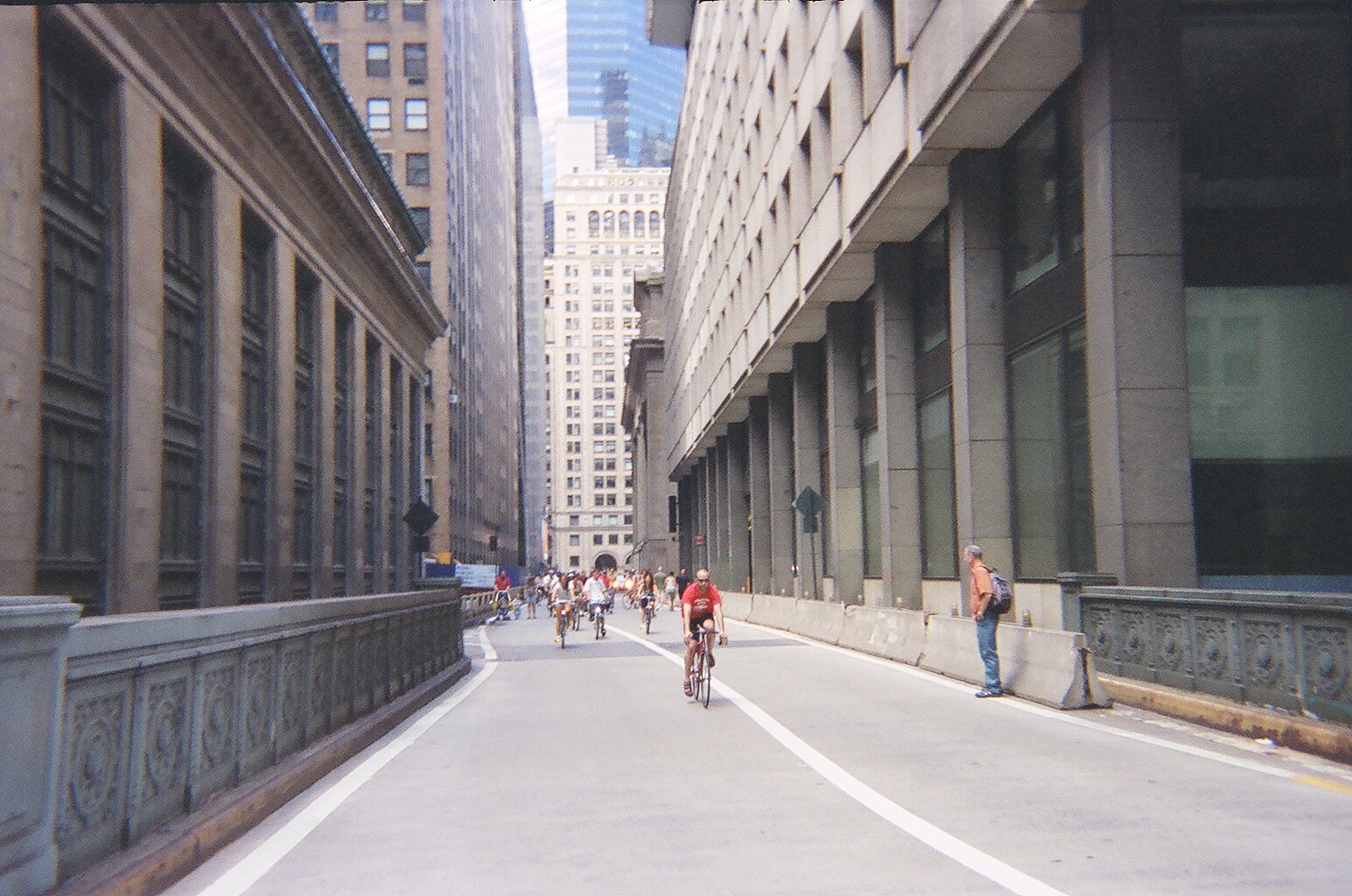
Here are some reasons to get people to shift from cars to transit:
Showing posts with label bicycling. Show all posts
Friday, June 22, 2018
What's the real story behind those photos of abandoned dockless bikeshare bikes?
At this point you've probably seen at least one, maybe several: pictures of "abandoned" or "discarded" dockless bikeshare bikes in China. I'm talking about the ones with hundreds, if not thousands, of bikes in the same picture. They're either very tightly stacked side by side, or more frequently jumbled on top of each other in a humongous heap, in a field or an empty lot. There's usually at least two different colors of bikes, representing different bikeshare companies.
There's almost never any explanation beyond a short caption. When I read "abandoned" I had this vision of some guy riding along on a bikeshare bike. All of a sudden the bike has a flat next to a field, so he casually tosses the bike into the field and walks on. A little while later a woman comes along. She gets tired of riding and stops next to the field, and sees the previous bike lying there. She tosses her bike on top of that one and walks away. Then some ill-behaved youths come running up carrying a bike that they found on a sidewalk, and throw it on top of that. It becomes the thing to do in this obscure Chinese city (Fuzhou? Chongqing? Qingdao?). For some reason, the bike companies have no interest in recuperating these hundreds of bikes, which have cost them tens of thousands of dollars. The bikes sit in the field and rust.
These photos are designed to scare, and they have been effective. Since they've appeared I have read several tweets, blog posts and articles where various people express their fear of "what happened in China." Ofo comes to town and next thing you know the hayfield behind the old Lowe's is full of bikes and there's nowhere to go smoke a joint. Those arrogant tech companies. We can't let that happen here!
You know what I haven't read? An explanation of how the bikes actually got in the field. Because the story I told is completely implausible. Yeah, I've heard about how wacky! and exotic! those Chinese people are. Then I got to know some, and it turns out they're just people. Sure, they'll do things in large numbers for money (like moving to cities) or social interaction (like the annual Lunar New Year travels) - just like Americans. They don't just do random stuff like throw bikes by the hundreds in some field.
What is the real story of what happened to those bikes in China? I'd be interested to know, but for now here's my guess: those bikes were thrown in that field - or stacked in that lot - by some organized group of people, led by a particular person or a small group. And the most likely organized group is the government. I strongly suspect that in every one of those pictures, the bikes were put there by government employees, on orders from some petty bureaucrat. Why? Maaaybe because they were broken. Maybe because the company had no permit to operate in that area. Maybe because that bureaucrat hates bikes. Maybe that bureaucrat is just an asshole.
When I think about it that way, it's no longer a story about arrogant tech companies or unsustainable bike share. It's not even about Those Wacky Chinese. It's about arrogant bureaucrats, supported by reactionary old people who drive, intent on maintaining control and preserving the hierarchy that puts them on top. And they're all boosted and broadcast by reactionary media people who love to get a rise out of us with scary photos.
That's a story as old as time, and it should scare us all that it's happening with bikeshare.
Monday, June 19, 2017
How we get safer crosstown streets
The killing of Citibike rider Dan Hanegby by a Short Line bus driver on West Twenty-Sixth Street this week highlighted a number of critical problems with the way buses are managed in Manhattan, and pointed up serious conflicts and contradictions in the agendas of transit, pedestrian and cycling advocates in the New York area and beyond.
It’s true that buses are dangerous to cyclists, and to pedestrians as well. The person who has always articulated this most clearly and forcefully has been Peter Smith. In a guest piece for Cyclelicious he focuses on “Bus Rapid Transit”; in a comment on a Greater Greater Washington post he talks about buses and bikes in general, and in a comment on a Bike Portland post he specifically discusses cases where bus drivers hit cyclists.
On a basic level, Smith is right: if we are really committed to Vision Zero, "the end goal is to do away with all vehicles that cannot live harmoniously with human beings — buses and cars should be the first to go." And although he claims that buses are more scary than cars, he also says that "the single occupancy vehicle in the city is the greatest manifestation of that evil—so it shouldn’t be tolerated."
If buses (and cars and trucks) cannot coexist with cyclists and pedestrians, what do we do about it? Smith’s vision is primarily centered around bikes and pedestrians, but sometimes people want to go further than they can bike. Sometimes we want to carry things - maybe very big things. And sometimes we can’t walk or bike at all. The answer, of course, is trains, as I’ve written before, and as @DoorZone wrote on Twitter in response to this tragedy:
NYC should only allow vehicles w/ governors, dead man's switches, & w/out horns south of 60th St. https://t.co/dalSbAOqH8
— DoorZone (@D00RZ0NE) June 16, 2017
That’s a lovely vision of the future, but how do we get to it? Even the wise cannot see all ends, but it seems like gradually investing more and more in rail (including at-grade trolleys), pedestrian and cycling infrastructure, and ending subsidies and requirements for roads and parking will lead to an incremental shift away from cars, buses and trucks and towards trains, bikes and walking. I think we can also do more with wheelbarrows, hand carts, cargo bikes and other non-motorized freight carriers than we currently do.
Unfortunately, our city’s advocates for walking and cycling aren’t conducting anything like a coherent campaign to shift our long-distance and heavy-goods movement from cars, buses and trucks to trains and trolleys. In fact, many of them are actively hostile to subways and trolleys, treating them as luxuries for the rich. In contrast, they elevate walking, cycling - and buses. In particular, they are fond of "Bus Rapid Transit," which they see as cheap, quick and democratic, and sometimes explicitly tout as a "surface subway."
These proposals are often presented as ways to get working-class New Yorkers to from homes outside of Manhattan to jobs outside of Manhattan, but there are still lots of jobs in Manhattan, and it’s a convenient transfer point to get to other parts of the metro area. In particular, there are lots of working-class people who live in parts of New Jersey and Rockland County where the bus is the most convenient way to get to work - and in fact, the Lincoln Tunnel Exclusive Bus Lane is the most rapid bus facility in the metro area.
But because of the way buses are mismanaged in New York City, there are almost no through-running bus lines. People from New Jersey have to get off the bus at or near the Port Authority Bus Terminal and make their way to jobs or shopping, usually by transferring to a subway.
The "Bus Rapid Transit" boosters are right about one aspect of buses: they can be scaled up quickly in response to increased demand. This worked very well when demand for transit rose beginning in 2007, in response to rising gas prices and crashing home equity. People began taking the bus in greater numbers, not just to get from the New Jersey suburbs in to Manhattan, but from cities like Philadelphia and Washington, and even further afield through the Chinatown bus network and relative newcomers like Megabus, Bolt and Vamoose.
The problem was that the "BRT" facility - the Exclusive Bus Lane and the Port Authority Bus Terminal that it feeds into - were already over capacity. So our "BRT" activists immediately demanded that it be expanded, right? No, they were actually pretty quiet about it, which left the bus operators to establish pick-up spots on the street, at handy transfer points in Manhattan, particularly Chinatown and Midtown.
When NIMBY "community members" came out to complain about the buses, were our “BRT” activists there to oppose them? No, they were pretty much AWOL, as they had been when NIMBYs torpedoed the 34th Street Busway. They did nothing as the State Senate forced bus operators to run a gauntlet of NIMBYs before they could legally pick up passengers on the street, and they haven’t had the power to increase off-street infrastructure.
Despite Peter Smith’s allegations I have not seen any proof that buses are any more dangerous than cars. In fact, we would expect them to be less dangerous, since they are operated by trained professionals with their careers potentially on the line. And yet self-proclaimed pedestrian advocates like Christine Berthet continue to repeat these allegations and to lobby for ever-greater restrictions on buses, and others in the livable streets movement echo them.
So what should we do to make our streets safer for cyclists? Some have called for physically separated crosstown bike lanes at key intervals. I like this idea. But what if you’re riding to a destination - or to a Citibike station - that isn’t on one of those streets? Can we create physically separated lanes on every street in the city? I don’t think that’s feasible or necessary.
As I’ve been arguing for years, we need to reconfigure our "side" streets as yield streets. They are all at least sixty feet wide. If you’ve ever been on one when it’s closed for construction or events, you know that they have plenty of room for two-way car traffic, and a hundred years ago they were all two-way. They can even accommodate a lane of parked cars on each side, plus a lane of moving cars in each direction, as long as the vehicles are all relatively narrow. When people started double parking it caused congestion, so the city changed them to one-way traffic flow - which has in turn led to a large increase in traffic as drivers circle the blocks. But when there is no double-parking the driving lane is extra wide, which leads to drivers speeding and crowding out cyclists.
The solution, as recommended by Andres Duany and Elizabeth Plater-Zyberk and the NACTO Street Design Guide, is to reserve space for loading zones throughout the length of each block, return all the streets to two-way flow, and ramp up enforcement of double parking. Then it is important to monitor the situation and increase the space for loading zones as necessary. Additional traffic calming measures like chicanes and pavement treatments may be necessary. If the design is implemented properly, drivers will be deterred from speeding by the prospect of a head-on collision, and will be less likely to pressure cyclists into the door zones.
You might have wondered why, instead of 26th Street in Manhattan where Dan Hornegby was killed, I used a picture of the 137-00 block of 45th Avenue in Flushing to illustrate an over-wide one-way cross street. As you can see from the second photo, the rest of the blocks on 45th Avenue are two-way, and people drive much more slowly and carefully. (Holly Avenue, one block south, is the same width, two-way, and a bus route.) Again, these yield streets are not a substitute for protected bike lanes, but a treatment for streets that are not chosen as high-priority cycling corridors. In other words, it should be the default configuration for all streets that are less than eighty feet wide.
In the long term, yes, we do need to get buses off our streets, but the urgency to get private cars off the streets is just as great. In the short term, we could do a lot more to accommodate buses in Manhattan, like facilitating through-running and stops on major crosstown streets. To make crosstown streets safer for cyclists, we should implement protected bike lanes leading to Citibike stations near all Midtown subway stations. The rest of the crosstown streets should be reconfigured as two-way yield streets.
Sunday, June 11, 2017
Long distance coaches should carry bikes
A couple of years ago I was in Penn Station and heard an announcement about bustitution due to track work. The announcer informed us that the buses would not be able to accept bikes. Just the day before I had been talking with some people about cycling in Montreal. I haven't had a chance to experience it, because I haven't been there since before they rolled out the Bixi bike share. Years ago I had planned to bring my bike there on a visit, but there was bustitution and Amtrak informed me I wouldn't be allowed to take the bike on the substitute buses.
In many small cities, government-run local buses are equipped with a front rack that can hold two or three bicycles. But the policy of long distance, usually private, coach operators (at least in North America) is typically that they will only allow bikes to be stored in the cargo bins if they are in boxes, with the handlebars removed. Of course, it is very difficult for a bicycle rider to carry a box large enough to hold the bike, and removing and reattaching handlebars requires time, skill and specialized tools.
Why do they do this? It smells to me of that toxic combination of elitism and liability worries that makes it painful to interact with American corporations. The owners and executives of the coach companies don't take their own buses, and they don't ride bikes. They don't want to take bikes on the coaches: they take up a lot of space, it's time-consuming for the drivers, and they're afraid of being sued if the bikes get broken. Their lawyers said something about liability, so they made a rule: no bikes.
If we could get long distance coaches to accept bicycles in a convenient way, this could easily be used to extend the coach network, with a measurable benefit to the lives of people who don't own cars. When I was a teenager, I was essentially cut off from all the jobs at the local mall because it was five miles from the nearest coach station. The roads from the bus station to the mall were relatively friendly to bike riders, but the roads from my town to the bus station were not. This would also encourage people to take a coach for tourism.
I’ve seen a few blog posts by bike advocates in favor of racks on city buses, or space for bikes on trains. But I don’t recall ever seeing one in favor of convenient bike storage on long-distance coaches. Do you know any coach operators that carry bikes conveniently? Was there anything that overcame their objections and persuaded them to do this?
Sunday, July 24, 2016
A way among the tube socks
I am not a Bicycle Advocate, and I don't believe that Bikeshare is Transit. But I'm now convinced that the combination of bike share and protected bike lanes has improved mobility for a lot of people. It has worked for me when I've traveled to DC and London, and at home here in New York. The cost has been relatively low, whether measured in terms of dollars, square feet of public space, or advocacy hours.
In my experience, bikeshare is not effective for getting people out of cars and taxis and decongesting our subways and sidewalks without that network of protected lanes and quiet side streets. I am a cautious rider, and I avoid streets where it feels like drivers have too much power or speed. Rather than fear for my life I will just walk or take the subway.
A few months ago I was on Irving Place and wanted to go to Soho. I figured I'd ride the relatively quiet Eighteenth Street to the Second Avenue protected bike lane. But when I got to Third Avenue I found my way blocked by a street fair.
I turned south for a few blocks on Third Avenue. I hate riding on big avenues without a bike lane; the drivers are either speeding or frustrated or both. It was also difficult to remember which streets went which way, but I think I avoided the pattern at Stuyvesant Square that sends you back west on Fifteenth Street, and headed east on Twelfth.
I was looking forward to getting onto Second Avenue. But when I got there I found the avenue completely filled by another street fair. These were not genuine community festivals, but the generic fairs that have become the norm here in New York City. My way was blocked by tube socks and mozzarepas. There wasn't even room on the sidewalk to walk my Citibike.
I doubled back and rode down Third Avenue again. I checked again a few blocks later and I was past the fair, but that was just luck; I didn't know until I'd gone all the way down the block.
For bikeshare to serve as a true transportation option, we don't just need a bike route network , but a reliable one. If any part of it is unavailable, the whole network is compromised, and people will be less likely to rely on it.
Of course it's not just bikes; the car network is disrupted. But drivers have lots of alternate routes: a driver whose way is blocked on Second Avenue would not be terribly inconvenienced by driving on Third. But for me, with Second Avenue blocked the nearest protected southbound avenue is Ninth Avenue/Hudson Street/Bleecker Street, meaning I would have to bike clear across the island and back.
This is also an issue for pedestrians. Walking a long city block out of the way is not always practical, leaving those of us trying to get somewhere mixing with the zeppole eaters.
As many have said, we need to reform these street fairs. We also need to convert more car lanes to bike lanes on the avenues. But in addition, we need to preserve some bike access through street fairs. If they can have fairs on sixty foot cross streets like Eighteenth, they can leave twelve feet of space on a 75-foot avenue like Second.
At a minimum, we should have some notification system for when the bike lane network is disrupted, whether by street fairs, construction or something else. A tweet on the Citibike feed would help.
In my experience, bikeshare is not effective for getting people out of cars and taxis and decongesting our subways and sidewalks without that network of protected lanes and quiet side streets. I am a cautious rider, and I avoid streets where it feels like drivers have too much power or speed. Rather than fear for my life I will just walk or take the subway.
A few months ago I was on Irving Place and wanted to go to Soho. I figured I'd ride the relatively quiet Eighteenth Street to the Second Avenue protected bike lane. But when I got to Third Avenue I found my way blocked by a street fair.
I turned south for a few blocks on Third Avenue. I hate riding on big avenues without a bike lane; the drivers are either speeding or frustrated or both. It was also difficult to remember which streets went which way, but I think I avoided the pattern at Stuyvesant Square that sends you back west on Fifteenth Street, and headed east on Twelfth.
I was looking forward to getting onto Second Avenue. But when I got there I found the avenue completely filled by another street fair. These were not genuine community festivals, but the generic fairs that have become the norm here in New York City. My way was blocked by tube socks and mozzarepas. There wasn't even room on the sidewalk to walk my Citibike.
I doubled back and rode down Third Avenue again. I checked again a few blocks later and I was past the fair, but that was just luck; I didn't know until I'd gone all the way down the block.
For bikeshare to serve as a true transportation option, we don't just need a bike route network , but a reliable one. If any part of it is unavailable, the whole network is compromised, and people will be less likely to rely on it.
Of course it's not just bikes; the car network is disrupted. But drivers have lots of alternate routes: a driver whose way is blocked on Second Avenue would not be terribly inconvenienced by driving on Third. But for me, with Second Avenue blocked the nearest protected southbound avenue is Ninth Avenue/Hudson Street/Bleecker Street, meaning I would have to bike clear across the island and back.
This is also an issue for pedestrians. Walking a long city block out of the way is not always practical, leaving those of us trying to get somewhere mixing with the zeppole eaters.
As many have said, we need to reform these street fairs. We also need to convert more car lanes to bike lanes on the avenues. But in addition, we need to preserve some bike access through street fairs. If they can have fairs on sixty foot cross streets like Eighteenth, they can leave twelve feet of space on a 75-foot avenue like Second.
At a minimum, we should have some notification system for when the bike lane network is disrupted, whether by street fairs, construction or something else. A tweet on the Citibike feed would help.
Thursday, September 17, 2015
Next stop: 34th Street-Hudson River Greenway
I rode the 7 train to the new 34th Street stop for the first time today. Too late? Well, I figured you all had the opening covered. I want to talk about the new connections that this station makes possible. The Times has mentioned that it's right across the street from the High Line, but I'm one of the few who have pointed out that the massive Megabus stop complex is right there too, and BoltBus is a block away. But also across the street is a Citibike dock, and a block away is the Hudson River Greenway.
This makes 34th Street-Hudson Yards the closest subway station to the river in Midtown. Only a handful of other stations come that close: Bowling Green and World Trade Center downtown, 79th and 96th on the Upper West Side, 145th in Harlem, 157th in Washington Heights, and Dyckman Street in Inwood. None of the ones above 79th currently have Citibike docks.
Thanks to the new station, a Citibike transfer to the Hudson River Greenway is now available. I've done similar connections before, but mostly the other way: riding a Citibike up the Eighth Avenue bike lane to 40th Street. Even then, that one long block on unprotected Midtown streets ends the bike ride on a sour note.
I once tried going the other way, riding a Citibike from Times Square across 41st Street to Ninth Avenue, but those two blocks were worse than one, and the abuse of the bike lane at the back of the Farley Post Office was depressing. I've ridden all the way across 42nd from Times Square to the Hudson River Greenway, once in each direction, and neither is an experience I want to repeat.
So today I took the 7 to 34th Street, rode the slow-ass funicular to the surface, hopped on a Citibike and only had to deal with one, relatively low-traffic, block of 34th Street. Then I was flying south on the Greenway, mostly protected from cars for a nice long way.
I really had only one worry: when I pulled up the Spotcycle app, it only showed me one free bike at the station. There was a second bike, but it was unavailable. I'm glad nobody took that bike before I got to it. I hope Citibike adds more docks or schedules it for more rebalancing, because it looks pretty popular.
This makes 34th Street-Hudson Yards the closest subway station to the river in Midtown. Only a handful of other stations come that close: Bowling Green and World Trade Center downtown, 79th and 96th on the Upper West Side, 145th in Harlem, 157th in Washington Heights, and Dyckman Street in Inwood. None of the ones above 79th currently have Citibike docks.
Thanks to the new station, a Citibike transfer to the Hudson River Greenway is now available. I've done similar connections before, but mostly the other way: riding a Citibike up the Eighth Avenue bike lane to 40th Street. Even then, that one long block on unprotected Midtown streets ends the bike ride on a sour note.
I once tried going the other way, riding a Citibike from Times Square across 41st Street to Ninth Avenue, but those two blocks were worse than one, and the abuse of the bike lane at the back of the Farley Post Office was depressing. I've ridden all the way across 42nd from Times Square to the Hudson River Greenway, once in each direction, and neither is an experience I want to repeat.
So today I took the 7 to 34th Street, rode the slow-ass funicular to the surface, hopped on a Citibike and only had to deal with one, relatively low-traffic, block of 34th Street. Then I was flying south on the Greenway, mostly protected from cars for a nice long way.
I really had only one worry: when I pulled up the Spotcycle app, it only showed me one free bike at the station. There was a second bike, but it was unavailable. I'm glad nobody took that bike before I got to it. I hope Citibike adds more docks or schedules it for more rebalancing, because it looks pretty popular.
Thursday, January 15, 2015
Driving to the walkway
Among the many crazy things about the new Tappan Zee Bridge, one of the craziest is the way that some environmentalists seem to melt into some kind of reverie whenever it's mentioned that the bridge is planned to have a bicycle and pedestrian path on it (once the original span is demolished and the second span built, sometime in the 2020s). It was one of the most effective greenwashing campaigns I've ever seen, giving liberals permission to dismiss concerns about sprawl and waste while satisfying them that they're doing "something for the environment."
Of course, there are many concerns about the bicycle and pedestrian path itself. I am very much in favor of access to bridges for non-motorized transportation, and I'm sure if nothing else it would see a ton of bike traffic on weekends from the regular cycling crowd that rides up 9W. But how many people would ride three miles over the bridge to commute or go shopping, much less walk? From Nyack to Grand Central via the bridge is over thirty miles each way, and the George Washington Bridge path is not crowded during rush hours. I've ridden and walked the roads at both ends of the bridge, and once you get away from the river towns and greenways they're really not safe or pleasant.
As Jane Jacobs wrote, "Parks are not automatically anything." What could make this a successful park? It would have stunning views, but would it be filled with deafening car noise like the paths on the George Washington and Triboro Bridges? How many people would cross when the weather is bad? How often would it be patrolled during off-hours?
But the crazy doesn't stop there. In November, the State released a study claiming that "151 total parking spaces are needed for both counties; 97 spaces in Westchester and 54 spaces in Rockland." That's right, they expect that more than 150 people would come by car during peak times and want to park and walk across the bridge - or maybe bring their bikes on racks on top of the car. But don't worry, the state planners say, we can just knock down the South Nyack Village Hall for parking - or maybe convert it to a "comfort station." Some day you might be pissing in the Mayor's office!
To be fair to the state planners, they based their estimates in part on projects like the "Walkway Over the Hudson," a similar project that took a valuable piece of transportation infrastructure and turned it into a tourist attraction where people drive from miles around to go for a walk.
The planners did consider the possibility (alternatives C1 and C2) of using meter and permit regulations to discourage tourists from parking on the streets of South Nyack, and constructing a sidewalk next to the three blocks of buildings and gardens that have been constructed in between the end of the Esposito rail-trail and the underused parking crater in downtown Nyack, allowing tourists to use that parking - and shop at local businesses while they're at it. That seems like far and away the most sensible approach, maybe too sensible for this project.
So there you have it, folks: a three-mile "shared-use path" that would not provide meaningful transportation options for more than a handful of people, that will probably be empty 90% of the time, and in the other 10% would attract 150 cars, for which the State may well bulldoze a historic town hall. And you know what? As a tourist attraction, it's probably okay. It's active and outdoors. Just don't try to tell me that it would be "environmentally friendly," or provide any meaningful contact with nature, or justify the money or the sprawl.
Of course, there are many concerns about the bicycle and pedestrian path itself. I am very much in favor of access to bridges for non-motorized transportation, and I'm sure if nothing else it would see a ton of bike traffic on weekends from the regular cycling crowd that rides up 9W. But how many people would ride three miles over the bridge to commute or go shopping, much less walk? From Nyack to Grand Central via the bridge is over thirty miles each way, and the George Washington Bridge path is not crowded during rush hours. I've ridden and walked the roads at both ends of the bridge, and once you get away from the river towns and greenways they're really not safe or pleasant.
As Jane Jacobs wrote, "Parks are not automatically anything." What could make this a successful park? It would have stunning views, but would it be filled with deafening car noise like the paths on the George Washington and Triboro Bridges? How many people would cross when the weather is bad? How often would it be patrolled during off-hours?
But the crazy doesn't stop there. In November, the State released a study claiming that "151 total parking spaces are needed for both counties; 97 spaces in Westchester and 54 spaces in Rockland." That's right, they expect that more than 150 people would come by car during peak times and want to park and walk across the bridge - or maybe bring their bikes on racks on top of the car. But don't worry, the state planners say, we can just knock down the South Nyack Village Hall for parking - or maybe convert it to a "comfort station." Some day you might be pissing in the Mayor's office!
To be fair to the state planners, they based their estimates in part on projects like the "Walkway Over the Hudson," a similar project that took a valuable piece of transportation infrastructure and turned it into a tourist attraction where people drive from miles around to go for a walk.
The planners did consider the possibility (alternatives C1 and C2) of using meter and permit regulations to discourage tourists from parking on the streets of South Nyack, and constructing a sidewalk next to the three blocks of buildings and gardens that have been constructed in between the end of the Esposito rail-trail and the underused parking crater in downtown Nyack, allowing tourists to use that parking - and shop at local businesses while they're at it. That seems like far and away the most sensible approach, maybe too sensible for this project.
So there you have it, folks: a three-mile "shared-use path" that would not provide meaningful transportation options for more than a handful of people, that will probably be empty 90% of the time, and in the other 10% would attract 150 cars, for which the State may well bulldoze a historic town hall. And you know what? As a tourist attraction, it's probably okay. It's active and outdoors. Just don't try to tell me that it would be "environmentally friendly," or provide any meaningful contact with nature, or justify the money or the sprawl.
Monday, November 17, 2014
When bike paths are not transportation
I've written before about the capacity of bike paths to move large numbers of people. A dedicated bike path performs this function best when it connects dense residential neighborhoods with dense job centers. The bike paths on the Brooklyn, Manhattan, Williamsburg and Queensboro Bridges are great examples of this. They may not transport as many people in a day, but they don’t transport thousands of dangerous, wasteful motor vehicles either. This is why we should convert one lane of the Brooklyn Bridge to a two-way bike path.
That said, a frequent train line can beat a bike path, or even a car lane, any day. On the Manhattan Bridge one fall day in 2012, according to the New York Metropolitan Transportation Council’s Hub-Bound Travel Study, one car lane carried almost five times as many people as the bike lane, but one subway track carried 36 times as many.
With that in mind, let’s turn to the Rockaway Beach Branch, and to a proposal to convert it to a bike trail instead of reactivating train service. The Trust for Public Land argues that it “will” (not “could”) fulfill a similar transportation function:
Yes, that’s nice, but how many of them would actually use it? I could save ten to fifteen minutes off my commute by biking to the subway station, but I don’t do it because there’s just a plain rack to lock it to. There is no secure bike parking at any subway station near me, and there is none proposed in the trail plan.
Even assuming that secure parking was built, or that every potential bike commuter was comfortable locking their bike up at a plain old rack (and that the city built enough additional plain old racks to accommodate them, how many cyclists are we talking about? I’m guessing it would be far below the 2,601 cyclists that the NYMTC counted on the Manhattan Bridge on that fall day in 2012.
Now let’s assume that instead we brought trains back to the Rockaway Beach Branch. Let’s assume that the service is the crappiest possible: less than once an hour off-peak and a mandatory change to get to Manhattan, like the Long Island Rail Road Oyster Bay Branch. We would still get at least 3,350 riders a day (PDF).
If instead we dug a tunnel under a few blocks of Rego Park and ran the R train out to Howard Beach, we would see a lot more riders. Even if there were only four stations and all of them had the ridership of the 104th Street station on the A train (1,736), that would still be almost 7,000 riders a day. The least popular station on the R train, 36th Street in Long Island City, saw 4,540 riders last year, and I’ve proposed adding stations at Myrtle Avenue and Fleet Street to serve large buildings that were built since the line’s fortune declined. The half million riders heralded by some rail proponents may be too ambitious, but even if the line is a dismal failure it would serve far more people per day than a trail.
If you’re still thinking of the bike trail as a transportation project, look at this quote from the Trust for Public Land:
(I’m pretty sure that last part about remaining open slightly later was added after I tweeted about this.) The bike paths on the Brooklyn, Manhattan, Williamsburg and Queensboro Bridges are open twenty-four hours. That’s because they’re transportation infrastructure, not parks.
That said, a frequent train line can beat a bike path, or even a car lane, any day. On the Manhattan Bridge one fall day in 2012, according to the New York Metropolitan Transportation Council’s Hub-Bound Travel Study, one car lane carried almost five times as many people as the bike lane, but one subway track carried 36 times as many.
With that in mind, let’s turn to the Rockaway Beach Branch, and to a proposal to convert it to a bike trail instead of reactivating train service. The Trust for Public Land argues that it “will” (not “could”) fulfill a similar transportation function:
Using the QueensWay to connect to subway stations, commuters could save 15 – 20 minutes each way to major work destinations such as Midtown Manhattan and Downtown Brooklyn. Residents will also be able to use the QueensWay to connect to stores and other destinations. … Using the QueensWay to connect to subway stations, commuters could save 15 – 20 minutes each way to major work destinations such as Midtown Manhattan and Downtown Brooklyn. Residents will also be able to use the QueensWay to connect to stores and other destinations.
Yes, that’s nice, but how many of them would actually use it? I could save ten to fifteen minutes off my commute by biking to the subway station, but I don’t do it because there’s just a plain rack to lock it to. There is no secure bike parking at any subway station near me, and there is none proposed in the trail plan.
Even assuming that secure parking was built, or that every potential bike commuter was comfortable locking their bike up at a plain old rack (and that the city built enough additional plain old racks to accommodate them, how many cyclists are we talking about? I’m guessing it would be far below the 2,601 cyclists that the NYMTC counted on the Manhattan Bridge on that fall day in 2012.
Now let’s assume that instead we brought trains back to the Rockaway Beach Branch. Let’s assume that the service is the crappiest possible: less than once an hour off-peak and a mandatory change to get to Manhattan, like the Long Island Rail Road Oyster Bay Branch. We would still get at least 3,350 riders a day (PDF).
If instead we dug a tunnel under a few blocks of Rego Park and ran the R train out to Howard Beach, we would see a lot more riders. Even if there were only four stations and all of them had the ridership of the 104th Street station on the A train (1,736), that would still be almost 7,000 riders a day. The least popular station on the R train, 36th Street in Long Island City, saw 4,540 riders last year, and I’ve proposed adding stations at Myrtle Avenue and Fleet Street to serve large buildings that were built since the line’s fortune declined. The half million riders heralded by some rail proponents may be too ambitious, but even if the line is a dismal failure it would serve far more people per day than a trail.
If you’re still thinking of the bike trail as a transportation project, look at this quote from the Trust for Public Land:
To ensure safety and security for neighbors and park users, the QueensWay will have gates at all entrances. The QueensWay will close at dusk except during winter months, when it will remain open slightly later to accommodate commuters.
(I’m pretty sure that last part about remaining open slightly later was added after I tweeted about this.) The bike paths on the Brooklyn, Manhattan, Williamsburg and Queensboro Bridges are open twenty-four hours. That’s because they’re transportation infrastructure, not parks.
Thursday, July 24, 2014
Why we need a Brooklyn Bridge cycle track
I remember when you could walk or bike over the Brooklyn Bridge at almost any hour and not feel crowded. Those days are long past: walking over the bridge has become a major tourist activity, and commuting by bike has become extremely popular. Thanks to hard work by advocates, especially Transportation Alternatives, the city reopened the south sidepath on the Manhattan Bridge to bicycles and pedestrians in 2001, and the north sidepath to bikes in 2004, taking a lot of daily commuters and recreational walkers and joggers off the Brooklyn Bridge.
Even with this additional capacity, the Brooklyn Bridge path gets a lot more cyclists and pedestrians than it can comfortably handle. Pedestrians complain bitterly about the cyclists, and vice versa. Often it is deserved: I've seen many thoughtless cyclists bombing down the offramp, and many clueless pedestrians drifting into the bike lane without looking. But mainly, the pie is too small for all the people who now want a slice. We need more capacity.
There have been proposals in the past to simply ban cyclists from the bridge, and the satirical @bikelobby account on Twitter has capitulated, but often the proposal is to build a new bikeway somewhere on top of the existing bridge structure, as with this 2012 proposal by City Council members Lander, Chin and Levin. I don't think we need to spend that much money; we should simply convert one of the current car lanes to a two-way cycle track.
Converting car lanes to cycle tracks is also not a new thing. It's been done over and over again by the city in the past seven years, first on Ninth Avenue, then Eighth and Kent and now even on the Pulaski Bridge, where the current multiuse path between Greenpoint and Long Island City is similarly strained. This would just be the same thing on the main level of the Brooklyn Bridge, and then the upper multiuse path could be dedicated to pedestrians. It's been proposed for the Brooklyn Bridge before, by Streetsblog commenters and Robert Sullivan.
You might think that the city could not afford to give up that car capacity, but in fact it might wind up increasing the total number of people who cross on the Brooklyn Bridge. There are no buses (or trucks) currently allowed on the bridge. The Manhattan Bridge bike path is well traveled, especially during rush hours, and the number of cyclists can rival the number of cars on nearby lanes.
Last month, at 7:30 on a Tuesday, Clarence Eckerson of Streetfilms took a quick count on the Manhattan Bridge. He counted a hundred cyclists in two minutes and 23 seconds, a rate that corresponds to2691 2517 vehicles per hour. By contrast (PDF), in 2010 the three outbound car lanes of the Brooklyn Bridge carry 3509 vehicles between 5:00 and 6:00 PM, or 1170 vehicles per lane per hour. The five outbound car/bus/truck lanes on the Manhattan Bridge carried 2382 vehicles, or only 476 vehicles per lane per hour.
In a subsequent tweet, Clarence acknowledged that his sample may not have been representative. "well I am sure that pace didn't hold up!" he wrote. "A dozen were on a tour group" But even if the typical peak counts are not that high (see this PDF from the city DOT), they are probably higher than 476 per hour, and maybe higher than 1170 per hour. This suggests that one of the lanes on the Brooklyn Bridge's main deck would carry more people in the peak rush hour as a two-way cycle track than it currently does as a single car lane.
Clearly there is more research to be done: more samples of peak hour bike and motor vehicle traffic, on both the Brooklyn and Manhattan Bridges. I'm looking forward to the Streetfilm!
Even with this additional capacity, the Brooklyn Bridge path gets a lot more cyclists and pedestrians than it can comfortably handle. Pedestrians complain bitterly about the cyclists, and vice versa. Often it is deserved: I've seen many thoughtless cyclists bombing down the offramp, and many clueless pedestrians drifting into the bike lane without looking. But mainly, the pie is too small for all the people who now want a slice. We need more capacity.
There have been proposals in the past to simply ban cyclists from the bridge, and the satirical @bikelobby account on Twitter has capitulated, but often the proposal is to build a new bikeway somewhere on top of the existing bridge structure, as with this 2012 proposal by City Council members Lander, Chin and Levin. I don't think we need to spend that much money; we should simply convert one of the current car lanes to a two-way cycle track.
Converting car lanes to cycle tracks is also not a new thing. It's been done over and over again by the city in the past seven years, first on Ninth Avenue, then Eighth and Kent and now even on the Pulaski Bridge, where the current multiuse path between Greenpoint and Long Island City is similarly strained. This would just be the same thing on the main level of the Brooklyn Bridge, and then the upper multiuse path could be dedicated to pedestrians. It's been proposed for the Brooklyn Bridge before, by Streetsblog commenters and Robert Sullivan.
You might think that the city could not afford to give up that car capacity, but in fact it might wind up increasing the total number of people who cross on the Brooklyn Bridge. There are no buses (or trucks) currently allowed on the bridge. The Manhattan Bridge bike path is well traveled, especially during rush hours, and the number of cyclists can rival the number of cars on nearby lanes.
Last month, at 7:30 on a Tuesday, Clarence Eckerson of Streetfilms took a quick count on the Manhattan Bridge. He counted a hundred cyclists in two minutes and 23 seconds, a rate that corresponds to
In a subsequent tweet, Clarence acknowledged that his sample may not have been representative. "well I am sure that pace didn't hold up!" he wrote. "A dozen were on a tour group" But even if the typical peak counts are not that high (see this PDF from the city DOT), they are probably higher than 476 per hour, and maybe higher than 1170 per hour. This suggests that one of the lanes on the Brooklyn Bridge's main deck would carry more people in the peak rush hour as a two-way cycle track than it currently does as a single car lane.
Clearly there is more research to be done: more samples of peak hour bike and motor vehicle traffic, on both the Brooklyn and Manhattan Bridges. I'm looking forward to the Streetfilm!
Thursday, December 5, 2013
Getting around the Meadowlands
If you've spent enough time in New Jersey, you know that it actually has some really nice, walkable, pretty towns, and some hip urban neighborhoods, and some beautiful parks. The challenge is getting between them. Buses and trains help, but some of us like to walk, or ride bikes.
One time I just got on my bike and ride west. That was an experience. I took the ferry to Hoboken and rode over the Palisades, and then I got to the Meadowlands. I got through, but it was miserable. If you've ever tried to get between Jersey City and Newark without a motorized vehicle you've basically got two options, the Lincoln Highway or the Newark Turnpike, and they're both as unwelcoming as they sound. I thought at one point that I should have taken the PATH train to Newark.
It makes sense for the Meadowlands to be not such a walkable place. It is a swamp, after all. As much as we've abused it, it's probably more sustainable not being filled with housing. Why would it be worth anyone's time to make it easy to walk through a swamp that doesn't have much more in it than sparsely placed industrial sites, many of them abandoned? But it is on the way from one interesting place to another. Or rather, it's in the way.
Eventually, I got to thinking: you could walk around the Meadowlands. At a certain elevation the swamp stops and there are some really nice, walkable, pretty towns, and some hip urban neighborhoods, and some beautiful parks. But there's also some yucky sprawl, the kind of stuff that inspired that "what exit?" joke.
When I go for a nice long walk (or bike ride), I want to be treated with respect. I want nice, well-maintained sidewalks and stop lights. I want to walk through friendly towns, past interesting buildings, with welcoming places to eat, drink and rest.
View Getting around the Meadowlands in a larger map
So in the past year I've walked around the Meadowlands, and I found a nice route for you, from the George Washington Bridge to Newark Broad Street Station. I can't promise you it will be like walking through Park Slope or Ditmas Park the whole way. There are occasional spots that are pretty unpleasant, mostly crossing the highways, but they're short. You'll never be too far from a place with wifi and ice coffee. A lot of those are Dunkin' Donuts, Starbucks and Panera, but some are funky independent shops. And when I say funky independent, I mean cute Korean coffehouses in Fort Lee, old Italian-American bakeries in Lyndhurst, and new Brazilian cafes in Kearny. Those don't all have wifi, but they all have atmosphere.
This route is approximate. There are some interesting alternatives, like through the Flat Rock Brook Nature Center in Fort Lee, or down Main Street in Hackensack, or a number of different routes through Teaneck. I routed it mostly along walkable commercial streets, and the major residential corridors connecting them. Feel free to switch over to quieter parallel streets as you like. The one area where I wouldn't counsel much divergence is in West Englewood, where even Palisade Avenue loses its sidewalk for half a block - but the other streets are sidewalk-less for more than that.
You may find it useful if you're planning a long-distance bike or walk through the area, but it's also quite nice for short trips. It's intersected by Red and Tan bus Routes 9, 11 and 20, and New Jersey Transit's Morris and Essex, Main, Bergen and Pascack Valley lines and the Route 4 vans, which can all get you to or from Manhattan in a relatively short time, as well as numerous local routes. So you can, for example, take the Pascack Valley line to Essex Street, grab lunch in Hackensack, walk across the river to Bogota and then north until you get tired, and catch a bus back to the city. Just remember that there's tunnel traffic during rush hour.
If you try this route, or if you know the area, let me know what you think. If you have suggestions or corrections, please leave them in the comments.
One time I just got on my bike and ride west. That was an experience. I took the ferry to Hoboken and rode over the Palisades, and then I got to the Meadowlands. I got through, but it was miserable. If you've ever tried to get between Jersey City and Newark without a motorized vehicle you've basically got two options, the Lincoln Highway or the Newark Turnpike, and they're both as unwelcoming as they sound. I thought at one point that I should have taken the PATH train to Newark.
It makes sense for the Meadowlands to be not such a walkable place. It is a swamp, after all. As much as we've abused it, it's probably more sustainable not being filled with housing. Why would it be worth anyone's time to make it easy to walk through a swamp that doesn't have much more in it than sparsely placed industrial sites, many of them abandoned? But it is on the way from one interesting place to another. Or rather, it's in the way.
Eventually, I got to thinking: you could walk around the Meadowlands. At a certain elevation the swamp stops and there are some really nice, walkable, pretty towns, and some hip urban neighborhoods, and some beautiful parks. But there's also some yucky sprawl, the kind of stuff that inspired that "what exit?" joke.
When I go for a nice long walk (or bike ride), I want to be treated with respect. I want nice, well-maintained sidewalks and stop lights. I want to walk through friendly towns, past interesting buildings, with welcoming places to eat, drink and rest.
View Getting around the Meadowlands in a larger map
So in the past year I've walked around the Meadowlands, and I found a nice route for you, from the George Washington Bridge to Newark Broad Street Station. I can't promise you it will be like walking through Park Slope or Ditmas Park the whole way. There are occasional spots that are pretty unpleasant, mostly crossing the highways, but they're short. You'll never be too far from a place with wifi and ice coffee. A lot of those are Dunkin' Donuts, Starbucks and Panera, but some are funky independent shops. And when I say funky independent, I mean cute Korean coffehouses in Fort Lee, old Italian-American bakeries in Lyndhurst, and new Brazilian cafes in Kearny. Those don't all have wifi, but they all have atmosphere.
This route is approximate. There are some interesting alternatives, like through the Flat Rock Brook Nature Center in Fort Lee, or down Main Street in Hackensack, or a number of different routes through Teaneck. I routed it mostly along walkable commercial streets, and the major residential corridors connecting them. Feel free to switch over to quieter parallel streets as you like. The one area where I wouldn't counsel much divergence is in West Englewood, where even Palisade Avenue loses its sidewalk for half a block - but the other streets are sidewalk-less for more than that.
You may find it useful if you're planning a long-distance bike or walk through the area, but it's also quite nice for short trips. It's intersected by Red and Tan bus Routes 9, 11 and 20, and New Jersey Transit's Morris and Essex, Main, Bergen and Pascack Valley lines and the Route 4 vans, which can all get you to or from Manhattan in a relatively short time, as well as numerous local routes. So you can, for example, take the Pascack Valley line to Essex Street, grab lunch in Hackensack, walk across the river to Bogota and then north until you get tired, and catch a bus back to the city. Just remember that there's tunnel traffic during rush hour.
If you try this route, or if you know the area, let me know what you think. If you have suggestions or corrections, please leave them in the comments.
Wednesday, August 14, 2013
Bikeshare budgets, how do they work?
I can now tell you that I'm a proud Citibike annual member, and I've been enjoying it. The biggest advantage is being able to use all that great Manhattan bike infrastructure without having to go through the inadequate bike infrastructure to get to it. The Ninth Avenue bike lane was installed in 2007, and I still haven't used it, because I haven't wanted to ride across from the Queensboro Bridge on 55th Street. With Citibike, I can take the subway to the West Side, or to Greenwich Village where the streets are calmer. I still haven't ridden the Ninth Avenue lane, but I have ridden the Eighth Avenue one.
It would be nice to have Citibike here in Queens, and in nearby parts of Brooklyn, and I'm glad that my City Councilmember Jimmy Van Bramer and State Senator Michael Gianaris are lobbying for it. But there's one thing I don't understand: where the money comes from. I've read a lot about potential Citibike expansion, and everyone just repeats the claim that the expansion will have to be paid for by the government. There is no explanation; it's just treated as though it's obvious, and then people move on to the question of where the government will get the money.
It's not obvious to me, though. Imagine a private bike rental business with five locations. The business can expand without money from the government. All it has to do is earn a surplus that the owner reinvests in new locations. The owner can even make a bet on future success by taking out a loan to pay for expansion. If Citibike can earn a surplus, it can do it too.
Is Citibike earning a surplus? I haven't seen anything one way or another. There are three main possibilities. It could be running a deficit and burning through the initial Citibank outlay of $41 million plus the Mastercard $6.5 million. It could be earning a surplus, but not enough to expand at any significant rate. Maybe it's not at a surplus yet. Or maybe the surplus is going to something other than expansion.
It turns out that we can actually estimate quite a bit. We know, from the Citibike website, that as of Sunday there were 69,830 annual memberships. The rate at which new people are joining is constantly dropping, as is standard, but the system may get up to a hundred thousand members a year, bringing in $9.5 million. There are about 1500 24-hour passes and 150 seven-day passes sold per day on average, earning $18,750 per day, which will come out to about another six million dollars a year, allowing for weather conditions. So the total membership income for the year will probably be around $15 million, which dwarfs the $10 million per year that the city gets from its sponsors.
So what are the expenses? According to this article, Bixi costs $400,000 Canadian a year to run 1800 bikes in Toronto, for an average of $222 per bike. Everything's more expensive here, so let's say $1.5 million a year for our 6,000 bikes. That means that we could pay for the the system out of 24-hour passes, or that it broke even with annual memberships before it even launched. Or about $23 million in profit, which is split between the city and Alta, leaving $11.5 million a year for expansion.
(Interestingly, this means that we don't actually need sponsorship; even without it, the city would still be on track to earn $6 million a year from the deal.)
The next question is how much expansion we can get for $11.5 million. Alta got $47.5 million from the sponsors, a $42 million loan from the vampire squid, and $5 million from its insurance company, for a total of $92.5 million. But a lot of the equipment was damaged by Hurricane Sandy, and it's not clear how much the bikes currently in use cost.
That said, before Sandy hit Alta told its insurance company that it had $20 million in equipment on the ground, so let's assume that that was for 7,000 bikes. That means that for $11.5 million we could expand the system by more than half its planned launch size - 3,500 bikes - every year.
To me that suggests that by this time next year I could be riding Citibikes from the Upper West Side to Long Island City to Bed-Stuy to Red Hook. In 2015 I could ride from my house to Tremont to Inwood, and south to Ridgewood and Brownsville. In 2018, who knows?
Feel free to go over my "back of the envelope" and point out anything that doesn't look right. But if I'm right, we don't need government money to expand Citibike. We only need it if we want to speed up the process. And you know, if we're spending $800 million to widen a bridge that carries hardly any transit, I have to wonder if we couldn't find a hundred million for Citibike expansion. Imagine what that would get us.
It would be nice to have Citibike here in Queens, and in nearby parts of Brooklyn, and I'm glad that my City Councilmember Jimmy Van Bramer and State Senator Michael Gianaris are lobbying for it. But there's one thing I don't understand: where the money comes from. I've read a lot about potential Citibike expansion, and everyone just repeats the claim that the expansion will have to be paid for by the government. There is no explanation; it's just treated as though it's obvious, and then people move on to the question of where the government will get the money.
It's not obvious to me, though. Imagine a private bike rental business with five locations. The business can expand without money from the government. All it has to do is earn a surplus that the owner reinvests in new locations. The owner can even make a bet on future success by taking out a loan to pay for expansion. If Citibike can earn a surplus, it can do it too.
Is Citibike earning a surplus? I haven't seen anything one way or another. There are three main possibilities. It could be running a deficit and burning through the initial Citibank outlay of $41 million plus the Mastercard $6.5 million. It could be earning a surplus, but not enough to expand at any significant rate. Maybe it's not at a surplus yet. Or maybe the surplus is going to something other than expansion.
It turns out that we can actually estimate quite a bit. We know, from the Citibike website, that as of Sunday there were 69,830 annual memberships. The rate at which new people are joining is constantly dropping, as is standard, but the system may get up to a hundred thousand members a year, bringing in $9.5 million. There are about 1500 24-hour passes and 150 seven-day passes sold per day on average, earning $18,750 per day, which will come out to about another six million dollars a year, allowing for weather conditions. So the total membership income for the year will probably be around $15 million, which dwarfs the $10 million per year that the city gets from its sponsors.
So what are the expenses? According to this article, Bixi costs $400,000 Canadian a year to run 1800 bikes in Toronto, for an average of $222 per bike. Everything's more expensive here, so let's say $1.5 million a year for our 6,000 bikes. That means that we could pay for the the system out of 24-hour passes, or that it broke even with annual memberships before it even launched. Or about $23 million in profit, which is split between the city and Alta, leaving $11.5 million a year for expansion.
(Interestingly, this means that we don't actually need sponsorship; even without it, the city would still be on track to earn $6 million a year from the deal.)
The next question is how much expansion we can get for $11.5 million. Alta got $47.5 million from the sponsors, a $42 million loan from the vampire squid, and $5 million from its insurance company, for a total of $92.5 million. But a lot of the equipment was damaged by Hurricane Sandy, and it's not clear how much the bikes currently in use cost.
That said, before Sandy hit Alta told its insurance company that it had $20 million in equipment on the ground, so let's assume that that was for 7,000 bikes. That means that for $11.5 million we could expand the system by more than half its planned launch size - 3,500 bikes - every year.
To me that suggests that by this time next year I could be riding Citibikes from the Upper West Side to Long Island City to Bed-Stuy to Red Hook. In 2015 I could ride from my house to Tremont to Inwood, and south to Ridgewood and Brownsville. In 2018, who knows?
Feel free to go over my "back of the envelope" and point out anything that doesn't look right. But if I'm right, we don't need government money to expand Citibike. We only need it if we want to speed up the process. And you know, if we're spending $800 million to widen a bridge that carries hardly any transit, I have to wonder if we couldn't find a hundred million for Citibike expansion. Imagine what that would get us.
Wednesday, February 20, 2013
Exporting death to Thailand
Cyclists have been shocked by the death last Wednesday of Mary Thompson and Peter Root in Phanom Sarakham, Thailand. The couple from Guernsey were cycling around the world and blogging their adventures when they were rear-ended by a pickup truck.

Highway 304 in Phanom Sarakham, where Root and Thompson were killed.
News reports quoted the driver as saying he "was reaching down to pick up a cap on the floor" and took his eyes off the road. The Thai tourist agency has apologized to their families, and a transportation professor said that foreign tourists should be warned about the dangerous behavior of Thai drivers.
The problem goes deeper than this, and of course it doesn't just affect European tourists. The Daily Mail mentioned that "Thailand is well known for its perilous roads, with more than 13,000 killed and almost 1million injured each year in accidents." The vast majority of these dead and injured are presumably local Thai citizens. Any response to Root and Thompson's death should make Thailand's roads safer for everyone.
Unfortunately, any safety measures would go against a strong push in the opposite direction. The road where Thompson and Root were killed, Highway 304, is listed as part of Asian Highway 19, the Central Subcorridor of the Southern Economic Corridor (PDF) of the Greater Mekong Subregion. In other words, it's one of the main routes from Bangkok to Phnom Penh in Cambodia.
Since the Greater Mekong Subregion was established in 1992, the Asian Development Bank and various governments have pumped billions of dollars into the highway network. From 2004 to 2007, it helped fund the widening of a large section of Highway 304 from a two lane country road to a divided four-lane stroad.
I wonder how much of that road-widening money came from the United Kingdom government, the de facto ruler of Guernsey, and from companies headquartered in Guernsey. I wonder how much of the money came from the United States and companies headquartered here. Regardless, the ideology of wider roads and faster cars and trucks comes largely from the US and the UK.
Mary Thompson and Peter Root may have been killed by a distracted driver in Thailand, but the seeds of their death were planted in Europe and North America.

Highway 304 in Phanom Sarakham, where Root and Thompson were killed.
News reports quoted the driver as saying he "was reaching down to pick up a cap on the floor" and took his eyes off the road. The Thai tourist agency has apologized to their families, and a transportation professor said that foreign tourists should be warned about the dangerous behavior of Thai drivers.
The problem goes deeper than this, and of course it doesn't just affect European tourists. The Daily Mail mentioned that "Thailand is well known for its perilous roads, with more than 13,000 killed and almost 1million injured each year in accidents." The vast majority of these dead and injured are presumably local Thai citizens. Any response to Root and Thompson's death should make Thailand's roads safer for everyone.
Unfortunately, any safety measures would go against a strong push in the opposite direction. The road where Thompson and Root were killed, Highway 304, is listed as part of Asian Highway 19, the Central Subcorridor of the Southern Economic Corridor (PDF) of the Greater Mekong Subregion. In other words, it's one of the main routes from Bangkok to Phnom Penh in Cambodia.
Since the Greater Mekong Subregion was established in 1992, the Asian Development Bank and various governments have pumped billions of dollars into the highway network. From 2004 to 2007, it helped fund the widening of a large section of Highway 304 from a two lane country road to a divided four-lane stroad.
I wonder how much of that road-widening money came from the United Kingdom government, the de facto ruler of Guernsey, and from companies headquartered in Guernsey. I wonder how much of the money came from the United States and companies headquartered here. Regardless, the ideology of wider roads and faster cars and trucks comes largely from the US and the UK.
Mary Thompson and Peter Root may have been killed by a distracted driver in Thailand, but the seeds of their death were planted in Europe and North America.
Friday, April 20, 2012
Games people play behind the wheel
In transportation there is almost always conflict, or at least the potential for conflict. Even on the most deserted road there are times when one person will want to go faster than the person in front. We have systems for resolving these conflicts: traffic laws, traffic cops, traffic signals.
But these systems are never followed 100% of the time. There are people who feel that the laws are wrong, or that the laws don't apply to them, or that the laws don't apply in a particular case, or that a particular law applies in a case when it actually doesn't. Enforcement is never 100%, and in many cities is far less.
When people aren't following the laws, they resolve conflicts with games of power and cunning. Sometimes one person will defer to another, giving up the transportation advantage for moral rewards. Sometimes a faster or more agile driver will slip into a place in line or a parking space and simply block the other vehicle from getting it.
Many times the conflict is played out in contests of weight and nerve in addition to speed and morals. In games of tailgating and chicken, a more brazen driver, often with a larger vehicle, will charge at another vehicle. The driver gives no hint that he or she is prepared to stop, leaving the impression that a collision will result if the other vehicle doesn't get out of the way. Honking the horn can be used for added intimidation.
When a challenge of chicken or tailgating is issued, the other driver may yield immediately, moving out of the way. The driver also has the option of ignoring the challenge and continuing on their path at the same speed. They may also answer the challenge, honking their horn in return and either speeding up for chicken or slamming on the brakes for tailgating.
If the second driver does not back down, the first driver faces the same choice: back down, continue or escalate. this continues until one party backs down or a crash ensues.
In such a system, pedestrians and cyclists have several disadvantages. In space-grabbing games, we take up only a small fraction of the space that a car or truck can occupy. In tailgating games, we usually go slower than motor vehicles. But it's in games of chicken that we have the worst disadvantages.
We don't usually have loud horns. I've fantasized about buying a portable air horn, but I think without backing it up with a large vehicle I'd be asking for trouble. We don't have speed, but most importantly we don't have mass and we don't have armor. If we lose a game of chicken with a car or truck, we usually pay with our lives.
The scariest thing, and a significant factor in cyclist and pedestrian injuries and deaths, is that many drivers play chicken with us anyway. They aim heavy vehicles at us at high speeds, as though we were protected by two-ton cars. Some of them are psychopaths who are well aware of our greater vulnerability, but after some uncomfortably close observation I'm convinced that the majority are simply acting out of habit and treating us like cars.
If you treat pedestrians and cyclists as cars, you wind up thinking that it's okay to charge at us. The worst you're likely to do is dent my fender, right? Of course the reality is that you can do much, much worse, as people do every day. For those of us who are still in touch with reality it has a chilling effect, which is why you see so few pedestrians and cyclists on stroads.
But these systems are never followed 100% of the time. There are people who feel that the laws are wrong, or that the laws don't apply to them, or that the laws don't apply in a particular case, or that a particular law applies in a case when it actually doesn't. Enforcement is never 100%, and in many cities is far less.
When people aren't following the laws, they resolve conflicts with games of power and cunning. Sometimes one person will defer to another, giving up the transportation advantage for moral rewards. Sometimes a faster or more agile driver will slip into a place in line or a parking space and simply block the other vehicle from getting it.
Many times the conflict is played out in contests of weight and nerve in addition to speed and morals. In games of tailgating and chicken, a more brazen driver, often with a larger vehicle, will charge at another vehicle. The driver gives no hint that he or she is prepared to stop, leaving the impression that a collision will result if the other vehicle doesn't get out of the way. Honking the horn can be used for added intimidation.
When a challenge of chicken or tailgating is issued, the other driver may yield immediately, moving out of the way. The driver also has the option of ignoring the challenge and continuing on their path at the same speed. They may also answer the challenge, honking their horn in return and either speeding up for chicken or slamming on the brakes for tailgating.
If the second driver does not back down, the first driver faces the same choice: back down, continue or escalate. this continues until one party backs down or a crash ensues.
In such a system, pedestrians and cyclists have several disadvantages. In space-grabbing games, we take up only a small fraction of the space that a car or truck can occupy. In tailgating games, we usually go slower than motor vehicles. But it's in games of chicken that we have the worst disadvantages.
We don't usually have loud horns. I've fantasized about buying a portable air horn, but I think without backing it up with a large vehicle I'd be asking for trouble. We don't have speed, but most importantly we don't have mass and we don't have armor. If we lose a game of chicken with a car or truck, we usually pay with our lives.
The scariest thing, and a significant factor in cyclist and pedestrian injuries and deaths, is that many drivers play chicken with us anyway. They aim heavy vehicles at us at high speeds, as though we were protected by two-ton cars. Some of them are psychopaths who are well aware of our greater vulnerability, but after some uncomfortably close observation I'm convinced that the majority are simply acting out of habit and treating us like cars.
If you treat pedestrians and cyclists as cars, you wind up thinking that it's okay to charge at us. The worst you're likely to do is dent my fender, right? Of course the reality is that you can do much, much worse, as people do every day. For those of us who are still in touch with reality it has a chilling effect, which is why you see so few pedestrians and cyclists on stroads.
Tuesday, April 10, 2012
Cassandra on the street
I've never been a huge risk-taker, but when I was younger I used to ride bikes and roller skates in traffic, for miles, on a regular basis. I did this on the country roads of New Hampshire, on the stroads of Westchester and Long Island, and on the streets of Manhattan, New York, Chicago and other cities. I crashed more than once on country roads when I was a teenager. I knew that I could get hurt badly, even killed. But I practiced defensive cycling and skating, keeping my eyes open, going slow when I needed to.
I also drove occasionally. I owned a car once when I was a teenager, but couldn't afford to maintain it. I like to think I was careful, but only relative to other teens. No way I could afford a car phone, but I did let myself get distracted by eating and listening to tapes. Sometimes I sped, but usually when everyone else was speeding too. I was already aware of many of the problems with cars, but I still enjoyed driving them, and I liked the idea of long drives.
That all changed several years ago when I saw a cyclist get killed by an inattentive driver. I stood there and watched the life drain out of the man, knowing that I and those around me had done all we could do to stop it. A few days later I found out that he had a wife and kids who would never see him come through their door again. The main thing I did after that was to move back to the city where I would never need to own a car, but my experience was not over.
In Greek mythology we hear the legend of Cassandra, the princess of Troy. Apollo gave her the gift of prophecy, but then out of jealousy cursed her that she would never be believed. She spent the rest of her life foretelling the Trojan War, the horse that the Greeks used to enter the city, and the sack of the city. One disaster after another she saw coming, but she could do nothing to stop them.
Since I saw that man die, I have been sensitive to the dangers of cars. When I see objects of a certain weight moving at a certain speed, that sensitivity activates knowledge from the physics courses I took way back in college, and I can predict what their impact would be. Often they don't collide, because one stops or the other one swerves, but the impact is narrowly missed. I am also aware of the dangers posed by cars driving on sidewalks, even at low speeds, and by cars parked on sidewalks forcing pedestrians out into traffic.
You could call this the gift of prophecy. But when I try to tell people, they don't believe. Who can blame them, really? As Upton Sinclair used to say, "It is difficult to get a man to understand something, when his salary depends upon his not understanding it." Many of these people have built their whole lives around their cars. How are they going to get to work? How will they get the kids to school? How will they get milk, and underwear, and sheet rock? How will they ever get laid? So they deny that there is a problem.
That is my curse. For years I tried to tell people when they were doing something that would put me or others in danger. Nobody wanted to hear it. I gave that up long ago, but still I see crashes that could happen. I keep them to myself, and just hope that this time will be more like other times, and that the cars will miss. That curse isolates me from people. When they're having a good time together in their cars, I stand by wailing about the destruction to come.
I also drove occasionally. I owned a car once when I was a teenager, but couldn't afford to maintain it. I like to think I was careful, but only relative to other teens. No way I could afford a car phone, but I did let myself get distracted by eating and listening to tapes. Sometimes I sped, but usually when everyone else was speeding too. I was already aware of many of the problems with cars, but I still enjoyed driving them, and I liked the idea of long drives.
That all changed several years ago when I saw a cyclist get killed by an inattentive driver. I stood there and watched the life drain out of the man, knowing that I and those around me had done all we could do to stop it. A few days later I found out that he had a wife and kids who would never see him come through their door again. The main thing I did after that was to move back to the city where I would never need to own a car, but my experience was not over.
In Greek mythology we hear the legend of Cassandra, the princess of Troy. Apollo gave her the gift of prophecy, but then out of jealousy cursed her that she would never be believed. She spent the rest of her life foretelling the Trojan War, the horse that the Greeks used to enter the city, and the sack of the city. One disaster after another she saw coming, but she could do nothing to stop them.
Since I saw that man die, I have been sensitive to the dangers of cars. When I see objects of a certain weight moving at a certain speed, that sensitivity activates knowledge from the physics courses I took way back in college, and I can predict what their impact would be. Often they don't collide, because one stops or the other one swerves, but the impact is narrowly missed. I am also aware of the dangers posed by cars driving on sidewalks, even at low speeds, and by cars parked on sidewalks forcing pedestrians out into traffic.
You could call this the gift of prophecy. But when I try to tell people, they don't believe. Who can blame them, really? As Upton Sinclair used to say, "It is difficult to get a man to understand something, when his salary depends upon his not understanding it." Many of these people have built their whole lives around their cars. How are they going to get to work? How will they get the kids to school? How will they get milk, and underwear, and sheet rock? How will they ever get laid? So they deny that there is a problem.
That is my curse. For years I tried to tell people when they were doing something that would put me or others in danger. Nobody wanted to hear it. I gave that up long ago, but still I see crashes that could happen. I keep them to myself, and just hope that this time will be more like other times, and that the cars will miss. That curse isolates me from people. When they're having a good time together in their cars, I stand by wailing about the destruction to come.
Sunday, September 18, 2011
Rebalancing?
Today, the Urbanophile tweeted a link to a "caution" about bike share from Payton Chung. While I agree that caution is in order, I'm disturbed by the framing of Chung's piece, particularly the assumption that a significant amount of "rebalancing" is necessary in any bike share system. Rebalancing is where share bikes are transported, usually in a truck, from "full" stations to "underutilized" ones. Let me go through my ideas in response to that:
First, there's something profoundly depressing about a bike system supported by large gasoline-powered vehicles. I first got the same feeling when I read about the large long-distance bike rides - not tours - that are supported by "sag wagons." Essentially, you ride your bike, but you're paying for someone to drive ahead of you with your stuff. This happens in races, too. A single sag wagon can carry stuff for multiple cyclists, but it still undercuts the whole idea of bicycles as transportation.
Paris's Vélib´system, as the first large-scale bike sharing system, showed that there is an imbalance in the use of the bikes - or at least two, in fact. First, there's a daily pattern where people ride their bikes from home to work and back again. Most bike share stations are not equally balanced in terms of home and work destinations, so the ones that have more homes nearby tend to be emptier in the middle of the day and fuller at night, and vice versa for stations close to jobs. There were similar patterns in terms of travel to shopping, recreation and metro stations.
This one seems like a no-brainer. The system should simply be built with enough flexibility to absorb extra bikes depending on time of day. There should be enough bikes at the home stations in the morning, and at the work stations in the afternoon. This may seem like a waste, but it's preferable to driving the bikes back to the home site for another wave of commuters, and back in the afternoon.
Secondly, the Vélib' managers found that people were quite willing to ride their bikes downhill, and less so uphill. Brian McEntee tweeted that Paris and DC have experimented with building incentives into the pricing structure to encourage people to ride uphill. This seems like a promising response.
It seems to me that there are two primary goals for a bike share system. One is to encourage cycling at the expense of any other mode, thus turning everyone into part-time cyclists and building a constituency of cyclists who will then support other parts of the agenda. The other is to create a composite transportation system that is more flexible, convenient and efficient than private cars. If you really want to increase efficiency overall, you need to look at how much fuel consumption, pollution and carnage a "rebalancing" trip adds to each bike ride.
Does the rebalancing (and all the other fossil fuel use that goes into a bike share system) make it more efficient, cleaner or safer to drive a single-occupant vehicle? What about a bus? Bike share works best with trips that are too dispersed to warrant a transit route, but if you're paying someone to drive a diesel vehicle back and forth, you might as well skip the bike share and just run a bus.
First, there's something profoundly depressing about a bike system supported by large gasoline-powered vehicles. I first got the same feeling when I read about the large long-distance bike rides - not tours - that are supported by "sag wagons." Essentially, you ride your bike, but you're paying for someone to drive ahead of you with your stuff. This happens in races, too. A single sag wagon can carry stuff for multiple cyclists, but it still undercuts the whole idea of bicycles as transportation.
Paris's Vélib´system, as the first large-scale bike sharing system, showed that there is an imbalance in the use of the bikes - or at least two, in fact. First, there's a daily pattern where people ride their bikes from home to work and back again. Most bike share stations are not equally balanced in terms of home and work destinations, so the ones that have more homes nearby tend to be emptier in the middle of the day and fuller at night, and vice versa for stations close to jobs. There were similar patterns in terms of travel to shopping, recreation and metro stations.
This one seems like a no-brainer. The system should simply be built with enough flexibility to absorb extra bikes depending on time of day. There should be enough bikes at the home stations in the morning, and at the work stations in the afternoon. This may seem like a waste, but it's preferable to driving the bikes back to the home site for another wave of commuters, and back in the afternoon.
Secondly, the Vélib' managers found that people were quite willing to ride their bikes downhill, and less so uphill. Brian McEntee tweeted that Paris and DC have experimented with building incentives into the pricing structure to encourage people to ride uphill. This seems like a promising response.
It seems to me that there are two primary goals for a bike share system. One is to encourage cycling at the expense of any other mode, thus turning everyone into part-time cyclists and building a constituency of cyclists who will then support other parts of the agenda. The other is to create a composite transportation system that is more flexible, convenient and efficient than private cars. If you really want to increase efficiency overall, you need to look at how much fuel consumption, pollution and carnage a "rebalancing" trip adds to each bike ride.
Does the rebalancing (and all the other fossil fuel use that goes into a bike share system) make it more efficient, cleaner or safer to drive a single-occupant vehicle? What about a bus? Bike share works best with trips that are too dispersed to warrant a transit route, but if you're paying someone to drive a diesel vehicle back and forth, you might as well skip the bike share and just run a bus.
Tuesday, August 23, 2011
Summer Streets: I want more!
I went to Summer Streets again last week, and again I had a good time. But in addition to my expansion suggestions, there were a few things that have started to get to me after four years. These are all pretty small things, but they could make a difference in people's enjoyment of the event, and in how well the event accomplishes its goals.
1. Framing. Several times I heard and read reference to the street being "closed," and at 1:00 I heard repeated announcements that they were going to "open it up again."
To someone like me, who rarely takes taxis and drives even less, when cars are allowed it doesn't feel "open" to me. It's open to me for three mornings a year, and pretty unavailable the rest of the time. Repeating over and over again that Park Avenue will be "opened up again" emphasizes that we don't belong.
A few times I've stayed on one of the streets and been directly addressed by the staff, who don't seem to be aware that bicycles are allowed on the streets even when Summer Streets is over. Last week a bunch of us were traveling the right direction in the Centre Street bike lane and got yelled at.
A more neutral framing would be to simply say, "Cars will be allowed on the street again. Be careful of the cars; they can kill you. Pedestrians move to the sidewalk, and bicycles move to the right."
2. Practice what you preach. What's with the DOT employees racing those stupid golf carts around? They're still three times heavier than anything else on the road. The DOT staff drive them too fast, and expect everyone else to get out of their way. They were never being used to transport anything, only to drive some self-important-looking people around.
There's a great spot at the foot of Park Avenue South where you can sit on a bench and look right up the avenue to Grand Central and the Pan Am Building. Across the street are an Au Bon Pain and a Starbucks. On each of the three Saturdays I took a break and sat there with an ice coffee, watching everyone walking, skating and riding by. This past week my view was blocked by one of those NYPD dollar vans, parked right on the sidewalk.
The DOT and the NYPD should respect the non-motorized, small-vehicle nature of the event. Leave the golf carts in the garage, and park the vans on the side streets. If people need to get someplace in a hurry, they should take the subway or a taxi - on one of the other avenues. Let the VIPs go be Very Important someplace else.
3. Be flexible with space. Someone decided that exactly half of the street should be dedicated to walkers and runners, and half to cyclists. There were little signs at key intersections reminding people to bike on the left and walk on the right, and they are always placed exactly midway between the sidewalk and the median, no matter how many cyclists or runners there are.
The volunteers shouted out at regular intervals, "Bikes to the left, walk to the right!" If cyclists went too far to the right they singled us out for special scolding, but never seemed to say a word to the runners or strollers in the left-hand lane.
All I'm asking for is a little flexibility. Volunteers should be told that if there are consistently more cyclists than pedestrians passing through an intersection, they should move the sign over, or at least refrain from scolding cyclists who ride just to the right of the sign.
4. The Park Avenue Tunnel. Every time I pass that, I think about how cool it would be to ride through it. It would also alleviate some of the bottlenecks in the East Thirties. It only needs to be open in one direction. Any arguments for not allowing bikes into the tunnel can also be made for not allowing cars into the tunnel on the other 362 days of the year.
5. Brooklyn Bridge conflicts. The DOT is intentionally directing hundreds of bikes and pedestrians onto the Brooklyn Bridge walkway on sunny summer weekends. This year I rode over on the second week, and it was packed with both cyclists and pedestrians, who were not always respecting each other's space.
This is a golden opportunity for someone (I'm thinking Transportation Alternatives, but it could be somebody else) to organize in favor of converting one car lane to a cycle track. It could start with Summer Streets, then be extended to every summer weekend, then 24/7. All you would have to do is station a few people at each end of the bridge with petitions and flyers, and you'd get both cyclists and pedestrians signing on. Alternatively, you could ask local politicians to cross the bridge on foot, and even on bike if they're willing.
1. Framing. Several times I heard and read reference to the street being "closed," and at 1:00 I heard repeated announcements that they were going to "open it up again."
To someone like me, who rarely takes taxis and drives even less, when cars are allowed it doesn't feel "open" to me. It's open to me for three mornings a year, and pretty unavailable the rest of the time. Repeating over and over again that Park Avenue will be "opened up again" emphasizes that we don't belong.
A few times I've stayed on one of the streets and been directly addressed by the staff, who don't seem to be aware that bicycles are allowed on the streets even when Summer Streets is over. Last week a bunch of us were traveling the right direction in the Centre Street bike lane and got yelled at.
A more neutral framing would be to simply say, "Cars will be allowed on the street again. Be careful of the cars; they can kill you. Pedestrians move to the sidewalk, and bicycles move to the right."
2. Practice what you preach. What's with the DOT employees racing those stupid golf carts around? They're still three times heavier than anything else on the road. The DOT staff drive them too fast, and expect everyone else to get out of their way. They were never being used to transport anything, only to drive some self-important-looking people around.
There's a great spot at the foot of Park Avenue South where you can sit on a bench and look right up the avenue to Grand Central and the Pan Am Building. Across the street are an Au Bon Pain and a Starbucks. On each of the three Saturdays I took a break and sat there with an ice coffee, watching everyone walking, skating and riding by. This past week my view was blocked by one of those NYPD dollar vans, parked right on the sidewalk.
The DOT and the NYPD should respect the non-motorized, small-vehicle nature of the event. Leave the golf carts in the garage, and park the vans on the side streets. If people need to get someplace in a hurry, they should take the subway or a taxi - on one of the other avenues. Let the VIPs go be Very Important someplace else.
3. Be flexible with space. Someone decided that exactly half of the street should be dedicated to walkers and runners, and half to cyclists. There were little signs at key intersections reminding people to bike on the left and walk on the right, and they are always placed exactly midway between the sidewalk and the median, no matter how many cyclists or runners there are.
The volunteers shouted out at regular intervals, "Bikes to the left, walk to the right!" If cyclists went too far to the right they singled us out for special scolding, but never seemed to say a word to the runners or strollers in the left-hand lane.
All I'm asking for is a little flexibility. Volunteers should be told that if there are consistently more cyclists than pedestrians passing through an intersection, they should move the sign over, or at least refrain from scolding cyclists who ride just to the right of the sign.
4. The Park Avenue Tunnel. Every time I pass that, I think about how cool it would be to ride through it. It would also alleviate some of the bottlenecks in the East Thirties. It only needs to be open in one direction. Any arguments for not allowing bikes into the tunnel can also be made for not allowing cars into the tunnel on the other 362 days of the year.
5. Brooklyn Bridge conflicts. The DOT is intentionally directing hundreds of bikes and pedestrians onto the Brooklyn Bridge walkway on sunny summer weekends. This year I rode over on the second week, and it was packed with both cyclists and pedestrians, who were not always respecting each other's space.
This is a golden opportunity for someone (I'm thinking Transportation Alternatives, but it could be somebody else) to organize in favor of converting one car lane to a cycle track. It could start with Summer Streets, then be extended to every summer weekend, then 24/7. All you would have to do is station a few people at each end of the bridge with petitions and flyers, and you'd get both cyclists and pedestrians signing on. Alternatively, you could ask local politicians to cross the bridge on foot, and even on bike if they're willing.
Monday, August 22, 2011
Money and Summer Streets
Earlier this month, I made some suggestions of changes to Summer Streets for livable streets activists to fight for. I've got a few more, but first I wanted to address a comment by "Greg Temps" on that earlier post. Some of you might be wondering why I pay so much attention to what some random anonymous guy writes on the internet. (Beat.) I find his arguments particularly worth considering because they sound like something that someone at the DOT might say.
There are existing food trucks, like the Mud Truck on Astor Place, that are evicted for Summer Streets. I think the Mud Truck contributes at least as much to the life of the plaza as the Starbucks does. Why does Starbucks get to keep selling coffee during Summer Streets, but the Mud Truck doesn't?
I don't particularly think that having "nothing for sale" is integral to the event. I mean, sure, we don't want it to turn into sixty blocks of tube socks and funnel cake, but I don't think that's a real danger here. There's a lot of middle ground between free applesauce and $5 mozzarepas.
The main point is that people need to take breaks, and when I take a break I don't want a mini zoomba class, I want to relax with a cup of iced coffee and people-watch. Right now it's hard to find a good spot for that, and I don't think it should be hard. I'd take a free cup of coffee, but I don't think that's in the budget.
Almost everything you mention costs money. While the city shortens parade routes and threatens to cut teachers, maintaining the event as it is is hard enough.This is a recipe for doing nothing, ever. I've lived in this city for a large chunk of the past forty years, and I can't remember a time when there wasn't something being cut from the budget. But I do believe that if you're making a case for the government to spend money, you should either suggest a revenue source or something else that could be cut. I think we can raise taxes a bit in this city, and I'm willing to pay more if it means a longer Summer Streets. I've also said that the budget for reconstructing city-owned highways and parkways should be cut back. Those would both provide more than enough money to cover the additional costs.
Food trucks and temporary sidewalk cafes cannot be allowed on Summer Streets as an integral part of the event is that NOTHING on the entire route is for sale.That's not true. All of the existing businesses along the route are selling things like crazy. The corporate sponsors may not be selling anything immediately, but they are definitely making an advertising pitch. Does it really matter if I can't buy the applesauce right there?
There are existing food trucks, like the Mud Truck on Astor Place, that are evicted for Summer Streets. I think the Mud Truck contributes at least as much to the life of the plaza as the Starbucks does. Why does Starbucks get to keep selling coffee during Summer Streets, but the Mud Truck doesn't?
I don't particularly think that having "nothing for sale" is integral to the event. I mean, sure, we don't want it to turn into sixty blocks of tube socks and funnel cake, but I don't think that's a real danger here. There's a lot of middle ground between free applesauce and $5 mozzarepas.
The main point is that people need to take breaks, and when I take a break I don't want a mini zoomba class, I want to relax with a cup of iced coffee and people-watch. Right now it's hard to find a good spot for that, and I don't think it should be hard. I'd take a free cup of coffee, but I don't think that's in the budget.
Wednesday, August 10, 2011
The war for Summer Streets is not over
This past Saturday I rode my bike in Summer Streets for the fourth year in a row, and it reminded me how much I like riding. I've never been an "avid cyclist" and I don't own a pair of bike shorts, but I have been a bike commuter at various times in my life. In the past several years I've avoided riding, mostly because I'm tired of being harassed on the road by people who are protected by two or three tons of metal. I was getting to my destination sweaty and stressed.
When there are no cars on the road, my anxiety level goes way down and I can actually have some fun. Sure there are a couple of inconsiderate people in every Summer Streets, but it would take a lot for them to do serious damage. All I really have to worry about is the cross-streets.This year was extra special, because not only do we have the Skillman Avenue bike lane leading from my neighborhood to Queens Plaza, but we now have a nice car-free path leading across the Plaza, where there used to be a hell of bridge-bound multi-lane speeding traffic. I can get from my block to Manhattan entirely on dedicated bicycle facilities. The only really uncomfortable part left is the ride from the Queensboro Bridge to Park Avenue.
Also last week, after watching Clarence's commute on Streetfilms, I was inspired to ride across the Manhattan Bridge and try the physically separated bike paths on Sands Street, Flushing Avenue and Kent Avenue. That was another five miles where I felt the same kind of freedom and camaraderie as on Summer Streets, but you can experience it every day. On a Saturday afternoon the streets of Greenpoint and Long Island City were pretty quiet, so even the shared and unmarked sections were not stressful.
But I'm writing this post to tell you that our victory in Summer Streets is not solid. In an otherwise positive piece, Channel 2 included a poll asking "Do you approve of the Summer Streets?" and although 80% did, 64 people took the time to click "No." Some of them griped all over the comments section. There are other rumblings that suggest that the car elites have not pleased with this success, and are waiting for an excuse to demand that it be scaled back.
The best thing we can do to combat that threat is to balance it with requests for more. Here are some ways:
1. Extend the reach. Channel 11 has a bizarre story that Summer Streets "Angers Outer Boroughs." Turns out it's an extended interview with one Upper East Side crank who presumes to speak for outer borough residents. Over the years I've seen several known Brooklynites cruising Park Avenue, and I'm sure that a large percentage of the people I saw Saturday were from outside Manhattan. But Croft has a point: it should be expanded citywide.
In 2009 I suggested extending the event across the Manhattan Bridge - not on the bike path, but on one of the decks - and down Flatbush Avenue to Prospect Park. It could also be extended across the upper deck of the Queensboro Bridge and down Queens Boulevard, or north up Adam Clayton Powell Boulevard, over the Macombs Dam Bridge and up the Grand Concourse. If you really want to reach Croft's "outer borough families," you could go all the way down Ocean Parkway to Coney Island, or Eastern Parkway, the Jackie Robinson Parkway and Union Turnpike to Lake Success, or Pelham Parkway to City Island. You could even go across the Verrazano to Staten Island. There are all kinds of possibilities.
2. Widen bottlenecks. The Park Avenue section flows well, but there was definitely some congestion on Fourth Avenue and Lafayette Street. This could be remedied by using Broadway or the Bowery south of Union Square.
3. Extend the hours. Why does it end at 1PM? That's when many New Yorkers are just waking up, and others are just finishing brunch. Some people want a little fun in the afternoon too.
4. Extend the days. Why not have it all summer, or even part of the fall? Or Sundays too?
5. Cater to people-watchers. One of my favorite parts of Summer Streets is just sitting and watching the parade of New Yorkers of all ages, but it's actually kind of hard to do. There are relatively few comfortable places to sit along Park Avenue. The handful of sidewalk cafes do a roaring business on those days, but imagine if there were more?
The DOT could give permits for restaurants along the route to set up temporary sidewalk cafes, and for food trucks to park in the curbside lane. Movable chairs and tables could be distributed along the sidewalk the length of the route, allowing people to take breaks, eat, drink and socialize. We don't need to worry about blocking the sidewalk, because people can walk in the street!
I know that these things cost money. The cost of policing, in particular, is one reason given why the hours and miles can't be extended. Setting out tables could also be expensive. But there have been repeated accusations over the years that the event is over-policed, and that more could be done with paid civilians and volunteers. The bottom line is that Bogotá does it every week, all year round, for seventy miles. Why can't we do it for ten weeks for half that length?
Sunday, July 24, 2011
Aspirational marketing in black communities
On Friday I was talking about cycle chic that sends an affirmational message: "You can be just as chic as you are ... on a bike!" Tonight I'll write about marketing that sends an aspirational message: "You're not chic now, but you could be ... on a bike!" These have the potential to be dishonest and manipulative, but we need something to counter the dishonest and manipulative car ads.
And now I think I'm ready to address Elly Blue's tweets about cycle chic, inspired by the meetings about North Williams Avenue in Portland, Oregon.
Well, yes. As always, it comes down to your goals. If your only goal is access for all, then you don't want to spend anything on the rich. Even then, getting the rich to give up their cars often ends up providing more support for transportation that poor people can use. But if your goals include preserving our resources, keeping our water clean and our children safe, building stronger societies and combating obesity, then you need to get everyone out of their cars, even Mike Bloomberg.
Beyond that, though, Blue makes an excellent point that also came up in relation to another Portland bike lane project: that people tend to support government projects that they feel are for "us" (or "future us") and withhold support from projects for "them." People who think of cyclists as "us" (whether they ride or not) tend to support bicycle infrastructure, while people who think of cyclists as "them" tend to oppose it.
Blue is arguing that the concerns about the North Williams project come from the black residents thinking of cyclists as "them." Based on Maus's posts, I'm not convinced that it's happening in this instance. There are other instances, though, where black people have spoken out against bike lanes, and also bus lanes, not to mention the Los Angeles Bus Riders Union. So there are definitely black people who think of cyclists as not "us," or at least not "future us."
The next point in Blue's argument is to say that black people don't think of cyclists as "future us" because cycle chic marketing has associated it too strongly with upscale culture, thus white culture. Again, this seems like a stretch to me. There are plenty of things that rich white people have that black people want, like big houses and SUVs. What is stopping black people from looking at a nice bicycle, seeing something valuable and desiring it? Nothing that I can think of.
On the other hand, it couldn't hurt to market cycle chic specifically to black people. Courvoisier went from being an old white guy's booze to a trendy "urban" drink after being the subject of a rap song. It's not like the car makers aren't working in this market. If black people can't see themselves riding a bike around like Katy Perry, what about Corinne Bailey Rae? Or does she not count because she's English?
There are a lot more white people than black people among the rich, but there certainly are a number of rich black people who are treated as role models by middle-class and working-class black - and white - people. A few are gangsters, but most are athletes, entertainers and businesspeople. It probably wouldn't hurt for cycling advocates to look at the most visible of these role models, find out if they ride bikes, and whether they do it visibly. If they don't ride, why not? If they do, why not do it publicly to an event or two?
In any case, I don't think the answer is to stop marketing cycle chic, but to broaden the image of cycle chic to include black people.
And now I think I'm ready to address Elly Blue's tweets about cycle chic, inspired by the meetings about North Williams Avenue in Portland, Oregon.
I'm more & more convinced that PR/branding campaigns to make cycling look chic & attractive do more harm than good. Watching bicycling get tangled up w/gentrification & race in PDX is what's convincing me. It shouldn't be exclusive. ... Branding bicycling as upscale *is* exclusive, offputting. Do the (relatively) rich really need our scarce advocacy resources & energy?
Well, yes. As always, it comes down to your goals. If your only goal is access for all, then you don't want to spend anything on the rich. Even then, getting the rich to give up their cars often ends up providing more support for transportation that poor people can use. But if your goals include preserving our resources, keeping our water clean and our children safe, building stronger societies and combating obesity, then you need to get everyone out of their cars, even Mike Bloomberg.
Beyond that, though, Blue makes an excellent point that also came up in relation to another Portland bike lane project: that people tend to support government projects that they feel are for "us" (or "future us") and withhold support from projects for "them." People who think of cyclists as "us" (whether they ride or not) tend to support bicycle infrastructure, while people who think of cyclists as "them" tend to oppose it.
Blue is arguing that the concerns about the North Williams project come from the black residents thinking of cyclists as "them." Based on Maus's posts, I'm not convinced that it's happening in this instance. There are other instances, though, where black people have spoken out against bike lanes, and also bus lanes, not to mention the Los Angeles Bus Riders Union. So there are definitely black people who think of cyclists as not "us," or at least not "future us."
The next point in Blue's argument is to say that black people don't think of cyclists as "future us" because cycle chic marketing has associated it too strongly with upscale culture, thus white culture. Again, this seems like a stretch to me. There are plenty of things that rich white people have that black people want, like big houses and SUVs. What is stopping black people from looking at a nice bicycle, seeing something valuable and desiring it? Nothing that I can think of.
On the other hand, it couldn't hurt to market cycle chic specifically to black people. Courvoisier went from being an old white guy's booze to a trendy "urban" drink after being the subject of a rap song. It's not like the car makers aren't working in this market. If black people can't see themselves riding a bike around like Katy Perry, what about Corinne Bailey Rae? Or does she not count because she's English?
There are a lot more white people than black people among the rich, but there certainly are a number of rich black people who are treated as role models by middle-class and working-class black - and white - people. A few are gangsters, but most are athletes, entertainers and businesspeople. It probably wouldn't hurt for cycling advocates to look at the most visible of these role models, find out if they ride bikes, and whether they do it visibly. If they don't ride, why not? If they do, why not do it publicly to an event or two?
In any case, I don't think the answer is to stop marketing cycle chic, but to broaden the image of cycle chic to include black people.
Saturday, July 23, 2011
Listening to the residents of North Williams Avenue
Yesterday I posted about cycle chic, and I said I would post a response to Elly Blue's tweets about the "tangling" of cycle chic with gentrification and racism. And I will, really! But before that, I wanted to share a thought that I had about the situation. This is entirely based on one blog entry on BikePortland and the comments on that entry, so if I'm missing out on other important information, please let me know.
I once attended a customer service training where we spent some time talking about irate customers. I got some good advice that has been borne out in my experience. Irate is sometimes used as a criticism, but in this case it was used in a purely descriptive sense. An irate person is someone who feels that they haven't been heard. I know from personal experience that it can be one of the most frustrating experiences to have something important to say, but to feel that nobody is listening, that nobody cares. It can fill some people with rage.
The lesson of this training was that when a customer is irate, the only thing you can do is listen. At that time the most important thing for them is to be heard. They don't want their technical problem fixed, they don't want a refund, they don't want an all-expenses-paid cruise to the Bahamas. If you try to solve their problem they'll just get angrier. Sometimes what they wanted to say doesn't have anything to do with the technical problem. It doesn't matter. Right then they just want to be heard and respected.
Once the customer has had a chance to tell their story - and you have to show that you've heard it and understood it in some way - the entire interaction changes. The urgency and hostility fade, and they relax. If they're not also confused, then you can start working on the problem itself. Sometimes they don't even have a problem anymore!
From the BikePortland post, it sounds like the Black residents of North Williams have a lot to say. Although they spoke calmly, they said very clearly that they needed to talk about the history of racial conflict before doing anything about reallocating street space. A white resident, Jack Olsen, who showed up to support the reallocation plan, was confused and frustrated by the focus on the past. He said, "I can begin to comprehend why that resentment is there; but if we delay this safety campaign and project for a year, and in that time another first grader is hit and killed, I'd feel that it was a huge failure on our part as a community."
I can very much relate to Olsen's frustration, but I want to reassure him and anyone else who feels impatient when something like this happens. It's pretty clear that the people at the meeting were acting in good faith. A listening phase like this rarely lasts a year. It has to happen for people like Michelle DePass and Donna Maxey to feel part of this project. The only alternative is to move the project along without their say, which will just increase their frustration and resentment. That choice seems pretty clear to me.
My suggestion to anyone who feels impatient about this is to listen harder. Jonathan Maus sets a good example by quoting people in their own words, then paraphrasing them to show his understanding. Once people feel that their story is heard, they stop being irate. Then everyone can work together (or not) to solve the problem.
Jack Olsen observed that there doesn't seem to have been any substantive objection to the actual plan. As with some of the technical problems I've worked on, it may turn out that there's no real disagreement about the street allocation plan itself. If that's the case, once the listening is done, the street could be ready for restriping!
I once attended a customer service training where we spent some time talking about irate customers. I got some good advice that has been borne out in my experience. Irate is sometimes used as a criticism, but in this case it was used in a purely descriptive sense. An irate person is someone who feels that they haven't been heard. I know from personal experience that it can be one of the most frustrating experiences to have something important to say, but to feel that nobody is listening, that nobody cares. It can fill some people with rage.
The lesson of this training was that when a customer is irate, the only thing you can do is listen. At that time the most important thing for them is to be heard. They don't want their technical problem fixed, they don't want a refund, they don't want an all-expenses-paid cruise to the Bahamas. If you try to solve their problem they'll just get angrier. Sometimes what they wanted to say doesn't have anything to do with the technical problem. It doesn't matter. Right then they just want to be heard and respected.
Once the customer has had a chance to tell their story - and you have to show that you've heard it and understood it in some way - the entire interaction changes. The urgency and hostility fade, and they relax. If they're not also confused, then you can start working on the problem itself. Sometimes they don't even have a problem anymore!
From the BikePortland post, it sounds like the Black residents of North Williams have a lot to say. Although they spoke calmly, they said very clearly that they needed to talk about the history of racial conflict before doing anything about reallocating street space. A white resident, Jack Olsen, who showed up to support the reallocation plan, was confused and frustrated by the focus on the past. He said, "I can begin to comprehend why that resentment is there; but if we delay this safety campaign and project for a year, and in that time another first grader is hit and killed, I'd feel that it was a huge failure on our part as a community."
I can very much relate to Olsen's frustration, but I want to reassure him and anyone else who feels impatient when something like this happens. It's pretty clear that the people at the meeting were acting in good faith. A listening phase like this rarely lasts a year. It has to happen for people like Michelle DePass and Donna Maxey to feel part of this project. The only alternative is to move the project along without their say, which will just increase their frustration and resentment. That choice seems pretty clear to me.
My suggestion to anyone who feels impatient about this is to listen harder. Jonathan Maus sets a good example by quoting people in their own words, then paraphrasing them to show his understanding. Once people feel that their story is heard, they stop being irate. Then everyone can work together (or not) to solve the problem.
Jack Olsen observed that there doesn't seem to have been any substantive objection to the actual plan. As with some of the technical problems I've worked on, it may turn out that there's no real disagreement about the street allocation plan itself. If that's the case, once the listening is done, the street could be ready for restriping!
Friday, July 22, 2011
The value of cycle chic
The concept of "cycle chic" has been controversial almost from the moment it started. Libby Maxim, "Biker Chick" of West Chester, Pennsylvania, totally missed the point and hated it. So did Kati Nolfi in Bitch Magazine.
Today, bikonomist Elly Blue added a new twist to the debate when she tweeted, "I'm more & more convinced that PR/branding campaigns to make cycling look chic & attractive do more harm than good. Watching bicycling get tangled up w/gentrification & race in PDX is what's convincing me. It shouldn't be exclusive."
Blue's point is much better than Maxim's or Nolfi's, but it'll have to wait because I want to deal with those first. The most important thing here is to get ourselves grounded again in our goals. I want to get people out of their cars, for the reasons stated above. That means that I only care about cycle chic to the extent that it gets people to choose not to drive as a habit, or to drive less, or not to buy a car (or to sell one they have), or not to fund car infrastructure (or to fund bike, transit and pedestrian infrastructure).
It's also important to point out that blogs like Copenhagen Cycle Chic and its imitators (Massapequa Cycle Chic, perhaps, someday) are not primarily sending aspirational messages. They're aimed at people who already consider themselves to be chic, and the message is, "You can be just as chic as you are ... on a bike!"
Some of the target audience may drive already. Some may be young adults who've been getting the message their whole lives that Real Grownups Drive Cars, and they're getting to the age where they may become Real Grownups. They're also constantly bombarded with ads that say, "you can be just as chic ... in this car!"
Many of them are also familiar with bike marketing and peer pressure that says that Real Cyclists wear shiny spandex and bike jerseys and those weird shoes. Maybe they think that's attractive, maybe not, but they don't identify. It's not them. If they manage to envision themselves as cyclists, it's looking uncomfortable and out of place in clothes that are tight in the wrong places.
The main content of the Cycle Chic blogs is candid shots of people on the street. Originally it was almost entirely women in skirts and high-heeled shoes, but they've branched out a bit. These people aren't dressed up to sell bicycles or cycling, they're dressed up to be attractive, and the bicycle is either an accessory or simply a way to move their attractive selves around town. They primarily send the value message: Look at these ordinary chic people. They're riding bikes, but they're clearly still getting laid. You're a chic person just like them. You can continue your chic lifestyle without a car.
BicyclesOnly has done the same thing with New Yorkers from all walks of life, including bike commuters (like this guy), families going to school, shoppers, women and people riding in the snow, with the stated goal of debunking the stereotype of cyclists as "fringe weirdo daredevils."
That's what Libby Maxim and Kati Nolfi get wrong. The people who want to dress like Katy Perry and Russell Brand are already doing that. Women who want to wear blue minidresses will do it whether they're on a bike or not, no matter how much Maxim and Nolfi scold them about the impracticality. If they don't ride a bike in their minidress, they might drive a car. Which would you rather see them doing?
My apologies to anyone who came here wanting to see pictures of women in skirts and heels or minidresses, or Russell Brand. Just follow the links.
Today, bikonomist Elly Blue added a new twist to the debate when she tweeted, "I'm more & more convinced that PR/branding campaigns to make cycling look chic & attractive do more harm than good. Watching bicycling get tangled up w/gentrification & race in PDX is what's convincing me. It shouldn't be exclusive."
Blue's point is much better than Maxim's or Nolfi's, but it'll have to wait because I want to deal with those first. The most important thing here is to get ourselves grounded again in our goals. I want to get people out of their cars, for the reasons stated above. That means that I only care about cycle chic to the extent that it gets people to choose not to drive as a habit, or to drive less, or not to buy a car (or to sell one they have), or not to fund car infrastructure (or to fund bike, transit and pedestrian infrastructure).
It's also important to point out that blogs like Copenhagen Cycle Chic and its imitators (Massapequa Cycle Chic, perhaps, someday) are not primarily sending aspirational messages. They're aimed at people who already consider themselves to be chic, and the message is, "You can be just as chic as you are ... on a bike!"
Some of the target audience may drive already. Some may be young adults who've been getting the message their whole lives that Real Grownups Drive Cars, and they're getting to the age where they may become Real Grownups. They're also constantly bombarded with ads that say, "you can be just as chic ... in this car!"
Many of them are also familiar with bike marketing and peer pressure that says that Real Cyclists wear shiny spandex and bike jerseys and those weird shoes. Maybe they think that's attractive, maybe not, but they don't identify. It's not them. If they manage to envision themselves as cyclists, it's looking uncomfortable and out of place in clothes that are tight in the wrong places.
The main content of the Cycle Chic blogs is candid shots of people on the street. Originally it was almost entirely women in skirts and high-heeled shoes, but they've branched out a bit. These people aren't dressed up to sell bicycles or cycling, they're dressed up to be attractive, and the bicycle is either an accessory or simply a way to move their attractive selves around town. They primarily send the value message: Look at these ordinary chic people. They're riding bikes, but they're clearly still getting laid. You're a chic person just like them. You can continue your chic lifestyle without a car.
BicyclesOnly has done the same thing with New Yorkers from all walks of life, including bike commuters (like this guy), families going to school, shoppers, women and people riding in the snow, with the stated goal of debunking the stereotype of cyclists as "fringe weirdo daredevils."
That's what Libby Maxim and Kati Nolfi get wrong. The people who want to dress like Katy Perry and Russell Brand are already doing that. Women who want to wear blue minidresses will do it whether they're on a bike or not, no matter how much Maxim and Nolfi scold them about the impracticality. If they don't ride a bike in their minidress, they might drive a car. Which would you rather see them doing?
My apologies to anyone who came here wanting to see pictures of women in skirts and heels or minidresses, or Russell Brand. Just follow the links.
Subscribe to:
Posts (Atom)