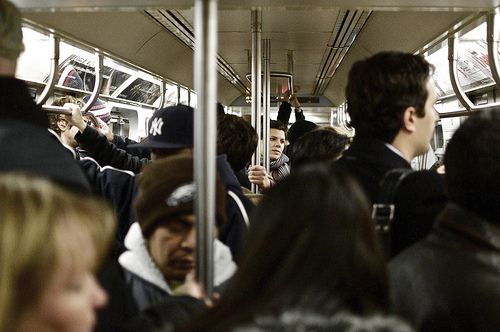
If you follow transportation politics you’ve heard of induced demand, a principle that activists have been invoking for decades to oppose road widening: Adding more capacity without market pricing simply invites more people to use a valuable resource. We see induced demand in roads and parking, as well as oil.
People have invoked induced demand in opposition to things that are much less destructive than driving. Transit managers have removed benches, lockers and trash cans from stations in the belief that this will reduce the demand for sitting, storing things and eating.
So what’s the difference between good induced demand and bad? It’s all about what it is that’s in demand. What are its real costs and benefits? Do the benefits justify the costs in the long term, and how long is long term? Can we handle the demand in the short term, and what happens if we can’t?
In terms of trash cans, given the staggering amount of money the MTA wastes on other things it wouldn’t be a huge expense for them to buy enough trash cans so that there’s one within twenty steps in all their stations, and to hire enough people to keep them from filling up and keep the platforms and tracks clean. The same is true for lockers and benches Somebody decided that the benefit wasn’t worth the cost, and I wouldn’t be surprised if that person drove to work and never found themselves on a subway platform holding an empty sandwich wrapper, or waiting for a train with tired feet.
In terms of roads and parking, we know that it costs an obscene amount of money to build a single structured parking space. Elevated roads and tunnels are similarly exorbitant. At-grade roads and parking are cheaper, but still cost a lot. They also encourage driving, with its pollution and carnage and waste of energy. I don’t know about you, but I don’t think it’s worth the cost.
I brought all this up to give you an idea of what goes through my mind when I hear people talking about how accommodations for disabled people help everyone. The usual example people give is how curb cuts for wheelchairs make life easier for parents with strollers. Sometimes people go on to talk about how elevators also help people to use strollers. And that’s where I start giving these people the side-eye.
I’m very much in favor of making our buses and trains wheelchair-accessible. I know several people with mobility impairments, including my own parents, I’ve talked with people who use wheelchairs and crutches about the difficulties of navigating the subway, and I’ve been temporarily disabled in the past. If we induce more demand for travel by people in wheelchairs and those with canes and walkers, I’m all for that, because up to now they’ve been forced to rely on Access-a-Ride, which is slow and inefficient, and limits their participation in society.
I have no objections if we build elevators for people in wheelchairs, and they happen to be useful for people with strollers, or even with “granny carts” for shopping. There is an added cost, though: the elevators are designed with a particular capacity of disabled users in mind, and induced demand from stroller and shopping cart users means kore crowds and longer waits. More demand also means more wear and tear on the machinery, more frequent outages (especially if the MTA doesn’t adjust its maintenance budget), and more money for repairs.
It doesn’t stop just at elevators making life easier for people with strollers, though. It starts getting presented as a moral obligation for us to fund elevators for parents. And since most parents who travel with their kids are women, it gets presented as an anti-sexist obligation to fund elevators. Then you get petitions for the MTA to allow parents to take strollers on buses without folding them. And that’s when I get pissed.
Last year I was on a bus in Great Britain, where people are allowed to bring strollers on buses. The bus filled up and people were having difficulty finding places to stand, because all the floor space was taken by strollers. The women traveling with the strollers made no move to take the kids out and fold them, so everyone else had to squeeze around them, including one woman who delayed the bus because she was not expecting to have to fold her own stroller.
It’s one thing to bring an unfolded stroller on an empty bus in Lebanon, New Hampshire. It’s a very different thing to bring one on a crowded bus or subway in New York City. We don’t have the capacity for it, so insisting on that space is taking away capacity from everyone else, including parents who carry their kids and fold their strollers. If you think there’s a significant value to society in giving that public space to unfolded strollers, get off your high horse and let’s talk about why it’s valuable and how we’re going to pay for it.
The weirdest thing about this debate is that it's not like people don't take small children on subways and buses. They do, and they always have. It’s not always easy, but traveling with kids by car isn’t always easy either. So why are people talking about taking kids in elevators now? I think it's the size of strollers.
When my wife was pregnant we went shopping for a stroller. The “normal” strollers were all large, heavy and difficult to fold. They were also fantastically expensive, with models costing hundreds of dollars. We settled for a “city” model that cost under a hundred and was lighter weight and could be folded with one hand, but it was still pretty heavy and bulky. I think we took it on the train maybe three or four times, and yes, it was a pain in the ass.
We wound up using a sling and a Baby Bjorn to carry the kid for the first year or so. Once he was old enough to hold his own head up we got an umbrella stroller for twelve dollars at Toys R Us. It made a huge difference. Either one of us could push it to the subway stairs, unbuckle the kid, pick him up with one hand, fold the stroller with the other hand, pick that up and head into the subway. With a little practice we could get it done in two seconds. Once we were on the subway (or bus) the stroller slid neatly under the seat.
Even when it was unfolded the umbrella stroller took up relatively little floor space and sidewalk width. It was light enough that either of us could pick the kid up in it and carry them for short distances. It wore out within a year, but I just went back and got another one. By the time we were ready for a third stroller, the kid was ready to walk.
I can understand why people hesitate to fold “city” strollers and drag them up stairs, and I sure as hell understand why nobody wants to carry a full size Graco anywhere, with or without a kid in the other arm. What I don’t quite understand is why people don’t use umbrella strollers.
I mean, people do use umbrella strollers. I just saw one a few minutes ago. What I don’t understand is why so many people assume that you only need one stroller, and the standard suburban models are fine for the city. Why aren’t there periodic articles in Queens Parent and Time Out Kids about the Best Subway Strollers? Why don’t people get schooled in umbrella strollers in the cafés of Park Slope and Sunnyside the way they get schooled in bike seats and breast pumps? When someone complains about being asked to fold their stroller on the subway, why isn’t the first response simply, “Have you tried an umbrella stroller?”
I can think of three reasons. Time Out isn’t running any stories about umbrella strollers because they’re cheap and they’ve been around for years. They’re not writing any stories about plain old bibs and sippy cups either. For similar reasons, umbrella strollers are no good for yuppie prosperity signaling, and because they’re complex aluminum structures they aren’t good for hipster artisanal credit.
The main reason people avoid umbrella strollers is that they can’t hold anything but the kid. Modern strollers have huge compartments that can hold diaper bags, breast pumps and groceries, plus cup holders, bag hooks and even running boards for older kids to stand on. Even the “city” models have at least one basket. When people have one they fill those compartments with everything they might possibly need, which can weigh as much as the stroller, or even a toddler.
This is exactly like “sport-utility vehicles ” which get filled up with all kinds of stuff that the passengers never use, but the driver carries around just in case. Or the large house with rooms full of belongings that the inhabitants haven’t touched in years. And the reason is the same: induced demand. When land and buildings are cheap, people hold on to their stuff. When gas, roads and parking are cheap, people shove their stuff in the SUV and use the gas, roads and parking to cart it all over town. And when train, bus, sidewalk, stair and elevator space is cheap, people shove their stuff in giant strollers and push it all over town.
I wouldn’t have a problem with this if the space really were cheap, but buses and elevators are expensive. I would even be willing to subsidize bus and elevator space for unfolded strollers if we had a real discussion and concluded that this subsidy would bring a real benefit to society. I think there’s a real case for it for groups with more small children than adults, or where the caregiver has a disability that makes it hard for them to carry a child, an umbrella stroller and a diaper bag.
Unfortunately, that is not the discussion we’re having. The discussion we are having is polluted by induced demand, by the assumptions that all small children are carried in giant, unfoldable strollers by physically and politically weak women who are incapable of selfishness, bad judgment, ignorance or any other failings. Can we change that, please?
Here are some reasons to get people to shift from cars to transit:
Showing posts with label gender. Show all posts
Sunday, January 28, 2018
Wednesday, May 15, 2013
Stuck on the subway
Today the Times published a good article by Kimberly Matus telling the story of how she was groped on a crowded subway train. In that particular case there were undercover police officers who noticed her facial expression and arrested her attacker, but the experience was upsetting nonetheless.
What I found striking is how limited Matus's choices were in the whole situation. As she wrote, "I tried to evade him but couldn’t move an inch in any direction." What a horrible feeling. Even when I was a young man I never had an experience like that, but what little hassle I've had is bad enough. I've been yelled at, pushed, and even sent flying into another passenger by some prejudiced jerk. And that's not counting the normal crush conditions, sermons and bad music.
After this incident, Matus recognized that her only choice was simply not to participate. She says she told her husband that "I wasn't planning on taking the subway anymore, at least during peak hours." I've done the same thing. I choose hours that give me a more comfortable commute. I also live a bit further out and take jobs even further in Queens. Of course I'm fortunate that we have these options. There are many New Yorkers, especially in this economy, who consider themselves lucky to have a job at all, and if that job means they squeeze onto a number 2 train at 8:15, that's what they do. And whatever happens, they put up with it.
Matus also has a couple of alternatives. She could ride a bike, which means dealing with a lot of the same jerks, but instead of squeezing on the train in sweat pants they're in control of deadly machines (barely in control). She could take the M57 bus to the Q60, but that would take a long time, and many of those buses get packed too. Since she works for her family's taxi business, maybe they just send a taxi to pick her up. (But I do appreciate the irony of even a taxi family seeing the value in traveling by subway.) That would cost her family money, just as it costs me money to take lower paying positions to avoid the Manhattan rush hour.
What I would like, and I bet Matus would like it too, is another option. An option where we get a seat, but we don't have to pay for a whole taxi for ourselves. I'm willing to pay more for a slower ride, if I knew I would be a little more comfortable.
What I'm talking about is the Death Valley of Commute Options. You're sick of squeezing into the subway, and you might be willing to pay more for a more comfortable ride. But you can't afford to buy and keep a car (assuming you even want to put people's lives at risk and heat up the planet). So you're stuck on the IRT with the sexual predators.
I'll talk about some solutions in a future post.
What I found striking is how limited Matus's choices were in the whole situation. As she wrote, "I tried to evade him but couldn’t move an inch in any direction." What a horrible feeling. Even when I was a young man I never had an experience like that, but what little hassle I've had is bad enough. I've been yelled at, pushed, and even sent flying into another passenger by some prejudiced jerk. And that's not counting the normal crush conditions, sermons and bad music.
After this incident, Matus recognized that her only choice was simply not to participate. She says she told her husband that "I wasn't planning on taking the subway anymore, at least during peak hours." I've done the same thing. I choose hours that give me a more comfortable commute. I also live a bit further out and take jobs even further in Queens. Of course I'm fortunate that we have these options. There are many New Yorkers, especially in this economy, who consider themselves lucky to have a job at all, and if that job means they squeeze onto a number 2 train at 8:15, that's what they do. And whatever happens, they put up with it.
Matus also has a couple of alternatives. She could ride a bike, which means dealing with a lot of the same jerks, but instead of squeezing on the train in sweat pants they're in control of deadly machines (barely in control). She could take the M57 bus to the Q60, but that would take a long time, and many of those buses get packed too. Since she works for her family's taxi business, maybe they just send a taxi to pick her up. (But I do appreciate the irony of even a taxi family seeing the value in traveling by subway.) That would cost her family money, just as it costs me money to take lower paying positions to avoid the Manhattan rush hour.
What I would like, and I bet Matus would like it too, is another option. An option where we get a seat, but we don't have to pay for a whole taxi for ourselves. I'm willing to pay more for a slower ride, if I knew I would be a little more comfortable.
What I'm talking about is the Death Valley of Commute Options. You're sick of squeezing into the subway, and you might be willing to pay more for a more comfortable ride. But you can't afford to buy and keep a car (assuming you even want to put people's lives at risk and heat up the planet). So you're stuck on the IRT with the sexual predators.
I'll talk about some solutions in a future post.
Friday, July 22, 2011
The value of cycle chic
The concept of "cycle chic" has been controversial almost from the moment it started. Libby Maxim, "Biker Chick" of West Chester, Pennsylvania, totally missed the point and hated it. So did Kati Nolfi in Bitch Magazine.
Today, bikonomist Elly Blue added a new twist to the debate when she tweeted, "I'm more & more convinced that PR/branding campaigns to make cycling look chic & attractive do more harm than good. Watching bicycling get tangled up w/gentrification & race in PDX is what's convincing me. It shouldn't be exclusive."
Blue's point is much better than Maxim's or Nolfi's, but it'll have to wait because I want to deal with those first. The most important thing here is to get ourselves grounded again in our goals. I want to get people out of their cars, for the reasons stated above. That means that I only care about cycle chic to the extent that it gets people to choose not to drive as a habit, or to drive less, or not to buy a car (or to sell one they have), or not to fund car infrastructure (or to fund bike, transit and pedestrian infrastructure).
It's also important to point out that blogs like Copenhagen Cycle Chic and its imitators (Massapequa Cycle Chic, perhaps, someday) are not primarily sending aspirational messages. They're aimed at people who already consider themselves to be chic, and the message is, "You can be just as chic as you are ... on a bike!"
Some of the target audience may drive already. Some may be young adults who've been getting the message their whole lives that Real Grownups Drive Cars, and they're getting to the age where they may become Real Grownups. They're also constantly bombarded with ads that say, "you can be just as chic ... in this car!"
Many of them are also familiar with bike marketing and peer pressure that says that Real Cyclists wear shiny spandex and bike jerseys and those weird shoes. Maybe they think that's attractive, maybe not, but they don't identify. It's not them. If they manage to envision themselves as cyclists, it's looking uncomfortable and out of place in clothes that are tight in the wrong places.
The main content of the Cycle Chic blogs is candid shots of people on the street. Originally it was almost entirely women in skirts and high-heeled shoes, but they've branched out a bit. These people aren't dressed up to sell bicycles or cycling, they're dressed up to be attractive, and the bicycle is either an accessory or simply a way to move their attractive selves around town. They primarily send the value message: Look at these ordinary chic people. They're riding bikes, but they're clearly still getting laid. You're a chic person just like them. You can continue your chic lifestyle without a car.
BicyclesOnly has done the same thing with New Yorkers from all walks of life, including bike commuters (like this guy), families going to school, shoppers, women and people riding in the snow, with the stated goal of debunking the stereotype of cyclists as "fringe weirdo daredevils."
That's what Libby Maxim and Kati Nolfi get wrong. The people who want to dress like Katy Perry and Russell Brand are already doing that. Women who want to wear blue minidresses will do it whether they're on a bike or not, no matter how much Maxim and Nolfi scold them about the impracticality. If they don't ride a bike in their minidress, they might drive a car. Which would you rather see them doing?
My apologies to anyone who came here wanting to see pictures of women in skirts and heels or minidresses, or Russell Brand. Just follow the links.
Today, bikonomist Elly Blue added a new twist to the debate when she tweeted, "I'm more & more convinced that PR/branding campaigns to make cycling look chic & attractive do more harm than good. Watching bicycling get tangled up w/gentrification & race in PDX is what's convincing me. It shouldn't be exclusive."
Blue's point is much better than Maxim's or Nolfi's, but it'll have to wait because I want to deal with those first. The most important thing here is to get ourselves grounded again in our goals. I want to get people out of their cars, for the reasons stated above. That means that I only care about cycle chic to the extent that it gets people to choose not to drive as a habit, or to drive less, or not to buy a car (or to sell one they have), or not to fund car infrastructure (or to fund bike, transit and pedestrian infrastructure).
It's also important to point out that blogs like Copenhagen Cycle Chic and its imitators (Massapequa Cycle Chic, perhaps, someday) are not primarily sending aspirational messages. They're aimed at people who already consider themselves to be chic, and the message is, "You can be just as chic as you are ... on a bike!"
Some of the target audience may drive already. Some may be young adults who've been getting the message their whole lives that Real Grownups Drive Cars, and they're getting to the age where they may become Real Grownups. They're also constantly bombarded with ads that say, "you can be just as chic ... in this car!"
Many of them are also familiar with bike marketing and peer pressure that says that Real Cyclists wear shiny spandex and bike jerseys and those weird shoes. Maybe they think that's attractive, maybe not, but they don't identify. It's not them. If they manage to envision themselves as cyclists, it's looking uncomfortable and out of place in clothes that are tight in the wrong places.
The main content of the Cycle Chic blogs is candid shots of people on the street. Originally it was almost entirely women in skirts and high-heeled shoes, but they've branched out a bit. These people aren't dressed up to sell bicycles or cycling, they're dressed up to be attractive, and the bicycle is either an accessory or simply a way to move their attractive selves around town. They primarily send the value message: Look at these ordinary chic people. They're riding bikes, but they're clearly still getting laid. You're a chic person just like them. You can continue your chic lifestyle without a car.
BicyclesOnly has done the same thing with New Yorkers from all walks of life, including bike commuters (like this guy), families going to school, shoppers, women and people riding in the snow, with the stated goal of debunking the stereotype of cyclists as "fringe weirdo daredevils."
That's what Libby Maxim and Kati Nolfi get wrong. The people who want to dress like Katy Perry and Russell Brand are already doing that. Women who want to wear blue minidresses will do it whether they're on a bike or not, no matter how much Maxim and Nolfi scold them about the impracticality. If they don't ride a bike in their minidress, they might drive a car. Which would you rather see them doing?
My apologies to anyone who came here wanting to see pictures of women in skirts and heels or minidresses, or Russell Brand. Just follow the links.
Thursday, October 8, 2009
States where women berely dare
Yesterday Streetsblog tweeted about a Treehugger post that uses the recently released commuting data from the census American Community Survey to compare women's commuting patterns by states.
The numbers are interesting, but it's important to keep in mind that unlike the regular census, this is a sample, with the possibility of sampling error. If we look at the actual data, the picture is a bit different. Delaware may have just 210 estimated women bicycle commuters, but that number has a margin of error of +/-187, meaning that the number could be as low as 23, or as high as 397. Keep this in mind when you're reading the rest of these figures.
The absolute numbers also tell only part of the story. If Delaware has only 210 women bicycle commuters, it also only has 873,092 people, 201,587 of whom are female commuters. It's the proportion of bicycle commuters among all female commuters that is really comparable from one state to another. If we consider Delaware's 0.10% figure (that's a tenth of one percent), the state rises from second lowest to ninth lowest, and Alabama (0.044%) drops from fifth lowest to second lowest.
In terms of proportion of women commuting by bicycle, the worst states are actually Mississippi (0.036%), Alabama, Tennessee (0.047%), Missouri (0.071%) and Arkansas (0.075%) - pretty much an Ozark-Delta-Appalachian belt of nastiness towards female cyclists. The best state by that measure is Oregon, with 1.4% of women commuting by bike. The next is D.C. (1.2%) and then a Rocky Mountain belt with Hawaii thrown in. So we know it's not the mountains.
In the Treehugger post, blogger April Streeter observes that 41% of all bike commuters in Rhode Island are women. That's an interesting number, but instead of the simple percentage of all cyclist commuters, a better estimate of the relative popularity of bike commuting between genders is the ratio of the proportions of bike commuters out of all commuters in each gender. Rhode Island's ratio is in fact high: 0.74% of women ride bikes to work for every 1% of men doing it. However, Vermont (0.86) and Utah (0.85) are even better. New England seems to be a good place for gender equality in bike commuting: both New Hampshire and Maine had 0.72% of women per 1% of men. Massachusetts (0.46) doesn't do as well, though, and neither does Connecticut (0.34) or New York (0.37).
The worst female-male ratios included most of our Graceland belt, with the worst in the country being - yup - Mississippi with only 0.08% of female bike commuters per 1% of males. Arkansas breaks from the belt with 0.43, but joining the bottom five are Puerto Rico (0.12) and Nevada (0.15). Tennessee had 0.18, Missouri 0.21 and Alabama 0.22 - but our friend Delaware is tied with Alabama.
The most dismal U.S. states to bike in, if we count simply by the number of women declaring to the census that they use a bike to get to work, are Mississippi, Delaware, West Virginia, Alabama, and Arkansas. Puerto Rico, also surveyed on the question, was similarly quite dismal. Mississippi had just 209 declared female cycling commuters, Delaware just 210, while West Virginia had 326, Alabama had 431, and Arkansas had 461. Puerto Rico declared 318 female cyclists.
The numbers are interesting, but it's important to keep in mind that unlike the regular census, this is a sample, with the possibility of sampling error. If we look at the actual data, the picture is a bit different. Delaware may have just 210 estimated women bicycle commuters, but that number has a margin of error of +/-187, meaning that the number could be as low as 23, or as high as 397. Keep this in mind when you're reading the rest of these figures.
The absolute numbers also tell only part of the story. If Delaware has only 210 women bicycle commuters, it also only has 873,092 people, 201,587 of whom are female commuters. It's the proportion of bicycle commuters among all female commuters that is really comparable from one state to another. If we consider Delaware's 0.10% figure (that's a tenth of one percent), the state rises from second lowest to ninth lowest, and Alabama (0.044%) drops from fifth lowest to second lowest.
In terms of proportion of women commuting by bicycle, the worst states are actually Mississippi (0.036%), Alabama, Tennessee (0.047%), Missouri (0.071%) and Arkansas (0.075%) - pretty much an Ozark-Delta-Appalachian belt of nastiness towards female cyclists. The best state by that measure is Oregon, with 1.4% of women commuting by bike. The next is D.C. (1.2%) and then a Rocky Mountain belt with Hawaii thrown in. So we know it's not the mountains.
In the Treehugger post, blogger April Streeter observes that 41% of all bike commuters in Rhode Island are women. That's an interesting number, but instead of the simple percentage of all cyclist commuters, a better estimate of the relative popularity of bike commuting between genders is the ratio of the proportions of bike commuters out of all commuters in each gender. Rhode Island's ratio is in fact high: 0.74% of women ride bikes to work for every 1% of men doing it. However, Vermont (0.86) and Utah (0.85) are even better. New England seems to be a good place for gender equality in bike commuting: both New Hampshire and Maine had 0.72% of women per 1% of men. Massachusetts (0.46) doesn't do as well, though, and neither does Connecticut (0.34) or New York (0.37).
The worst female-male ratios included most of our Graceland belt, with the worst in the country being - yup - Mississippi with only 0.08% of female bike commuters per 1% of males. Arkansas breaks from the belt with 0.43, but joining the bottom five are Puerto Rico (0.12) and Nevada (0.15). Tennessee had 0.18, Missouri 0.21 and Alabama 0.22 - but our friend Delaware is tied with Alabama.
Subscribe to:
Posts (Atom)