Showing posts with label access. Show all posts

Friday, August 23, 2024

AirBnb can be really useful sometimes

A quiet residential street in Northampton, Massachusetts with wooden 2 and a half story houses along it

In the past several years I've seen a number of posts attacking the company AirBnb, which is fine, but often they go further and attack the general concept of short-term housing rental outside of hotels. These posts have struck me as oblivious at best, and sometimes even callously indifferent. I rarely hear arguments in favor of short-term housing rental outside of travel industry promotion, so I wanted to give my entirely uncompensated argument for why I like them.

This is not an argument about the merits of AirBnb or any other company, or of tourism in general. It's about why short-term housing rental should be allowed wherever hotels, long-term rentals and vacation home ownership are allowed, and should not be restricted as a kludge to limit tourism overall.

I've stayed in plenty of hotels, inns, bed and breakfasts and youth hostels, and they can be great, but they're not always enough. Sometimes there simply are not enough hotels in a town, or a neighborhood.

Let's use the city of Northampton, Massachusetts as an example. There is exactly one hotel in downtown Northampton: the Hotel Northampton, a classic institution, almost a century old, with 106 rooms. That's a tiny amount for a small city with a college, a hospital and a large number of tourist attractions. There are at least two smaller hotels, three motels and a bed and breakfast within the city limits, as well as six across the river in Hadley and five in Amherst.

You could say that the people who can't afford the Hotel Northampton simply pay with longer trip times. That's not fair to begin with, but beyond that, only four of the other hotels are within a comfortable walk of the city center and Smith College. I believe they are all on bus routes, but those buses do not always run frequently, and there are some times when no buses run at all, such as early Sunday morning. Many of the motels, particularly in Hadley, are in areas that are dangerous and hostile to pedestrians.

Thus the price structure of the hotels discriminates against people who pay less, not just by imposing a time penalty and the cost of taxis when buses are not running, but by imposing a higher risk of death or injury.

If we look at AirBnb, there are rooms and apartments for rent near downtown, but they're available at rates comparable to the motels in Hadley, or even cheaper. No cost penalty, no time penalty, no car or taxi or extra bus trip required.

There are some towns that have no hotels at all. If someone wants to visit those towns, the only hotel may be miles away, with no transit at convenient times. But those towns may have a few short-term rentals where a visitor may even be able to arrive by transit and walk to their destinations.

Another benefit I've gotten from short term rentals is the experience of staying in a house or apartment that's integrated into a residential neighborhood. Sometimes it can be nice to stay in a hotel in a commercial or entertainment district, but those districts are often empty on weekends.

Many short-term rentals are in architecturally interesting places, and staying there overnight can give visitors a better opportunity to appreciate them. It can also allow visitors to live like locals in ways that hotels don't offer.

There are costs and risks to short term rentals. I don't want to dismiss them. I'm just frustrated with discussions of short term rentals that talk exclusively about the downsides without mentioning the reasons why people might choose them over hotels, or why they might even help people make trips that wouldn't otherwise be possible.

I'm often surprised when people don't mention these positive aspects. Have they never enjoyed staying in a quirky apartment in a quiet neighborhood and shopping with locals? Have they never been stuck in some shitty motel in a strip mall in the middle of nowhere, where they can't get to a restaurant without driving? Or paying through the nose to get snotty treatment from a stuck-up desk clerk at a downtown motel in an office district that's deserted on a Sunday night?

Saturday, September 11, 2021

People bought COVID cars for access to recreation

Recently I wrote about the people who claimed to be "fleeing" the disease-ridden cities, but in actuality were in no more danger from COVID-19 in their urban apartments than in the exurban houses they moved to. I noted that there are probably less people "fleeing" the cities than there seem to be, as they tend to be well-connected and overrepresented in the media. They have added a lot to our greenhouse gas emissions on a per capita basis, but the damage they've done to our climate is probably more in having disrupted the return to walkable urban living that's been going on for the past twenty years or so.

Another group that has done damage is the people who stayed in the city (most of the time) but bought cars. This includes influential journalists like Baltimore resident and Earther staff writer Dharna Noor and New York Times City Hall bureau chief and former transit reporter Emma Fitzsimmons.

As with the people who "fled," there are probably nowhere near as many of these car buyers as you would think from the stories in the media. There was a surge of car purchases in the late spring of 2020, but this may simply be purchases that people would have made earlier but couldn't because of lockdown.

Those of us who care about the climate, or carnage, or energy waste, or inequality, should regard every vehicle purchase as a policy failure. In particular, those purchases that have happened in response to the COVID-19 pandemic point to a vulnerability in our strategy to reduce car travel. It is worth our time to examine what motivated people to buy cars and drive.

I would love to see a rigorous market survey, and if you know of any, please pass them on to me. In the absence of anything like that I'm going by what I've read in the news and on Twitter. Yes, Twitter isn't real life, and neither is the news, but this is to a large extent about the way we think about cars and transit, and how that affects our plans for the future.

Let's start with what these people didn't buy cars for: daily activities. I'm sure there are people - health care and food service workers - who bought cars to shorten their commutes, but I don't hear a lot about them. Everyone had access to basic daily shopping - as much as any of us. There were lines at some stores, but nobody went hungry because their local supermarket was closed.

When people give reasons for buying cars, what do you hear? Noor wrote eloquently about her experience, and what she says echoes what I heard from other people - those who bought cars during the pandemic, and those who already had them. Yes, her partner's work needs was what it took to outweigh everything she knew about the downside of cars, but here's what the car did for her:

I was no longer comfortable with my regular regional train rides to see my family members living outside the city. And during quarantine, living near the spots I frequented like the public library and my favorite local punk bar no longer seemed like a plus. I longed instead to be able to easily head to the H Mart about 10 miles (16 kilometers) west to mask up and buy bok choy or visit the big parks outside the city for hikes, but it was proving difficult to figure out how to do so.

What do you hear over and over again from drivers? What do you see on Facebook and Instagram? Recreation and shopping. People driving to parks and beaches. Driving to specialty stores, bulk clubs, ethnic restaurants. Driving to meet friends and visit relatives. Driving to hotels and AirBnbs.

As case counts dropped and capitalists started talking about "reopening" as early as the summer of 2020, people started using their cars for more daily tasks like commuting to work and bringing kids to camp and school. But to the extent the car boom of 2020 was a real thing, it wasn't driven by work and school trips.

In 2020, people bought cars for recreation. They may not have bought that many, but it was and is a public relations disaster for transit. And it was completely avoidable, both in the short term and the long term. We need to learn the lessons from that and avoid it in the future.

Tuesday, April 3, 2018

Who's your Suburb Buddy?

Adam Hengels had a good post about fighting rising rents back in 2015. He points out that while "gentrification" battles are almost always fought on the neighborhood level, the problem is actually regional:

The battlefield is not in the gentrifying neighborhoods. It is in the more wealthy neighborhoods where empowered residents fight to keep new people out.


There are tons of pretty suburban towns, and even small cities, that could be cozy, hip, dense alternatives to Manhattan or Brooklyn, but they've got zoning that keeps apartment buildings out and stifles nightlife, giant parking lots surrounding the commuter rail stations, infrequent train service and parking requirements that drive foot traffic away. If they got their act together, a lot of people would be moving there instead of here.

Here's an example: I live in Woodside, Queens. Per capita $24,399, population density 44,500 per square mile. We've got a decent commute to Manhattan (30 minutes to Grand Central), and a nice mix of shops and restaurants (a Walk Score of 94). I'd be happy to have more people here, but if they went someplace else that'd be okay too.

If I walk down to the Long Island Railroad station, I can get a train to Hewlett and take a short walk to the village of Hewlett Bay Park, which Wikipedia lists as the wealthiest per capita place (city, town, village) in the New York metro area at $113,320. Hewlett Bay Park has a population density of just 1,382 people per square mile, and a Walk Score of 42. It's an hour and thirteen minutes to Grand Central: a beautiful walk to the LIRR Far Rockaway Branch station, then change at Penn for the 3 train to the Shuttle.

The population of Hewlett Bay Park is estimated at 437 people, which is about a third the population of my co-op. Their zoning requires that every building be built on a minimum lot size of one acre, which is about a third the size of the lot my co-op is on. If the whole village were the same density as Woodside, it could hold about 17,800 people. Think how rents would go down across the metro area!

Last year we had a huge fight over a ten story building that would have added about 200 units to the neighborhood. That building would have fit on a single one of Hewlett Bay Park's 256 acres. Or if Hewlett Bay Park allowed townhouses near the train station, those 200 units could be spread across ten or twenty acres. My neighbors and I couldn't agree on whether we wanted it here, but I'll bet none of them would have been energetically opposed to putting it in Hewlett Bay Park.

Of course it's unfair to put all the burden on Hewlett Bay Park for accommodating the million or so people who want to live in New York. Right next door is Hewlett Neck, per capita income $88,049, population density 766.2 per square mile. There are a bunch of other wealthy villages and towns that are keeping people out with exclusionary zoning.

So why, even since Adam's post appeared three years ago, do people keep fighting at the neighborhood level? I think there are two reasons: first, the spatial segregation strategy of moving to the suburbs does effectively put a lot of distance between the wealthy and the crowds, not just in terms of raw travel time, or even in terms of social networks, but in terms of migration pressure. My wife and I did look at apartments in Scarsdale, but we're the exception in our class and income bracket. Most of the people moving into our neighborhood have been priced out of Inwood or Ridgewood. The people moving into Ridgewood got priced out of Williamsburg. The people moving into Williamsburg got priced out of Greenwich Village. The people in the Village got priced out of the Upper East Side, and the people there got priced out of Scarsdale. So even if we yell at the people in Ridgewood and Williamsburg it's not going to help much.

The second reason people don't fight Scarsdale is fragmentation. There are lots of wealthy, exclusive suburbs that are keeping people out who then chain-bid my mom's rent up. Why blame Scarsdale for my troubles and not Bronxville? How do I pick one?

It might be possible to do some kind of multilayered market research and find out exactly which set of racist NIMBYs to blame for the migration into your neighborhood, but that's probably not worth the trouble. We can do this quasi-randomly, keeping to a set of basic principles:

  1. It should have a good transit commute. I do not want to take decent car-free Manhattanites and ship them out to Yorktown Heights where they'll all buy Volvos. There are in fact many New York suburbs where you can walk to shopping, walk to the train, walk to everything. If you can't walk to shopping, we'll have to zone for shopping when we zone for apartments.
  2. This should be a place that can sustainably absorb lots more people. That means probably not low-lying areas like Deal or Centre Island. Hewlett Bay Park is on the bay, but it's mostly out of the flood zone and didn't do too bad during Sandy.
  3. Everybody pile on the favored quarter. New York has some suburbs that are not wealthy. Some of them are already changing, like Newark and Rutherford. Others are too poor to be attractive to people who already live in Brooklyn Heights, like Freeport. Let's focus on the top of the food chain.

With that in mind, here are the ten places in the New York area with the highest per capita income where Google Maps gives a transit commute time to Grand Central, with their densities and their walk scores. Next time your local NIMBYs come out in force against a building, pick a town from this list. I've already claimed Hewlett Bay Park for the people of Woodside, so spread things out by picking a different town. If you've already heard someone else using a town, pick a different one. If they're all taken, pull up the next twenty. Make a bunch of buttons saying WHY ISN'T THIS BEING BUILT IN DARIEN? and hand them out. Let's see what happens!

PlaceStateCountyPer capita incomeDensityWalk ScoreTransit lineTransit commute to Grand Central
Hewlett Bay ParkNYNassau$113,3201,38242Far Rockaway1:13
New CanaanCTFairfield$105,846322.786New Canaan1:09
DarienCTFairfield$105,846203.927New Haven0:59
North HillsNYNassau$100,0931,54327Port Washington1:01
WestportCTFairfield$97,39550323New Haven1:08
Sands PointNYNassau$95,647222.423Port Washington1:26
PlandomeNYNassau$95,102857.615Port Washington0:58
MatinecockNYNassau$93,559118.15Oyster Bay1:25
GreenwichCTFairfield$90,0871,27894New Haven0:44
ScarsdaleNYWestchester$89,907873.236Harlem0:32

Sunday, January 28, 2018

Stroller bloat on the subways

If you follow transportation politics you’ve heard of induced demand, a principle that activists have been invoking for decades to oppose road widening: Adding more capacity without market pricing simply invites more people to use a valuable resource. We see induced demand in roads and parking, as well as oil.


People have invoked induced demand in opposition to things that are much less destructive than driving. Transit managers have removed benches, lockers and trash cans from stations in the belief that this will reduce the demand for sitting, storing things and eating.

So what’s the difference between good induced demand and bad? It’s all about what it is that’s in demand. What are its real costs and benefits? Do the benefits justify the costs in the long term, and how long is long term? Can we handle the demand in the short term, and what happens if we can’t?

In terms of trash cans, given the staggering amount of money the MTA wastes on other things it wouldn’t be a huge expense for them to buy enough trash cans so that there’s one within twenty steps in all their stations, and to hire enough people to keep them from filling up and keep the platforms and tracks clean. The same is true for lockers and benches Somebody decided that the benefit wasn’t worth the cost, and I wouldn’t be surprised if that person drove to work and never found themselves on a subway platform holding an empty sandwich wrapper, or waiting for a train with tired feet.

In terms of roads and parking, we know that it costs an obscene amount of money to build a single structured parking space. Elevated roads and tunnels are similarly exorbitant. At-grade roads and parking are cheaper, but still cost a lot. They also encourage driving, with its pollution and carnage and waste of energy. I don’t know about you, but I don’t think it’s worth the cost.

I brought all this up to give you an idea of what goes through my mind when I hear people talking about how accommodations for disabled people help everyone. The usual example people give is how curb cuts for wheelchairs make life easier for parents with strollers. Sometimes people go on to talk about how elevators also help people to use strollers. And that’s where I start giving these people the side-eye.

I’m very much in favor of making our buses and trains wheelchair-accessible. I know several people with mobility impairments, including my own parents, I’ve talked with people who use wheelchairs and crutches about the difficulties of navigating the subway, and I’ve been temporarily disabled in the past. If we induce more demand for travel by people in wheelchairs and those with canes and walkers, I’m all for that, because up to now they’ve been forced to rely on Access-a-Ride, which is slow and inefficient, and limits their participation in society.

I have no objections if we build elevators for people in wheelchairs, and they happen to be useful for people with strollers, or even with “granny carts” for shopping. There is an added cost, though: the elevators are designed with a particular capacity of disabled users in mind, and induced demand from stroller and shopping cart users means kore crowds and longer waits. More demand also means more wear and tear on the machinery, more frequent outages (especially if the MTA doesn’t adjust its maintenance budget), and more money for repairs.

It doesn’t stop just at elevators making life easier for people with strollers, though. It starts getting presented as a moral obligation for us to fund elevators for parents. And since most parents who travel with their kids are women, it gets presented as an anti-sexist obligation to fund elevators. Then you get petitions for the MTA to allow parents to take strollers on buses without folding them. And that’s when I get pissed.

Last year I was on a bus in Great Britain, where people are allowed to bring strollers on buses. The bus filled up and people were having difficulty finding places to stand, because all the floor space was taken by strollers. The women traveling with the strollers made no move to take the kids out and fold them, so everyone else had to squeeze around them, including one woman who delayed the bus because she was not expecting to have to fold her own stroller.

It’s one thing to bring an unfolded stroller on an empty bus in Lebanon, New Hampshire. It’s a very different thing to bring one on a crowded bus or subway in New York City. We don’t have the capacity for it, so insisting on that space is taking away capacity from everyone else, including parents who carry their kids and fold their strollers. If you think there’s a significant value to society in giving that public space to unfolded strollers, get off your high horse and let’s talk about why it’s valuable and how we’re going to pay for it.

The weirdest thing about this debate is that it's not like people don't take small children on subways and buses. They do, and they always have. It’s not always easy, but traveling with kids by car isn’t always easy either. So why are people talking about taking kids in elevators now? I think it's the size of strollers.

When my wife was pregnant we went shopping for a stroller. The “normal” strollers were all large, heavy and difficult to fold. They were also fantastically expensive, with models costing hundreds of dollars. We settled for a “city” model that cost under a hundred and was lighter weight and could be folded with one hand, but it was still pretty heavy and bulky. I think we took it on the train maybe three or four times, and yes, it was a pain in the ass.

We wound up using a sling and a Baby Bjorn to carry the kid for the first year or so. Once he was old enough to hold his own head up we got an umbrella stroller for twelve dollars at Toys R Us. It made a huge difference. Either one of us could push it to the subway stairs, unbuckle the kid, pick him up with one hand, fold the stroller with the other hand, pick that up and head into the subway. With a little practice we could get it done in two seconds. Once we were on the subway (or bus) the stroller slid neatly under the seat.

Even when it was unfolded the umbrella stroller took up relatively little floor space and sidewalk width. It was light enough that either of us could pick the kid up in it and carry them for short distances. It wore out within a year, but I just went back and got another one. By the time we were ready for a third stroller, the kid was ready to walk.

I can understand why people hesitate to fold “city” strollers and drag them up stairs, and I sure as hell understand why nobody wants to carry a full size Graco anywhere, with or without a kid in the other arm. What I don’t quite understand is why people don’t use umbrella strollers.

I mean, people do use umbrella strollers. I just saw one a few minutes ago. What I don’t understand is why so many people assume that you only need one stroller, and the standard suburban models are fine for the city. Why aren’t there periodic articles in Queens Parent and Time Out Kids about the Best Subway Strollers? Why don’t people get schooled in umbrella strollers in the cafĂ©s of Park Slope and Sunnyside the way they get schooled in bike seats and breast pumps? When someone complains about being asked to fold their stroller on the subway, why isn’t the first response simply, “Have you tried an umbrella stroller?”

I can think of three reasons. Time Out isn’t running any stories about umbrella strollers because they’re cheap and they’ve been around for years. They’re not writing any stories about plain old bibs and sippy cups either. For similar reasons, umbrella strollers are no good for yuppie prosperity signaling, and because they’re complex aluminum structures they aren’t good for hipster artisanal credit.

The main reason people avoid umbrella strollers is that they can’t hold anything but the kid. Modern strollers have huge compartments that can hold diaper bags, breast pumps and groceries, plus cup holders, bag hooks and even running boards for older kids to stand on. Even the “city” models have at least one basket. When people have one they fill those compartments with everything they might possibly need, which can weigh as much as the stroller, or even a toddler.

This is exactly like “sport-utility vehicles ” which get filled up with all kinds of stuff that the passengers never use, but the driver carries around just in case. Or the large house with rooms full of belongings that the inhabitants haven’t touched in years. And the reason is the same: induced demand. When land and buildings are cheap, people hold on to their stuff. When gas, roads and parking are cheap, people shove their stuff in the SUV and use the gas, roads and parking to cart it all over town. And when train, bus, sidewalk, stair and elevator space is cheap, people shove their stuff in giant strollers and push it all over town.

I wouldn’t have a problem with this if the space really were cheap, but buses and elevators are expensive. I would even be willing to subsidize bus and elevator space for unfolded strollers if we had a real discussion and concluded that this subsidy would bring a real benefit to society. I think there’s a real case for it for groups with more small children than adults, or where the caregiver has a disability that makes it hard for them to carry a child, an umbrella stroller and a diaper bag.

Unfortunately, that is not the discussion we’re having. The discussion we are having is polluted by induced demand, by the assumptions that all small children are carried in giant, unfoldable strollers by physically and politically weak women who are incapable of selfishness, bad judgment, ignorance or any other failings. Can we change that, please?

Saturday, July 15, 2017

Buy American Sprawl

The American Action Forum recently released a critique of “Buy America” laws on the basis that they place undue hardship on transit agencies and set a ceiling on the quality of the equipment they use. I’m not one to put a lot of trust in Republican think-tanks, but I’ve heard similar critiques from transit advocates across the political spectrum.


The idea of "buy America" is initially appealing, especially when you hear about the horrendous conditions in sweatshops overseas. But there are lots of European and East Asian companies that have better working conditions than you find in factories in the United States. In fact, the “American” trains are frequently assembled in the US in a factory owned by one of these companies, out of parts produced by factories in other countries owned by the same company.

The main argument for "buy America" in transit that holds up to any scrutiny is the idea of maintaining or boosting our manufacturing capability. Because of "buy America," there are American citizens in Plattsburgh, Yonkers and Portland who know how to make trains. If the market grows again some day, there may be enough business for an American company to hire some of these workers and go into competition with Bombardier, Kawasaki and Alstom.

Another argument is that manufacturing transit locally builds the constituency for transit. People who might never ride the subway fight for subway funding, because they build the subways. This is potentially valuable for New York, where our tax money is regularly diverted to road building under the guise of "parity for upstate."

Unfortunately, that potential rarely seems to work out. It’s impossible to tell which legislators supported what project and which ones opposed it, because they do everything in secret. But the bottom line is that these plants have been running for decades and our transit systems are underfunded every year by the Legislature.


Whenever I take the Hudson River Line I like going past the Kawasaki factory in Yonkers. Here’s a former Otis elevator factory making trains for the New York Subway that’s only a few miles from the subway itself. More importantly, it’s walking distance from home for many low-income workers, and a short transit ride for millions.


Contrast the walkable downtown Kawasaki factory with the Bombardier factory built in the 1990s on a decommissioned Air Force base in Plattsburgh. This is an unpleasant forty-minute walk from downtown, and relatively few people live nearby.


There is a bus that runs hourly and stops outside the plant, but it runs in a circle, so the trip back takes forty minutes. I’m guessing the vast majority of workers drive.


The Alstom plant in Hornell, where the new Acela train cars will be assembled, is a bit better. It was built by the Erie Railroad in the nineteenth century, so it was built to be walkable.


But Hornell has no passenger train service, and it is served by only one bus a day to Rochester, and another going back to Elmira. At least Plattsburgh has nine buses a day to Albany, plus daily Amtrak service.


The new CRRC plant in Springfield where they'll be building the new MBTA cars looks like it'll be super sprawly and unwalkable from the renderings.


But if you check out the location on Google Maps it actually looks much better: twenty minutes from downtown on the G2 bus. On the other hand, Siemens's plant in Sacramento is sprawly and a twenty minute walk from the nearest bus stop:


Kawasaki may have built a very walkable and transit-oriented plant in Yonkers, but their plant in Lincoln, where the new WMATA subway cars are being built, is out in the cornfields near the airport, a 35-minute walk from the nearest bus:


Even the Hitachi plant in Medley, Florida, where the trains for the Miami Metrorail are made, is almost two hours from downtown Miami, including an hour by bus from the nearest Metrorail station in Hialeah and then a half hour walk:


So you might have noticed that we're fighting for money to be spent on transit, and it goes to pay people who never take transit, and in many cases couldn't take transit if they wanted to. And what if we didn't have Buy America? Well, notice that all these companies are headquartered in other countries? Some of the manufacturing (and in some cases, most of the manufacturing) is done at plants owned by the same company and located in other countries.


In the case of Bombardier, many of New York's subway cars are made at this old snowmobile plant 87 miles north of Québec city, with no bus or train service.


On the other hand, the main Alstom plant in Valenciennes, France is a half-hour by tram from the main Valenciennes train station - which has multiple trains per hour to Paris, including the TGV.


And the Siemens plant in Krefeld in densely populated Westphalia, is a half hour by commuter rail and bus from the main Krefeld train station, with frequent service to Aachen, Duisberg, Cologne and even Mönchengladbach, wherever that is.


The CRRC factory in Changchun is forty minutes from the main train station.


More importantly it's surrounded by hundreds of high-rise apartment buildings, any one of them big enough to comfortably house a sizable chunk of the workforce of these American factories.


And finally, take a look at Kawasaki's main plant in Kobe, less than twenty minutes on foot from the main high-speed rail station, right near the harbor.


Just a few blocks away we see classic Japanese urbanism: residential high-rises and Really Narrow Streets.


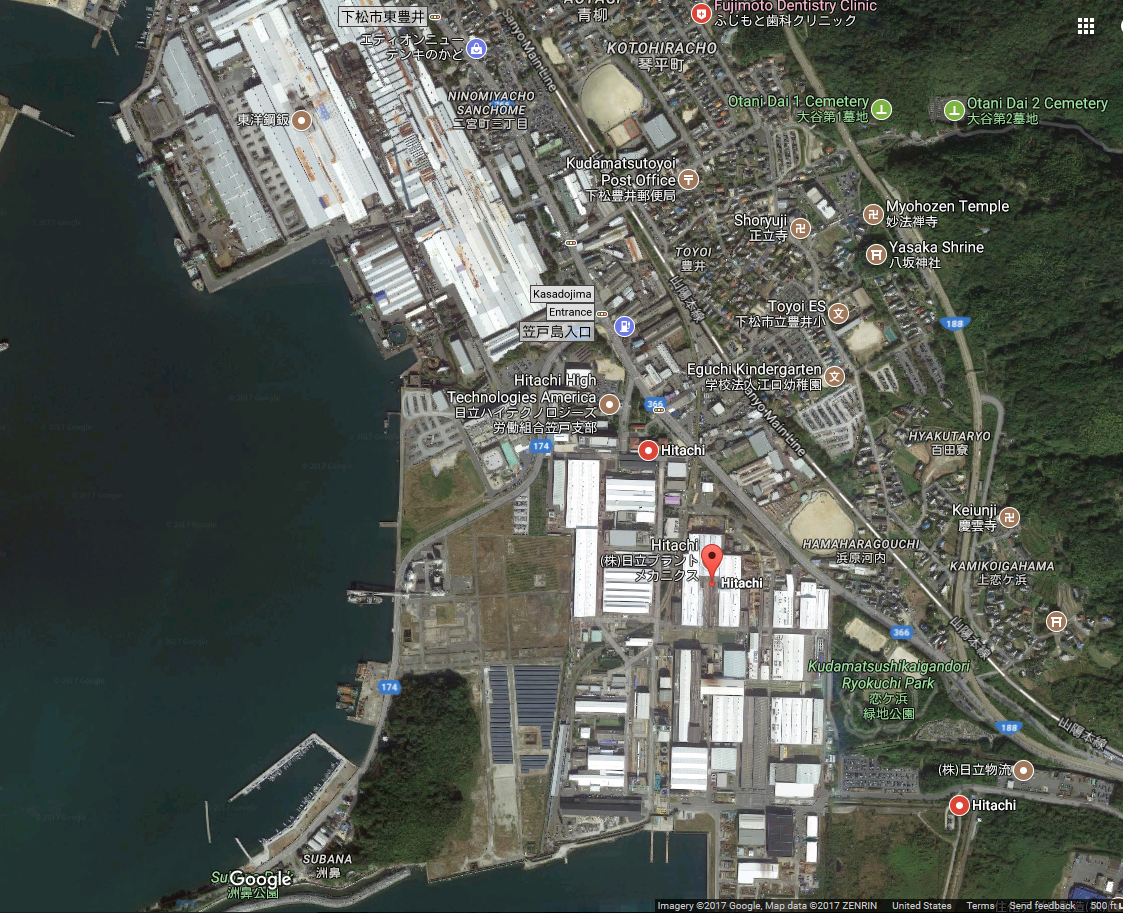
The Hitachi Kasado plant in Kudamatsu is slightly sprawlier, but still a short transit or walking commute for thousands of workers.

The bottom line is that when our transit dollars go to China or Japan or Germany or France, they go to people who commute on foot and by train. When they go to Yonkers or Springfield, they may go to some bus or foot commuters. But when they go to Hornell or Plattsburgh or La Pocatière, or even Sacramento or Hialeah, they go to people who never use transit.

Ordinarily this would not be such a big deal; we're talking a few thousand people total, out of millions of car drivers in North America. But if we're counting the number of vehicle-miles traveled eliminated by the purchase of these trains, we need to subtract the vehicle-miles traveled by all those workers.

The other factor is that these contracts are sometimes presented as a way to build electoral support for transit outside of cities. This may be purely a transaction on the electoral level: a legislator votes to fund the transit agency capital plan, and the agency provides jobs in the legislator's district that they can take credit for. But what happens then? How many train cars does New York need? How long will these legislators keep up their end of the bargain? And what happens when the desire of their sprawl-living, long-distance-driving constituents for more and bigger roads conflicts with the needs of transit users (as opposed to transit agency managers)?

I've already made the case that cutting road and parking budgets can often do more to achieve our goals (see the top of the page) than spending more money on transit. Combine that with the fact (documented by the AAF in the report I mentioned at the beginning) that with Buy America our rail car budgets buy only 75% of what they would otherwise, and they encourage people to drive, what are we really getting for our tax dollars?

Friday, December 16, 2016

What if the MTA is interested in bringing back the trains?

I’ve always opposed the proposal to convert the Rockaway Beach Branch of the Long Island Railroad into a bike trail, because I think the land is too valuable as a rapid transit corridor to use for anything else. Trail advocates protest that they too are in favor of transit, and they wish we could bring transit back to the corridor, but gee, sadly the MTA is just not interested.


Not only was the MTA not interested, according to the trail pushers, but it was a waste of time to get them interested. Nobody in the area wants a train. The selfish NIMBYs would block any attempt by the MTA to rebuild the rails, and the parents whose kids use the ballfields “on” (actually near) the line would howl. The line will never be reactivated. But the NIMBYs wouldn’t oppose a park!

A few times they almost had me convinced. Against the power that has now arisen there is no victory, they whispered. Why not make the best of it? Have a nice rail trail. It'll close at dark, but in the wintertime we'll try to keep it open "slightly later" in case you're trying to ride home from work. You like the South County Trailway, don’t you? It’s not so bad!

So here it is a few years later, and it turns out that a lot of the NIMBYs have opposed a park. There are people in the area who are in favor of bringing the trains back. And the MTA is doing a study of reactivating train service! The bike trail advocates (who were really transit advocates that had given up hope, you remember) must be overjoyed!

Turns out that - surprise! - the bike trail advocates, now paid by the Governor and park-oriented nonprofits, are against reactivating the rails, and they’re repeating all the NIMBY arguments. The most bizarre one I’ve seen is that the noise of passing trains would distract students at three schools at the Metropolitan Avenue Campus. This is complete nonsense: my kid went to school for six years across the street from the noisy 7 train el and doesn’t remember ever being distracted by it, and the Rockaway Branch would have brand-new rails on an embankment. But as LLQBTT pointed out on Twitter, the presence of these schools is actually a point in favor of reactivating train service. Wouldn’t an Expeditionary Learning School be much better if the Expeditions could be taken by train? Wouldn’t it be better if kids could take the train to Little league practices instead of being driven by their parents?

The bike path advocates are also making up new, ostensibly pro-transit, arguments that don’t make sense to anyone who actually does transit advocacy. How many riders would we really expect to take the new Rockaway Beach Branch train to Kennedy Airport instead of the AirTrain, and why do we care? They indulge and amplify the fears of a handful of Rockaway residents that Rockaway Branch trains would “end the A train.” And if they believe that it would “cause slowing of trains” on the LIRR main line, why not support finishing the partly-built connection to the Queens Boulevard subway, as described by Capt. Subway?

The worst of all the arguments against bringing back the trains a legal one: that a section of the right-of-way was transferred to Forest Park, and that restoring the trains would constitute “alienation of parkland.” This is absolute hogwash. New York City parks are criss-crossed with transportation corridors, some of which are genuinely oppressive, destructive and deadly, and the City has not to my knowledge raised any legal objections. The Jackie Robinson Parkway - its name an insult to the athlete - has a much bigger negative impact on Forest Park than the Rockaway Beach Branch ever will. It would actually make a great busway and bike path, opening up the park to residents of some of the poorest Brooklyn neighborhoods, but the Trust for Public Land has shown no interest in it.

More than anything else, these statements by the bike trail advocates have given proof to my hunch that they are not in favor of transit, that they think a bike path is more important than anything, and that they are willing to lie through their teeth in order to get one.

Saturday, October 1, 2016

When ridership doesn't matter

In the past couple of years I’ve noticed something that would be baffling in a lot of contexts, and is still kind of hard to believe when you see it. It’s called a pass-up, and it’s when a transit vehicle is so full that it can’t fit any more people, and leaves riders standing on the platform or the curb.


It’s bad enough when there really is another bus coming along in a minute. It’s bad enough when the city doesn’t have enough track capacity or enough train cars to move all the people who want to ride. But what I’m really talking about is when you can’t get on a bus and there isn’t another bus for ten minutes or more, or when one bus or train after another is uncomfortably packed.

It’s possible that the MTA, with its heavy debt service burden and its large employee benefit obligations, is incapable of bringing in a profit on any route at any time, no matter how many people ride it, so that it never helps the bottom line to add buses. But that would be a very different story than they told in 2010 when they cut service.

If you asked some of the people waiting for the M60 how they feel about the prospect of a fare increase, they would probably complain and tell you they couldn’t afford it. But if you asked them whether they’d pay fifty cents more to get a seat on the bus, or to just ensure there would be room for them on the next bus that came, they might say yes.

On the face of it, it makes no sense. These are paying customers; why wouldn’t the agency want their money?

We know it usually works in the other direction: transit providers don’t get enough riders, so they raise fares and cut back service, which drives away some of the remaining riders, in what is known as the Transit Death Spiral. We’ve put measures in place to protect transit systems from that. The problem is that those measures also remove most of the incentives for actually serving passengers.

The Transit Death Spiral is in fact a perfectly normal outcome for anyone who is selling something but is unable to compete. They sell less and less, and with less income they are unable to maintain the quality of their product. Customers give their money to the competitor, who can use it to improve the competing product.

Transit advocates knew there was a public interest in keeping transit around, so they got the government to subsidize it. But the reason transit was losing market share was that the government was subsidizing competing roads. There was a powerful popular consensus in favor of gas, roads and parking, and a popular distrust of railroad companies and “the traction interests.” There were also powerful undemocratic forces attacking transit, like Bob Moses, car companies and road lobbyists.

Transit advocates tried to promote an “all of the above” strategy, but rarely achieved “parity,” let alone more than 20%. They then largely fell back on charity arguments, which are inherently self-limiting because they implicitly accept the idea that nobody would take a bus or train unless they can’t afford to drive.

Then came transit advocates’ deal with the devil, the mistake that we’re still paying for today. After failing in both market competition and popular subsidies, transit advocates tried to beat road lobbyists at their undemocratic, competition-stifling game. They turned to public authorities.

Even today you see transit advocates arguing with a straight face that they can’t improve transit without a regional authority. Public authorities are the tools that Moses used to achieve power without a popular mandate. They allow elected officials to maintain a degree of control, but give the appearance of independence, protecting transit bureaucrats from all accountability to the voters or the market.

The result of this is that now, when there are plenty of passengers, the transit managers seem to have no interest in increasing frequency to serve the people who want to ride. What’s in it for them? They don’t get punished for leaving money on the table, and politicians don’t complain about crowded buses.

There are people who want to serve those people and take their money. But the city blocks them, and self-righteous bloggers spew bombast about “privatization” and “stratified transportation systems.” The state could serve them well, but the governor finds more political value in spending city money to build roads in the suburbs and the country. And on this the social justice advocates are silent.

Friday, April 15, 2016

The majestic equality of subway gropers

In February Emma Fitzsimmons reported on a recent rise in crimes against women on the subways. On Wednesday, in a thoughtful guest post for Second Avenue Sagas, Sarah Kaufman summarized an important point in Fitzsimmons's article: "Women are also the predominant victims of subway-based crimes, specifically robbery, forcible touching (340 cases reported in 2015), public lewdness (223 cases) and sexual abuse (130 cases)."


Kaufman continues, "When possible, women prefer another, safer mode, rather than waiting in desolate subway stations or at dimly-lit bus stops. Depending on their economic well-being, women may opt for dollar vans, taxis, livery cabs, Citi Bikes, Lyfts, Vias or Ubers. Women outnumber men in the relatively inexpensive dollar vans (ridership is 63% female, according to Eric Goldwyn), but use taxis less frequently than men do (34% female) and are vastly underrepresented on the comparatively costly Citi Bike (24% of rides are taken by women)."

This may be increasing, but it is not particularly new. In 2013 Kimberly Matus talked about her experience being groped on the subway. In 2009 I remarked that many of the riders on express buses are women, particularly older women who are probably commuting to clerical or managerial jobs. Years ago a middle-aged female friend of mine said that she even preferred the local buses of Manhattan to the subway.

The connection that Kaufman draws between transit and Citibike is insightful. People have criticized the gender imbalance in urban cycling generally, and in particular in the "vehicular cycling" movement, which in its majestic equality, encourages men as well as women to mix with speeding traffic protected only by a light helmet. Citibike is a bit safer, being rolled out only after the installation of protected bike lanes on some Midtown avenues, but the numbers suggest that women feel much less safe.

As with vehicular cycling, there is a movement within transit advocacy that disdains all comfort, and quite a bit of safety, in pursuit of a sort of Spartan equality. They have no power to increase transit funding, but they insist on low fares, resulting in crowded, unreliable subways and buses. All conditions on transit must be completely equal; as the reactions to San Francisco's Leap bus showed, any difference in comfort or convenience is worse than offensive, it is ridiculous. And yet private cars, and the public infrastructure we built to serve them, can be as comfortable or convenient as possible because it is completely off the radar for this movement.

These transit advocates, in their majestic equality, encourage men as well as women to pack into subway cars with thieves and sexual predators, shout down any other options, and somehow seem puzzled when these women buy cars at the first opportunity. Hm.

Thursday, April 7, 2016

What are your #SightsOfSI?

Tourists don't know where to go when they get off the Staten Island Ferry, so let's make some posters for them! Here's one I made:


And here's one Joby Jacob made:


You can make your own!

  1. Find a picture of the sight on Flickr or Google Images, or create your own. It must be freely distributable - either your own picture or one marked as shareable with Creative Commons.
  2. Find the shortest off-peak travel time to the sight, by bus or Staten Island Railway, from the Ferry terminal, using Google Maps or the bus/SIR schedule.
  3. If the route is by bus, find the ramp where the bus leaves from the ferry terminal in the bottom right inset of the bus map (PDF).
  4. Put the name of the sight, the travel time, the bus route or SIR, the ramp letter and the photo credit over the photo.
  5. If you like, you can credit yourself and add the #SightsOfSI hashtag.

Add your photos to this Google+ album or tweet them with the #SightsOfSI hashtag, and I'll feature the best ones on this blog!

Tuesday, April 5, 2016

Visit Saint George!

Staten Island is home to beautiful parks, lovely architecture, tasty restaurants and fascinating museums. As Joby Jacob and I recently documented, on a warm sunny day thousands of tourists take the ferry to the island, getting a free harbor cruise. While there, they could grab a quick bite, explore the prewar architecture of the North Shore, or take a short bus ride to the museums of Snug Harbor. Instead, the vast majority catch the next boat back to Manhattan without ever setting foot outside the ferry terminal.


Some tourists play it safe, follow the herd, go where they're told or plan in advance. Those kinds of tourists will require more explicit marketing, which deserves its own post. Other tourists like to explore, and many of them do this already.

Part of the problem is that the design of the ferry terminal and the streets around it discourage exploration. The neighborhood by the ferry terminal, Saint George, is charming and walkable, and has been acknowledged by the New York City Economic Development Corporation as the most promising site for "the kind of vital downtown that has long eluded Staten Island." The terminal and the streets obscure the attractions of the area and make pedestrians feel unwelcome. Since tourists getting off the ferry are pedestrians, the design winds up making tourists feel unwelcome.


The problem begins with the elevation of the main passage of the ferry terminal. While the roof deck has a clear view of some interesting-looking buildings in Saint George, tourists are not guided up there. Instead they are confronted with a series of ramps leading up to bus platforms, a stairway down to the Staten Island Railway, and a stairway marked "Richmond Terrace." None of these provide a view of anything outside the terminal; the line of sight is blocked by stairs and canopies.


Some tourists find their way up the stairs to the walkway. It affords a decent view of Saint George, but it is mostly bare, exposed concrete with a minimal canopy protecting people from the elements. It is very wide right outside the terminal, but narrows to a twenty-foot sidewalk when crossing the SIR tracks before the intersection with Richmond Terrace. Half the width of this sidewalk is currently blocked by construction for the Staten Island Wheel and outlet mall project.


The intersection between the ferry terminal approach and Richmond Terrace is the third part of the problem. The walkway is now just a sidewalk for the Ferry Terminal Viaduct, four two-lane ramps carrying buses, cars, taxis and bikes over the Railway. The intersection is designed for the cars and buses, with slip lanes, recessed crosswalks and lots of extra asphalt. It is confusing and intimidating to pedestrians.


The fourth and final obstacle is the buildings that greet visitors leaving the ferry terminal: Staten Island Borough Hall, the Richmond County Courthouse and the Saint George branch of the New York Public Library. According to my AIA Guide they were all designed by Carrère and Hastings in the early twentieth century. I should rather say that they fail to greet visitors, because they all have turned their backs to the ferry.


On one visit in 2014 I passed a troupe of thespians performing scenes from Shakespeare on the steps of Borough Hall, but this past Saturday Joby and I found the steps deserted, and the courthouse entrance permanently closed (without even any markings to indicate what it was). The handful of shops on the next block of Richmond Terrace were either closed or of no interest to tourists, or both.


A short walk around the corner showed us a different scene. Stuyvesant Place offered a variety of modest but inviting restaurants and shops. The courthouse has a fully functioning door on that side. So does Borough Hall - with parking for the Borough President and various high-level functionaries. The Library still presents a closed door to Stuyvesant Place, but you can walk around the block again and find a welcoming entrance, as well as the new Supreme Court building.


These buildings, shops and restaurants may not be things that every tourist would find interesting, but Joby and I saw a number of tourists who were tempted to stay on Staten Island for more than ten minutes. Many of them made it past the first two obstacles of lack of visibility and the exposed walkway (it was a warm Spring day), only to disappear at the intersection with Richmond Terrace.

I can easily imagine more tourists spending an hour or two in Saint George, New Brighton and Tompkinsville. We saw a number of storefronts that were either empty or closed on Saturday. It wouldn't take many more tourists to support a few more cafes and shops, which would in turn bring more tourists.

It would cost a lot to reconfigure the terminal so that arriving passengers can see the way to Saint George. It might not be worth spending that much right now, but we should talk about that when it comes time to redo the terminal for other reasons.

The walkway from the terminal to Richmond Terrace needs to be wider for its entire length, so that tourists never feel like second-class citizens, even if they are on foot on Staten Island. It needs to be better protected from sun, rain and wind, but also to be more interesting for tourists. A few signs advertising nearby attractions and businesses would help, but the city could also grant permits for vendors and buskers in the wider parts.

The intersection where the terminal viaduct meets Richmond Terrace needs to be reconfigured to be more welcoming to pedestrians. This is the kind of thing the DOT has done all over the other boroughs. They know how.

Finally, the institutions of Richmond Terrace - Borough Hall, the Courthouse, the Library and even the Post Office - need to turn around and welcome tourists. The Shakespeare performance I saw was a nice start, but the borough could do a lot more with that plaza. What about a Bryant Park-like cafe? Or the Supreme Court could rent the space inside its east facade to the Staten Island Museum, which is a block north on Stuyvesant Place.


Saint George is a pretty, walkable neighborhood just steps from the ferry. There is no good reason for eighty to ninety percent of people who arrive in the ferry to turn right around without leaving the terminal.

Sunday, March 27, 2016

Visit Staten Island!

Staten Island offers lovely architecture, beautiful parks and fascinating museums. Thousands of tourists set foot on the island on warm sunny days. But as Joby Jacob and I discovered yesterday, there's a problem...

Monday, November 9, 2015

The anti-bus terminal

The Department of City Planning thinks it would be a good idea to have a bus terminal in the new "Flushing West" district that they're planning (PDF). Apparently at one of their outreach sessions people talked to them about "Rerouting of bus routes to alleviate traffic on Main Street" and the "Need for a distinct central bus terminal." So they said they would "Evaluate siting a mixed-use Bus Transit Center (BTC) near northern and southern edges of the rezoning area."

As this map shows, there are twenty MTA bus lines that converge on Flushing, as well as the #7 subway, the Port Washington Branch of the Long Island Rail Road, and private buses to Chinatown and Sunset Park. There are also private buses to various casinos in the region. Of these, the underground 7 train station is the only one that is at all protected from rain or snow. The buses pick up and drop off at a variety of stops along Main Street, 39th Avenue, Roosevelt Avenue, 41st Avenue and 41st Road.

Because the Flushing West district starts at Prince Street, a block west of the western entrance to the Main Street subway station, the proposed bus station could be as close as the corner of Roosevelt and Prince, 225 yards from the subway, or as far away as Northern Boulevard and the river, three quarters of a mile from the subway.

But is there actually even a need for a distinct central bus terminal? It's a good idea to go over the reasons we have them. City Planning gave only one: "Provide relief to bus congestion from curbside layovers in the downtown." But if we think about existing bus terminals like the Port Authority or Newark Penn Station, they provide value in several ways:

  • One-stop shopping for buses. Right now if you're going to Bay Terrace, you can take either the Q13 or the Q28, which is handy because they leave from roughly the same spot in Flushing. But if you're going to Northern Boulevard in Bayside you'll have to decide ahead of time whether you're taking the Q12 or the Q13, because they leave from stops a block apart.
  • Easy transfer between buses, and from buses to trains. Right now if you want to change from a northbound Q44 to an eastbound Q13, or from the 7 train to a southbound Q17, you have to walk a couple of blocks on crowded sidewalks.
  • Short-term bus layovers. Some of the bus routes (like the Q44) pass through Flushing, but most of them terminate there. It makes sense to start and end as many bus driver shifts as possible at transit hubs, because it encourages drivers to commute by transit. Sometimes drivers need a short break between runs, and sometimes they finish a run early. It's important to have enough short-term bus storage to handle those needs.
  • Long-term bus layovers. Demand is not flat for buses; there are rush hours. It is often more efficient to store buses close to the transit hub in the middle of the day instead of sending them to the depot (a two mile trip) and back.
  • Avoiding street congestion. One of the biggest time savers for bus riders at the Port Authority is that most of the buses have direct ramps into and out of the Lincoln Tunnel, and don't have to compete with private cars.
  • Ticketing, shelter, bathrooms, food and shopping for people waiting for buses.

The first thing to ask is what the current arrangement does and doesn't provide. It does not avoid much street congestion or provide for long-term layovers. According to the City Planning powerpoint, the buses stored for short-term layovers get in the way of buses picking up and dropping off passengers. As I detailed above, some of the transfers require walking multiple blocks through dense crowds, and there are a few problems with one-stop shopping. There is very little shelter for people waiting for buses.


On the plus side, transfers from the 7 train to most of the buses are pretty quick and easy. One-stop shopping for the buses that go on Main Street, Kissena Boulevard and Parsons Boulevard works pretty well, and now that bus schedules are available through Google Maps it's even easier to know which bus is scheduled to leave next. There are public bathrooms and Metrocard machines in the subway station. Downtown Flushing's biggest advantage is in terms of food and shopping. If you're transferring in a hurry you can usually pick up a scallion pancake, a Big Mac, a bubble tea or any of a staggering variety of other fast foods and beverages before the next bus leaves. Within a block of the Main Street station there's a Macy's, a Duane Reade and half a dozen Chinese mini-malls.

So what would the proposed bus terminal provide that we don't already have? Shelter and space for short-term layovers, maybe shorten a couple of the transfers and make one-stop shopping a bit easier. Hmmm, maybe that would be worth it if someone else paid for it...

But note that the terminal proposal doesn't do anything to address the biggest obstacle to bus flow: private cars. And it would make the single most important transfer - the transfer from the 7 train to any bus - at least a block long, and potentially much longer. People currently disperse from the corner of Main and Roosevelt in all four directions to board buses using six staircases and two escalators; the proposal would concentrate them all along one route, accessed by one staircase: the one at the northwest corner.

Some people go to Flushing specifically for the restaurants. Others go for specific shopping and cultural anchors, and stop at restaurants on their way. But if you think about it for a minute, it's clear that the dispersed pedestrian flow from the subway to the bus stops is one of the biggest drivers of business at the shops and restaurants in the area.

There are of course other factors at play, but I wonder how much of the affluence and growth of Downtown Flushing relative to other transit hubs like Jamaica and Journal Square can be credited to this layout, where businesses are on the way in a sense that can't be said of the other hubs. How many people would cease to walk by the Quickly+ on Roosevelt if the B12 terminus were moved west of Main Street? Are the Flushing merchants ready to find out?

Sadly, I'm guessing that they are. That first quote from the City Planning powerpoint, "Rerouting of bus routes to alleviate traffic on Main Street," sounds just like the kinds of quotes that Flushing's elites give to papers. No matter how clear the evidence that the vast majority of shoppers arrive by bus or train, both the old white elites and the new Asian elites seem utterly convinced that anyone who matters comes by car.

Despite what livable streets advocates, city planners and the developers themselves wanted, these merchants and politicians insisted on raising the amount of parking in the new Flushing Commons development to an insane level. They fought bitterly a recent attempt to increase bus speeds through the area by dedicating lanes of Main Street to buses (PDF). The new mall south of Roosevelt Avenue comes with a staggering amount of parking.

It would not surprise me at all if it were a merchant or politician who asked for "Rerouting of bus routes to alleviate traffic on Main Street." This is clearly someone who sees the upper-middle-class white and East Asian drivers as the rightful users of Main Street, and the bus riders, many of them black and South Asian, as interlopers who must be banished to the periphery.

This is yet another situation where we have to ask "who's getting out of the way?" The only way that I could see a bus terminal as an improvement is if it (a) directly connected to the subway and (b) bypassed a large amount of car traffic. No long nasty tunnel like the one to the Port Authority; I'm talking about demolishing a big chunk of one of the blocks at the corner of Main and Roosevelt. I'm talking about bus-only underground ramps from further out on Main, Kissena, Parsons and Northern that flow right into the bus bays and layover garage.

Of course, that would be a humongous cost, and if you're going to dig a tunnel you might as well put in an orbital subway connecting Flushing to Jamaica, the airports, Astoria and Upper Manhattan. None of it sounds like it would justify the cost of construction, so let's drop that, at least for a few decades.

What could we do that's cheaper? In 2012 the Department of Transportation considered reconfiguring Main and Union Streets to provide dedicated bus lanes, and rejected those options because they didn't want to slow down private cars and trucks (PDF). If we really want to improve bus service, we could revisit those options. We could also widen the sidewalks on Main Street to make room for bus shelters.

What we should not do under any circumstances is move bus stops away from Main Street and into the Flushing West area. Transit advocates need to be clear: that is not a bus proposal, it's an anti-bus proposal. The staff at City Planning listened to the anti-bus people; now they need to listen to the pro-bus people and kill any effort to put a bus terminal in Flushing West.

Saturday, October 31, 2015

It's time to stop saying "gentrification"

Gentrification is a bad word, because it blames the wrong people. Don't talk about "gentrification" or "gentrifiers." Talk about what the problem actually is: high rents, high prices, displaced residents, displaced businesses, losing old buildings, ugly new buildings, or not enough trains, buses, classrooms or parks.

Everyone knows that gentrification is the biggest problem facing our cities, and that it's the fault of the hipsters and techbros and greedy developers. The rents and prices jump sky-high, displacing poor people and small businesses. Historic structures are torn down and replaced with out-of-scale apartments. This strains the already burdened infrastructure serving the neighborhood, resulting in crowded buses, schools and parks. Everyone knows that, but everyone is wrong.

It is true that the rent is too damn high in some neighborhoods, and prices are pretty high too. Some people are getting priced out of neighborhoods where they've lived. Some good-looking old buildings get torn down, and some ugly new buildings get built. The government isn't always quick to increase transit, school or park capacity to meet demand.

What is not true is that these high rents, high prices, displacements, ugly buildings and strained infrastructure are somehow caused by hipsters (whatever they are), techbros, or greedy developers (or even non-greedy developers). In fact, we know the cause: we've turned our suburbs, small cities and countryside into hellish car-scapes, and severely limited the growth of places where you can get around on foot or by train. People try to move to those places anyway, driving up the rents and prices. Developers respond to that by building where they can.

The solution is to stop subsidizing car-oriented development and legalize more walkable, transit-oriented development. It has nothing to do with developers, hipsters or techbros. They are the symptom that will go away when the disease is cured.

The word "gentrification" automatically places the blame on the "gentrifiers." There is no way to hear the word without assigning the blame to them. If you know that they are not to blame, you have to make your mind do extra work to remove the blame from them each time you use the word. The people who hear you will not always do that work.

That's why I've stopped using the word "gentrification." Maybe you haven't noticed, but it's been absent from my blog and Twitter feed for over a year, except when I'm challenging the concept. But I still hear a lot of my friends and comrades-in-arms using it, even the ones who should know better.

So please, don't say "gentrification" unless you're attacking the concept. Think about what your focus really is - high rents, high prices, displaced residents, displaced businesses, losing old buildings, ugly new buildings, or not enough trains, buses, classrooms or parks. And then say that. And tell your friends!

Saturday, October 10, 2015

Which should we fight harder, job sprawl or housing sprawl?

Eric Jaffe had a good review of a University of Denver study about job sprawl. The study shows, basically, that if you make transit more convenient to people's jobs (or vice versa), they're less likely to drive to work than if you make it more convenient to their homes.


Thinking about it, that makes sense. If you own a car, you're much more likely to want to keep it at your end of the transit line than at the work end. Is there even anyone who lives in the city, keeps a car overnight in, say, North White Plains, and drives it to work in the sprawl every morning? I tried to think of actual economic or legal disincentives to this, but the real answer seems to be more primal: a car is a big expensive thing that you paid for, and you want it at the home end of the train line.

What I'm a bit less sold on is where the study authors, Gregory Kwoka, Eric Boschmann and Andrew Goetz, go from here. As Sandy Johnston highlights in a blog post, they also look at "non-work related personal trips" and conclude that working near a transit station is a bigger factor for determining whether you drive for those trips than living near a transit station is.

I can kind of see it. If you work in Manhattan, or even in downtown Denver, you're more likely to walk over to Walgreens or the Gap to pick up some necessities before you hop on the train home. You might meet friends or a date in the city after work. You might even buy groceries. On the weekend you might take the train into the city to go to a museum.

On the other hand, if you take transit out to the sprawl, you're probably just going to take transit right back rather than trying to walk around. But what I have a hard time with is the idea that when you get off the train from the sprawl and walk to your house, then you're going to get right in your car and drive to the supermarket or your kid's school or your AA meeting. I can't really see any of the New York drivers I know doing this. I know some who live in walkable communities, take the train to work in Manhattan, and then drive around on the weekends, but any car owners who live someplace walkable and work someplace not so walkable pretty much drive to work.

My guess is that this part of the study is a quirk of Denver geography. When I was last in Denver, they had only built part of the first light rail line, and there were some stations that didn't have much around them besides housing. Maybe there are a lot of stations where there isn't a supermarket or even a deli on the walk home from the train. Maybe these people live a short walk from the station but drive there anyway because there's a huge "free" park-and-ride.

I'm also not sure how this affects the land use and public investment cycles. In my experience, transit riders who don't own cars tend to be relatively strong advocates for dense development patterns as well as investment in transit and pedestrian infrastructure. People who take the train to work but drive evenings and weekends tend to identify as drivers and support sprawl zoning and investments in highways and parking lots. And sadly, even people who take transit or walk most of the time, but keep a car in the garage to drive to their country house in Vermont every few weeks, tend to identify as drivers and vote like drivers.

I think the best conclusion is that job sprawl is a slightly bigger problem than housing sprawl, but housing sprawl matters too. And even vacation sprawl matters.

Thursday, September 17, 2015

Next stop: 34th Street-Hudson River Greenway

I rode the 7 train to the new 34th Street stop for the first time today. Too late? Well, I figured you all had the opening covered. I want to talk about the new connections that this station makes possible. The Times has mentioned that it's right across the street from the High Line, but I'm one of the few who have pointed out that the massive Megabus stop complex is right there too, and BoltBus is a block away. But also across the street is a Citibike dock, and a block away is the Hudson River Greenway.


This makes 34th Street-Hudson Yards the closest subway station to the river in Midtown. Only a handful of other stations come that close: Bowling Green and World Trade Center downtown, 79th and 96th on the Upper West Side, 145th in Harlem, 157th in Washington Heights, and Dyckman Street in Inwood. None of the ones above 79th currently have Citibike docks.

Thanks to the new station, a Citibike transfer to the Hudson River Greenway is now available. I've done similar connections before, but mostly the other way: riding a Citibike up the Eighth Avenue bike lane to 40th Street. Even then, that one long block on unprotected Midtown streets ends the bike ride on a sour note.

I once tried going the other way, riding a Citibike from Times Square across 41st Street to Ninth Avenue, but those two blocks were worse than one, and the abuse of the bike lane at the back of the Farley Post Office was depressing. I've ridden all the way across 42nd from Times Square to the Hudson River Greenway, once in each direction, and neither is an experience I want to repeat.

So today I took the 7 to 34th Street, rode the slow-ass funicular to the surface, hopped on a Citibike and only had to deal with one, relatively low-traffic, block of 34th Street. Then I was flying south on the Greenway, mostly protected from cars for a nice long way.

I really had only one worry: when I pulled up the Spotcycle app, it only showed me one free bike at the station. There was a second bike, but it was unavailable. I'm glad nobody took that bike before I got to it. I hope Citibike adds more docks or schedules it for more rebalancing, because it looks pretty popular.