A lot of people are alarmed by the language Donald Trump, with its emphasis on “taking back our country” and “making America great again.” They evoke the phrases used by ugly, repressive movements throughout history: They have taken over our land and ruined it. We must defeat them and take it back.
Brian Lehrer recently had a great interview with Mark Lilla, a Columbia humanist who’s just written a book on reactionary thinking. Lilla observed that reactionary movements thrive on words like “once” and “again,” evoking past golden ages that were often entirely fictional (Lilla gives the example of Hungarian fascists who imagine a time when their boundaries contained no Jews or Roma) and promising to make them reality in the future.
As I was writing this, I was struck by the realization that these reactionary movements never succeed in bringing about the golden ages they promise. Instead, at best they establish an isolated decline, and at worst they unleash horrific mass murders.
Anyone who knows Trump’s history of racial provocation has not been surprised that his comments appeal to reaction as well. But I’ve been just as disturbed by the rhetoric used by some around recent migrations and developments in cities.
When Andrew Cuomo created a nonprofit organization called “The Committee to Save New York” back in 2011 to provide superficially independent advocacy for his initiatives, it struck me as the messianic delusions of an egomaniac with real power. But Jeremiah Moss’s “SaveNYC” campaign - an outgrowth of his “Vanishing New York” blog, feels like a totally different kind of threat. It feels reactionary.
In his blog Moss bemoans, in inflammatory terms, the loss of small businesses, institutions and landmarks, and the opening of chain stores and trendy spots. If you read it regularly - or if, like Moss, you read the news and walk the streets with an eye for these events - the cumulative weight of all those closings definitely brings a feeling of impending doom. How long before Manhattan looks like the Westchester Galleria?
I have no reason to doubt the individual facts that Moss cites: businesses closing, buildings demolished, chain stores expanding and yes, corruption and inequality. But as with Trump or the other cases Lilla cites, it’s not at all clear that the past was any better, or that the reactions championed by Moss will make the future like the past, or any better at all.
Anyone who knows the history of New York - or human history for that matter - knows that businesses have been closing and buildings being demolished since forever. Many of the beloved businesses bemoaned by Moss and his fans were once the crass new businesses and buildings, taking the place of earlier beloved authentic community businesses and historic buildings, and maybe even longterm residents.
Even chain stores have been in New York for longer than any of the businesses mentioned by Moss. Sure, the chains keep expanding - until they stop. Queens is full of buildings that used to hold Child’ses and Woolworths. They didn’t ruin the city, and neither did Chock Full O’Nuts or Horn and Hardart. Remember when it seemed like Krispy Kreme and Blimpie were going to take over the city?
I’ve never seen any quantitative data to show that the numbers of quirky independent storefronts, soulless corporate chain stores, venerable community institutions, ridiculous hipster playplaces, or beloved family businesses have changed significantly over the years. I also haven’t seen data on the rates at which businesses are opening and closing, and buildings are being demolished.
I suspect that if we had any, it would show that the relative numbers of various kinds of businesses have remained relatively constant over the years, with individual businesses simply moving from despised new invader to community institution over time. I would also guess that the rates of change have been roughly cyclical, without a dramatic increase in turnover in the long term. In other words, what we see here looks less like a response to actual trends and more like the recency effect in action.
Moss also concentrates exclusively on businesses that he sees as providing some unique value. In the Vanishing New York there are no corrupt restaurants, discriminatory boutiques, derivative bodegas or ugly buildings. Nobody goes out of business because they mismanage their finances, provide bad service or sell crappy stuff. Everything must be saved. Nothing must go.
So far this is a simple difference of facts and policy. I think that Moss and his followers are misguided and disagree with their vision of New York. They reciprocate. We each try to convince people to go with our side.
What I find disturbing is when the rhetoric goes beyond factual disagreements into the inflammatory. If we take Moss’s claim that “the soul of New York City is getting murdered” at all seriously, it can only be seen as a call to action. These are drastic times, he is telling us. And drastic times require what?
Similarly, reasonable people can disagree about whether the “Small Business Jobs Survival Act” would actually help any small businesses and their jobs survive (and whether that would actually lead to better lives for people overall). But when the rhetoric goes beyond policy recommendations into scapegoating, that’s not just disturbing but alarming.
Moss has ratcheted up the rhetoric: the hashtag for his SBJSA campaign is #takebackNYC. Who do they want to #takebackNYC from? The claim is that it’s the corrupt real estate developers. I’m not dismissing the undemocratic influence of these business people, but even if there is too much turnover in retail Moss has not made a convincing case that the real estate developers are behind it, or that this bill would do anything to improve the situation.
I’m not really worried for the developers; they can take care of themselves. I’m worried that the idea of “taking back NYC” will spread beyond them. I’ve already covered how the term “gentrification” in general, and Moss’s movement in particular, turn migrants (who often themselves have been displaced by rising rents in other neighborhoods) into the Other, and scapegoat them as the agents of displacement.
One thing I’ve noticed about angry people in political movements is that if they get blocked by opponents who are more powerful, they will often turn their anger on targets that they have a chance of defeating. Thus bus advocates will attack train advocates before they try to defeat road advocates. Pedestrians will attack cyclists instead of drivers. And similarly, I fear that the “take back NYC” crowd will find themselves unable to defeat the corrupt developers and will turn first on the non-corrupt developers, and then on people moving in to the developments.
Think about that the next time you read one of Moss’s jeremiads. When the people he stirs up find themselves unable to Save NYC, or Take Back NYC, what are they going to do? Who are they going to try to take back NYC from?
Showing posts with label symbolic rituals. Show all posts
Showing posts with label symbolic rituals. Show all posts
Thursday, October 13, 2016


Friday, February 19, 2016
A Century of Subway Scolding
Jessica Hester had a great post detailing how we've been trying to alternately shame and cajole people into being respectful and not taking up too much space since the subways were built more than a century ago. But she didn't explicitly draw the conclusion I did: that there is no evidence these campaigns have actually decreased manspreading, blocking doors or rude language on the subway.

Don't get me wrong: there's a lot of stuff on the subway that annoys me, and I want it to stop. But it's not the same stuff that annoys other people. For example, I can't stand cell phone conversations or some asshole playing deejay on their tinny little speakers, but I have no problem with people clipping their fingernails. I would do it myself if so many people hadn't told me they hate it. And that's what I think a lot of these people are missing: the understanding that even if you can't understand why something bothers other people, it still does, and maybe you still shouldn't do it.
It may be simply that evil will always exist in the world, and the campaigns are necessary to simply keep us running in place against the forces of backpacks and panhandling. But if you've been doing something for a hundred years without making any progress, maybe you should try something else? As Hester points out, these conditions respond to forces outside the system: there is a lot less boombox-playing, smoking and tobacco-spitting today than there were in previous decades, and more mobile video games, cell phone music and Showtime.
Police Commissioner Bratton visited the subway last week, and as Ben Kabak observed, his comments were mostly clueless and out of touch. Outsider perspective can be valuable, but only if the outsider watches, listens and thinks before saying anything. I think Bratton was correct that if we are seeing more fights it's a symptom of overcrowding.
There are some transit problems that are encouraged by underuse of the transit system, like muggings, rape and graffiti. But there are others that are exacerbated by overuse and crowding, like unwanted sexual contact, door-blocking and fighting over seats. This means that the real solution is to increase transit capacity, and efforts to get people to be more polite and take up less room are mostly a waste of time.
That said, there is at least one area I can think of where a real education campaign - not a scolding campaign - could make a small difference. I'll talk about it in a future post. In the meantime, keep doing what you can to increase capacity!

Don't get me wrong: there's a lot of stuff on the subway that annoys me, and I want it to stop. But it's not the same stuff that annoys other people. For example, I can't stand cell phone conversations or some asshole playing deejay on their tinny little speakers, but I have no problem with people clipping their fingernails. I would do it myself if so many people hadn't told me they hate it. And that's what I think a lot of these people are missing: the understanding that even if you can't understand why something bothers other people, it still does, and maybe you still shouldn't do it.
It may be simply that evil will always exist in the world, and the campaigns are necessary to simply keep us running in place against the forces of backpacks and panhandling. But if you've been doing something for a hundred years without making any progress, maybe you should try something else? As Hester points out, these conditions respond to forces outside the system: there is a lot less boombox-playing, smoking and tobacco-spitting today than there were in previous decades, and more mobile video games, cell phone music and Showtime.
Police Commissioner Bratton visited the subway last week, and as Ben Kabak observed, his comments were mostly clueless and out of touch. Outsider perspective can be valuable, but only if the outsider watches, listens and thinks before saying anything. I think Bratton was correct that if we are seeing more fights it's a symptom of overcrowding.
There are some transit problems that are encouraged by underuse of the transit system, like muggings, rape and graffiti. But there are others that are exacerbated by overuse and crowding, like unwanted sexual contact, door-blocking and fighting over seats. This means that the real solution is to increase transit capacity, and efforts to get people to be more polite and take up less room are mostly a waste of time.
That said, there is at least one area I can think of where a real education campaign - not a scolding campaign - could make a small difference. I'll talk about it in a future post. In the meantime, keep doing what you can to increase capacity!
Saturday, October 31, 2015
It's time to stop saying "gentrification"
Gentrification is a bad word, because it blames the wrong people. Don't talk about "gentrification" or "gentrifiers." Talk about what the problem actually is: high rents, high prices, displaced residents, displaced businesses, losing old buildings, ugly new buildings, or not enough trains, buses, classrooms or parks.
Everyone knows that gentrification is the biggest problem facing our cities, and that it's the fault of the hipsters and techbros and greedy developers. The rents and prices jump sky-high, displacing poor people and small businesses. Historic structures are torn down and replaced with out-of-scale apartments. This strains the already burdened infrastructure serving the neighborhood, resulting in crowded buses, schools and parks. Everyone knows that, but everyone is wrong.
It is true that the rent is too damn high in some neighborhoods, and prices are pretty high too. Some people are getting priced out of neighborhoods where they've lived. Some good-looking old buildings get torn down, and some ugly new buildings get built. The government isn't always quick to increase transit, school or park capacity to meet demand.
What is not true is that these high rents, high prices, displacements, ugly buildings and strained infrastructure are somehow caused by hipsters (whatever they are), techbros, or greedy developers (or even non-greedy developers). In fact, we know the cause: we've turned our suburbs, small cities and countryside into hellish car-scapes, and severely limited the growth of places where you can get around on foot or by train. People try to move to those places anyway, driving up the rents and prices. Developers respond to that by building where they can.
The solution is to stop subsidizing car-oriented development and legalize more walkable, transit-oriented development. It has nothing to do with developers, hipsters or techbros. They are the symptom that will go away when the disease is cured.
The word "gentrification" automatically places the blame on the "gentrifiers." There is no way to hear the word without assigning the blame to them. If you know that they are not to blame, you have to make your mind do extra work to remove the blame from them each time you use the word. The people who hear you will not always do that work.
That's why I've stopped using the word "gentrification." Maybe you haven't noticed, but it's been absent from my blog and Twitter feed for over a year, except when I'm challenging the concept. But I still hear a lot of my friends and comrades-in-arms using it, even the ones who should know better.
So please, don't say "gentrification" unless you're attacking the concept. Think about what your focus really is - high rents, high prices, displaced residents, displaced businesses, losing old buildings, ugly new buildings, or not enough trains, buses, classrooms or parks. And then say that. And tell your friends!
Everyone knows that gentrification is the biggest problem facing our cities, and that it's the fault of the hipsters and techbros and greedy developers. The rents and prices jump sky-high, displacing poor people and small businesses. Historic structures are torn down and replaced with out-of-scale apartments. This strains the already burdened infrastructure serving the neighborhood, resulting in crowded buses, schools and parks. Everyone knows that, but everyone is wrong.
It is true that the rent is too damn high in some neighborhoods, and prices are pretty high too. Some people are getting priced out of neighborhoods where they've lived. Some good-looking old buildings get torn down, and some ugly new buildings get built. The government isn't always quick to increase transit, school or park capacity to meet demand.
What is not true is that these high rents, high prices, displacements, ugly buildings and strained infrastructure are somehow caused by hipsters (whatever they are), techbros, or greedy developers (or even non-greedy developers). In fact, we know the cause: we've turned our suburbs, small cities and countryside into hellish car-scapes, and severely limited the growth of places where you can get around on foot or by train. People try to move to those places anyway, driving up the rents and prices. Developers respond to that by building where they can.
The solution is to stop subsidizing car-oriented development and legalize more walkable, transit-oriented development. It has nothing to do with developers, hipsters or techbros. They are the symptom that will go away when the disease is cured.
The word "gentrification" automatically places the blame on the "gentrifiers." There is no way to hear the word without assigning the blame to them. If you know that they are not to blame, you have to make your mind do extra work to remove the blame from them each time you use the word. The people who hear you will not always do that work.
That's why I've stopped using the word "gentrification." Maybe you haven't noticed, but it's been absent from my blog and Twitter feed for over a year, except when I'm challenging the concept. But I still hear a lot of my friends and comrades-in-arms using it, even the ones who should know better.
So please, don't say "gentrification" unless you're attacking the concept. Think about what your focus really is - high rents, high prices, displaced residents, displaced businesses, losing old buildings, ugly new buildings, or not enough trains, buses, classrooms or parks. And then say that. And tell your friends!
Thursday, November 6, 2014
Moynihan Bus Rapid Transit Station!
Ben Kabak tweeted about a new proposal from something called Woods Bagot to open up Penn Station to sunlight by removing the theater under Madison Square Garden:

For many years I've argued that the "Moynihan Station" proposal contained at least two major design flaws that nullified any improvement to passenger circulation: it has lots of steps, and it's west of where most people want to go. Woods Bagot pays lip service to Moynihan Station proposal, but I would hope that this helps people realize they don't need to use the Farley Post Office to bring light back into Penn Station. Since they talk about "wrapping around" Madison Square Garden, I hope it will also deal with the atrocious pedestrian conditions above Penn Station:

Of course, there is one major drawback to the proposal: it's a wonderful vision for increased mobility, but it's not Pat Moynihan's vision, and may fail to adequately glorify our late Senator.
But wait! The proposal also mentions that "a new location for the well-used theater is unresolved." I've got the perfect place: the old Farley Post Office across the street. And you know what else we could put there? Buses!

We know that there's a shortage of places to catch a bus in Manhattan, particularly near the Lincoln Tunnel. Meanwhile, good terminals are critical to efficient hub-and-spoke bus networks, but our elected officials would rather pander to private car owners. There is a lot of space (with skylights!) inside the old building where the postal trucks used to go, and more along the sides:

You could even build a flyover across Eighth Avenue, or maybe even an underpass next to the train tracks, if you wanted to spend some money. Back inside, there are big open spaces for concourses:

Two of the biggest annoyances for transit advocates are the Moynihan Station fans with their desire to build a giant sculpture and tell us it's a functioning train station, and "Bus Rapid Transit" pushers who tell us that trains are wasteful luxuries for white people and we should be spending all the government money on buses. I've always argued that the Lincoln Tunnel XBL is the most effective form of bus rapid transit in the country. If we call this the Moynihan Bus Rapid Transit Station, maybe we can get both of these groups together to build a gorgeous temple for bus riders to enter the city like gods.

For many years I've argued that the "Moynihan Station" proposal contained at least two major design flaws that nullified any improvement to passenger circulation: it has lots of steps, and it's west of where most people want to go. Woods Bagot pays lip service to Moynihan Station proposal, but I would hope that this helps people realize they don't need to use the Farley Post Office to bring light back into Penn Station. Since they talk about "wrapping around" Madison Square Garden, I hope it will also deal with the atrocious pedestrian conditions above Penn Station:

Of course, there is one major drawback to the proposal: it's a wonderful vision for increased mobility, but it's not Pat Moynihan's vision, and may fail to adequately glorify our late Senator.
But wait! The proposal also mentions that "a new location for the well-used theater is unresolved." I've got the perfect place: the old Farley Post Office across the street. And you know what else we could put there? Buses!

We know that there's a shortage of places to catch a bus in Manhattan, particularly near the Lincoln Tunnel. Meanwhile, good terminals are critical to efficient hub-and-spoke bus networks, but our elected officials would rather pander to private car owners. There is a lot of space (with skylights!) inside the old building where the postal trucks used to go, and more along the sides:

You could even build a flyover across Eighth Avenue, or maybe even an underpass next to the train tracks, if you wanted to spend some money. Back inside, there are big open spaces for concourses:

Two of the biggest annoyances for transit advocates are the Moynihan Station fans with their desire to build a giant sculpture and tell us it's a functioning train station, and "Bus Rapid Transit" pushers who tell us that trains are wasteful luxuries for white people and we should be spending all the government money on buses. I've always argued that the Lincoln Tunnel XBL is the most effective form of bus rapid transit in the country. If we call this the Moynihan Bus Rapid Transit Station, maybe we can get both of these groups together to build a gorgeous temple for bus riders to enter the city like gods.
Wednesday, September 3, 2014
The light is better on the poor door
I was listening to Tanya Snyder and Jeff Wood treating the latest “poor door” outrage with some well-deserved skepticism. Jeff mentioned the (entirely hypothetical at this point) “luxury” residents of the new development at 40 Riverside Boulevard not wanting to “mix with the mudbloods” and asked, “if you don’t like it, move to Westchester or whatever.”
Jeff’s mention of Westchester brought to mind an important point: that places like Westchester are much more segregated. I grew up on the Upper West Side, and we would walk out the front door and see people of all income levels. Now I can’t afford to live there, but still when I go back I see people who are less well off than I am. If we don’t live in the neighborhood (in the projects, or in rent controlled or rent stabilized apartments), we can come to shop or visit the parks; some come to panhandle. It’s easy to reach by subway and bus.
Westchester County, on the other hand, is a lot more difficult. Yes, you can get to Rye or Scarsdale on the train, but it costs a lot more. The buses to Yorktown Heights and Armonk are a lot less frequent and convenient. And there is no poor door, because no poor people are allowed in the building, unless they’re there to mop the floors. In Westchester they have whole cities for the poor, like Port Chester and Yonkers.
My wife and I once looked at an apartment in Westchester, and on our way in with our real estate agent we saw another couple coming out with a different agent. Once we were inside the agent showing us the apartment grumbled loudly to us at the gall of the other agent. She wasn’t specific, but it was clear that she was angry he was showing the apartment to a black couple. Needless to say, we didn’t go back to that agent, but she was carrying on a long tradition of segregation in the county, a tradition defended by “moderate” gubernatorial candidate Rob Astorino.
There's a famous parable of a man who loses his keys in the dark. A friend sees him searching under a streetlight and asks, "is this where you dropped them?" "Actually, no," replies the man, "but the light is better here."
I am reminded of this story when I think of people protesting the network of private employee buses shuttling employees of Google and Apple from San Francisco townhouses to Siicon Valley office parks. Much easier to lead showoff blockades against big white buses than to confront NIMBYs who oppose building more housing in San Francisco or creating dense walkable places in Silicon Valley itself. The light is better on the Google buses.
It's also much easier to fight a thirty-cent increase in the subway fare than to confront wealthy suburbanites who demand low bridge tolls. It's easier to be outraged by rich people stepping over homeless people on the streets of Manhattan than by rich people strolling the streets of Pleasantville protected from the poor by miles and rivers and highways. And that's the reason the “poor door” got so much more press than Westchester’s segregation. It's dramatic, it’s in your face, and the symbolism is inescapable. The light is better on the poor door.
Jeff’s mention of Westchester brought to mind an important point: that places like Westchester are much more segregated. I grew up on the Upper West Side, and we would walk out the front door and see people of all income levels. Now I can’t afford to live there, but still when I go back I see people who are less well off than I am. If we don’t live in the neighborhood (in the projects, or in rent controlled or rent stabilized apartments), we can come to shop or visit the parks; some come to panhandle. It’s easy to reach by subway and bus.
Westchester County, on the other hand, is a lot more difficult. Yes, you can get to Rye or Scarsdale on the train, but it costs a lot more. The buses to Yorktown Heights and Armonk are a lot less frequent and convenient. And there is no poor door, because no poor people are allowed in the building, unless they’re there to mop the floors. In Westchester they have whole cities for the poor, like Port Chester and Yonkers.
My wife and I once looked at an apartment in Westchester, and on our way in with our real estate agent we saw another couple coming out with a different agent. Once we were inside the agent showing us the apartment grumbled loudly to us at the gall of the other agent. She wasn’t specific, but it was clear that she was angry he was showing the apartment to a black couple. Needless to say, we didn’t go back to that agent, but she was carrying on a long tradition of segregation in the county, a tradition defended by “moderate” gubernatorial candidate Rob Astorino.
There's a famous parable of a man who loses his keys in the dark. A friend sees him searching under a streetlight and asks, "is this where you dropped them?" "Actually, no," replies the man, "but the light is better here."
I am reminded of this story when I think of people protesting the network of private employee buses shuttling employees of Google and Apple from San Francisco townhouses to Siicon Valley office parks. Much easier to lead showoff blockades against big white buses than to confront NIMBYs who oppose building more housing in San Francisco or creating dense walkable places in Silicon Valley itself. The light is better on the Google buses.
It's also much easier to fight a thirty-cent increase in the subway fare than to confront wealthy suburbanites who demand low bridge tolls. It's easier to be outraged by rich people stepping over homeless people on the streets of Manhattan than by rich people strolling the streets of Pleasantville protected from the poor by miles and rivers and highways. And that's the reason the “poor door” got so much more press than Westchester’s segregation. It's dramatic, it’s in your face, and the symbolism is inescapable. The light is better on the poor door.
Wednesday, August 13, 2014
The transportation hypocrisy of civil libertarians
It was in the news yesterday that the Drug Enforcement Administration paid an Amtrak employee over $800,000 over twenty years for confidential passenger information that it could have gotten for free. The Albuquerque Journal reported in April 2001 that they were getting it through "a computer with access to Amtrak's ticketing information." People like Senator Grassley are spinning it as government waste, but to me there's a bigger story: why should Amtrak have given this information to the DEA in the first place?
That was the response of the American Civil Liberties Union of New Mexico back in 2001, and they were then "pondering whether to take legal action." A few months later they clearly had bigger fish to fry, so it's understandable why this issue went on the back burner.
What's not understandable is why transit freedom has gone on the back burner, and pretty much stayed there, since 2001. Some of you may actually be too young to know that before then, you could board an intercity bus or train without giving your name or showing identification. You just walked up to the ticket counter and handed over your cash.
I've been taking Trailways buses since I was a kid, and I remember when it all changed, sometime shortly after September 11, 2001. I walked up to the ticket window at the Port Authority and asked for a ticket, and the person asked for my name. "Why?" "Security." "I don't want my name on some list!" "Nobody's going to put your name on a list." I sounded like a goddamn schizophrenic. After some back-and-forth he said, "Just give me a name!" Okay, I gave him a name that could plausibly have been a nickname for me, but wasn't, and he put it in the computer - and on some list, of course. Soon after that, they began requiring photo ID or a credit card to buy the tickets. I think they even tried to get the drivers to check the photo ID before they let people on the bus, but that one at least didn't fly.
What has amazed me to this day is that there was absolutely no mention of any of this by anyone but me. People complain (with good reason) about taking off their shoes at airports and about no-fly lists, and even about draconian treatment on buses near the Mexican border, but I don't remember seeing a single mention of buses or trains requiring a name for intercity tickets. Hell, I still don't know what counts as intercity. I don't have to give my name for a ticket to Nyack or Poughkeepsie, but I do for a ticket to New Paltz.
But what really burns me up is when civil libertarians complain about license plate scans or toll surveillance. Driving is not a right, it's a privilege, especially in a place like New York where transit is plentiful. And these civil libertarians don't even acknowledge that the MTA has a record of the movements of everyone who buys a Metrocard with a credit card.
And yes, it's true that potential criminals or even terrorists can use buses and trains to move around. But we live in a free country, where it's not a crime to be a potential criminal or terrorist, or just someone who doesn't want to drive. Or at least we used to.
That was the response of the American Civil Liberties Union of New Mexico back in 2001, and they were then "pondering whether to take legal action." A few months later they clearly had bigger fish to fry, so it's understandable why this issue went on the back burner.

What's not understandable is why transit freedom has gone on the back burner, and pretty much stayed there, since 2001. Some of you may actually be too young to know that before then, you could board an intercity bus or train without giving your name or showing identification. You just walked up to the ticket counter and handed over your cash.
I've been taking Trailways buses since I was a kid, and I remember when it all changed, sometime shortly after September 11, 2001. I walked up to the ticket window at the Port Authority and asked for a ticket, and the person asked for my name. "Why?" "Security." "I don't want my name on some list!" "Nobody's going to put your name on a list." I sounded like a goddamn schizophrenic. After some back-and-forth he said, "Just give me a name!" Okay, I gave him a name that could plausibly have been a nickname for me, but wasn't, and he put it in the computer - and on some list, of course. Soon after that, they began requiring photo ID or a credit card to buy the tickets. I think they even tried to get the drivers to check the photo ID before they let people on the bus, but that one at least didn't fly.
What has amazed me to this day is that there was absolutely no mention of any of this by anyone but me. People complain (with good reason) about taking off their shoes at airports and about no-fly lists, and even about draconian treatment on buses near the Mexican border, but I don't remember seeing a single mention of buses or trains requiring a name for intercity tickets. Hell, I still don't know what counts as intercity. I don't have to give my name for a ticket to Nyack or Poughkeepsie, but I do for a ticket to New Paltz.
But what really burns me up is when civil libertarians complain about license plate scans or toll surveillance. Driving is not a right, it's a privilege, especially in a place like New York where transit is plentiful. And these civil libertarians don't even acknowledge that the MTA has a record of the movements of everyone who buys a Metrocard with a credit card.
And yes, it's true that potential criminals or even terrorists can use buses and trains to move around. But we live in a free country, where it's not a crime to be a potential criminal or terrorist, or just someone who doesn't want to drive. Or at least we used to.
Saturday, November 23, 2013
Inequality: disease or symptom?
Do you want to see real inequality? Do you want to see well-fed people, satisfied smiles on their faces, walking past lines of hungry people waiting in the cold, or in the hot sun? It's not hard to find, here in one of the richest cities in the world: just go to any restaurant that has a line for brunch.
Yes, I'm being flippant. But I'm making a real point: just because you observe inequality in a place does not mean that that place creates inequality. In fact, imagine if you had a magical machine that turned poor people into rich ones, or even if you just had someone who sat at a desk and handed out stacks of twenties. You'd see poor people next to rich people, because the poor people have to go to that place to become rich people. In fact, if you go to some of the places where smug people tell you you won't see rich people stepping over poor people, chances are very good that they're that way because of segregation, like Detroit.
I've been to places with relatively mild weather - Seattle, Vancouver and Albuquerque, in particular, but I'm sure there are more - and people there told me that their city attracts homeless people because the living is easy. You can see the challenge: suppose that your city has a million poor people, and you come up with a brilliant economic development plan that lifts them all out of poverty in a year. What would happen next? A million more people would move in, ready for their chance to escape poverty. Perfectly reasonable on their part.
What's not reasonable is to blame "the city" - its government, and usually its people - for the inequality, as I often see being done to New York. If you see inequality in a city, it could be that the city is making its residents poorer, or it could be keeping its poor residents down over generations. It could be that everyone's getting richer equally, but the rich had a head start. Or the city could be making its poor residents richer, and they then move out or have a low birth rate, and are replaced by poor immigrants.
There are even ways to tell. Look at adults (living anywhere) who were born to poor city residents. Are they richer or poorer than their parents? How does their change in wealth compare to the children of their parents' wealthier neighbors?
I honestly don't know. I haven't looked at that data. But I'm not the one demonizing New York for "inequality."

Yes, I'm being flippant. But I'm making a real point: just because you observe inequality in a place does not mean that that place creates inequality. In fact, imagine if you had a magical machine that turned poor people into rich ones, or even if you just had someone who sat at a desk and handed out stacks of twenties. You'd see poor people next to rich people, because the poor people have to go to that place to become rich people. In fact, if you go to some of the places where smug people tell you you won't see rich people stepping over poor people, chances are very good that they're that way because of segregation, like Detroit.
I've been to places with relatively mild weather - Seattle, Vancouver and Albuquerque, in particular, but I'm sure there are more - and people there told me that their city attracts homeless people because the living is easy. You can see the challenge: suppose that your city has a million poor people, and you come up with a brilliant economic development plan that lifts them all out of poverty in a year. What would happen next? A million more people would move in, ready for their chance to escape poverty. Perfectly reasonable on their part.
What's not reasonable is to blame "the city" - its government, and usually its people - for the inequality, as I often see being done to New York. If you see inequality in a city, it could be that the city is making its residents poorer, or it could be keeping its poor residents down over generations. It could be that everyone's getting richer equally, but the rich had a head start. Or the city could be making its poor residents richer, and they then move out or have a low birth rate, and are replaced by poor immigrants.
There are even ways to tell. Look at adults (living anywhere) who were born to poor city residents. Are they richer or poorer than their parents? How does their change in wealth compare to the children of their parents' wealthier neighbors?
I honestly don't know. I haven't looked at that data. But I'm not the one demonizing New York for "inequality."
Monday, October 14, 2013
The Eighth Borough

Some things that have been called the sixth borough of New York City:

Some things that have been called the seventh borough of New York City:
Some things that have been called the eighth borough of New York City:
Monday, September 2, 2013
Take the Chinatown Van to the U.S. Open
There were some chuckles on my Twitter feed over the Times article about U.S. Open champion tennis players getting stuck in traffic as they were being chauffeured from Manhattan hotels to the courts in Queens. If you absolutely must stay at a five-star hotel in Midtown, well, I'm afraid you will just have to leave early and sit in traffic. If you're prepared to be a bit more flexible, there are several alternatives, and they'll will work if you're a US Open spectator as well.
- Get a hotel near Flushing Meadows. There are many fine hotels within a ten-minute chauffeured car ride of the Tennis Center, including ten that are conveniently located near the food and nightlife of Downtown Flushing. There are even two four-star hotels in the area, but they're a bit more isolated and car ride would be a little longer.
- The Long Island Rail Road. You can stay at the four-star Hotel Pennsylvania, right above Penn Station, and take the train right to the park. You may have to deal with some crowds along the way, but you'll probably get a seat, especially if you wear your tennis whites, and the trip is under half an hour if you time it right.
- The number 7 train. This was recommended by a number of people, but I honestly can't recommend it. The 7 is my train, and the entire tournament it's been packed with tennis fans. If crowds (as in, someone's texting hand in your shoulder blade crowds) help your game, go for it. Otherwise, consider alternate routes.
- The Chinatown van. They leave as soon as they're full, so you always get a seat! From the three-star Hotel Mulberry, it's a short walk down to Division Street, where the vans load up just east of the Bowery. For two dollars, you get a ride to Flushing, often with Chinese pop or opera music. In Flushing, most of the vans will let you off at College Point Boulevard and 59th Avenue, where you can walk through the park to the tennis center. If you speak a Chinese language you can ask ahead of time, but generally if you're not on the highway you can just call out, "Stop, please!"
To return to Manhattan you'll have to catch the vans in Flushing, on 41st Avenue just off of Main Street, but you can get there by the #7 train from the park (which will be much less crowded than the opposite direction) and have a tasty Sichuan dinner in Flushing after the match.


Tuesday, May 7, 2013
"Why would they take the glass encasing off of a bus stop?"
I've written before about the Republican mayoral candidates' responses to a debate question about bus frequency, and their notions of accountability for transit. The Democratic candidates got their own bus question, too, which you can see at 1:50 on the video:

Both the Republican and Democratic candidates seemed really amused by questions about transit. I'm not sure what they thought was so funny. It's possible that they might have been equally amused by a question about parking, but I wonder if there isn't something patronizing there. Maybe it's because the questions are so narrowly focused on parochial issues - and that in turn is probably because our elites have given up on meaningful subway expansion.
The candidates each followed a basic pattern: praise (perhaps patronizingly) the questioner, maybe make a joke, and then pivot to a topic that they had prepared for: control of the transit system. Ben Kabak has addressed this issue in response to proposals by Joe Lhota and Chris Quinn, but you know what's really funny? This is one part of transit that is in fact controlled by the City government.
Bus companies in the city, including the MTA and intercity buses under the State's crazy new rules, get to post a destination sign and a schedule if they want, and that's about it. The bus stops themselves are controlled by the City Department of Transportation, directly under the Mayor.
The bus shelters are "street furniture," covered under a contract with Cemusa along with newsstands, bike shelters and those automatic toilets that are always a few years in the future. Cemusa pays for all the "furniture" and gets to keep the money from selling ads on it. (Incidentally, this Cemusa contract is why the City couldn't use ad revenue to fund bike share the way Paris did.)
The benches are part of the DOT's CityBench program, separate from the Cemusa contract, to install a thousand benches around the city. It was proposed in Planyc 2.0, as a service to pedestrians and to give people more chances to socialize.
Chris Quinn promised to "go and find out why the MTA has seemingly moved away from the concept of keeping people dry." I can't find her report anywhere, but maybe she's still researching it. My guess is that the bus shelter was taken out because it didn't fit the "siting requirements," but there was still room for a bench. The removal of the shelter and the installation of the bench may have been coordinated, or they may not; the DOT is still a pretty opaque bureaucracy, and it's hard to tell how organized it is.
I don't expect mayoral candidates to know everything about city government, but I think it's kind of sad that you have three long-term members of the City Council and one former member of the Board of Estimate, including two people who have been elected to citywide office, and none of them had any clue that the office they're running for does have control over bus stops. (How do I know? I read Streetsblog.)
And that in turn makes me wonder: if any of them did have control over the entire public bus system, would they know what to do with it?

I want to know why the MTA, who's always crying for money, is putting all these steel benches by the bus stops, and taking out the glass encasing from the bus stop. If they have no money and they're constantly doing fare hikes, why would they take the glass encasing off of a bus stop where people can get wet, and invest money in new benches? It seems just a misuse of the money, and I want to know what mayor is going to take care of that.
Both the Republican and Democratic candidates seemed really amused by questions about transit. I'm not sure what they thought was so funny. It's possible that they might have been equally amused by a question about parking, but I wonder if there isn't something patronizing there. Maybe it's because the questions are so narrowly focused on parochial issues - and that in turn is probably because our elites have given up on meaningful subway expansion.
The candidates each followed a basic pattern: praise (perhaps patronizingly) the questioner, maybe make a joke, and then pivot to a topic that they had prepared for: control of the transit system. Ben Kabak has addressed this issue in response to proposals by Joe Lhota and Chris Quinn, but you know what's really funny? This is one part of transit that is in fact controlled by the City government.
Bus companies in the city, including the MTA and intercity buses under the State's crazy new rules, get to post a destination sign and a schedule if they want, and that's about it. The bus stops themselves are controlled by the City Department of Transportation, directly under the Mayor.
The bus shelters are "street furniture," covered under a contract with Cemusa along with newsstands, bike shelters and those automatic toilets that are always a few years in the future. Cemusa pays for all the "furniture" and gets to keep the money from selling ads on it. (Incidentally, this Cemusa contract is why the City couldn't use ad revenue to fund bike share the way Paris did.)
The benches are part of the DOT's CityBench program, separate from the Cemusa contract, to install a thousand benches around the city. It was proposed in Planyc 2.0, as a service to pedestrians and to give people more chances to socialize.
Chris Quinn promised to "go and find out why the MTA has seemingly moved away from the concept of keeping people dry." I can't find her report anywhere, but maybe she's still researching it. My guess is that the bus shelter was taken out because it didn't fit the "siting requirements," but there was still room for a bench. The removal of the shelter and the installation of the bench may have been coordinated, or they may not; the DOT is still a pretty opaque bureaucracy, and it's hard to tell how organized it is.
I don't expect mayoral candidates to know everything about city government, but I think it's kind of sad that you have three long-term members of the City Council and one former member of the Board of Estimate, including two people who have been elected to citywide office, and none of them had any clue that the office they're running for does have control over bus stops. (How do I know? I read Streetsblog.)
And that in turn makes me wonder: if any of them did have control over the entire public bus system, would they know what to do with it?
Thursday, December 6, 2012
Rockland County is not being short-changed by the MTA
Rockland County Executive Scott Vanderhoef has been complaining for years that his county pays more to the Metropolitan Transportation Authority than they get back in the budget. Last year the county paid some consultants at Cambridge Systematics to analyze the 2010 MTA budget (PDF). They came back with a grave accusation: county residents and businesses sent $110 million in taxes, fees and fares to the MTA, but only got $68 million in services and capital improvements, for a "value gap" of $41.9 million.
 Dana Rubenstein reports that on November 30, Vanderhoef wrote to the MTA, asking for an "exemption" for the county from the fare and toll hikes planned for March. "Common sense financial fairness would dictate, therefore, that Rockland County be exempt from the proposed fare increases," he wrote. "During my 20-year tenure as Rockland County Executive and a NYMTC Principal, it is with a deep conviction rooted in justice that I have fought for Rockland County’s fair share from the M.T.A. Rockland County is burdened by its orphan status as a New York community on the West side of the Hudson River—deep in NJ Transit territory."
MTA spokesman Aaron Donovan shot that one down. "Rockland residents enjoy higher property values, Rockland’s Metro-North commuters bring home higher salaries, and Rockland’s overall economy benefits from the regional economy and its robust transportation system. Rockland’s contribution to the M.T.A. supports its entire system, benefiting even the Rockland residents who commute to NYC by car and who wouldn’t be employed as police officers or firemen or construction workers or teachers in New York City if there were no MTA to make the City run."
Aaron is completely right, but he didn't even need to go there. When this study came out back in March, Ben Kabak posted the story, and Larry Littlefield nailed it in a comment on Ben's post: "Everyone has a value gap because much of the money is going to the past. They just don’t want to pay a share of the debt."
Sure enough, Rockland's share of the MTA's $1.91 billion debt service comes out to $41.9 million. The so-called "value gap" is just Rockland's share of the bond payments. The Cambridge Systematics report didn't pick up on that because they decided from the beginning to ignored debt service. Oh, and all this debt was racked up under Vanderhoef's comrade in arms Governor George Pataki, who Rockland voted for in 1994, 1996 and 2002.
As Rubenstein pointed out, Vanderhoef has been complaining that the MTA short-changes Rockland since 1997. It probably wasn't true then, and it's definitely not true now. I'm glad she's found people to call him on this, but none of them seem to pick up on the point that the entire "value gap" is nothing but payments on the debt that Vanderhoef himself supported.
Should Rockland get better transit service? Absolutely. But not to make things equal, just to fix the county's broken transportation system.

MTA spokesman Aaron Donovan shot that one down. "Rockland residents enjoy higher property values, Rockland’s Metro-North commuters bring home higher salaries, and Rockland’s overall economy benefits from the regional economy and its robust transportation system. Rockland’s contribution to the M.T.A. supports its entire system, benefiting even the Rockland residents who commute to NYC by car and who wouldn’t be employed as police officers or firemen or construction workers or teachers in New York City if there were no MTA to make the City run."
Aaron is completely right, but he didn't even need to go there. When this study came out back in March, Ben Kabak posted the story, and Larry Littlefield nailed it in a comment on Ben's post: "Everyone has a value gap because much of the money is going to the past. They just don’t want to pay a share of the debt."
Sure enough, Rockland's share of the MTA's $1.91 billion debt service comes out to $41.9 million. The so-called "value gap" is just Rockland's share of the bond payments. The Cambridge Systematics report didn't pick up on that because they decided from the beginning to ignored debt service. Oh, and all this debt was racked up under Vanderhoef's comrade in arms Governor George Pataki, who Rockland voted for in 1994, 1996 and 2002.
As Rubenstein pointed out, Vanderhoef has been complaining that the MTA short-changes Rockland since 1997. It probably wasn't true then, and it's definitely not true now. I'm glad she's found people to call him on this, but none of them seem to pick up on the point that the entire "value gap" is nothing but payments on the debt that Vanderhoef himself supported.
Should Rockland get better transit service? Absolutely. But not to make things equal, just to fix the county's broken transportation system.
Sunday, December 2, 2012
Listening - skeptically - to NIMBYs
So Kaid Benfield's post "Mitigating the environmental paradox of smart growth: softening urban density" got the snazzier title "The Case for Listening to NIMBYs" when it was reposted on the Atlantic Cities. There are several parts of the post that I'm uncomfortable with (e.g. the idea of "nature" and "density" as monolithic things that always have the same effects on people), but I want to highlight the part that the editor (Richard Florida?) highlighted with the new headline.
Benfield quotes two planners, Susan Henderson and Lisa Nisenson, who make some pretty decent recommendations for better community engagement and more sophisticated placemaking. But he frames them in a false dichotomy:
Yes, it's a bad idea to ignore NIMBY opposition. This is Bob Moses thinking, and it was wrong when he did it. On the other hand, it's also wrong to simply accept NIMBY claims. And it's often a bad idea to horse-trade with NIMBYs; I personally do lament some concessions. O woe of the half-assed height variance!
Here's the problem: NIMBYs lie. They don't all lie, and they don't lie all the time, but enough NIMBYs lie often enough that you can't just take their word for things. They don't just lie to other people, they lie to themselves. Of course, developers lie, too, and planners lie. We're all people.
NIMBYs are also irrational. Just like developers and planners and crazy anonymous transit geeks. We're all people.
Seriously, how many NIMBY Predictions of Doom have you heard? Things that made absolutely no sense? But when you looked in the person's eyes as they stood at the mic in the community center, you knew that they really believed that removing two parking spaces would lead to gridlock, chaos and honking twenty-four hours a day. And then the two parking spaces were removed, and there was no increase in gridlock, chaos or honking, but the person has never admitted that they were wrong. Somebody, somewhere should make a catalog of these crazy predictions.
We should listen to NIMBYs, not because that's how you get things done, but because they're people. People deserve respect, and one of the best ways to show respect is by listening. But listening and acknowledgment do not necessarily mean acceptance or agreement. We need to listen skeptically.
Yes, NIMBYs sometimes lie and they're often clueless. Even more often, they're engaging in at least one of these types of irrational behavior:
You may have noticed that people don't like it if you tell them they're being irrational. So what do you do if you think they are? Make them justify, rationally, their concerns and their Predictions of Doom. In other words: listen, but be skeptical. In the long run, listening without being skeptical doesn't do anyone any favors, including the NIMBYs.
Benfield quotes two planners, Susan Henderson and Lisa Nisenson, who make some pretty decent recommendations for better community engagement and more sophisticated placemaking. But he frames them in a false dichotomy:
All too often, I think smart growth advocates seek to ignore NIMBY opposition (“we’re right and they’re wrong”) or simply seek to overpower it politically. (Wise developers, to their credit, often negotiate with opponents, frequently succeeding in getting to a “yes” by making concessions that, in the long run, will save them time and money compared to legal battles. Urbanist policy advocates generally lament these concessions.)
Some pro-development commentators are starting to suggest a different strategy: acknowledge that NIMBY fears are frequently well-founded and address them with changes in design, policy and process that respect their concerns.
Yes, it's a bad idea to ignore NIMBY opposition. This is Bob Moses thinking, and it was wrong when he did it. On the other hand, it's also wrong to simply accept NIMBY claims. And it's often a bad idea to horse-trade with NIMBYs; I personally do lament some concessions. O woe of the half-assed height variance!

Here's the problem: NIMBYs lie. They don't all lie, and they don't lie all the time, but enough NIMBYs lie often enough that you can't just take their word for things. They don't just lie to other people, they lie to themselves. Of course, developers lie, too, and planners lie. We're all people.
NIMBYs are also irrational. Just like developers and planners and crazy anonymous transit geeks. We're all people.
Seriously, how many NIMBY Predictions of Doom have you heard? Things that made absolutely no sense? But when you looked in the person's eyes as they stood at the mic in the community center, you knew that they really believed that removing two parking spaces would lead to gridlock, chaos and honking twenty-four hours a day. And then the two parking spaces were removed, and there was no increase in gridlock, chaos or honking, but the person has never admitted that they were wrong. Somebody, somewhere should make a catalog of these crazy predictions.
We should listen to NIMBYs, not because that's how you get things done, but because they're people. People deserve respect, and one of the best ways to show respect is by listening. But listening and acknowledgment do not necessarily mean acceptance or agreement. We need to listen skeptically.
Yes, NIMBYs sometimes lie and they're often clueless. Even more often, they're engaging in at least one of these types of irrational behavior:
- Escapism. Some people lead lives of quiet desperation. Some people are less quiet about it. One way to console themselves about their days in the office is to spend their nights as the Defender of the Neighborhood against the Oversized Tree Pits.
- Inertia. Things are pretty good the way they are. Why would I want to change that? Besides, I'm looking to sell next year and I don't want anything that might bring the price down even temporarily.
- Status anxiety. If my neighborhood gets a bad reputation, it could rub off on me.
- Overgeneralization. If this thing has happened more than once before, it will probably happen again. Prejudice is a form of overgeneralization.
You may have noticed that people don't like it if you tell them they're being irrational. So what do you do if you think they are? Make them justify, rationally, their concerns and their Predictions of Doom. In other words: listen, but be skeptical. In the long run, listening without being skeptical doesn't do anyone any favors, including the NIMBYs.
Thursday, October 25, 2012
What's so great about low farebox recovery?
I just want to take a minute to talk about the ... strange statement that came out of the Straphangers Campaign last week, in response to the MTA's fare hike proposal. I'm trying to be polite here, but it's, um, puzzling and frustrating. Here's part of the quote that Ben Kabak ran:
Forget big cities; let's look at cities with really low farebox recovery. These are the top agencies in the country, right?
This is a really weird way to think about farebox recovery. There are a lot of transit systems in other parts of the world, and even in this country. that have a much higher farebox recovery ratio. If you don't want to go to Hong Kong, just head up to the Port Authority for a bus to the exotic land of Hudson County, New Jersey, where all the most frequent routes are privately owned and operated. Sure, the Port Authority runs the PATH trains and the state of New Jersey runs a slew of coverage and anchor routes. But if you added up all the routes, I'm guessing the farebox recovery would be way above 53%.

Does Hudson County have an inferior transit system? Well, yes. They only have two subway lines and one light rail line, and everything else is buses that can get stuck in traffic or ferries that don't go very close to people's homes. Some of the buses are crowded or noisy, or have saggy seats. But that's not because they have a high farebox recovery ratio. It's because the zoning is crazy, and encourages people to drive instead of taking transit. With all the parking that's been built, it's a wonder that anyone takes the bus.
People do take the bus in Hudson County, because it's frequent and convenient. That's a lot more than you can say for the buses run by the Southeast Tennessee Human Resource Agency, even if they are a bit newer and cleaner.
If anything, we should be shooting for a higher farebox recovery ratio. That would insulate transit users from the predatory demands of people like Lee Zeldin and Scott Vanderhoef. If we pay for all our transit, what would they be able to take?
The fact is that farebox recovery doesn't have anything to do with pubic support for transit, and it doesn't have anything to do with the quality of transit. It's a reflection of the efficiency of the transit system (supply) and the lack of competition from cars (demand). That's the bottom line. Hearing Gene Russianoff kvetching about high farebox recovery is discouraging, and hearing Joe Lhota repeating that is depressing.
New York City Transit already has the highest fare box operating ratio in the nation at 53%. That is the share of operating costs covered by fares. MTA Chairman Joseph Lhota said in September that “when you compare the public support given to mass transit agencies nationwide on a per customer basis, New York ranks at the very bottom.
In comparison to New York City Transit’s 53% ratio, the average for large systems nation-wide that operate both buses and subways was 38% in 2011. That’s according to the Federal Transit Administration in 2011, its most recent figures. Looking at big cities that run both subways and buses, the farebox operating ratio in Boston was 38%, Chicago 44%, Los Angeles 27%, Philadelphia 37%, and Washington, D.C. 42%.
Forget big cities; let's look at cities with really low farebox recovery. These are the top agencies in the country, right?
| Agency | Farebox Recovery Ratio |
|---|---|
| The Greater New Haven Transit District (does not include CT Transit buses) | 0.5 % |
| SunLine Transit Agency (Riverside, CA) | 1.5 % |
| Southeast Tennessee Human Resource Agency (SETHRA) | 2.7 % |
| Crescent City Connection Division (New Orleans Ferries) | 2.7 % |
| City of Glendale Transit (AZ) | 3.1 % |
| Twin Cities Area Transportation Authority (Benton Harbor and Saint Joseph, MI) | 3.2 % |
| Broward County Community Bus Service (FL) | 3.4 % |
| Muncie Indiana Transit System (MITS) | 3.6 % |
| Clarkstown Mini-Trans (NY) | 3.8 % |
| Cleveland Area Rapid Transit (OK) | 3.9 % |
This is a really weird way to think about farebox recovery. There are a lot of transit systems in other parts of the world, and even in this country. that have a much higher farebox recovery ratio. If you don't want to go to Hong Kong, just head up to the Port Authority for a bus to the exotic land of Hudson County, New Jersey, where all the most frequent routes are privately owned and operated. Sure, the Port Authority runs the PATH trains and the state of New Jersey runs a slew of coverage and anchor routes. But if you added up all the routes, I'm guessing the farebox recovery would be way above 53%.

Does Hudson County have an inferior transit system? Well, yes. They only have two subway lines and one light rail line, and everything else is buses that can get stuck in traffic or ferries that don't go very close to people's homes. Some of the buses are crowded or noisy, or have saggy seats. But that's not because they have a high farebox recovery ratio. It's because the zoning is crazy, and encourages people to drive instead of taking transit. With all the parking that's been built, it's a wonder that anyone takes the bus.
People do take the bus in Hudson County, because it's frequent and convenient. That's a lot more than you can say for the buses run by the Southeast Tennessee Human Resource Agency, even if they are a bit newer and cleaner.
If anything, we should be shooting for a higher farebox recovery ratio. That would insulate transit users from the predatory demands of people like Lee Zeldin and Scott Vanderhoef. If we pay for all our transit, what would they be able to take?
The fact is that farebox recovery doesn't have anything to do with pubic support for transit, and it doesn't have anything to do with the quality of transit. It's a reflection of the efficiency of the transit system (supply) and the lack of competition from cars (demand). That's the bottom line. Hearing Gene Russianoff kvetching about high farebox recovery is discouraging, and hearing Joe Lhota repeating that is depressing.
Friday, September 28, 2012
Queue myopia
Benjamen Walker has a new radio documentary out for the BBC (MP3), all about waiting on line. It's definitely worth a listen. I especially appreciated the distinction between "serpentine" first-come first-served queues of the kind you get at banks and airports, and separate queues of the kind you get at most supermarkets. It always drove me nuts when Duane Reade drugstores had the separate queues, because I kept getting stuck with a tube of toothpaste behind someone with a cart full of stuff, watching people fly through the next register. I'm really glad they've gone serpentine.
I have to say that while I share Walker's concerns about inequality, I have a problem with the overall thrust of his thesis. I'm aware that people generally don't like being called "myopic," but I can't think of a better word. Let me know if you have suggestions.
My problem with Walker's approach to "priority queueing" is the same as my frustration with Richard Brodsky's arguments against congestion pricing, or the Free Public Transit campaigns, or the typical liberal opposition to raising the price of just about anything. It's based on a limited view of its subject, in this case queuing, and focuses in on a local pattern of inequality while ignoring the wider inequalities that exist.
In all of Walker's examples, he presents an existing system without inequalities, and describes a "priority queuing" that allows people to get what they want faster by paying more. But in all those cases, if you zoom out you find that there was always inequality; it has just been realigned on a finer scale, or perhaps in a more blatant way.
Before I get into the exact examples, there's a clear inaccuracy in Walker's story, one that shouldn't have gotten past the fact-checkers. In a segment on the I-85 Express lanes in Atlanta, one of his sources claims that "they kicked the carpools out of the hot lanes, slowing down all the other lanes." Walker himself repeated this in an interview with Mike Pesca on the Brian Lehrer Show. It's not true, and it should be corrected.
It seemed funny that they would be called "hot lanes," since "HO/T" stands for "high occupancy/toll," meaning that you can use them if you either have high occupancy or pay a toll. And in fact the PeachPass FAQ says, "Three person carpools, vanpools, motorcycles, Alternative Fuel Vehicles, and transit will be able to use the HOT lanes without paying but are still required to register for a Peach Pass account prior to using the roadway." The Atlanta Journal-Constitution confirms, "Three person carpools, vanpools, motorcycles, Alternative Fuel Vehicles, and transit will be able to use the HOT lanes without paying but are still required to register for a Peach Pass account prior to using the roadway."
These "hot lanes" in Atlanta have been inserted into a system where the very rich have had helicopters for decades and chauffeurs for centuries, and the very poor have no cars. Airplanes have boarded first class passengers before coach for as long as I can remember. Was it ever any different? Maybe back when the middle class couldn't afford air travel at all. Atlanta, remember, is the place that gave Raquel Nelson a higher penalty than the driver of the car that hit her son.
Amusement parks? There are multiple amusement parks in a given area, and they probably already practice some kind of price discrimination. I'm sure that wealthy people who don't want to wait on line at Six Flags can pay for other options, like jet skis. And community colleges - people with more money can get an education at a private college without waiting. Before you could buy Gold Tech Support, the support was always better for IBM customers than for Emachines customers, and people who assembled their computers from parts got no support at all.
That's only scratching the surface. People with money have long been able to jump the queue in nightclubs and restaurants, and shop in stores with shorter lines. Just compare the lines in Brooks Brothers or Ann Taylor to those at Marshall's, Conway or Ross's. If you're prepared to bribe someone you can get all kinds of special treatment; in 2003, Esquire ran two great articles by Tom Chiarella on what you can get for a twenty dollar bill. Usually you don't even have to do anything as crass as bribery, you just have to look like you're going to spend some money.
In the end, I am just as disturbed as Walker at the idea that something can be so much easier for people who have more money. But I recognize that it's always been that way. These new high-tech "priority queues" are just a rearrangement of that inequality, not creating something new. There may be problems with that rearrangement, but you'd have to dig deeper to find them.
I have to say that while I share Walker's concerns about inequality, I have a problem with the overall thrust of his thesis. I'm aware that people generally don't like being called "myopic," but I can't think of a better word. Let me know if you have suggestions.

My problem with Walker's approach to "priority queueing" is the same as my frustration with Richard Brodsky's arguments against congestion pricing, or the Free Public Transit campaigns, or the typical liberal opposition to raising the price of just about anything. It's based on a limited view of its subject, in this case queuing, and focuses in on a local pattern of inequality while ignoring the wider inequalities that exist.
In all of Walker's examples, he presents an existing system without inequalities, and describes a "priority queuing" that allows people to get what they want faster by paying more. But in all those cases, if you zoom out you find that there was always inequality; it has just been realigned on a finer scale, or perhaps in a more blatant way.
Before I get into the exact examples, there's a clear inaccuracy in Walker's story, one that shouldn't have gotten past the fact-checkers. In a segment on the I-85 Express lanes in Atlanta, one of his sources claims that "they kicked the carpools out of the hot lanes, slowing down all the other lanes." Walker himself repeated this in an interview with Mike Pesca on the Brian Lehrer Show. It's not true, and it should be corrected.
It seemed funny that they would be called "hot lanes," since "HO/T" stands for "high occupancy/toll," meaning that you can use them if you either have high occupancy or pay a toll. And in fact the PeachPass FAQ says, "Three person carpools, vanpools, motorcycles, Alternative Fuel Vehicles, and transit will be able to use the HOT lanes without paying but are still required to register for a Peach Pass account prior to using the roadway." The Atlanta Journal-Constitution confirms, "Three person carpools, vanpools, motorcycles, Alternative Fuel Vehicles, and transit will be able to use the HOT lanes without paying but are still required to register for a Peach Pass account prior to using the roadway."
These "hot lanes" in Atlanta have been inserted into a system where the very rich have had helicopters for decades and chauffeurs for centuries, and the very poor have no cars. Airplanes have boarded first class passengers before coach for as long as I can remember. Was it ever any different? Maybe back when the middle class couldn't afford air travel at all. Atlanta, remember, is the place that gave Raquel Nelson a higher penalty than the driver of the car that hit her son.
Amusement parks? There are multiple amusement parks in a given area, and they probably already practice some kind of price discrimination. I'm sure that wealthy people who don't want to wait on line at Six Flags can pay for other options, like jet skis. And community colleges - people with more money can get an education at a private college without waiting. Before you could buy Gold Tech Support, the support was always better for IBM customers than for Emachines customers, and people who assembled their computers from parts got no support at all.
That's only scratching the surface. People with money have long been able to jump the queue in nightclubs and restaurants, and shop in stores with shorter lines. Just compare the lines in Brooks Brothers or Ann Taylor to those at Marshall's, Conway or Ross's. If you're prepared to bribe someone you can get all kinds of special treatment; in 2003, Esquire ran two great articles by Tom Chiarella on what you can get for a twenty dollar bill. Usually you don't even have to do anything as crass as bribery, you just have to look like you're going to spend some money.
In the end, I am just as disturbed as Walker at the idea that something can be so much easier for people who have more money. But I recognize that it's always been that way. These new high-tech "priority queues" are just a rearrangement of that inequality, not creating something new. There may be problems with that rearrangement, but you'd have to dig deeper to find them.
Monday, September 24, 2012
Greenwashing with recreation
I got pretty annoyed this weekend listening to Lieutenant Governor Duffy blathering on to Alan Chartock about how Governor Cuomo loves the environment so much, he would never approve hydrofracking if he thought it would harm the environment at all! How do we know Cuomo loves the environment so much? Because he just loves spending time outdoors in the woods!
I was composing a thousand word blog post in my mind about greenwashing through recreation, when Stephen Miller announced a caption contest with a photo of Cuomo canoeing on some pristine Adirondack body of water. So here is a picture that tells the whole story:

I would credit the photographer, but the Governor's Flickr stream doesn't say who it is. Very nice shot, though.
Please feel free to retweet my contest entry tweet. Also, please share this picture on Facebook! As a pseudonymous fictional entity, your Cap'n is not allowed on Facebook, so please be my minions!
You can find out why the Tappan Zee Bridge is a cancer in our midst at www.thetappanzeebridgeisacancerinourmidst.com, or by browsing my Tappan Zee-related posts.
I was composing a thousand word blog post in my mind about greenwashing through recreation, when Stephen Miller announced a caption contest with a photo of Cuomo canoeing on some pristine Adirondack body of water. So here is a picture that tells the whole story:

I would credit the photographer, but the Governor's Flickr stream doesn't say who it is. Very nice shot, though.
Please feel free to retweet my contest entry tweet. Also, please share this picture on Facebook! As a pseudonymous fictional entity, your Cap'n is not allowed on Facebook, so please be my minions!
You can find out why the Tappan Zee Bridge is a cancer in our midst at www.thetappanzeebridgeisacancerinourmidst.com, or by browsing my Tappan Zee-related posts.
Friday, September 21, 2012
The limits of kvetchocracy
Earlier this year it was big news when the City released a map, and summary reports of complaint calls to its 311 telephone system. Deputy Mayor Goldsmith claimed that it would "help residents hold government accountable," but it's really hard to take any concrete information from it besides the simple fact that these are the places and issues that people have called 311 about.
I'm a big fan of trouble ticket systems, especially those that empower a competent, conscientious manager to keep better track of requests and responses. 311 is a great tool for that. Interpreted with caution, the statistics can even tell us some useful things about the city. But as a reliable gauge for what the population as a whole want or care about, or even a replacement for other forms of citizen participation, it sucks. Here are some reasons why.
Who has that kind of time? The young and the old. Children and teenagers may have time, but they can't vote and probably don't think of 311 as something available to them. Unemployed people have time, unless they're following the advice of job coaches to make their job search into a full-time job, but they may feel discouraged and disenfranchised, especially if they come from low-income backgrounds. That leaves retirees and people on long-term disability.
These retirees are the same people who show up at all the community board meetings. Many of them are nice people who care about their neighbors, but most of the current batch are trapped in the middle-class Baby Boomer ideology. This is the worldview that equates car ownership, parking and use with freedom, opportunity and upward social mobility, and sidewalks, apartments and transit with dirt, crime and corruption. This worldview colors and pervades their activities, making them more likely to care about noise, parking and congestion, and less likely to care about sidewalk obstruction, transit delays and pedestrian harassment.
Knowing this, it is not surprising that the 311 calls reflect the priorities of middle-class Baby Boomers more than any actual reality on the ground. That will always be present as long as a 311 call takes so long and other populations feel discouraged and disenfranchised. Cutting the alternate-side announcements to ten seconds or less would make a difference, but the totals are not representative of public opinion in general. We need to be very careful that they're not taken out of context.
I'm a big fan of trouble ticket systems, especially those that empower a competent, conscientious manager to keep better track of requests and responses. 311 is a great tool for that. Interpreted with caution, the statistics can even tell us some useful things about the city. But as a reliable gauge for what the population as a whole want or care about, or even a replacement for other forms of citizen participation, it sucks. Here are some reasons why.

- It can be rigged. If a media outlet or political leader asks a group of constituents to call 311 about an issue, it can be a good thing if it helps to document that issue. But it can lead to misleading counts of calls.
- It is easily stymied by silos. If you call 311 about a problem with the subways, the operators will transfer you to the MTA's much less helpful system at 511. There is no recording of your call, so David Greenfield has no way of comparing the number of subway complaints with the number of parking complaints - if he gets a tally of subway complaints at all.
- It favors the unimaginative. On several 311 calls, I've wasted time with the agent tried to find the right pigeonhole for my issue. If you have a well-known problem like "parking ticket lookup" the agents know exactly what to do with it, and it shows up nicely on the tallies. If you have a hard-to-categorize problem? Last I checked, there was no catch-all where someone from the Mayor's office would actually try to figure out uncategorizable problems.
- Some people are discouraged. If your step-street has been covered with trash for years, why would you expect a telephone call to solve it? If the cops are not ticketing people who park on the sidewalk, why would you expect them to start just because you ask? In those cases the lack of a 311 call doesn't mean people don't care, it means they've given up. Last month's map actually shows encouragingly that the districts with the most calls tend to be ones with large African American populations, so maybe those populations have overcome their discouragement, but it is always a possibility.
- It favors people with time on their hands. If you call 311, you always have to listen to some long-ass announcement about alternate side parking. Then you have to explain your problem to the agent, which takes longer if you don't have a boring problem. Then you have to give the agent your name and contact information, and write down the tracking number. All that takes time, and if you're on your way to the subway you don't have that kind of time.
Who has that kind of time? The young and the old. Children and teenagers may have time, but they can't vote and probably don't think of 311 as something available to them. Unemployed people have time, unless they're following the advice of job coaches to make their job search into a full-time job, but they may feel discouraged and disenfranchised, especially if they come from low-income backgrounds. That leaves retirees and people on long-term disability.
These retirees are the same people who show up at all the community board meetings. Many of them are nice people who care about their neighbors, but most of the current batch are trapped in the middle-class Baby Boomer ideology. This is the worldview that equates car ownership, parking and use with freedom, opportunity and upward social mobility, and sidewalks, apartments and transit with dirt, crime and corruption. This worldview colors and pervades their activities, making them more likely to care about noise, parking and congestion, and less likely to care about sidewalk obstruction, transit delays and pedestrian harassment.
Knowing this, it is not surprising that the 311 calls reflect the priorities of middle-class Baby Boomers more than any actual reality on the ground. That will always be present as long as a 311 call takes so long and other populations feel discouraged and disenfranchised. Cutting the alternate-side announcements to ten seconds or less would make a difference, but the totals are not representative of public opinion in general. We need to be very careful that they're not taken out of context.
Sunday, September 2, 2012
Your Guide to New York State's Judicial Nomination Process
As I mentioned recently, there were two bizarre judicial rulings in the New York State Supreme Court setting back transportation reform. On August 18, State Supreme Court judge Arthur Engoron declared that the Five Borough Taxi Plan was unconstitutional, and on August 22, State Supreme Court judge Bruce Cozzens declared that a payroll tax that funds a significant chunk of the city's transit operations is unconstitutional. They both rested their opinions on a dubious principle of home rule.
The State Supreme Court - that sounds like a big deal, huh? Like New York's version of Justices Breyer and Roberts? Actually, as I learned in eighth grade, the Supreme Court is actually the state's lowest court, able to be overruled by the Appellate Division and the Court of Appeals, not to mention federal courts. But it's still significant. So where did these guys come from, anyway, and how did they get this kind of power?
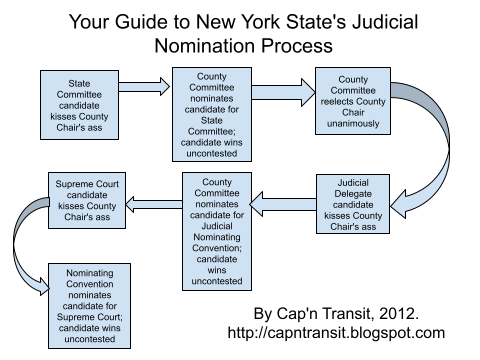
Governing magazine has the answer, and it links to two editorials that are definitely worth a read. I sure didn't learn this stuff in eighth grade! It turns out that New York State has a hugely crappy, undemocratic system of electing judges. Sure, you can get nominated as an independent, but to get the nomination of the Democratic or Republican parties you don't run in the primary like you might for a legislative seat. You need to be chosen by a Judicial Nominating Convention.
Who votes in the nominating convention? Judicial Delegates. Who chooses the judicial delegates? In principle, you can vote for them in the primary, but in practice nobody bothers to collect the signatures to contest a judicial delegate election. The county party committee can nominate candidates for the primary without requiring signatures, and the party committee is controlled by the county chair. So in practice, the county chairs nominate the delegates and tell them who to nominate for judgeships, and the delegates do it.
Okay, so where do these County Chairs come from? They're elected by the county committee, which is made up of the party's State Committee members from that county. In theory, the State Committee members are elected in the primary elections, but just like the judicial delegates, it's very rare to collect petitions and run for the State Committee. Most people just get nominated by the County Chairs themselves. Once that happens, of course, they owe something to the chairs, so they keep re-electing them.
Now you might have noticed that in this system, the State Committee members and judicial convention delegates have effectively zero decision-making power. Their entire function is to obfuscate the system so that people can't tell what's going on, and give it a veneer of legitimacy. So why do they bother? What do they get out of it? Besides a chance for some kinky sex in an Albany motel, that is?
The most ambitious of these people are candidates for higher office. By attending the State Committee and the judicial nominating convention, they have a chance to prove their loyalty to their patrons. This marks their place in the hierarchy, and then when vacancies come up for elected positions, including judgeships, they may be chosen by the county or state chair to be the party's candidate and not have to collect petitions. The less ambitious people, or the ones marking time in between elected terms of office, are rewarded for their loyalty with powerful roles on the boards of government authorities, and sinecures at well-connected nonprofits and corporations.
The State Court of Appeals is actually nominated in a slightly cleaner way, by the state's Commission on Judicial Nomination, whose commissioners are nominated by the Governor, the Chief Judge and the majority and minority leaders of the two legislative chambers. Of course, how the legislative leaders get elected isn't exactly clean either, but it's a slight improvement.
So the next time you hear, "State Supreme Court Judge," remember that they're essentially appointed by the county party chairs. And the next time you hear about a scandal involving a county party chair, think about how many judges that chair has selected.
The State Supreme Court - that sounds like a big deal, huh? Like New York's version of Justices Breyer and Roberts? Actually, as I learned in eighth grade, the Supreme Court is actually the state's lowest court, able to be overruled by the Appellate Division and the Court of Appeals, not to mention federal courts. But it's still significant. So where did these guys come from, anyway, and how did they get this kind of power?
Governing magazine has the answer, and it links to two editorials that are definitely worth a read. I sure didn't learn this stuff in eighth grade! It turns out that New York State has a hugely crappy, undemocratic system of electing judges. Sure, you can get nominated as an independent, but to get the nomination of the Democratic or Republican parties you don't run in the primary like you might for a legislative seat. You need to be chosen by a Judicial Nominating Convention.
Who votes in the nominating convention? Judicial Delegates. Who chooses the judicial delegates? In principle, you can vote for them in the primary, but in practice nobody bothers to collect the signatures to contest a judicial delegate election. The county party committee can nominate candidates for the primary without requiring signatures, and the party committee is controlled by the county chair. So in practice, the county chairs nominate the delegates and tell them who to nominate for judgeships, and the delegates do it.
Okay, so where do these County Chairs come from? They're elected by the county committee, which is made up of the party's State Committee members from that county. In theory, the State Committee members are elected in the primary elections, but just like the judicial delegates, it's very rare to collect petitions and run for the State Committee. Most people just get nominated by the County Chairs themselves. Once that happens, of course, they owe something to the chairs, so they keep re-electing them.
Now you might have noticed that in this system, the State Committee members and judicial convention delegates have effectively zero decision-making power. Their entire function is to obfuscate the system so that people can't tell what's going on, and give it a veneer of legitimacy. So why do they bother? What do they get out of it? Besides a chance for some kinky sex in an Albany motel, that is?
The most ambitious of these people are candidates for higher office. By attending the State Committee and the judicial nominating convention, they have a chance to prove their loyalty to their patrons. This marks their place in the hierarchy, and then when vacancies come up for elected positions, including judgeships, they may be chosen by the county or state chair to be the party's candidate and not have to collect petitions. The less ambitious people, or the ones marking time in between elected terms of office, are rewarded for their loyalty with powerful roles on the boards of government authorities, and sinecures at well-connected nonprofits and corporations.
The State Court of Appeals is actually nominated in a slightly cleaner way, by the state's Commission on Judicial Nomination, whose commissioners are nominated by the Governor, the Chief Judge and the majority and minority leaders of the two legislative chambers. Of course, how the legislative leaders get elected isn't exactly clean either, but it's a slight improvement.
So the next time you hear, "State Supreme Court Judge," remember that they're essentially appointed by the county party chairs. And the next time you hear about a scandal involving a county party chair, think about how many judges that chair has selected.
Monday, August 13, 2012
In your half of road...
I remember when I visited Massachusetts for the first time as a teenager. I stepped into a crosswalk with no traffic light and prepared to wait for the cars to pass, but they stopped and let me cross first! I was pretty amazed. A few years later I went back to a different town in Massachusetts, and they did it there too!
I started thinking about how great it would be if drivers did that everywhere, but here's the kind of jackassery we had to deal with in New York State at the time:
You must yield to a pedestrian, but only if they're in your half of the road! With that kind of wishy-washy law in place, I figured that nobody would ever bother to figure out if I was in their half of road, and sure enough they just cruised on by.
But then lo! The State Legislature passed a law making our crosswalks equal to those of Massachusetts and New Jersey. No more of this "IN YOUR HALF OF ROAD" bullshit.
That was the time that I really could have used this law, because I moved to Queens right around then. Most of the intersections here in Queens are what they call "unsignalized," where two streets cross and only one has stop signs. If there are only cars, the cars on the street without signs just cruise right through while the drivers on the other street stop. If pedestrians try to cross a street without stop signs, the drivers just barrel on through the same way. You can wait five minutes at one of these crosswalks during rush hour.
With this law, though, I could just step into the crosswalk and they'd have to stop! But what counts as a crosswalk? Unlike the crosswalks in, say, Great Barrington, there was no paint in some of these intersections. None. If it doesn't have the zebra stripes, do drivers have to stop?
According to the law, they do. In New York State, if there's a line of sidewalk broken only by the street, then the space in the street where the sidewalk would be is a crosswalk. It doesn't matter if there are zebra stripes or no paint at all. The only thing that can make it not a crosswalk is one of those signs that say "NO PED X-ING."
With that in mind, I promptly marched up to the unsignalized intersection on my corner and started to cross. The driver didn't stop. I was smart enough to pull back before I got creamed. It was clear that just changing the law was not enough.
I started thinking about how great it would be if drivers did that everywhere, but here's the kind of jackassery we had to deal with in New York State at the time:

You must yield to a pedestrian, but only if they're in your half of the road! With that kind of wishy-washy law in place, I figured that nobody would ever bother to figure out if I was in their half of road, and sure enough they just cruised on by.
But then lo! The State Legislature passed a law making our crosswalks equal to those of Massachusetts and New Jersey. No more of this "IN YOUR HALF OF ROAD" bullshit.
That was the time that I really could have used this law, because I moved to Queens right around then. Most of the intersections here in Queens are what they call "unsignalized," where two streets cross and only one has stop signs. If there are only cars, the cars on the street without signs just cruise right through while the drivers on the other street stop. If pedestrians try to cross a street without stop signs, the drivers just barrel on through the same way. You can wait five minutes at one of these crosswalks during rush hour.
With this law, though, I could just step into the crosswalk and they'd have to stop! But what counts as a crosswalk? Unlike the crosswalks in, say, Great Barrington, there was no paint in some of these intersections. None. If it doesn't have the zebra stripes, do drivers have to stop?
According to the law, they do. In New York State, if there's a line of sidewalk broken only by the street, then the space in the street where the sidewalk would be is a crosswalk. It doesn't matter if there are zebra stripes or no paint at all. The only thing that can make it not a crosswalk is one of those signs that say "NO PED X-ING."
With that in mind, I promptly marched up to the unsignalized intersection on my corner and started to cross. The driver didn't stop. I was smart enough to pull back before I got creamed. It was clear that just changing the law was not enough.
Friday, June 15, 2012
Community boards would stifle transit innovation
Recently I expressed doubt that the New York Metropolitan Transportation Authority could create an innovative bus service like the Koreana van between Flushing and Fort Lee. Commenter Three Station Square gave a couple of counterexamples: the M60, introduced in 1992, connected 125th Street in Manhattan with La Guardia Airport, and the S89, introduced in 2007, connects the West Shore of Staten Island with the Hudson-Bergen Light Rail. George K pointed out that the S89 followed part of the route of Joel Azumah's 144 bus, but that in turn had taken over the route from Red and Tan in Hudson County.
Most of the innovations listed by Three Station Square are tweaks, including the extension of the Q5 and Q85 across the city limits to the Green Acres Mall in Valley Stream. And they're good tweaks; we like them, right? Well, you can expect even those to go away if one of "Gridlock Sam" Schwartz's proposals is adopted.

Schwartz's "equitable transportation formula" includes this point: "No service reductions on local buses for three years without Community Board approval." Sounds great, right? We hate service cuts, and we like community. More power to the community! What could possibly go wrong?
Any transit expansion advocate who's ever been to a New York City community board meeting knows exactly what's wrong with that. Many of the people who are involved in community boards are nice people who really want to do what's best for their city and their neighborhood. But the boards themselves are undemocratic and tend to be dominated by drivers and obsessed with increasing the supply of free parking. Their proceedings are almost always reactive and usually reactionary. They tend to stifle and oppose growth and innovation.
Some of you may be familiar with London's borough councils (elected by district) or Paris's district councils (elected at large). The community boards are nothing like that. Prospective members must be nominated by either their City Council member or the Borough President, and then approved by the Borough President's office. Some councilmembers and borough presidents value inclusiveness and a diversity of opinion, and some don't. Community board members are all volunteers, and the significant time commitment makes it difficult for people with day jobs to attend.
As a result, the boards tend to be dominated by people who are older and wealthier than the average for the district. In 2012 that means that they tend to own cars and drive them, to see driving and parking as an inalienable right, and to identify more with drivers than with pedestrians, cyclists or transit riders. The top issues they care about seem to be: (1) getting developers to provide more parking, (2) preventing anyone from interfering with double parking, (3) preventing traffic changes that they fear would overwhelm the neighborhood with cars, and (4) doing something about those damn bikers that almost ran over poor Connie.
Older and wealthier people also tend to be more interested in protecting what they already have than in getting more that they might use in the future. As a result, transportation discussions at community boards tend to be about preserving existing rights and privileges. There is very little interest in innovation. When they do support innovation, it's usually ornamental initiatives that present no threat to the car-oriented status quo. Why risk what you've worked so hard to get?
I have a number of friends who put in a lot of time and energy on community boards around the city. This is not to denigrate their efforts; it's important for someone to show up and make it clear that these aren't the only people in "the community." But I think they'd all agree that giving more power to community boards is a bad idea.
Basically, if you want to kill an idea, the best way to do it is to require community board approval. Which is why I'd be fine with requiring community board approval to buy leaky headphones, or to walk up the down side of the staircase, or to split a line at the Duane Reade. But transit cuts are not like that.
So why wouldn't I want to kill transit cuts? Because you can't have transit expansion without transit cuts. As I wrote on Sunday, for an agency to try something new, it needs to be able to cut it if it isn't working out.
In the case of across-the board reductions like we saw in 2010, community boards can't prevent the State Assembly from cutting the transit budget. They can only tie the MTA's hands as they try to deal with those budget cuts. Schwartz's proposal would not make the cuts go away. It would either force the MTA to borrow more or raise fares, or it would hold back service reductions on routes that are popular with influential community members, usually the elderly. Other routes would have to be reduced even more to compensate.
As with the bogus fairness, the elevated busways and the dollar fare reductions in neighborhoods with no subways, this is an idea that may sound nice to people who don't know that much about transit. But under scrutiny, it falls apart.
Yes, we need tolls on the East River bridges, and I agree with the many people who have argued that it will happen sooner or later. It's not worth all these bad things to make it happen sooner. Almost all of the elements in Schwartz's plan would lead to a net increase in driving citywide, and that's not what we're in this for.
Most of the innovations listed by Three Station Square are tweaks, including the extension of the Q5 and Q85 across the city limits to the Green Acres Mall in Valley Stream. And they're good tweaks; we like them, right? Well, you can expect even those to go away if one of "Gridlock Sam" Schwartz's proposals is adopted.

Schwartz's "equitable transportation formula" includes this point: "No service reductions on local buses for three years without Community Board approval." Sounds great, right? We hate service cuts, and we like community. More power to the community! What could possibly go wrong?
Any transit expansion advocate who's ever been to a New York City community board meeting knows exactly what's wrong with that. Many of the people who are involved in community boards are nice people who really want to do what's best for their city and their neighborhood. But the boards themselves are undemocratic and tend to be dominated by drivers and obsessed with increasing the supply of free parking. Their proceedings are almost always reactive and usually reactionary. They tend to stifle and oppose growth and innovation.
Some of you may be familiar with London's borough councils (elected by district) or Paris's district councils (elected at large). The community boards are nothing like that. Prospective members must be nominated by either their City Council member or the Borough President, and then approved by the Borough President's office. Some councilmembers and borough presidents value inclusiveness and a diversity of opinion, and some don't. Community board members are all volunteers, and the significant time commitment makes it difficult for people with day jobs to attend.
As a result, the boards tend to be dominated by people who are older and wealthier than the average for the district. In 2012 that means that they tend to own cars and drive them, to see driving and parking as an inalienable right, and to identify more with drivers than with pedestrians, cyclists or transit riders. The top issues they care about seem to be: (1) getting developers to provide more parking, (2) preventing anyone from interfering with double parking, (3) preventing traffic changes that they fear would overwhelm the neighborhood with cars, and (4) doing something about those damn bikers that almost ran over poor Connie.
Older and wealthier people also tend to be more interested in protecting what they already have than in getting more that they might use in the future. As a result, transportation discussions at community boards tend to be about preserving existing rights and privileges. There is very little interest in innovation. When they do support innovation, it's usually ornamental initiatives that present no threat to the car-oriented status quo. Why risk what you've worked so hard to get?
I have a number of friends who put in a lot of time and energy on community boards around the city. This is not to denigrate their efforts; it's important for someone to show up and make it clear that these aren't the only people in "the community." But I think they'd all agree that giving more power to community boards is a bad idea.
Basically, if you want to kill an idea, the best way to do it is to require community board approval. Which is why I'd be fine with requiring community board approval to buy leaky headphones, or to walk up the down side of the staircase, or to split a line at the Duane Reade. But transit cuts are not like that.
So why wouldn't I want to kill transit cuts? Because you can't have transit expansion without transit cuts. As I wrote on Sunday, for an agency to try something new, it needs to be able to cut it if it isn't working out.
In the case of across-the board reductions like we saw in 2010, community boards can't prevent the State Assembly from cutting the transit budget. They can only tie the MTA's hands as they try to deal with those budget cuts. Schwartz's proposal would not make the cuts go away. It would either force the MTA to borrow more or raise fares, or it would hold back service reductions on routes that are popular with influential community members, usually the elderly. Other routes would have to be reduced even more to compensate.
As with the bogus fairness, the elevated busways and the dollar fare reductions in neighborhoods with no subways, this is an idea that may sound nice to people who don't know that much about transit. But under scrutiny, it falls apart.
Yes, we need tolls on the East River bridges, and I agree with the many people who have argued that it will happen sooner or later. It's not worth all these bad things to make it happen sooner. Almost all of the elements in Schwartz's plan would lead to a net increase in driving citywide, and that's not what we're in this for.
Saturday, May 26, 2012
Man's parking-lot inhumanity to man
A few months ago I was so caught up in my tablet (probably writing a blog post) that I forgot to ring the bell to get off the bus, and it sailed right past my stop. I was in a hurry, but I said to myself, "No problem, I'll just cut across this parking lot!"
It had been a while since the last time I was in such a big parking lot, so I had forgotten how hellish they were. When you spend a lot of your travel time as a pedestrian being bullied by drivers, you may think that full-time pedestrians are the only people who get bullied by drivers.

I wasn't even bullied by any drivers that day. I just had to walk across an enormous expanse of asphalt, with the sun beating down, constantly aware that a car could come speeding up behind me, or zip around the corner in front of me, or pull out from one side or the other. And this one wasn't even so bad. It was only March, so the sun wasn't too hot. There were no dust storms, or flash floods, or any of the other things that make wide expanses of asphalt so unbearable.
As I walked, I looked at the other people in the parking lot and thought, "They're not full-time pedestrians. They're drivers! They get shat on just like me!" This is not an "us and them" issue. The drivers and the parking lot designers were making "us" (i.e. other drivers) miserable.
But then I realized that even among drivers it's not all "us." The people who park closer in have a distinct advantage: the closer in you park, the longer you're a driver and the less time you're a pedestrian. You can bully the other drivers who get the spaces further out, because they've become pedestrians while you're still a driver. This is one of the reasons people go nuts over parking spaces.
You may think, "Well, okay, but at least it's equal opportunity, because everyone can park closer in; they just have to get there earlier or get lucky." And "handicap" spaces - well, people with handicap permits deserve the advantage because they have a hard time getting around on foot. But this parking lot was attached to a hierarchical institution where the closer-in spaces were assigned to people higher up in the hierarchy. After I crossed that awful parking lot I came to another one, reserved for people with higher rank. Then I came to a smaller lot with numbered spaces that were assigned to specific individuals.
At this institution, the top people get to stay drivers for the longest period of time, while those at the bottom of the pyramid become pedestrians almost as soon as they arrive. That's one way the hierarchy is reinforced. In some places, the assignment of parking spaces is a form of power in its own right, and the person who controls that assignment can exact favors in exchange for granting a preferred space. The really special people (I have no idea whether they exist at this institution) are the ones who get driven around; they always get dropped off at the door, and never have to walk through a parking lot.
This is just one of many ways that drivers bully and harass each other, not just pedestrians. It's worth remembering. And interestingly, as a bus passenger I'm not even at the bottom. I don't have to walk through the parking lot at all (especially if I'm not in a hurry). There are sidewalks for us bus passengers, and although drivers often bring their cars onto the sidewalks and bully us there, it's less common.
Parking lots are hell, and they're hell for almost everyone. So why do we keep building them? Why do we have a large regulatory apparatus whose primary job is forcing people to build parking lots? Why do we have an army of people ready to spring into action the moment they think there's not enough parking? The whole thing is crazy, tragically crazy.
It had been a while since the last time I was in such a big parking lot, so I had forgotten how hellish they were. When you spend a lot of your travel time as a pedestrian being bullied by drivers, you may think that full-time pedestrians are the only people who get bullied by drivers.

I wasn't even bullied by any drivers that day. I just had to walk across an enormous expanse of asphalt, with the sun beating down, constantly aware that a car could come speeding up behind me, or zip around the corner in front of me, or pull out from one side or the other. And this one wasn't even so bad. It was only March, so the sun wasn't too hot. There were no dust storms, or flash floods, or any of the other things that make wide expanses of asphalt so unbearable.
As I walked, I looked at the other people in the parking lot and thought, "They're not full-time pedestrians. They're drivers! They get shat on just like me!" This is not an "us and them" issue. The drivers and the parking lot designers were making "us" (i.e. other drivers) miserable.
But then I realized that even among drivers it's not all "us." The people who park closer in have a distinct advantage: the closer in you park, the longer you're a driver and the less time you're a pedestrian. You can bully the other drivers who get the spaces further out, because they've become pedestrians while you're still a driver. This is one of the reasons people go nuts over parking spaces.
You may think, "Well, okay, but at least it's equal opportunity, because everyone can park closer in; they just have to get there earlier or get lucky." And "handicap" spaces - well, people with handicap permits deserve the advantage because they have a hard time getting around on foot. But this parking lot was attached to a hierarchical institution where the closer-in spaces were assigned to people higher up in the hierarchy. After I crossed that awful parking lot I came to another one, reserved for people with higher rank. Then I came to a smaller lot with numbered spaces that were assigned to specific individuals.
At this institution, the top people get to stay drivers for the longest period of time, while those at the bottom of the pyramid become pedestrians almost as soon as they arrive. That's one way the hierarchy is reinforced. In some places, the assignment of parking spaces is a form of power in its own right, and the person who controls that assignment can exact favors in exchange for granting a preferred space. The really special people (I have no idea whether they exist at this institution) are the ones who get driven around; they always get dropped off at the door, and never have to walk through a parking lot.
This is just one of many ways that drivers bully and harass each other, not just pedestrians. It's worth remembering. And interestingly, as a bus passenger I'm not even at the bottom. I don't have to walk through the parking lot at all (especially if I'm not in a hurry). There are sidewalks for us bus passengers, and although drivers often bring their cars onto the sidewalks and bully us there, it's less common.
Parking lots are hell, and they're hell for almost everyone. So why do we keep building them? Why do we have a large regulatory apparatus whose primary job is forcing people to build parking lots? Why do we have an army of people ready to spring into action the moment they think there's not enough parking? The whole thing is crazy, tragically crazy.
Subscribe to:
Posts (Atom)