Wednesday, April 30, 2008

Truckers call for Cap on Fuel Prices

From NBC News, via Streetsblog:

The truckers said they want Congress to issue an immediate cap on gasoline, diesel and heating oil prices. They are demanding a $2 a gallon cap on all of the fuels.


Hm, aren't these the same "capitalists" who've been saying we shouldn't give any money to Amtrak because "it hasn't made a profit"?

BRT as a Means to an End

As I've written before, it's important to keep a broad perspective on things. While transit geeks like me get excited about the simple idea of creating more transit, that's not really enough reason. COMMUTE has a very good reason for promoting BRT: to serve underserved communities, particularly low-income people. In order to do that well, you need to not only know where the low-income people with shitty commutes live, but also where they need and want to go. I don't have that information, and if COMMUTE has it, they didn't share it with us. If someone can give me that information, I'll do what I can to help find good BRT routes to accommodate it.

I support the goal of serving underserved communities, and I have a few others, as described in this post:
  • Reducing pollution

  • Increasing transportation and land-use efficiency

  • Improving social interaction

  • Reducing carnage

These intermediate goals will also help low-income people, by improving their air quality, reducing the carnage on their streets, preserving jobs for them, and improving the social fabric of their neighborhoods. But in order to accomplish these goals, it's not enough to transport low income people. We need to get people out of their cars, and since car drivers in the New York area tend to be better-off, that means getting some middle-class and rich people out of their cars.

When it comes to getting people out of their cars, keep in mind that the rising cost of gasoline will accomplish much of this by itself. People who used to drive even though they're well-served by transit are now leaving the car at home, or even selling it, and taking that transit. If they couldn't get to their jobs and shopping easily by transit, they find other places to work and shop. Many people whose homes are not well-served by transit are moving to places that are.

Sprawly places like eastern Queens and southeastern Brooklyn pose a problem for sustainability: the way they're set up now, it's very difficult for someone to live out there and get to work and shopping without a car. The people who live there now could all move to western Queens and South Brooklyn, but that wouldn't be a very efficient use of space, would it? We need to find a way to reshape the sprawl into transit-oriented development: clusters of dense housing, employment and shopping near transit, and less-dense housing and parkland in between. This is hard to do without transit, so the question becomes how best to extend transit to these sprawly areas.

This is where I see the biggest value for BRT - and hopefully light rail, and eventually maybe more subways. This is also good because this is where there are the largest number of wide boulevards and highways, that can more easily be converted to BRT. Many of these places were originally designed around streetcars to begin with, but if not, they can be redeveloped around this model.

What kind of trips should we be designing BRT for? Just as it doesn't make sense to drive for your daily shopping, it doesn't make much sense to rely on transit for that daily shopping. We should be aiming, through zoning and subsidies if necessary, to have everyone live within convenient walking distance of a decent supermarket (and not tear down historic structures to build parking for supermarkets). Plain old buses (with signal prioritization and other improvements wherever possible) can accommodate other kinds of shopping and socializing.

Rapid transit should be for special occasion shopping, entertainment and socializing, and for commuting. That means - you guessed it - connections to Manhattan. But, as Joan Byron pointed out, there are also job centers in the other boroughs, and making connections between the boroughs should be a secondary goal. I'll explore some of these possibilities in future posts.

We should also think about long-distance connections: how easy is it for someone from Baychester to get to Penn Station for an Amtrak train? For someone from College Point to get to the Port Authority for a Peter Pan bus? For a resident of Kingsbridge to get to any of the airports?

Monday, April 28, 2008

BRT Bait-and-Switch: the COMMUTE Plan

In the first post in this series, I identified a very serious bait-and-switch, often practiced by unscrupulous anti-transit people, where Bus Rapid Transit ("BRT") is set up as "just like subways, only cheaper!" in order to divide and conquer pro-transit forces. In the second post, I pointed out a much more benign one, where BRT was put forth as a solution for slow bus routes, even though the planned BRT would do nothing to speed the slow routes.

In this post I will discuss another well-intentioned bait-and-switch, but one that I also feel is not a good idea. This one comes from the Pratt University Center for Community Development, in support of the COMMUTE coalition. It's laid out in an article for the Gotham Gazette by the Pratt Center's Joan Byron. Byron unfortunately characterizes BRT as "a subway running above the ground on rubber tires," but otherwise she makes several good points. There are other flaws in her reasoning, however.

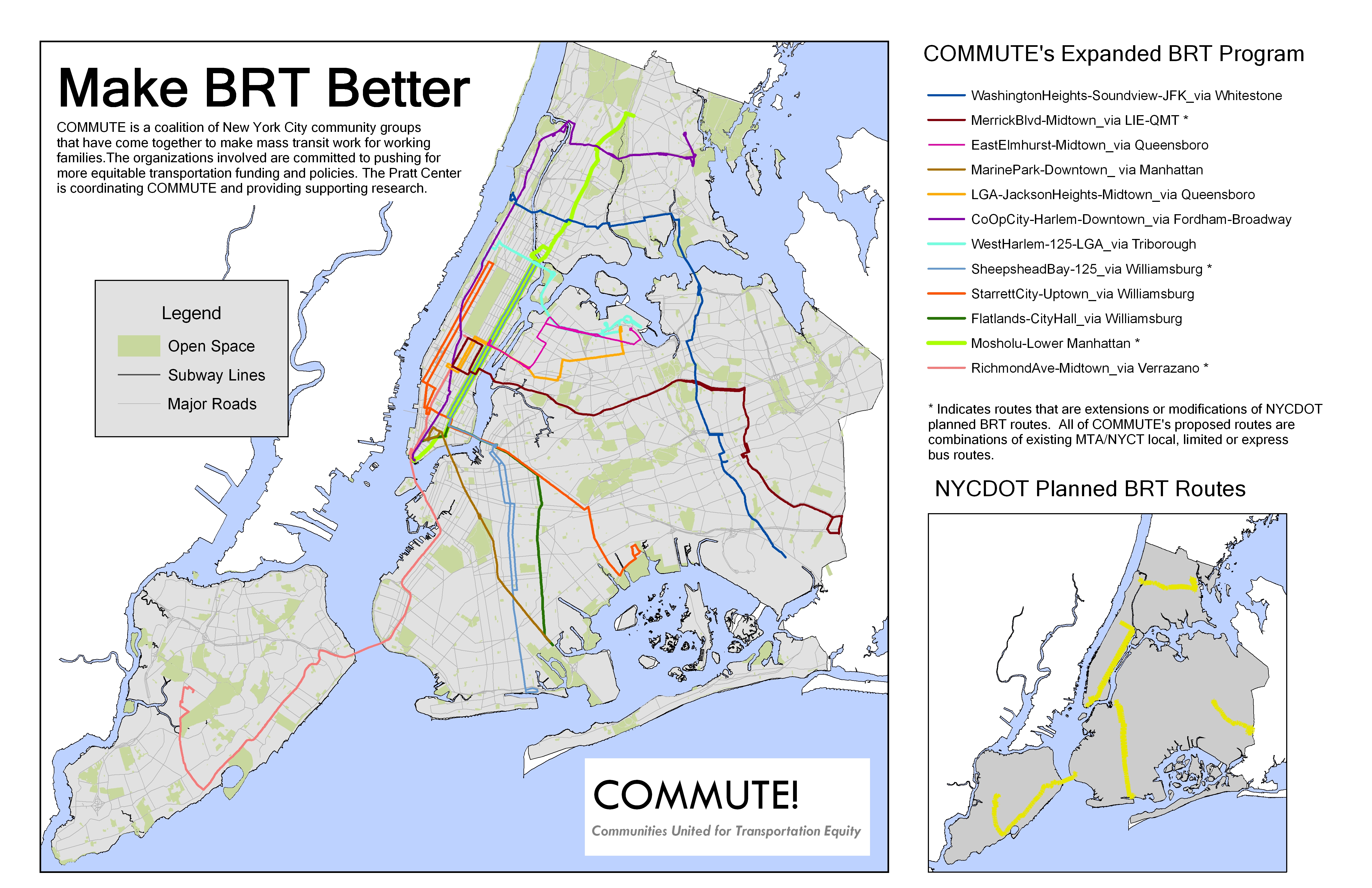
Byron's argument is essentially this: Even in New York, there are thousands of people who have long commutes to low-paying jobs. One of our top transportation priorities should be to shorten the commutes for these low-income workers, giving them more time to live their lives. Another should be to connect these workers with more opportunities, giving them more power in the job market. BRT can accomplish both these goals, for less money and less political hassle than digging a subway. She mentions the joint NYCDOT/MTA BRT effort, and links to a map of improved routes proposed by COMMUTE.

There's no question that Byron's goals are laudable. My concerns are whether BRT can accomplish them for significantly less money and hassle than rail, and whether the BRT routes that COMMUTE proposes would do much towards those goals.

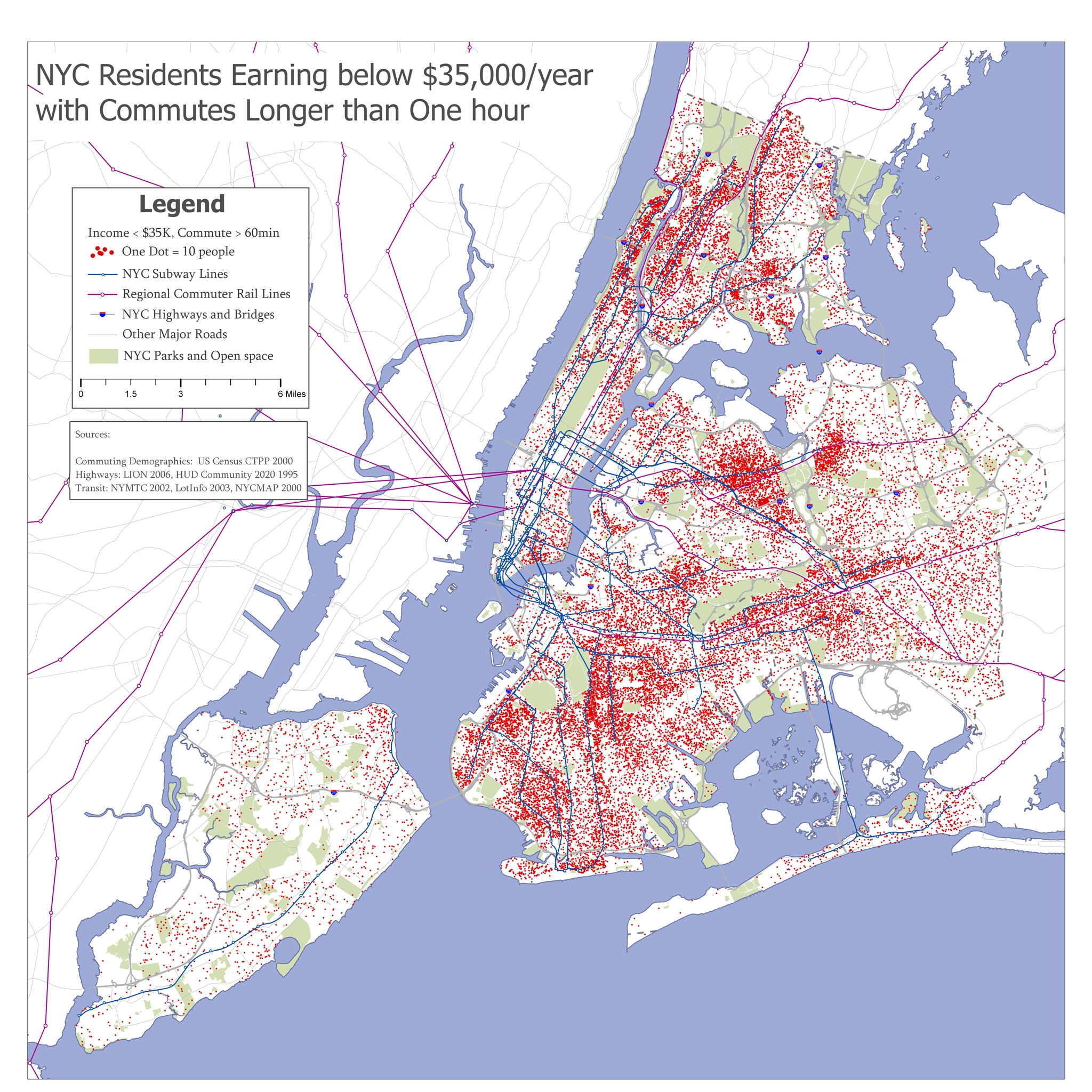
The largest clusters of red dots on the low-income long-commute map are in Inwood/Washington Heights, Corona, Flushing, Flatbush and Sunset Park. All these areas are fairly well-served by transit, however: just about every dot in those clusters is within a fifteen-minute walk to a subway station. The main problem seems to be that the jobs require a long ride on those subways. You might say that the northern part of Corona/East Elmhurst, southern Flushing, and eastern Sunset Park are too far from the train, but of those, only Corona would be served by the proposed BRT routes.

It's important to remember that the non-grade-separated BRT that COMMUTE is advocating can almost never travel faster than a subway along the same route, because the subways are grade-separated. Any of the proposed BRT routes that parallel subways (such as those on Broadway in Brooklyn and Manhattan, and Flatbush Avenue in Brooklyn) will be slower, and will thus not shorten the commute times for these commuters.

The sad story of the Merrick Boulevard BRT line showed that many people will fight tooth and nail to preserve parking, and thus that BRT routes that involve removing parking will likely face more political opposition than ones that don't. This means that all the BRT routes proposed for four-lane or narrower corridors (such as Third Avenue in the Bronx, Sutphin and Parsons Boulevards in Queens, and Broadway and Utica Avenue in Brooklyn) will be very difficult to implement. How much more difficult would a subway be?

The BRT routes shown on the map do not seem to have much of a pattern to them. Byron criticizes the NYCDOT/MTA BRT plans for relying on transfers to subways and commuter rail, but for BRT to work without transfers it has to go to jobs. Byron put forth a great goal of connecting low-income workers to closer jobs that are currently difficult to get to by transit, but how do the COMMUTE routes help? They don't seem to go to very many obvious low-wage job centers. If they are in fact designed to do this, spelling that out is essential to winning the political support necessary to overcome the parking defenders.

The corridors where it is easiest to implement BRT are corridors where there is already a large number of lanes dedicated to moving cars. It's much easier to convert car lanes to BRT lanes than it is to convert parking lanes to BRT. This means six-lane or wider boulevards, and expressways. For this reason, COMMUTE's proposed routes along the Gowanus Expressway, LIE and Astoria Boulevard/Grand Central Parkway are the most likely to succeed - and they can be designed to serve populations in Sunset Park, Jamaica and Corona. Main Street and Northern Boulevard are other promising candidates. The DOT should give all of these a good look, and consider other corridors, but leave the other COMMUTE recommendations to a later stage.

Ever since I first saw that low-income commute density map, I've been wondering where these people all commute to, and how we can make their commutes shorter. I'd like to see that study. I also hope that some day, the Pratt Center or another organization will do a real study assessing the skills in these low-wage, long-commute neighborhoods, find jobs to match them, and plot routes to make the commutes easier. That would be very cool. This apparently random BRT wishlist - not so cool.

Sunday, April 27, 2008

Another BRT Bait-and-Switch

In an earlier post, I talked about how Bus Rapid Transit ("BRT") can be used to deflect energy from rail transit: promise "a subway running above the ground on rubber tires" - but cheaper! - and some people will get behind that, while the rail transit diehards waste energy trying to win back the defectors. Well, there's another kind of bait-and-switch: highlighting a problem and then proposing a BRT "solution" that would do nothing for the problem.

I feel kinda bad singling these people out, since they're obviously dedicated transit advocates with a long history of supporting social justice, and I still think that the individual advocates, their organizations and goals are worthy of support. Still, I think this kind of tactic does nobody any favors, and I'm willing to go up against it.

You may have heard of the Pokey Awards. Every year, the Straphangers' Campaign releases a list of the slowest bus routes for each borough. Recently it has supplemented the Pokeys with Schleppie Awards for the most unreliable routes. Every year's press release includes a plug from Transportation Alternatives for BRT. So far so good: it's very important to draw attention to the slowness and unreliability of the bus system, and to get people to take action instead of just complaining.

The problem is that the BRT solutions that are pushed every year have very little to do with the routes that win the Pokeys and Schleppies. Here are the laureates for every year:


YearPokeySchleppie
2007M23M1
2006M14AM1
2005M34
2004M34
2003M23
2002M96


There's a lot that could be done to speed up travel on 14th, 23rd, 34th and 96th Streets, as well as the streets where the other Pokey recipients travel in the outer boroughs. But none of the Pokey Award press releases address them. Instead, each release mentions the MTA/NYCDOT BRT pilot program, which would do very little for these corridors. For Manhattan, the pilot site was First and Second Avenues, and each Pokey Award press release trumpets the potential improvements to the M15 corridor, despite the fact that the M15 is never on the list of slowest routes.

Incidentally, on April 17 Transportation Commissioner Janette Sadik-Khan announced that the city planned to turn half of 34th Street into a dedicated busway. Now that would make sure that the M34 is never again on the Pokey list. If it works, hopefully she'll do the same for 14th, 23rd and 96th Streets.

I've written more about the Pokeys than I intended to. Like I said, both the NYPIRG Straphangers Campaign and Transportation Alternatives are good organizations and deserve your support. Don't withhold it on account of this. All I'm asking is that for the '08 Pokey and Schleppie awards the press release include measures that would actually speed up the award winning bus routes.

Sunday, April 20, 2008

Reclaiming the Streets

Larry Littlefield writes that if motorists refuse to tax themselves to reduce congestion and pay for the road space they use, we'll just have to transfer their road space to uses that serve more taxpayers.

Wednesday, April 16, 2008

Poisoning the Well

With the demise of congestion pricing, transit and livable streets advocates have encountered the dysfunction that is Albany politics. Many are understandably frustrated, and looking for something to do. Before the final non-vote, the League of Conservation Voters set up a political action committee funded at about $300,000 - with strong hints that lawmakers who failed to support congestion pricing would not receive money from the PAC, and challengers to those lawmakers probably would.

Streetsblog commenter JK had this interesting insight about the relationship between patronage and corruption:

The big reform would be banning earmarks/member items/pork/set asides. There are some interesting studies which suggest there is a relationship between the amount of pork/patronage and the competitiveness of elections. ( I'll see if I can find a famous one from Argentina.)


JK hasn't provided the study, but I did a little googling and came up with this one. I haven't yet read it to the end, but it looks pretty interesting. For now I'm going to take it as a given that the more pork, the less competitive the elections. Here's what I wrote in response:

JK, that is awesome! The machine is so entrenched and pulling it out by the roots would be really difficult. But if it feeds on patronage ... poison the patronage, and it dies!


Let's take a closer look at the pork in the state budget - something the Legislature doesn't want us to do, and succeeded for several years at preventing us from doing, which is baffling in itself. The State Budget page still doesn't have any details five days later, but some of the papers have information about this budget and previous ones. This 2007 list from Rockland is particularly interesting. It shows the level of patronage - i.e. the discrepancy between the favored and the less-favored. While in 2006 Silver took $7 million for his own district, in 2007 Rockland legislators got between $103,000 and $153,000 (I'm assuming that the "million" in the blog post is a mistake).

The thing that gets me is that the total $200 million per house is a big deal (it'd buy about 100 subway cars), but the amounts for each member are chump change, at least in Rockland. $153,000 is a lot more than I make in a year, but it's much less than the value of my apartment. Corporations and large nonprofits toss this kind of money around all the time.

So let's say you're a wealthy heir, dot-com whiz or good-government organization with a few million to spend on reforming state government. You fund a nonprofit group dedicated to community improvement. Then you pick a legislator who's pissed you off recently and find out the amount and recipient of each of their "member items." Your nonprofit offers them an identical grant - on the condition that they sign an agreement rejecting the legislator's member item. Knowing the speed of state government, you already have an advantage: they can get the money from you in their bank account tomorrow, or wait god knows how long for the state grant to come through.

Some may not be willing to reject the pork money right away. You could then offer them double the money, or triple, or ten times. For an individual legislator we know you can't spend more than $70 million doing that. The League of Conservation Voters expects to have $300,000, so they could do the double-your-money offer.

If you do that for two years, then the next election cycle the constituents will have received absolutely no pork from that legislator. The legislator gets no ribbon-cutting or check-delivery ceremonies - in fact there are none, because your organization quietly refuses to participate. The various organizations might still feel that the legislator was influential in determining what you gave them, so you might want to mix it up a bit, pull a Claire Zachanassian: say that if they vote for someone else - anyone, even the legislator's son - then you'll guarantee that there will be a fund of twice the district allocation available for the next ten years.

You might not even have to require them to refuse the member item. Just the fact of paying the exact same amount as the legislator might be enough to confuse things. I'm just throwing ideas out here, but the point is that for any individual legislator the totals are so small that it should be really easy to make an example of someone. A really wealthy person could easily buy the whole state. How crazy is that, selling your district's votes for $153,000?

Monday, April 14, 2008

Malthus, Grant Me ...

Some of you may be familiar with the Serenity Prayer. It's often associated with Alcoholics Anonymous and related twelve-step programs, but according to an Atlantic Monthly article by Paul Elie, it was written by Reinhold Niebuhr in response to the escalation of the Cold War. It's such a succinct expression of a general insight about life that it's useful even if you're not an alcoholic or a politician, or a Christian, or even a theist. It goes like this:

God, give us grace to accept with serenity the things that cannot be changed, courage to change the things that should be changed, and the wisdom to distinguish the one from the other.


So here's my Supplement to the serenity prayer:

And God, protect us from those who lie about what they can and can't change, and give us the insight to see through their lies.


Have you ever been talking to an annoying customer service agent or bureaucrat and gotten this, "The computer won't let me do that," or "The computer needs me to put this information in"? Computers are tools. They do what we tell them to do. They go down, and any organization with any sense has a plan to make do without computers for a day or two. If the computer won't let our Customer Service Agent refund our money for an obvious mistake, it's because the Customer Service Agent's boss won't let him do that.

Have you ever been told that something is impossible, but you have the sneaking feeling that it's not actually impossible? That the real reason you can't do it is because the person telling you it's impossible doesn't want you to do it? But it's just a feeling; you don't know for sure whether they're telling you the truth. Or even whether they're telling themselves the truth. That's what the Insight Supplement is useful for.

I hate to say it, but sometimes I get that sneaking feeling when people are making population projections. I support congestion pricing, but not because "OMG! NYC will have a million more ppl in 2030!" but because it would be good for the nineteen million people we already have.

Fortunately, many environmentalists now understand the principle of induced demand as applied to roads, but unfortunately, many of them don't apply the same principle to population in general. We don't have complete control over population, but that doesn't mean we have to accommodate any population trends that have been observed without question.

The answer is not just to assume that the million people will come no matter what, but to question why they're coming, whether they'll still come in an economic downturn, whether there's any way to redirect at least some of them to other places that can accommodate them better, and whether there's any way to get those of them who do show up to settle in a sustainable way.

I'll be referring back to this in specific cases where population projections are used to justify bad planning.