Thursday, November 6, 2014

Moynihan Bus Rapid Transit Station!

Ben Kabak tweeted about a new proposal from something called Woods Bagot to open up Penn Station to sunlight by removing the theater under Madison Square Garden:


For many years I've argued that the "Moynihan Station" proposal contained at least two major design flaws that nullified any improvement to passenger circulation: it has lots of steps, and it's west of where most people want to go. Woods Bagot pays lip service to Moynihan Station proposal, but I would hope that this helps people realize they don't need to use the Farley Post Office to bring light back into Penn Station. Since they talk about "wrapping around" Madison Square Garden, I hope it will also deal with the atrocious pedestrian conditions above Penn Station:


Of course, there is one major drawback to the proposal: it's a wonderful vision for increased mobility, but it's not Pat Moynihan's vision, and may fail to adequately glorify our late Senator.

But wait! The proposal also mentions that "a new location for the well-used theater is unresolved." I've got the perfect place: the old Farley Post Office across the street. And you know what else we could put there? Buses!


We know that there's a shortage of places to catch a bus in Manhattan, particularly near the Lincoln Tunnel. Meanwhile, good terminals are critical to efficient hub-and-spoke bus networks, but our elected officials would rather pander to private car owners. There is a lot of space (with skylights!) inside the old building where the postal trucks used to go, and more along the sides:


You could even build a flyover across Eighth Avenue, or maybe even an underpass next to the train tracks, if you wanted to spend some money. Back inside, there are big open spaces for concourses:


Two of the biggest annoyances for transit advocates are the Moynihan Station fans with their desire to build a giant sculpture and tell us it's a functioning train station, and "Bus Rapid Transit" pushers who tell us that trains are wasteful luxuries for white people and we should be spending all the government money on buses. I've always argued that the Lincoln Tunnel XBL is the most effective form of bus rapid transit in the country. If we call this the Moynihan Bus Rapid Transit Station, maybe we can get both of these groups together to build a gorgeous temple for bus riders to enter the city like gods.

Saturday, November 1, 2014

The problems with the yards

I live in Woodside, Queens, not too far from Sunnyside. I love both neighborhoods, but there are a few problems. Recently, urban planners and some of my neighbors have focused on a few in particular:

  • The rent is too damn high. I own a co-op, but I do know people who have been displaced, and people who want to live here but are having a hard time finding an affordable apartment. Increasing the housing supply would be a big help.
  • We are cut off from Astoria and Long Island City by the Sunnyside Yards to the north and west. These rail yards break up the street grid, leaving about nine ways to walk across them. All but one involve walking through industrial areas, which can have low foot traffic, especially on nights and weekends. Four of these involve crossing long, noisy, boring bridges over the Sunnyside Yards.
  • We don't have big parks. We have a number of small parks and playgrounds, but no big forests or greenways. The parks we do have can get crowded, particularly on hot summer days.
  • There aren't as many jobs as there could be. We've got relatively low unemployment rates, but we could use more jobs.

The planners have been talking for years about addressing these problems by building a deck over the Sunnyside Yards, but my neighbors are afraid of seeing our infrastructure and services overloaded. I'm concerned that there will be too much parking, and that whatever benefit we get won't be worth the cost. I'm pretty sure there are better solutions to these problems. I'll talk more about the proposals and concerns in future posts.

Sunday, October 26, 2014

What do low Tappan Zee Bridge tolls mean for you?

  • Do you drive to work across the bridge? Hooray! Your commute from your house in Rockland with the big yard to the office park in Westchester will continue to be affordable … for you, at least.
  • Do you drive across the bridge for shopping or socializing, or to get to a vacation home? Woo hoo! You will still be able to spend long hours driving to and from the mall parking lot. Enjoy your time off!
  • Do you drive a truck across the bridge? All right! Your business will continue to make a profit, until gas prices get too high.
  • Do you sell things in a mall or strip mall in Westchester or Rockland? Yowza! Your parking lots will still be full, and you may even recoup your investment.
  • Are you a politician or bureaucrat representing the area? Yippee! Pandering opportunities galore!
  • Do you take buses across the bridge, or in Westchester or Rockland? Not so good. People will continue to drive and to pressure their politicians for more roads and parking. Transit agencies will keep struggling for riders and subsidies.
  • Do you sell things in a walkable village in Westchester or Rockland? Sorry! The downtown resurgence you bet on is still a long way off. Hope you've got plenty of seed money to burn through before your gastropub gets out of the red!
  • Do you walk in Westchester or Rockland? Yeah, welp. The sidewalks, trails and density you need will continue to be neglected by elites who drive everywhere.
  • Do you breathe in Westchester or Rockland? Whoops! Why don't you take a nice drive up to New Paltz and enjoy the fresh air up there?
  • Do you take trains or buses in New York State? Oh, gee, sorry! We have no money for new transit. And look at that, we have no money to maintain the subways and buses you currently use. Wonder where all that money went?
  • Do you pay taxes in New York State? Wow! Those services you used to get for your tax dollars, like schools and low college tuition? Sorry to tell you, but the state is broke! We just can't afford luxuries like that any more. It's a new era!

Sunday, September 28, 2014

What is the challenge of our generation in New York?

As I wrote a few weeks ago, speaking about the problem of suburban poverty, Chuck Marohn said, "the challenge of our generation is to make sure that we don't leave those people behind." A group of researchers at the Brookings Institution, led by Alan Berube and Elizabeth Kneebone, have been investigating this important issue, and last year they came out with a book, Confronting Suburban Poverty, with a companion website. By comparing the 2000 Census with the 2008-2012 American Community Survey, they make a strong case that poor people are being displaced from center cities to suburbs.

I've been thinking along similar lines to Chuck's for a while now. I want to make sure that poor people aren't getting dispersed from my city, New York, to the suburbs and then left behind, so I looked into it. I've heard stories about people being displaced from Manhattan, from Brooklyn, and even from my own neighborhood in Queens. I want to know where they're going, and how we can preserve their access to New York's jobs and services.

On the Brookings website, it turns out the New York area has one of the lowest rankings in the country for (Edit) the increase in concentrated poverty, 89 out of 100:


Kneebone does observe that "all metro areas saw suburban poverty grow during the 2000s," and in the data table, she and her colleagues list the "New York-Northern New Jersey-Long Island, NY-NJ-PA" Metropolitan Statistical Area as having a 35.6% growth in the suburban poor population between 2000 and 2008-2012 (from 708,574 to 960,883).

The first question is, what do the Brookings researchers mean when they talk about "suburban" anything? Joe Kriesberg raised that question, and Kneebone and Berube answered it: "We identify cities as the first named city in the MSA title and any other named city that has a population of 100,000 or more. We treat the remainder of MSAs as suburbs." That means that in the New York-etc. MSA they counted New York, Newark, Jersey City, Yonkers, Bridgeport, New Haven, Paterson, Stamford and Elizabeth as cities, but Edison, Woodbridge, Hamilton, Trenton, Norwalk, Clifton, New Rochelle, Mount Vernon and Passaic are suburbs.

I'll talk about what I found in a later post, but for now I just wanted to get this part out there.

Friday, September 12, 2014

Did you bring enough housing for everybody?

When I was a kid, one of the things the teachers told us was that if you bring snacks or candy, you have to bring enough for everyone. If you don't, it winds up going mostly to your friends and excluding a lot of kids, which isn't fair.

I realized recently that this also applies to people who want to keep rents down through rent controls, not increasing the supply, like Tom Angotti:

At bottom, developers typically argue, the housing problem is all about supply and demand. Let us increase the supply, they say, and there will be more housing to go around for all. This, not rent regulation, will keep rents from rising. That’s good old trickle-down economics, which never works. Indeed, we’ve just come through a couple of decades in which the total housing supply has grown dramatically, and so have rents, but there was also a huge loss of low-rent housing. Over the last 20 years almost 250,000 units of rental housing were deregulated.

I want to give Angotti props for two things: unlike many rent control advocates, Angotti actually listens to people who advocate increasing the supply, and he takes the time to write an articulate response. So even though I'm criticizing his arguments, the same criticism is even more true of other people's arguments.

First of all, one sorta-valid question that Angotti raises: if total housing supply has increased (I don’t have the figures, but I’ll assume that it’s true), and rents have also increased, doesn’t that falsify the supply-side argument?

Well, no, because Angotti’s representation of "what developers typically argue" is inaccurate. I honestly don’t know what developers typically argue, because I’m not one and I don’t spend much time listening to them. But if the problem is all about supply and demand, then Angotti left out the demand side. A fairer statement of the argument would be "Let us increase the supply to match the demand, and there will be enough housing to go around for all."

If we phrase the proposal this way, we have to look at demand, and all signs point to a huge increase in the demand for New York’s walkable urban spaces and its well-paying jobs. But Angotti does not want to look at demand. Instead, he shrugs it off as a “speculative real estate fever.” He acknowledges that “the plan claims the city’s population is bound to increase in the next decade,” but argues, bizarrely, that the projected increase is not based on evidence of real demand but of demand induced by “the development of smaller housing units.” That is all he says about the demand side.

To people who currently rent in the city, Angotti’s blustering about "gentrification" and displacement may be comforting, but for me it rings hollow. I’m a fourth-generation New Yorker, but after college (two decades ago, which is as far back as Angotti goes in his piece), I couldn’t afford to live in the neighborhood I knew best, the Upper West Side. Even now, with a solidly middle-class family income, four of the neighborhoods that my family has called home are now out of my range.

Things might have been different if my parents had not done the back-to-the-land thing in the seventies. They might have been different if, when I spent a few years to go to school in another state, I had played the illegal sublet game instead of giving up my rent-stabilized apartment. They might have been different if one of my family members had gotten a bigger apartment for me to illegally inherit when he died. But as it is, my family has given up several rent-regulated apartments, and I am displaced, one of the victims that Angotti and his fellow rent-regulation advocates cry for, and the Upper West Side community is poorer because the studio I inherited there was too small for my family.

Except that I’m not one of the victims that Angotti cries for. My family didn’t live in any of these places for "decades and generations," but instead migrated around the metropolitan area, chasing dreams of suburban comfort, rustic peace and creative success across the generations. Because we left our rent-regulated apartments semi-voluntarily, I don’t count as one of Angotti's displaced. I have no right of return.

You know who else doesn’t matter in the world of the rent-regulation advocates? Immigrants from other countries, looking for cheap places to settle in the U.S. The talented and ambitious from other parts of the country, looking to make it in New York. The queer and the weird and the non-conforming, chased out of their tight-knit communities in small towns and suburbs. Anyone who wants to live without a car and not be part of a small, oppressed minority.

There is no housing for us, because the rent-regulation advocates didn’t bring enough for everybody. They only brought enough for their friends, those fortunate enough to be currently benefiting from rent regulation and subsidized housing. If I were their kindergarten teacher I would have a quiet talk with their parents after school.

Honestly, I’m fine: I have a nice co-op in Queens. But it’s the thought that counts, and the thought that we don’t count is pretty damn offensive. It leaves this old lefty fuming at the cozy club mentality that Angotti tries to dress up as justice.

Wednesday, September 3, 2014

The light is better on the poor door

I was listening to Tanya Snyder and Jeff Wood treating the latest “poor door” outrage with some well-deserved skepticism. Jeff mentioned the (entirely hypothetical at this point) “luxury” residents of the new development at 40 Riverside Boulevard not wanting to “mix with the mudbloods” and asked, “if you don’t like it, move to Westchester or whatever.”

Jeff’s mention of Westchester brought to mind an important point: that places like Westchester are much more segregated. I grew up on the Upper West Side, and we would walk out the front door and see people of all income levels. Now I can’t afford to live there, but still when I go back I see people who are less well off than I am. If we don’t live in the neighborhood (in the projects, or in rent controlled or rent stabilized apartments), we can come to shop or visit the parks; some come to panhandle. It’s easy to reach by subway and bus.

Westchester County, on the other hand, is a lot more difficult. Yes, you can get to Rye or Scarsdale on the train, but it costs a lot more. The buses to Yorktown Heights and Armonk are a lot less frequent and convenient. And there is no poor door, because no poor people are allowed in the building, unless they’re there to mop the floors. In Westchester they have whole cities for the poor, like Port Chester and Yonkers.

My wife and I once looked at an apartment in Westchester, and on our way in with our real estate agent we saw another couple coming out with a different agent. Once we were inside the agent showing us the apartment grumbled loudly to us at the gall of the other agent. She wasn’t specific, but it was clear that she was angry he was showing the apartment to a black couple. Needless to say, we didn’t go back to that agent, but she was carrying on a long tradition of segregation in the county, a tradition defended by “moderate” gubernatorial candidate Rob Astorino.

There's a famous parable of a man who loses his keys in the dark. A friend sees him searching under a streetlight and asks, "is this where you dropped them?" "Actually, no," replies the man, "but the light is better here."

I am reminded of this story when I think of people protesting the network of private employee buses shuttling employees of Google and Apple from San Francisco townhouses to Siicon Valley office parks. Much easier to lead showoff blockades against big white buses than to confront NIMBYs who oppose building more housing in San Francisco or creating dense walkable places in Silicon Valley itself. The light is better on the Google buses.

It's also much easier to fight a thirty-cent increase in the subway fare than to confront wealthy suburbanites who demand low bridge tolls. It's easier to be outraged by rich people stepping over homeless people on the streets of Manhattan than by rich people strolling the streets of Pleasantville protected from the poor by miles and rivers and highways. And that's the reason the “poor door” got so much more press than Westchester’s segregation. It's dramatic, it’s in your face, and the symbolism is inescapable. The light is better on the poor door.

Tuesday, September 2, 2014

The challenge of our generation

Rents are rising in cities across the country, and people who can’t afford the new rents have to go somewhere. At CNU 22 in June, Mike Lydon observed (48:15) that “We’re completely unprepared to put people who have the least resources out on the edge … thirty miles from downtown.” Chuck Marohn declared that “the challenge of our generation is to make sure that we don’t leave those people behind.” You can see their conversation with Jason Roberts and Joe Minicozzi, recorded by Gracen Johnson for Strong Towns, or listen to it on the latest Strong Towns podcast.

You got the call, people. Let’s rise to that challenge! I think the best way to deal with it is to bring prices down by building a diversity of relatively dense housing where there already is good transit, but many people will move to the suburbs, and some already have. WNYC made an incredibly useful map showing median income by census tract, based on the 2007-2012 American Community Survey. Here’s the New York area:


Interestingly, on this map the real concentrated poverty that we see in Fort Greene or West Farms – census tracts with median household incomes below fifteen thousand dollars – is only found in three places outside of New York city: Bridgeport, New Haven and the Seth Boyden and Otto Kretchmer projects in Newark (now closed). Instead, there are a lot of census tracts with median incomes between $15,000 and $25,000 a year. But outside of New York, Bridgeport and New Haven those are found in only a handful of other cities. In the rest of the metro area, median income is over $25,000.

The towns that have census tracts with median incomes between $15,000 and 25,000 are as follows: In New York State, Yonkers, Mount Vernon (one project), Spring Valley and Kiryas Joel. In New Jersey it’s Jersey City, North Bergen, Newark, Elizabeth, Asbury Park, Passaic and Paterson.

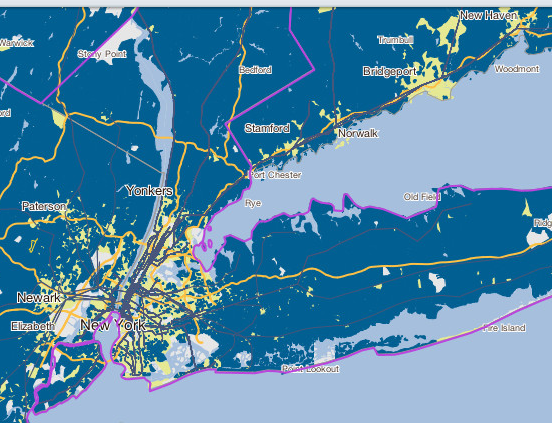
The primary challenge with the "suburbanization of poverty" is that the farther out people move, the harder it is for them to access good-paying jobs. Someone who is displaced from Fort Greene in Brooklyn to the West Ward of Newark trades a 45-minute subway ride for a trip on a bus to a commuter train to a subway that can take over an hour. Interestingly, it's not so much the cost of transportation that's the problem, as we can see by looking at the Center for Neighborhood Technology's Housing+Transportation index. In all these areas, housing and transportation costs combined were less than 45% of household income (indicated by yellow), which was often not the case for "wealthier" areas nearby (indicated by blue).


Here's the tricky part: these are based on the reports of people who had work, so they could by definition afford their commutes. It may be that the reason they can't access better-paying jobs is that they couldn't afford the commute, but we don't know that. Giving the H+T data the benefit of the doubt, we should focus on making the commute to better-paying jobs quicker, not just cheaper. That means increasing the capacity of the routes to job centers - primarily New Jersey Transit and Metro-North trains - and bringing rapid service to places, like Newark's West Ward and Yonkers's Schlobohm Houses, that are currently only accessible by relatively slow buses.

In future posts I'll talk about some potential investments that could improve job access from these areas.