Wednesday, August 9, 2023

Land trusts, co-ops and imperfect representation

Last month the New York Times ran an article by Claire Fahy about community land trusts. I've been hearing more about them lately: there's a group calling itself the Western Queens Community Land Trust that shows up to events, and my City Council member regularly indicates support for them. Several of the people I follow on social media also express support for them.

I've already explained one reason community land trusts are a bad idea: they assign benefits to people based on where they are. The intent is to grant people benefits as compensation for hardship, past (oppressive urban highways and drug laws, and yes I know that these things are not really in the past), or present/future (cheap roads, communication and energy in the country). Despite this intent, the benefits regularly go to people who don't need or deserve them, such as recent arrivals and wealthy vacationers. The benefits also fail to go to people who do need and deserve them, because they've left the area, because they are not part of the legally defined group, or because there aren't enough benefits to go around.

But even if you ignore the fact that it's not really fair to distribute benefits to people based on where they currently live, there's another problem: the trust part. Community land trusts don't have a mechanism to ensure that those benefits are reliably and evenly distributed to the people who live in their declared territory. The trusts are currently constituted as private nonprofit corporations, and I am not aware of any mechanism for governance, proposed or possible, that could make them genuinely representative. We're just supposed to trust them.

Fahy says "The concept of a community land trust began in 1969" and talks about a recent increase in the use of community land trusts in urban areas. That's probably true, but the concept of a nonprofit organization owning property and leasing it out to individuals and families is much older. And in fact, Fahy mentions that the concept was directly copied from the Moshavim model of settler colonialism in Israel, which is a dubious distinction.

Here in New York we have nonprofit housing developers like the Phipps Houses that have been renting at below-market prices for generations. We've also had housing cooperatives since the 1880s at least, and they don't live up to the lofty rhetoric of "community" we hear from some proponents.

I've lived in two different housing coops. One suffered from underinvestment stemming from an effort to keep rents affordable; another suffered from corruption by the officials who were responsible for running the property, and managed to get away with tens of thousands of dollars.

From what I've heard, these are relatively minor concerns in the grand scheme of what can go wrong with a housing coop. The condominium models used around the country and around the world are similar. Among the more extreme risks are the collapse of the Champlain Towers in Florida in 2021. Some have argued that the disinvestment we saw in Champlain Towers is a flaw in the condominium model.

Beyond the risk of corruption is a more general vagueness about governance. Who decides what the land trust should invest in? Which new properties should it buy? How much housing should it build, or allow to be built? What criteria should it use for who it sells/lends to? Should it develop and lease commercial properties, community facilities, parking? If it earns profits, what happens to those profits?

Who chooses the people that make those decisions? Are they appointed by elected officials? Are they elected at the bottom of the ballot, overshadowed by candidates for President, Mayor or Congress? Or in low-turnout off-year elections? Or are they elected by the membership of the Land Trust - and who gets to be a member? Are they even just a self-perpetuating board of directors? Where is the trust there?

Since they live in the midst of housing co-ops and nonprofit housing, you'd think the people who are promoting community land trusts here in New York City would acknowledge the existence of those models, compare the community land trust model to those models, and have some argument about why community land trusts are preferable, but I haven't seen anything like that. You might also think they'd acknowledge the problems of governance and function that have affected co-ops and nonprofits. Nope.

Community land trusts are also promoted as a way to combat the housing crisis. Fahy says, "The primary model in New York creates rental units," but they don't really create any units. They simply buy property and rent it out.

The trusts have the power to reduce displacement by keeping rents low and resisting pressure to sell, but I haven't seen a discussion of how that would address the core problem of housing: there isn't enough of it in places where people want to live. They're not any more capable of creating new housing than any other organization; in fact, they may impede it. This is no solution for the vast numbers of people who don't already own housing.

In sum, community land trusts are likely to serve the wrong people, and may not even successfully represent those people, or function competently at all. They are promoted as a solution to the housing crisis, but even if they function perfectly they're no better at creating new housing than any other organizational model, and likely worse.

Why are we still talking about them?

Sunday, January 22, 2023

The 2021 farebox numbers

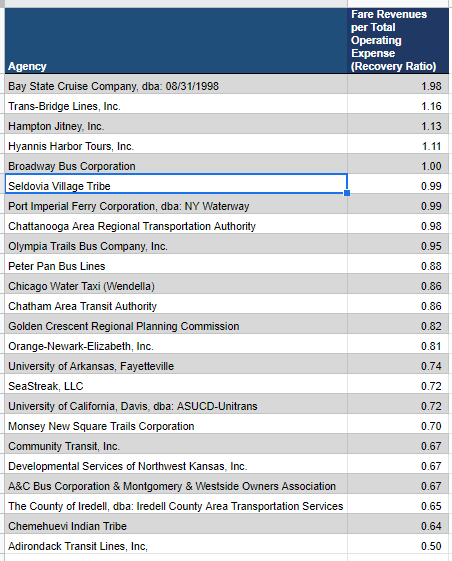
screenshot of the list of 24 organizations with the highest farebox recovery ratios in 2021

Alexander asked on Twitter about the series of posts I did on farebox recovery ratios reported to the United States National Transit Database from 2007 through 2010. The Federal Transit Administration has continued to publish the NTD every year; I just got a little tired of compiling the data, and engagement kind of went down. But let's take a look and see how things are these days!

The Database for each year used to be published in December of the following year, so 2021 is now the most recent year available. The data used to be in Table 26, but the FTA staff is no longer numbering the tables, so now it's in the Metrics table. I've imported the 2021 Metrics table into Google Sheets for your convenience.

Since we're looking at traditional transit providers, the first thing to do is filter out the contract providers (any TOS but DO) and the demand response and vanpool providers (Mode of DR and VP). That leaves us with 22 transit providers.

The first thing I noticed is how many more ferry operators are reporting. In 2010 we had New York Waterway and BillyBey, but in 2021 we have eight: Bay State (Boston to Provincetown), Hyannis Harbor (also Cape Cod), Seldovia Village (connects Homer, Alaska to a Native village with no competing roads), New York Waterway, Chicago Water Taxi, Chatham Area Transit (connecting downtown Savannah to the Convention Center), SeaStreak (connects New York with bedroom and resort towns in New Jersey and Massachusetts) and the Chemehuevi Indian Tribe (connects one end of London Bridge to a casino across Lake Havasu).

In 2010 we had the University of Georgia; in 2021 we have the University of Arkansas and the University of California at Davis. Those don't really count because they're paid for up front by student fees. The Chattanooga inclined plane also broke even in 2021.

A couple of items were flagged by the FTA staff as "Questionable," including the claim by the Golden Crescent Regional Planning Commission that its bus service brings in $9.26 per trip in fares, when their website says they only charge $1.50. They didn't flag the Developmental Services of Northwest Kansas's claim that they earn $16 per trip in fares while only charging $3, but I find that questionable myself. Similarly with Iredell County Area Transportation Services' report of $7.75 per trip contrasts with their website's $1-3 fare. I'm guessing both of those are clerical errors.

That leaves nine bus companies, all in the New York area, making more than a 50% farebox recovery ratio in 2021, which you may remember was a difficult year for transit agencies: Trans-Bridge, Hampton Jitney, Broadway Bus, Olympia Trails, Peter Pan, Orange-Newark-Elizabeth, Monsey New Square Trails, Community Transit, A&C Bus/Montgomery and Westside, and Adirondack Transit.

To answer Alexander's question: there are six bus companies on this list that use the Lincoln Tunnel Exclusive Bus Lane: Trans-Bridge, Olympia Trails (the CoachUSA subsidiary serving Newark Airport from Manhattan), Peter Pan, Monsey New Square Trails (a commuter service focused on Hasidic Jews), Community Transit (a CoachUSA subsidiary serving East and West Orange and Livingston, NJ from the Port Authority) and Adirondack Transit. Of the buses making more than 75% farebox recovery ratio in 2010, some had gone out of business before the adoption of work-from-home arrangements when doctors began discovering COVID-19 cases in March, like Frank Martz Trailways.

Most of the companies missing from the short list were just losing a lot of money. Suburban Transit, the CoachUSA subsidiary serving New Brunswick area, made a 22% farebox recovery ratio in 2021. DeCamp made 21%, and Rockland Coaches, the CoachUSA subsidiary formerly doing business as Red and Tan Lines, made 19%. This is a useful lesson, because the management of these companies took a very conservative approach, canceling all service for months and leading restoration with peak-direction rush-hour service. Rockland has still not restored full-day or weekend service. In contrast, Trans-Bridge, Olympia Trails, Peter Pan, Monsey and Adirondack all run service middays, reverse-peak and weekends.

It wasn't flagged as "Questionable," but I find it questionable that Broadway Bus was able to run eight buses for $13.97 an hour total. If I'm not mistaken, Broadway Bus and A&C may have gone out of business since 2021. With three routes in Newark I don't quite understand how Orange-Newark-Elizabeth (a CoachUSA subsidiary) makes an 81% farebox recovery ratio.

The big success story in this list, of course, is Hampton Jitney, which made a 13% profit in 2021. The Hamptons were infamous as the destination for a number of wealthy people who (with no good reason) "fled the city." They did, of course, have to come back at least temporarily, and while they may be willing to drive out there, spending hours on the Long Island Expressway is a different story. So those who can't afford helicopters take the train or the bus.

Saturday, September 11, 2021

People bought COVID cars for access to recreation

Recently I wrote about the people who claimed to be "fleeing" the disease-ridden cities, but in actuality were in no more danger from COVID-19 in their urban apartments than in the exurban houses they moved to. I noted that there are probably less people "fleeing" the cities than there seem to be, as they tend to be well-connected and overrepresented in the media. They have added a lot to our greenhouse gas emissions on a per capita basis, but the damage they've done to our climate is probably more in having disrupted the return to walkable urban living that's been going on for the past twenty years or so.

Another group that has done damage is the people who stayed in the city (most of the time) but bought cars. This includes influential journalists like Baltimore resident and Earther staff writer Dharna Noor and New York Times City Hall bureau chief and former transit reporter Emma Fitzsimmons.

As with the people who "fled," there are probably nowhere near as many of these car buyers as you would think from the stories in the media. There was a surge of car purchases in the late spring of 2020, but this may simply be purchases that people would have made earlier but couldn't because of lockdown.

Those of us who care about the climate, or carnage, or energy waste, or inequality, should regard every vehicle purchase as a policy failure. In particular, those purchases that have happened in response to the COVID-19 pandemic point to a vulnerability in our strategy to reduce car travel. It is worth our time to examine what motivated people to buy cars and drive.

I would love to see a rigorous market survey, and if you know of any, please pass them on to me. In the absence of anything like that I'm going by what I've read in the news and on Twitter. Yes, Twitter isn't real life, and neither is the news, but this is to a large extent about the way we think about cars and transit, and how that affects our plans for the future.

Let's start with what these people didn't buy cars for: daily activities. I'm sure there are people - health care and food service workers - who bought cars to shorten their commutes, but I don't hear a lot about them. Everyone had access to basic daily shopping - as much as any of us. There were lines at some stores, but nobody went hungry because their local supermarket was closed.

When people give reasons for buying cars, what do you hear? Noor wrote eloquently about her experience, and what she says echoes what I heard from other people - those who bought cars during the pandemic, and those who already had them. Yes, her partner's work needs was what it took to outweigh everything she knew about the downside of cars, but here's what the car did for her:

I was no longer comfortable with my regular regional train rides to see my family members living outside the city. And during quarantine, living near the spots I frequented like the public library and my favorite local punk bar no longer seemed like a plus. I longed instead to be able to easily head to the H Mart about 10 miles (16 kilometers) west to mask up and buy bok choy or visit the big parks outside the city for hikes, but it was proving difficult to figure out how to do so.

What do you hear over and over again from drivers? What do you see on Facebook and Instagram? Recreation and shopping. People driving to parks and beaches. Driving to specialty stores, bulk clubs, ethnic restaurants. Driving to meet friends and visit relatives. Driving to hotels and AirBnbs.

As case counts dropped and capitalists started talking about "reopening" as early as the summer of 2020, people started using their cars for more daily tasks like commuting to work and bringing kids to camp and school. But to the extent the car boom of 2020 was a real thing, it wasn't driven by work and school trips.

In 2020, people bought cars for recreation. They may not have bought that many, but it was and is a public relations disaster for transit. And it was completely avoidable, both in the short term and the long term. We need to learn the lessons from that and avoid it in the future.

Sunday, August 22, 2021

The people who had no reason to leave the city

If you read some accounts of the COVID-19 pandemic, you'll come across the idea that people "fled the cities" en masse - that the cities were seething pits of disease and death, that everyone who could leave did, and that they were justified in doing so. I'm really sick of hearing this, because it's largely false, and it's interfered with our ability to respond effectively to climate change, resource depletion, carnage and social injustice.

When I discussed this on Twitter, a few people raised important caveats. Shabazz Stuart noted that anyone who was living in an unsafe situation was justified in getting away from it. In particular, low income Black, Latinx and Asian people tend to live in crowded apartments and houses where they can't distance from people who might carry the disease.

Jake Saltzman pointed out that some people who might be white and relatively privileged still had an economic-related health incentive to leave the city. Many people who could work remotely but didn't have housemates they could trust were better off moving in with family outside the city, or finding a cheaper place where they could have room to themselves.

The people I'm focusing on here are the people in situations like mine or better. Every member of my family has a room to work remotely, and every family member or couple has their own bedroom. The working adults have steady, remote work. Our neighbors are generally conscientious and cooperative.

The crazy thing about this past year is that I live in one of the hardest-hit zip codes in the country, but I only knew a couple of people who died of COVID-19, and they were relatively low-income acquaintances who weren't white. Several of my friends had the disease, but fortunately they all survived. At this point I have seen no data that suggests that people with the privilege to work remotely and live in a place where everyone has their own room were in any greater danger in the city than in the country or the suburbs. We need to put that myth to bed.

Last Spring we were swimming in a sea of misinformation. President Trump was flailing around for anything that would minimize the effect of the pandemic on his wealth and power, from denial to misdirection to scapegoating. Epidemiologists, nationalists and economic elitists were stuck in ideological traps that to this day make them downplay the need for masks, quarantines and ventilation.

All this misinformation created a knowledge vacuum, which was filled with the simplistic reasoning and prejudices that people have used throughout history when confronted with plagues: attack the people who already have the disease, attack the weak, run away from the places where people have the disease, run away from crowds and poor people.

Some of us pointed this out at the time. We noted that none of the science supported the idea that there was any safety to be gained for well-off white people with their own apartments and bedrooms by relocating to the suburbs or the country. That just disappeared into the sea of misinformation.

At this point we don't really know the impact of this migration, but I can make some guesses. Let's imagine a family with two adults and two kids living in an apartment in Manhattan. And for comparison's sake let's say they own a car. Now let's say this family rents a house in the hills outside of Stone Ridge, NY.

Let's imagine that this family is the most obnoxious car-driving Manhattanites possible. They insist that the only way to get their kids to their private schools is by driving, so it only makes sense that one parent drive to work after dropping the kids off. They spend every weekend driving to Costco, to the Alley Pond Environmental Center, to day and overnight trips in the Poconos and the Hamptons.

Even this family would at least double their driving if they moved to Stone Ridge. All the little trips that they did on foot in Manhattan - to the corner deli, to the cafe, to the park for daily walks, runs and playground fun - would require a car.

They might replace the playground trips with recreation in the backyard and the woods, but to replicate the social interaction that kids get in a neighborhood playground requires coordinating with other parents to drive kids to the same backyard. Even with town Facebook groups this is not easy, especially for newcomers.

Similarly, our hypothetical family might find a house that's walking distance from one restaurant or shop, or a small cluster of shops at best, but it wouldn't be walking distance from any others. It probably wouldn't be walking distance from a bus or train to the city.

If they're lucky (and willing to spend a lot), they might get a house with places to walk in the woods, on the property attached to the house or on adjacent public or private land, or maybe on nice quiet roads. If they're unlucky they'll be stuck on a small plot off a busy road with no shoulders and have to drive somewhere just to take a walk.

All these things add up to a dramatic increase in driving, even for our family that was already driving much more than the average Manhattan household. They had one car, they might buy or lease another car so that both adults could drive to different places, even if they're working from home.

Now imagine a family that previously had no car. They went from a lifestyle that was exclusively transit and walking, with maybe the occasional taxi trip, to one that requires driving everywhere.

Some people have gone for a more moderate increase in car use, moving to towns like New Paltz or Beacon where they can get to some shops and restaurants and the city without driving, but use a car for other shopping and socializing. But even though that's less of an increase it's not tiny.

This is an explosion in the vehicle miles traveled by our hypothetical families, and it's bad for all the reasons why cars are bad: pollution, especially global warming; waste of land, fuel and other resources; carnage. But in the aggregate how much of an increase are we talking about? If we're only going by anecdote it would be huge. Last year the papers and blogs were full of stories of people "fleeing" the city, and this year there's a bunch of stories about how the housing markets upstate have gone crazy.

It's important not to read too much into these stories. Just as it only takes a small number of cars to tip Manhattan's crowded streets into gridlock, it only takes a small number of wealthy buyers and renters to overwhelm the heavily-zoned housing stock of Ulster County. And it only takes a small number of influential people doing something to give the impression that "everybody's" doing it.

As I've written before, there are also limits to how much damage people can do to the region and the climate in a short timeframe. We're already seeing stories about people who tried "fleeing" and discovered that driving sucks and the country can be boring.

The real damage may be to the Cycle. This is where we really make a difference in transportation. The vicious cycle in transportation over the twentieth century involved people moving housing, jobs and shopping further apart, buying cars to drive between them, then lobbying for roads and parking to make driving easier. The easier it is to drive, the more people will buy cars and lobby to make driving easier.

For the past few decades, at least here in New York City, the Cycle has been running the opposite way, in the virtuous direction. People have been selling their cars, moving to the city and demanding better transit and sidewalks, and telling everyone how great it is. The movement to the suburbs has slowed.

My biggest concern about these "flight to the country" stories (in combination with the "contaminated city" stories) is the extent to which they've shifted the narrative and pushed the Cycle more in the vicious direction. Already we've heard our incoming Governor point to the "flight to the country" as a reason to "reexamine" implementing the congestion pricing law that was passed a few years ago.

I don't think this will last. I think rural living is unsustainable for people who aren't actively involved in rural activities, and people will eventually move back to the city. My fear is that the "flight to the country" narrative will cost us precious years or even decades where we exacerbate global warming and make the planet less habitable for our grandchildren.

So everybody, please stop repeating myths about the city being safer. And please stop acting like the wealthy, influential people who left the city are representative of the general population, or of any trend. And do what you can to stop subsidizing wasteful sprawl.

Sunday, July 4, 2021

Cities don't think

I listen to a few podcasts that cover issues of land use and transportation, and they tend to be heavy with urban planners. I also follow some urban planners on Twitter. I've recommended them regularly and I wouldn't follow them or listen to them if I didn't find their views valuable on the whole, but occasionally there are indications that the worldview shared by urban planners has some shortcomings. One thing I've picked up on lately is the omnipresent anthropomorphizing of cities.

I say urban planners here, but they're not the only ones who do it. I've noticed it to some degree from historians, political scientists, economists, as well as journalists and laypeople.

On these podcasts and in these tweets, cities aren't just places where people live, or organizations governing those people. Cities want things, or maybe they don't want them. In the words of the hosts and guests, cities can be happy about things, or dislike them. Most of all, cities think.

Now, there actually are theories that the complex systems of cities are not just similar to the complex systems underlying human thoughts and emotions, but functionally equivalent to them. Some people believe that cities actually do want and dislike and understand.

In general I don't think the people I listen to in these podcasts actually believe that cities can think or feel. I think sometimes they mean that the inhabitants of a city undertake a collective decision-making process and come to a consensus about a course of action. Sometimes they're referring to a scientific opinion poll. Sometimes they mean that the elected mayor or city council believes or feels a certain way.

Sometimes they just mean that a city transportation commissioner believes something, or a transit authority CEO feels something. Sometimes it's lower-level planners or bureaucrats. Sometimes it's a single politician, or just a particularly influential pundit or celebrity, or a group that holds a rally or sends its members to speak at a public meeting.

This is a very common kind of ambiguity, and normally it's not a problem. But problems can arise, particularly when it comes to collective decision making, collective responsibility and finality.

Urban planners - and historians, political scientists, economists, journalists and most laypeople - all know, at least on some level, that collective decision making is a messy process. The same people who will tweet "City X doesn't want a train," are the same ones who will tweet a screenshot of a mixed opinion poll from City Y on zoning height limits the next day. People who say "City Z chose mixed use" will also cover a referendum from City W on bus funding.

So why do people on these podcasts and blogs keep saying things like "City V doesn't want to fund transit?" Well, it's easier than remembering which person from City V said something negative about transit funding, whether that person was a citywide elected official, a civil servant, a local representative, a representative of a membership organization, a self-appointed "community leader" or just some random crank.

It's also easier than remembering how the speaker heard about how City X supposedly feels. Referendum? City Council vote? Press release? Public testimony? Facebook comment? Some taxi driver's rant?

There's also a universal tendency for people to anthropomorphize collectivities, substances and even abstract entities: water finds its level, nature abhors a vacuum, information wants to be free.

But this shorthand of attributing thoughts and feelings to cities runs a lot of risks. It can paper over all kinds of failures in collective decision making. It can misrepresent the thoughts and feelings of powerful elites as the desires of all residents. It can enable loud, privileged voices to pre-empt debate by proclaiming a consensus that does not exist, or by declaring a matter settled when it should be re-examined. It can even prompt a backlash against people in a given city, including people who were excluded from any kind of say in what their city was supposed to have felt or thought or believed.

For the past several years I've been trying to avoid claiming that cities (or states or countries or peoples) want or think anything. Instead, I've taken the time to examine why I am tempted to make such a claim, whether there has been any collective decision made, who has actually made the decision and how democratic the process has been. And I talk about that.

This takes more time, but for me it's been invaluable to spend that time thinking about these issues. And I really can't think of anything better to spend my time on, as someone who cares about where public money goes and what government employees do, than contemplating how people come together (or not) to respond to challenges and set priorities for their governments.

I hope you'll join me! Next time you're tempted to say something like "City Y doesn't want new housing," please stop, take a minute and think about what you mean by that.

Thursday, January 21, 2021

Don't make land a proxy for people

A couple of years ago I read a Politico article about bitcoin mining in eastern Washington with this quote: "Most of the surplus is exported, at high prices, to markets like Seattle or Los Angeles, which allows the utilities to sell power locally at well below its cost of production." This is not an isolated occurrence - I read a similar story from Inner Mongolia.

Why would the people running a power company sell the power below cost? They could simply be doing it as a bribe, to buy off a constituency with a lot of political sympathy. They could be doing it because rural incomes are low relative to those in big coastal cities, and the regulators wanted to be nice to people with lower incomes, or to subsidize rural living. Or they could be doing it as a form of compensation to people who might have added risk living downstream from a large dam, or other environmental costs related to the project.

Whatever the reason, they didn't count on bitcoin miners free riding on the cheap power - a form of "jurisdictional arbitrage" over the artificial cost difference. I bet there's a couple other things they didn't count on, and if you've also taken Econ 101, you're probably thinking of the same things, like that they're not providing the same discounts to low-income people in cities, and that these subsidies for rural living are encouraging rural overpopulation, which can have disastrous costs.

The reason is that land is an imperfect proxy for people. Sometimes it works great, and sometimes it fails. And when it fails bad, the consequences can be really disastrous.

Lately I've been hearing calls for an arrangement like the cheap rural power in connection with New York State's proposed legalization of recreational marijuana use. There's a very good reason for this: the drug laws passed by Nelson Rockefeller and others targeted drugs largely used by low-income Black and Latinx people, and they were enforced more harshly on dealers and users from those populations.

These discriminatory practices had an effect not just on the individual drug dealers and users and their families, but on their communities - and I use this word to mean their friends, neighbors and customers, people who owned businesses and charities where they might have spent money if they weren't in prison, and people who might have benefited from other, non-drug-related, work that they might have done.

When the drug enforcement authorities removed people and their productive power from their communities, they reduced the political and economic power of those communities, resulting in neglected housing stock and infrastructure.

So basically, the white elites of New York and their elected representatives screwed low-income Black and Latinx people over for decades. What do we do about it? At a minimum, any of the dealers convicted under these laws who are still willing and able to work should be guaranteed jobs in the field. I'm frankly baffled that I would have to say this: if your business is selling pot, why the fuck wouldn't you hire people who have a documented track record of success selling pot under really difficult conditions?

Okay, so what about the people who can't work, or don't want to sell drugs any more, or who were just convicted of possession? If they're dead, what about their heirs? They should be refunded all the fines and prison fees they've paid over the years, paid a regular minimum wage for any prison employment, and paid damages for unjust imprisonment.

Now here's the tricky part: what about their communities? Their friends, neighbors, customers, the businesses and charities where they might have spent money? The groups whose political and economic power was reduced? The housing stock and infrastructure of the places they called home?

Well, how many of those friends, neighbors and customers are still there? How many of the businesses and charities are still operating? How big was the Black and Latinx population in those areas when they were arrested, and how big is it today? Who lives in those houses now? Who walks the sidewalks and takes the train? To take a stark example, think about almost any block in North or East Williamsburg.

Let's avoid the temptation to blame migrants. Migration is a normal part of human existence. If these pot dealers and users hadn't been unjustly imprisoned they might be retired to Miami or Mayagüez right now. Many of them might be anyway. If they hadn't been economically oppressed, they and their kids might be "gentrifying" somewhere else right now. In any case, can we agree that there's no reason to send our tax dollars to some wealthy white family living in a row house in Williamsburg with no connection to a convicted pot dealer who lived there in the sixties?

Now, here's a slightly more difficult problem. What if it's one of these neighborhoods, like Harlem or Bedford-Stuyvesant, where a lot of the people moving in are middle-class or wealthy Black and Latinx people? They still face discrimination for the way they look and maybe their accents or names, but they haven't been held back by the drug laws. Are they entitled to any of this money?

We could probably continue thinking up different categories of people and the degree to which they should be entitled to any reparations for the Rockefeller drug laws, but the point is that land is an imperfect proxy for people. And when I keep hearing about sending money to affected "communities" and hardly anything about support for affected people and their heirs, I start to smell a bait-and-switch.

This brings me, finally to a transportation issue. Lately, you might have seen some posts about proposals to mitigate some side effects of highway teardowns. Alexander Laska of Third Way Energy and Beth Osborne of Transportation for America wrote:

"To ensure that neighborhoods around the highway receive the benefits of its removal or modification, the project sponsor for any award under this program should be required to establish a land trust or land bank that would receive initial ownership of any property that becomes developable through activities supported by a grant under this program. The land trust would help locals buy the property, preserve and build affordable housing, support the opening of locally-owned small businesses, and preserve greenspace and parks."

As with the case of mitigating marijuana legalization, the goals of this proposal are ones that I support. Having been priced out of three of the New York neighborhoods I've called home, I don't want to see anyone forced to move because rents rise beyond their ability to pay. But I think the proposal, and others like it, are misguided and will ultimately be damaging to the very populations they aim to protect.

This is just one of many proposals that avoid placing the blame for rising rents where it belongs: on the people responsible for restricting the supply of housing, which channels every increase in the quality of life of a neighborhood into a bidding war with wealthy people attracted by that increase, driving up rents.

Osborne is no dummy, and she does acknowledge, in an interview with Streetsblog's Kea Wilson, that the real culprits are the local elites and the intolerant zoning they've established: “But of course, when the supply [of highway-free, walkable neighborhoods] is artificially constrained and demand is extremely high, that creates a really valuable product." But she professes no hope of ever overcoming that intolerance. "You have to actively protect land to make sure that people can afford to stay.”

But as with marijuana legalization and cheap hydroelectricity, protecting land doesn't do much to protect the people affected. This is personal for me: as a child I lived in a neighborhood that benefited from the cancellation of plans for one expressway and the tearing down of another. Now I can't afford to live in that neighborhood. I'm a prime victim of rising rents, unable to live in my childhood home.

Here's the thing, though: a land trust wouldn't have done diddly shit for me, because I wasn't living in that neighborhood when the highway was torn down. I wanted to stay; my parents moved away while the highway was still up, and took me with them. I couldn't even stay in the next neighborhood because I wanted to move out of my parent's apartment and rents were too high for my income. I left the third neighborhood to go to school, and couldn't move back because I'd given up my rent-stabilized apartment.

The neighborhoods I lived in when I was a bit older never even benefited from a highway teardown (although both of them could have). Rents just went up because people in my generation realized that the suburbs suck. A community land trust wouldn't have done much for me in the third neighborhood because once I left I was no longer a "long-time resident." Even if I'd qualified for one in my second neighborhood, it would probably have been oversubscribed, with a gigantic wait list.

Who would benefit from the community land trusts proposed by Laska and Osborne? A subset of residents: those who don't move. Those who never leave the area to go to school, or spend time in another country. Those who never try out another city for a year or two, to realize what they were missing in New York. Maybe those who leave, but who master the practice of subletting, of property management, of gaming the system. And it would probably wind up benefiting wealthier people who move in after the land trust is established.

Basically, the people who benefit from the community land trusts are the same people who benefit from intolerant zoning, from rent control, from community benefits agreements, from community boards: the local elites. Yup, this is just another bribe to local elites to get them to agree to something that they already know would be good for everyone who lives in the area.

Here's the bottom line: If you want to help the people, help the people. You want to help poor people? Send money to people who don't have a lot of money. You want to compensate people for racist policies that sent them and/or their family members to prison? Find those people and give them money. You want to counteract the effects of intolerant land use policies? Fight the intolerant land use policies. You want to compensate people who are victims of intolerant land use policies? Give those people an opportunity to register and send them a cut of rising property values.

Whatever you do, don't make poor people live in poor places to get cheap electricity. Don't give money to people who were never affected by racist policies, and just happened to move to a place where lots of people were. Don't make people stay in the same place in order to benefit from rising property values.

The bottom line is: don't make land a proxy for people.

Saturday, February 15, 2020

When to go negative


Recently I wrote about how, in the nineties and early 2000s, discussions about transit advocacy were short on hope and full of negativity. Any positive online post was immediately greeted by three pronouncements: our transit system is too wasteful to finish anything, the opposition is too strong, and every project needs to get on line behind the other projects waiting for resources. This was profoundly discouraging to transit advocates.

Transit expansion proposals are like brainstorming sessions. The concept of brainstorming recognizes that negativity can squelch creativity and dampen enthusiasm. It's hard to get excited about anything when your proposals are constantly being critiqued and shot down.

Things have changed a lot in the past fifteen years. Phase 1 of the Second Avenue Subway was completed, demonstrating that we are capable of finishing things. The City instituted pedestrian safety improvements on Queens Boulevard, demonstrating that the NIMBYs don't always have the final word. And the City financed an extension of the 7 train, demonstrating that the order of transit projects can be changed.

For a while it seemed like things had changed. People were making more fantasy maps, proposing new tunnels, track extensions, electrifications and service increases. But lately it seems that things have gone backwards a bit. I've perceived an increase in negative responses to expansion proposals.

I don't often hear the response that the opposition is too strong, although I did just get someone yesterday trying to tell me that "maybe people in eastern Queens don't want a subway." I also rarely hear that we can't talk about anything that isn't in the 1967 Subway Action Plan until we've finished the Second Avenue Subway.

I do still hear a variant of the wastefraudandabuse complaints that were rife in the past. After multiple posts by Alon Levy I've been persuaded that this is actually a thing, and we could potentially build subways a lot quicker if we could bring construction costs in line with Europe or China. But even when I feel that waste arguments are germane I've often pushed back on them.

There is a cost to the way we build subways in this country. But It's not at all obvious that this cost is being driven by the imagination of railfans on Twitter, or that there is value in demanding that every proposal bring in "enough riders to support it" based not on any agreed-on ridership model but on a critic's hunch.

In fact, I would argue that these critiques are the same old naysaying as we had back in the nineties, dressed up in new words. It's a way for one poster to assert dominance over another: your proposal isn't good enough, I know better than you.

Are there times when it's appropriate to criticize a proposal based on its cost, or any other reason? Of course. So when are those times? How do you know?

Think about brainstorming. The brainstorming session is over when it's time to allocate resources. Which project is going to get the money? Are we going to use the land for rail or bus? How much of our advocacy time are we going to spend on each project?

That's the time to think about what's bad about each project - and what's good. Not what's good or bad in absolute terms, but what's the best use of our money, land and time right now. And not someone else's money, land or energy, but the resources that we share.

This is the key issue: no project is wasteful until resources are dedicated to it. And other people's waste is none of our business, unless they ask us for our opinion, or maybe if we want to use their example as one to follow - or not.

Okay, I hear you saying, but I see all these bad habits! People are proposing lines that won't attract enough riders. What if some state legislator sees that tweet and sticks their proposal in the budget? They need to have these bad habits beaten out of them now!

All I can say to that is that you should maybe take a look at the negative posts from before 2005. Those people were convinced they knew better: that we can't finish anything, that the NIMBYs always win, and that every project needs to get on line. They were wrong on all three counts, but their insistance that everyone else was wrong poisoned the discourse for decades.

Is that who you want to be? The person who makes advocates hesitant to write up their hopes, out of fear that they're going to be held up for ridicule? The person who inspires half a dozen others to spend their time tearing down other people's ideas instead of developing their own?