Recently
I drew your attention to Kimberly Matus's story about being groped on a downtown 2 train, and the fact that the only way she could be reasonably sure of avoiding a repeat of that situation was to take a taxi to work, or buy a car.
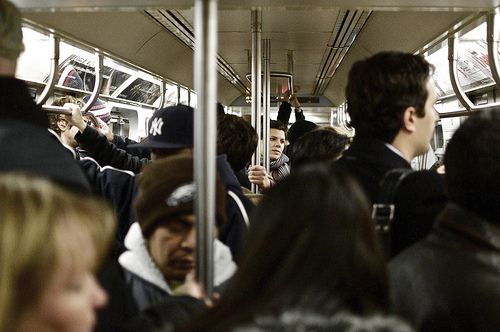
The Death Valley of Commute Options means that Matus - and people like me who just want to sit down - have no reasonable transit alternative. We can take a cheap, fast train or a cheap, slow bus, and both of them force us to deal with crowding and noise. Even the taxis are
hard to find, and the legal options for sharing are rare. The system is set up to force us into cars.
The frustrating thing is that it doesn't have to be this way. Whenever there's crowding or queuing, chances are someone is willing to pay to escape it. If the government sets up an alternative it will get customers, and if barriers to entry are low, private businesses will set up alternatives.
Sadly, barriers to entry are not low. The City DOT
refuses to allow any private bus lines to operate within city limits, the City Council
won't authorize commuter vans to pick up passengers legally, the NYPD
won't let them use the bus lanes, and the State Legislature
is driving intercity bus operators out of business, based on
bad data from the Federal DOT.
I'm proposing that instead the City allow well-regulated private buses to bid on selected routes, charging whatever fare the market will bear. And no, not on the routes with the lowest demand, which basically
ensures failure without an anchor, but on high-demand routes, paralleling subway lines. It would help if the city also provided dedicated bus lanes and bus bulbs along these routes, but I don't think they're absolutely necessary. From what I can see, the demand is there even if the buses are much slower than the subway.
I can envision a million objections, but there are two serious ones I can think of. The first is that it will undermine
the strength of the transit unions and the quality of life of transit workers. Because of this, I propose (1) that all bidders be required to operate a closed shop on these routes, employing only members of the transit unions that are currently active in the city.
The second, raised by Zoltán, is that it's not fair to make women pay more to avoid sexual assault. I completely agree, and I think we should be working towards a system where such offenses are rare and swiftly punished. But I don't think we should have to wait for that, and it's not the only reason to provide comfortable alternatives to the subway.
The third is that it will poach customers from the existing subway and bus routes. In the comments to my previous post, Alon Levy tried to argue that this would mean a "mass exodus from the subway," and that it was somehow okay for New York subways to be operating at 100% of recommended capacity because Tokyo subways have much higher loads.
I'm not convinced. I think we should be aiming for passenger loads below 100%, something like the Shoupian ideal of 85%. Why shouldn't people be comfortable during rush hour? But I agree that the government should not be subsidizing competition to its own transit system, the way it currently does by building and widening highways. But to address these objections, I suggest the following additional conditions:
(2) That there be no direct subsidy to the private operators. If there are enough people who think they can make a profit, they should pay the city an amount to be determined by competitive bidding.
(3) That the routes be rebid every year, based on a survey of passenger loads. The routes should connect subway stations that currently require travel on a line that sees loads greater than 85% capacity at rush hour (or even
outside of rush hour, with reasonable deviations. If a route drops below 85% on a survey, it is no longer eligible for parallel bus service.
In addition, I think these two conditions would help ensure consistency and satisfaction:
(4) That the routes be served at least every fifteen minutes from 6AM to midnight, seven days a week. If an operator fails to provide that level of service, the DOT should rescind the authorization to operate on that route. If the operator cannot make a profit, there should be a formal process for abandoning a route.
(5) That the MTA allow the private operators to accept Metrocards and any other standard MTA fare payment system, if the operator desires it.
What would such a network of bus routes look like? Ultimately, that would be up to the operators bidding for the routes. But I have some ideas about what I would bid on if I had a bus company. First, if we assume that the chart above is still correct, it would mean paralleling the 1, 2, 3, 4, 5, 6, E and L trains. Those lines roughly parallel Eric Fischer's travel map of geocoded tweets:
Knowing that most people are commuting to jobs in East Midtown, I set up a bunch of routes that focus on that area.
I would definitely pay five dollars for a guaranteed seat on one of these buses during rush hour, even if I had to sit on it for an hour, as long as it meant avoiding a crowded subway. I'd pay even more if it had BusTime, legroom, outlets, broadband internet and an espresso machine. I bet some people who currently drive or take taxis or black cars into the city would take one of these buses instead. Surely it's worth a try?


 Map: Eric Fischer / Flickr.