Friday, December 28, 2012

Valley Transportation Myopia

The San Jose Mercury News has an article about the 25th anniversary of the Santa Clara Valley Transportation Authority's light rail system, quoting a few supporters and one critic. The supporters are VTA transportation planning manager Kevin Connolly, "the train's godfather" Rod Diridon, and a few riders, all of whom have Spanish last names and say that they ride the trolley because they don't own cars. The single critic quoted is Tom Rubin, an accountant who gets paid as a "transportation consultant" who mostly gets paid to attack transit. Sometimes Rubin will make arguments that seem "pro bus" in order to attack rail, but when there's no rail involved he's happy to attack buses.

On Twitter, some transit advocates did criticize the VTA. They're probably right. I've never been to Silicon Valley, but it sounds like it was relatively badly planned. It also sounds like there's a zoning issue behind the fact that many of the farms bordering on the lines haven't been built up with dense, walkable neighborhoods. That said, there's a bigger factor at play, one that I've touched on many times in the past: transportation myopia.


In the twenty-five years since the first VTA trolley ran, the federal, state and county governments and the VTA have widened four competing highways and built numerous interchanges and other "improvements." Here are a few that I could find details on:


CA 237Convert to "freeway standards"1997
I 880Widen from US 101 to Montague Expressway2004$76.3m
CA 17Add auxiliary lanes2007$28.2m
CA 87HOV lanes south and north2007$121.9m
I-280Ramp Metering and Widening2010$5.5m

As you can see, just about every branch of the VTA light rail system has seen millions of dollars invested in competing roads. Add to that the cost of constructing the 101, 280, 680 and 880 to begin with, which only happened within the previous twenty-five years. Those wouldn't have affected the design of the system, and thus the "Cost to run a light rail vehicle for an hour," but they have definitely sapped ridership, which affects all the other indicators mentioned.

Rubin is actually half right when he says "I think the original concept was very seriously flawed." Whatever the flaws of the original trolley concept and zoning, they pale in comparison to the flaw in the concept of building a trolley system at the same time as you expand the competing road network.

Monday, December 24, 2012

The MTA's $27 million consumer surplus

One of the often repeated fears about dollar vans and other privately operated transit options is that they will "poach" customers from a public transit operator on the route, which may have a legal monopoly, and that by doing so they will "skim" profits from that route, reducing the revenue that public operator gets and increasing the burden on the taxpayers, or reducing the "coverage" that the public operator can cross-subsidize. This is a legitimate concern, but in most cases it is completely unfounded.


To begin with, the agency has to make a profit on the route. Even if private operators believe they can make money, it is not always profitable for public operators. Sometimes this is for legitimate reasons: if the private operators can only make a profit through exploitative wages or hours, or by not offering a reasonable set of benefits, we don't want to encourage that exploitation. But if the profits earned by the private operators come from reducing costs in other ways, from offering a better value, or even from being able to raise fares on people who can afford it, the only objection is the skimming one.

How many routes make any operating profit, let alone an overall profit? I'll look at the New York MTA because it's my hometown transit monopoly, but I'm interested to hear about other systems. In early 2010 the MTA released ridership and cost figures for each of its bus routes, based on data from Labor Day through the end of November 2009. There were 22 routes that brought in more in fares than they cost to run.

If we extrapolate those figures to the whole year, these 22 routes combined brought in $27,400,000. Of that, most came from just five bus routes that netted over $2 million apiece: the Bx12, the M86, the Bx19, the M23 and the M79. The remaining 166 routes lost a combined $276 million, more than ten times as much as the 22 top routes brought in.

To put this in perspective, that $27 million surplus was 3.3% of the total $823 million grossed by New York City Transit buses. It's 0.87% of NYC Transit's overall $3.1 billion in farebox revenue, and 0.33% of the total $8.3 billion operating expenses for 2009. In other words, it's a drop in the bucket. Nobody at NYC Transit or the State Legislature would miss it.

There may be good reasons not to allow private buses to run on New York City streets, but skimming the consumer surplus is not one of them.

Greenfield toll, HOV and bus lanes are no improvement

The news is that the toll roads in Orange County, California are not bringing in as much money as planned. Similarly with Maryland's Intercounty Connector. In Virginia, high occupancy/toll lanes won't bring any revenue for the state government, even though it spent half a billion dollars on them.


Some people, who don't like the idea of toll roads in general, will take these developments as evidence against the whole idea of tolling. It's not; it's evidence against the wisdom of building roads. It's especially stupid to build toll roads and competing free roads at the same time, as was done in California, just as it's stupid to build transit and competing free roads at the same time.

What's really annoying is that for some people, building toll or high-occupancy vehicle lanes is automatically assumed to be a greenfield operation, the same way Kate Slevin insisted that "we can't have BRT without" a wider Tappan Zee Bridge.

Some of this is related to the idea that a toll is only used to finance the cost of road construction - and not maintenance or reconstruction, somehow. That idea was put to rest in 1937 when Bob Moses issued new bonds for the already-built Triborough Bridge. Just as you can always remove or reduce tolls and pay for a road with tax money, you can always collect or raise tolls and use them to pay for other things.

You can always convert an existing lane to toll, HOV or bus-only. It's easier when you have a nice wide, uncongested highway so that you have room to build nice landscaped barriers around the special lanes, but there's usually room for a jersey barrier. And of course you can always make the whole highway tolled, HOV or bus-only.

The main problem is that if you only implement tolls or vehicle restrictions on new greenfield lanes or highways, those highways will be empty a lot of the time. In the past they've tended to fill up eventually, but with current driving trends this will happen more and more slowly. One day someone will look at a ten-year-old tollway and realize that the promised cars will simply never appear. How many of those empty highways will we have built by then?

It's time to stop thinking that all HOV, bus or toll lanes have to be added. That kind of thinking doesn't solve any problems, and only leads to empty roads and empty treasuries.

Thursday, December 13, 2012

Free transit won't keep commuters coming back

Just a quick note. Eric Jaffe has a review of an MIT study of transit mode shift. This study has a lot of interesting implications, but claims of the value of free transit are overstated.

The study piggybacked on a MIT initiative in September 2008, where all employees with full-time parking permits were offered a free one-week transit pass. A number of these employees agreed to participate in the study, where they committed to commuting by transit for at least three days that week, and fill out a survey. Thirty percent of the survey participants gave up their parking permits immediately, and 25% were still on transit six months later.

Jaffe touts the free aspect of the trial as significant, but I think he - and the study authors - are overstating it. The key is that the transit was only free for one week; after that, the participants who shifted to transit had to pay full price.

Remember, these are full-time MIT employees; I don't think they're exactly poor. In the surveys they indicated that relative cost was a factor in their mode choice, but transit doesn't have to be free to compete on cost grounds. Most of the transit passes mentioned by the authors cost more than $65 per month, but probably less than $65 plus gas, car maintenance and insurance.

There are important take-aways to this study. I'm sure the free trial helped convince drivers to try transit; it's hard to justify even a week of transit if you're already paying $65 per month for a parking permit. And once they tried it, many of them realized that it wasn't all creeps and weirdos. Equally important, there was a value proposition there. For some participants, transit provided a better overall value for the price than driving. For other participants it didn't provide better value, and they went back to driving.

Transit managers that believe they do offer a better value than drivers should try free trials. Rather than offering them to everyone and overloading the system for a week, though, it would probably be better to simply mail a random chunk of the population free one-week transit passes. Whatever happens, it's important to make a clear distinction between free trials and free transit.

Sunday, December 9, 2012

Tweaking congestion by time of day

Last week I observed that we have a degree of control over the speed of cars and the level of congestion on streets. We can design streets to encourage or discourage speeding. In between, we can adjust the capacity of the street by making it one-way or two-way, and adding or removing parking. There are a host of other traffic speeding/calming strategies like signal timing, lane width changes and sidewalk extensions. But I closed by observing that congestion varies with time of day, and even with time of year (Gridlock Alert Day?).

A street that has stop-and-go traffic during the rush hour may have smooth-flowing cars in the middle of the day, and wide open spaces at 1:00 AM. This daily variation can cause huge problems. Many years ago I had the frustrating experience of renting a moving van on Tenth Avenue at 3:00 PM, and getting to Third Avenue around 3:30. Much worse, of course, is the carnage caused by cars speeding through deserted streets late at night and on weekends.


Traffic engineers know all about the daily variation, of course. Their solution is simply to design a road big enough to keep cars flowing during the peak demand, and if people can go even faster on the off-peak they consider that a bonus. Of course, those of us who have to cross the street with those fast cars don't consider it a bonus.

Traffic calming advocates might say that the observed traffic speed should never rise above 20 MPH between 6AM and midnight. On high-demand streets this will lead to gridlock during rush hours, and probably slow traffic during middays and "shoulder" times. If I had to choose, I would choose slower traffic over death, but some of the most vocal, powerful people in the city would rather go fast. Fortunately, there are other ways.

The way that's currently employed by the New York City Department of Transportation is rush-hour parking restrictions on avenues and boulevards across the city. This is a relatively blunt instrument and the city wields it clumsily, with long periods of No Standing on places like Queens Boulevard and Flatbush Avenue. These are much longer than the actual rush hours, leading to speeding and dangerous conditions.

This is where congestion pricing comes in. By congestion pricing I don't just mean a cordon toll to keep traffic low. I mean a charge that varies by time of day: higher when there's more demand, lower when demand drops. The idea is to keep cars moving at roughly the same speed all day. Because the charge can be set by computer, there is much more flexibility than with rush-hour parking restrictions.

What I found on my visit to London was that the congestion charge worked well to keep cars moving all day. The problem was that they were moving too fast. That's a problem that congestion pricing advocates in other cities would do well to keep in mind.

Some day I hope we have congestion pricing here in New York City to flatten out that daily variation in driving. But I hope that we take advantage of that flattening to restore two-way traffic flow (yes, even on Manhattan avenues) and on-street parking, to keep speeds down below 20 MPH. Eventually we can widen sidewalks and add more bike lanes as necessary to accommodate cyclists and pedestrians, and tweak the parking, lane configuration and congestion charge to keep cars moving, but at relatively safe speeds.

Tactical Transit Strike Force!

Back in 2010 I wrote a list of things I wanted from transit advocacy organizations, but wasn't getting. Well, there's a new organization in town that aims to deliver at least #3 (discuss new revenue sources), #4 (hold elected officials responsible), #7 (focus on transit) and #8 (a simple, accessible structure). It's called the Riders' Alliance. They're just getting started, but it's a promising start. I've joined, and we'll see where they go. You might want to give them a shot too.

One of their first focus areas is the G train, and they encountered resistance from the MTA to their request for more frequent G service. The Brooklyn Paper's Danielle Furfaro highlights their quandary: "Activists working to better the G train say the Metropolitan Transportation Authority has created a catch-22 by refusing to make any service improvements on the line due to low ridership. But critics claim ridership on the so-called Brooklyn Local remains low simply because service is so bad."


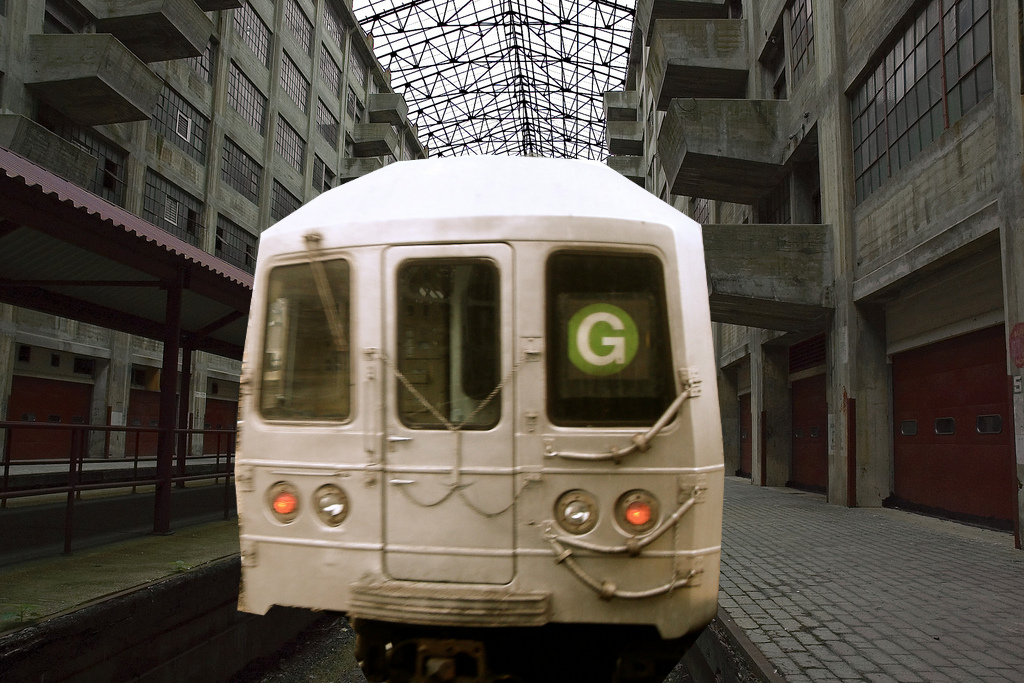
The G train arrives in the Brooklyn Army Terminal, with a little help from Pro-Zak and bitchcakesny.

Well, I claim that ridership on the G train remains low because it's competing with the free, subsidized BQE, and it'll just get worse if the State spends $1.7 billion to replace the Kosciuszko Bridge with a wider one. But what if Riders' Alliance members Dustin Joyce and Sarah Kaufman are right, and there is a pool of untapped ridership that is being kept away by the six-car trains and ten-minute headways?

The most straightforward way to test this would be to simply try it. This is the approach known as tactical urbanism that's already been applied in areas like street design. Imagine if the MTA ran ten-car trains at five-minute headways for a year. I'm guessing that they would see a big jump in ridership. At the end of the year, they could cut the frequency and train lengths back to whatever is necessary to support that ridership.

This kind of strategy is similar to the "penetration pricing" strategy sometimes used in marketing. In that case, the seller sets the price low (or free) temporarily to build awareness and brand loyalty. Examples include the special low introductory rates on credit cards and cable television. In our case, though, the goal would simply be to establish that there is a market for this service.

This has actually been done before, unintentionally, at the MTA. From 1976 through 2009 the G terminated at Smith-9th Streets. Then, when the agency reconstructed the Culver viaduct they temporarily extended the G to Church Street. This past July, after some lobbying, the MTA leadership decided to make the extension permanent.

We should be able to do this kind of experimentation without a major viaduct reconstruction. I know that train cars are expensive, and the MTA doesn't have that many to spare, but I believe that these experiments can be worth it in the long run. If nobody's willing to do it with trains, then we should do it with buses.

Think about a bus route that's losing the MTA a lot of money. If you can't think of one, I have a few suggestions. Or maybe it's a route that hasn't been tried. Or a route that's popular but could use just a little oomph to push it over the edge into running an operating profit.

Now imagine that some organization (it doesn't have to be the MTA, it only needs permission from the Department of Transportation to pick up passengers on the street) has a fleet of twenty brand new, clean buses with expert, responsible drivers. They take the Q79 route, say, and saturate it with buses, every five minutes or less, for a year.

What would ridership look like at the end of that time? Suppose by then you've got enough riders to provide service every fifteen minutes with a 50% recovery ratio. At that point, the MTA can take it over with normal bus service, and the Tactical Transit Strike Force can move on to, say, the B71.

We hear a lot about the power of targeted, experimental interventions to transform city life and give people a sense of what's possible. Now let's do that for transit.

Thursday, December 6, 2012

Rockland County is not being short-changed by the MTA

Rockland County Executive Scott Vanderhoef has been complaining for years that his county pays more to the Metropolitan Transportation Authority than they get back in the budget. Last year the county paid some consultants at Cambridge Systematics to analyze the 2010 MTA budget (PDF). They came back with a grave accusation: county residents and businesses sent $110 million in taxes, fees and fares to the MTA, but only got $68 million in services and capital improvements, for a "value gap" of $41.9 million.

Dana Rubenstein reports that on November 30, Vanderhoef wrote to the MTA, asking for an "exemption" for the county from the fare and toll hikes planned for March. "Common sense financial fairness would dictate, therefore, that Rockland County be exempt from the proposed fare increases," he wrote. "During my 20-year tenure as Rockland County Executive and a NYMTC Principal, it is with a deep conviction rooted in justice that I have fought for Rockland County’s fair share from the M.T.A. Rockland County is burdened by its orphan status as a New York community on the West side of the Hudson River—deep in NJ Transit territory."

MTA spokesman Aaron Donovan shot that one down. "Rockland residents enjoy higher property values, Rockland’s Metro-North commuters bring home higher salaries, and Rockland’s overall economy benefits from the regional economy and its robust transportation system. Rockland’s contribution to the M.T.A. supports its entire system, benefiting even the Rockland residents who commute to NYC by car and who wouldn’t be employed as police officers or firemen or construction workers or teachers in New York City if there were no MTA to make the City run."

Aaron is completely right, but he didn't even need to go there. When this study came out back in March, Ben Kabak posted the story, and Larry Littlefield nailed it in a comment on Ben's post: "Everyone has a value gap because much of the money is going to the past. They just don’t want to pay a share of the debt."

Sure enough, Rockland's share of the MTA's $1.91 billion debt service comes out to $41.9 million. The so-called "value gap" is just Rockland's share of the bond payments. The Cambridge Systematics report didn't pick up on that because they decided from the beginning to ignored debt service. Oh, and all this debt was racked up under Vanderhoef's comrade in arms Governor George Pataki, who Rockland voted for in 1994, 1996 and 2002.

As Rubenstein pointed out, Vanderhoef has been complaining that the MTA short-changes Rockland since 1997. It probably wasn't true then, and it's definitely not true now. I'm glad she's found people to call him on this, but none of them seem to pick up on the point that the entire "value gap" is nothing but payments on the debt that Vanderhoef himself supported.

Should Rockland get better transit service? Absolutely. But not to make things equal, just to fix the county's broken transportation system.